Planting Trouble : The Risk Hidden In Seed Mixes
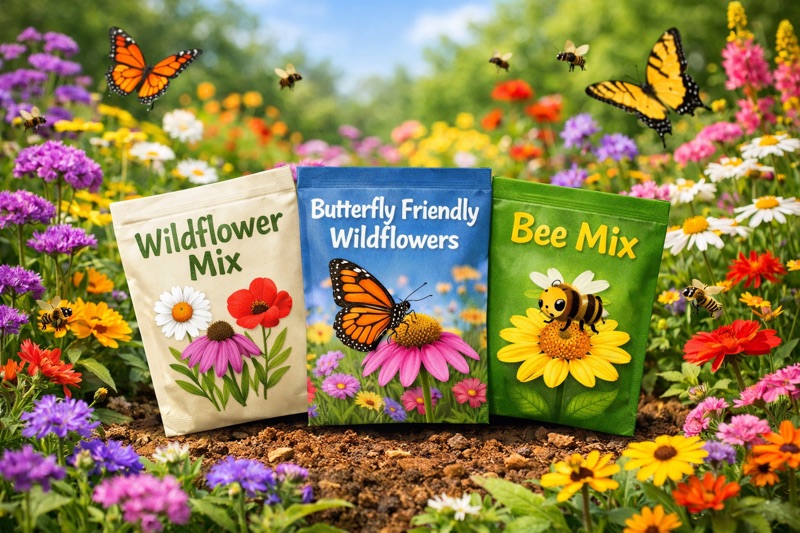
Why Wildflower and Pollinator Seed Mixes Aren’t Always What They Seem
What looks like a simple packet of seeds can change an entire ecosystem.
Some “wildflower” and pollinator mixes aren’t as harmless as they seem, quietly causing lasting harm.
Before you plant with good intentions, learn what might really be growing.
Buying flower seeds often feels like a simple, positive choice. Many gardeners reach for “wildflower” or pollinator seed mixes hoping to add beauty to their space and support nature at the same time. What most people don’t realize is that not all seed mixes are created with local ecosystems in mind.
This article explores how some commercially sold seed packets can be misleading and why that matters. You’ll learn how certain plants included in popular mixes may be non-native or invasive, how easily they can spread beyond gardens, and the unintended consequences they can have on native plants, pollinators, and wildlife. The goal isn’t to discourage gardening, but to shed light on what’s often hidden behind appealing packaging and well-intentioned marketing.
By understanding what’s really inside these seed mixes, gardeners can make more informed and responsible choices. This guide will help you recognize potential red flags, understand why native plants matter, and feel more confident choosing seeds that truly support local ecosystems. With the right knowledge, planting flowers can be a meaningful way to protect nature not unknowingly put it at risk.
Photo Credits: sunsoll.com
Why Pollinator Friendly Doesn’t Always Mean Safe?
Words like pollinator-friendly, wildflower mix, and bee-safe appear on countless seed packets, instantly creating a sense of trust. These labels suggest that the plants inside are beneficial, natural, and safe for local wildlife. Unfortunately, these terms are often used loosely and aren’t regulated, which means they don’t always reflect what’s actually in the mix.
Seed mixes can contain a wide range of plants, including non-native species that were never part of local ecosystems. While some may provide nectar, others can spread aggressively, outcompeting native plants that insects and wildlife depend on. When native plants are pushed out, biodiversity suffers, and specialist pollinators that rely on specific host plants are often the first to be affected.
Understanding why “pollinator friendly” doesn’t always mean environmentally safe is an important first step. In the sections that follow, we’ll look more closely at how seed marketing works, what may be hiding in seed mixes, and why choosing the right plants truly matters for protecting pollinators and the ecosystems they depend on.
The Power Of Buzzwords :
Seed packets are designed to catch our attention, and the words used on them play a powerful role in how we make purchasing decisions. Phrases like pollinator friendly, wildflower mix, bee safe, and supports biodiversity create a sense of trust and reassurance. For gardeners who genuinely want to help nature, these buzzwords can make a product feel like the responsible and ethical choice.
The problem is that many of these terms are not clearly defined or regulated. A seed packet can use pollinator-friendly language without being required to include native plants or exclude invasive species. In some cases, the mix may contain non-native plants chosen for quick growth, bright blooms, or low cost rather than ecological benefit. What looks like a helpful choice on the surface may not align with the needs of local ecosystems.
This kind of marketing doesn’t mean gardeners are at fault, it highlights how easy it is to be misled by appealing labels. Understanding the power of buzzwords helps us pause, look beyond the packaging, and ask better questions about what we’re planting. Awareness is the first step toward making choices that truly support pollinators and protect native habitats.
Buzz Words Breakdown: What Do These Labels Really Mean?
🔘 “Pollinator Friendly” :
Sounds reassuring, but it often only means the plants produce nectar or pollen. It does not guarantee the plants are native, non invasive, or beneficial to specialist pollinators.
🔘 “Wildflower Mix” :
This can include a blend of native and non-native species or none that are native at all. Some mixes contain plants that grow aggressively and can escape into natural areas.
🔘 “Bee Safe or Bee Friendly” :
These terms usually focus on flowering plants rather than long-term habitat needs. They rarely consider host plants required by native bees and butterflies to complete their life cycles.
🔘 “Supports Biodiversity” :
A vague claim that isn’t backed by standards. A mix may still reduce biodiversity by crowding out native plants once established.
What Really Is Inside A Seed Mix? :
At first glance, a seed mix may seem simple like a variety of flowers blended together for colour, convenience, and broad appeal. In reality, many mixes are created for visual impact and fast growth rather than ecological compatibility. The plants included are often selected because they germinate easily, bloom quickly, and look attractive on packaging, not because they belong in local ecosystems.
Some seed mixes contain non-native species that may not pose an immediate problem in a garden setting but can spread beyond where they’re planted. Once established, these plants can escape into nearby fields, roadsides, and natural habitats, where they may grow more aggressively than native species. Without natural predators or controls, certain non-native plants can begin to dominate landscapes.
In more concerning cases, seed mixes may include plants that are already recognized as invasive in parts of North America. These species can outcompete native plants for space, sunlight, and nutrients, leading to reduced plant diversity. As native plants disappear, the insects and pollinators that depend on them especially specialist species with specific host plant needs are left without the resources they need to survive.
How Invasive Plants outcompete Native Plants :
Invasive plants often have traits that allow them to grow faster and spread more aggressively than native species. Many produce large numbers of seeds, grow quickly from even small fragments, or tolerate a wide range of soil and weather conditions. This gives them a strong advantage, especially in disturbed areas like gardens, roadsides, and natural edges where they can establish easily.
Once established, invasive plants compete directly with native plants for sunlight, water, space, and nutrients. Because they grow densely or spread rapidly, they can shade out native seedlings before they have a chance to mature. Over time, this reduces the diversity of plants in an area, replacing a varied landscape with just a few dominant species.
Native plants evolved alongside local wildlife and play specific roles within ecosystems. When invasive plants push them out, the effects ripple outward. Fewer native plants means fewer food sources and host plants for insects, birds, and other wildlife. What begins as competition between plants can quickly turn into a larger ecological imbalance that affects entire ecosystems.
How this happens in Seed Mixes and Gardens? :
When invasive or aggressive non-native plants are included in seed mixes, gardens can unintentionally become starting points for their spread. These plants are often chosen because they grow quickly and reliably, which makes them appealing for commercial mixes. In a garden setting, they may sprout faster and grow more densely than native plants planted alongside them.
As these plants take hold, they compete with native flowers for space, sunlight, and nutrients. Native plants, which often grow more slowly and establish deeper root systems over time, can be crowded out before they have a chance to mature. Even in well-tended gardens, aggressive plants can dominate flower beds, reducing the variety of species that were originally planted.
From gardens, these plants don’t always stay contained. Seeds can be carried by wind, water, birds, or human activity into nearby natural areas, where they continue to spread. What begins as a well-intentioned gardening choice can gradually contribute to the decline of native plants beyond the garden fence, reinforcing why careful seed selection matters for protecting local ecosystems.
A Common Garden Scenario:
A gardener plants a pollinator-friendly seed mix along a fence or in a sunny corner of their yard. Within weeks, a few plants grow quickly and begin to dominate the space, while other seedlings struggle or disappear altogether. By the end of the season, the area that was meant to support a variety of flowers is mostly covered by just one or two aggressive plants.
Over time, seeds from these plants spread beyond the garden through wind, water, or wildlife. Nearby natural areas start to show the same pattern fewer native plants and less variety overall. What started as a small, well-intended garden project quietly becomes part of a much larger environmental problem.
How Invasive Plants Reduce Biodiversity :
Biodiversity refers to the variety of plants and animals that make up a healthy ecosystem. When many different native plant species grow together, they create layers of habitat and food sources that support insects, birds, and other wildlife. This diversity helps ecosystems remain resilient and balanced.
When invasive plants spread, that balance begins to shift. Fast-growing or aggressive species can dominate an area, replacing a diverse mix of native plants with just a few types of vegetation. As plant diversity declines, so does the variety of insects and animals that rely on those plants for food, shelter, and reproduction.
Over time, reduced biodiversity makes ecosystems more vulnerable to disease, pests, and environmental changes. With fewer native plants available, wildlife has fewer options to adapt, and entire food webs can be disrupted. What may start as a small change in plant composition can lead to long-term ecological consequences that are difficult to reverse.
Visual Comparison : A Tale Of Two Gardens
🌱 A Diverse, Native focused Garden : Shows many different plant shapes, heights, and bloom times. Native flowers, grasses, and host plants create layers of habitat, supporting a wide variety of pollinators, birds, and beneficial insects throughout the season.
🌿 A Dominate Garden : Appears full at first but is largely made up of one or two aggressive plants. Bloom times are limited, plant variety is low, and fewer insects are present. Despite the flowers, the garden supports far less wildlife.
How does this impact Specialist Pollinators :
Not all pollinators can use every plant they encounter. While some insects are generalists and can feed from a wide range of flowers, specialist pollinators rely on specific native plants to survive. Many butterflies, moths, and native bees need particular host plants to lay their eggs or feed their larvae, and without those plants, they cannot complete their life cycles.
When invasive or aggressive non-native plants replace native species, these essential host plants disappear. Even if a garden looks full of blooms, it may no longer provide what specialist pollinators actually need. Nectar alone isn’t enough without the right native plants, future generations of these insects cannot survive.
Seed mixes that lack native host plants or allow invasive species to dominate can unintentionally create landscapes that appear pollinator-friendly but function as ecological dead ends. Protecting specialist pollinators means protecting the native plants they depend on, which is why careful seed selection plays such an important role in conservation.
A Gentle Example : Butterflies and Host Plants
A gardener may plant a colourful pollinator seed mix hoping to attract butterflies. Adult butterflies might visit the flowers for nectar, giving the impression that the garden is supporting them. However, when it comes time for butterflies to lay their eggs, the plants their caterpillars need may be missing.
Many butterfly species rely on specific native host plants for their young. If those plants have been crowded out by aggressive non-native flowers from a seed mix, caterpillars have nothing to eat once they hatch. In this way, a garden can appear butterfly-friendly while quietly failing to support the next generation.
This is why protecting butterflies isn’t just about planting flowers. It’s about planting the right plants. Gardens that include native host plants alongside nectar sources provide real, lasting support for butterflies and help ensure their life cycles can continue.
A Gentle Example: Bees and Native Plants
A garden planted with a pollinator seed mix may attract bees at first, especially if the flowers produce plenty of nectar. Generalist bees might visit briefly, giving the impression that the garden is doing its job. But many native bees have specific needs that go beyond nectar alone.
Some bees rely on particular native plants for pollen, nesting materials, or nearby habitat structure. When aggressive non-native plants dominate a garden, those native resources can disappear. Even though flowers are present, the garden may no longer meet the needs of local bee species, especially those that are more specialized.
Supporting bees means creating gardens that reflect the ecosystems they evolved with. When native plants are replaced by invasive or unsuitable species from seed mixes, bees lose critical resources. Choosing seeds carefully helps ensure gardens provide not just food, but true habitat for native bees.
A Gentle Example: Moths and Nighttime Pollination
Moths are often overlooked because they work quietly at night, but they play an important role in pollination and food webs. A garden planted with a pollinator seed mix may attract adult moths to nectar-rich flowers after dark. From the surface, it can seem like the garden is supporting them just as intended.
However, many moth species depend on specific native plants for their caterpillars. If those host plants are missing or have been crowded out by aggressive non-native plants from a seed mix, moths have nowhere safe to lay their eggs. Without suitable food plants, caterpillars cannot survive, even if adult moths are present.
Moths are a vital food source for birds, bats, and other wildlife, meaning their decline affects entire ecosystems. Gardens that include native host plants help support moths at every stage of life, reinforcing why seed choices matter far beyond what we see during the day.
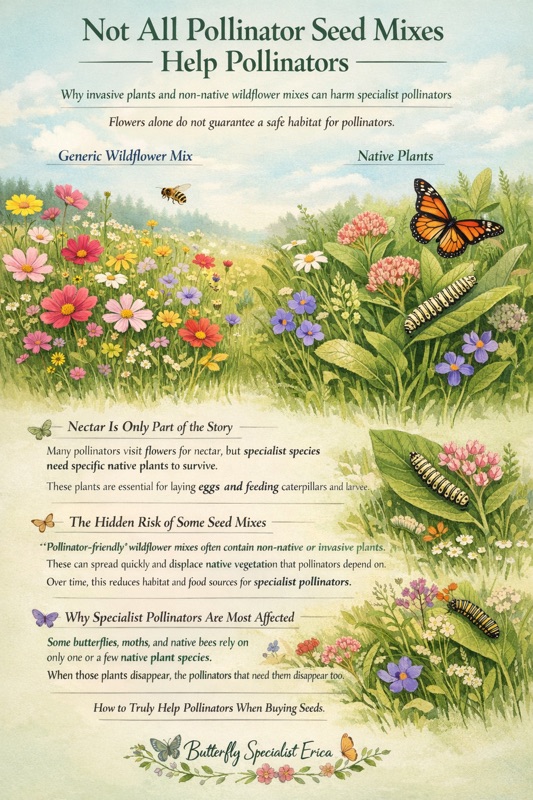
This poster was created for this section of this educational article by me. You are more than welcome to save this poster image to your device, and share it on social media to spread awareness to your audience. Please make sure to give me (Butterfly Specialist Erica) credit for this image, If you do decide to share it.
How Invasive Species End Up In Store Bought Seed Packets
Many gardeners assume that if a seed packet is sold in a local store, the plants inside must be safe for the region. After all, these products are widely available and often marketed as environmentally friendly. However, the journey from seed production to store shelf is more complex than most people realize.
Seed mixes are often produced in large quantities and distributed across multiple provinces, states, or even countries. Plants included in these mixes may perform well in one region without causing harm, but behave very differently in another climate or ecosystem. What is considered manageable in one area can become invasive in another.
Understanding how this happens helps explain why invasive species sometimes appear in commercially sold products. In the subsections that follow, we’ll look at how large scale production works, why regional differences matter, and how quickly certain plants can spread once they become established.
Produced For Scale Not For Region
Many commercial seed mixes are produced in large batches to be sold across wide geographic areas. Instead of being tailored to a specific province, state, or ecosystem, they are often designed to perform reliably in a variety of climates. This approach makes distribution easier and more cost-effective, but it doesn’t always account for the unique ecological needs of each region.
As a result, the same seed mix may be placed on shelves in very different environments. While some plants in the mix may be harmless or even beneficial in one location, they may not be appropriate in another. The focus on scale and convenience can unintentionally overlook regional ecological differences.
When Harmless In One Place Becomes Harmful In Another
Plants do not behave the same way in every environment. A species that coexists peacefully with other plants in its native range may become aggressive when introduced to a new area without natural controls such as pests, diseases, or competing vegetation. Climate, soil type, and growing conditions can also influence how vigorously a plant spreads.
In some cases, a plant included in a seed mix may be considered non-problematic in one region but listed as invasive in another. Without clear regional labeling, gardeners may unknowingly plant species that have the potential to spread beyond their yard. What seems safe based on packaging or availability may not reflect local ecological realities.
How Quickly Invasive Plants Can Spread
Once established, certain invasive plants can spread rapidly. Many produce large quantities of seeds that travel easily by wind, water, wildlife, or even on clothing and equipment. Others spread underground through roots or rhizomes, forming dense patches that are difficult to remove.
Because invasive plants often grow quickly and adapt well to disturbed areas, they can establish themselves before native plants have a chance to compete. Over time, small garden plantings can expand into nearby natural spaces such as roadsides, fields, and wetlands. Early establishment is often subtle, but the long-term impact can be significant and challenging to reverse.
A Common Real World Example :
A gardener purchases a colourful wildflower mix from a large retail store, assuming it’s suitable for their region. The label highlights bright blooms and pollinator support, but doesn’t specify whether the plants are native locally. Within a season or two, one fast-growing species begins spreading beyond the intended garden bed.
Over time, that plant appears along the fence line, in nearby ditches, and eventually in natural areas close to the neighbourhood. What began as a small garden planting quietly expands, requiring significant effort to manage. Situations like this are not uncommon and they show how easily invasive plants can gain a foothold through well intentioned purchases.
A Simple Checklist For Buying Seed Mixes Responsibly
Before purchasing a seed mix, take a few moments to look beyond the front of the package.
✔ Check the plant list
Look for a full list of species included in the mix. Avoid products that only say “wildflower blend” without naming the plants inside.
✔ Research each species
Search the plant names alongside your province or state to see if any are listed as invasive or problematic in your region.
✔ Prioritize native plants
Choose mixes labeled specifically for your local region and confirm that the plants are native to your area not just native to North America in general.
✔ Be cautious with vague buzzwords
Terms like “pollinator-friendly” or “bee-safe” are not regulated. These phrases do not automatically mean the plants are native or ecologically appropriate.
✔ Buy from reputable native plant nurseries
Local native plant growers and conservation-focused suppliers are more likely to offer regionally appropriate species.
✔ Consider creating your own mix
Purchasing individual native seed packets allows you to control exactly what goes into your garden.
Common Mislabeled Or Problematic Plants To Watch For (Canada Focused)
Many seed mixes marketed in Canada use appealing labels such as wildflower mix, pollinator blend, butterfly garden mix, or bee-friendly flowers. These names suggest that the plants inside are naturally suited to Canadian ecosystems and beneficial to local wildlife. However, the reality is often more complicated.
Some of the plants included in these blends are native to Europe or Asia rather than to Canada. While they may produce abundant nectar and attract adult pollinators, they often provide little to no host value for native insects. Over time, certain species can spread beyond garden beds, competing with and displacing the native plants that butterflies, bees, and moths truly depend on.
In the subsections that follow, we’ll look more closely at common seed mix categories and the types of plants frequently found within them. Understanding what to watch for helps gardeners make informed choices that support Canadian ecosystems rather than unintentionally contributing to ecological imbalance.
Wildflower Mixes : What’s Often Inside
“Wildflower mix” is one of the most common labels found on seed packets across Canada. The name suggests a natural blend of native meadow flowers, but many commercial mixes contain a combination of native and non-native species and sometimes none that are truly native to the local region. These blends are often designed for bright colour, quick blooms, and easy growth rather than ecological compatibility.
Some plants included in wildflower mixes are native to Europe or Asia and have been widely naturalized in North America. While they may not always be officially listed as invasive everywhere, they can spread aggressively in certain climates. Over time, fast-growing non-native species may outcompete slower growing native plants, reducing plant diversity in gardens and nearby natural areas.
Because the term “wildflower” is not regulated, it does not guarantee that the plants belong to Canada’s ecosystems. Looking beyond the name on the packet is an important first step toward protecting native habitats.
Pollinator Wildflower Blends
Pollinator blends are marketed as supportive habitats for bees, butterflies, and other beneficial insects. These mixes often focus on nectar rich flowers that bloom abundantly and attract visible pollinators. While nectar is important, it represents only one part of what pollinators need to survive.
Many pollinator blends contain non-native flowering plants that provide short-term nectar sources but lack host value for specialist species. Without native host plants, butterflies and moths cannot lay eggs successfully, and some native bees cannot collect the specific pollen they rely on. A garden full of blooms may appear healthy but still fall short ecologically.
True pollinator support means providing both nectar and native host plants. When seed blends overlook this balance, they may unintentionally prioritize appearance over long-term ecosystem health.
Butterfly Wildflower Blends
Butterfly blends are especially appealing to gardeners hoping to attract colourful visitors. These mixes often highlight bright, nectar-producing flowers that adult butterflies readily visit. However, adult feeding is only one stage of a butterfly’s life cycle.
Most butterfly species depend on specific native plants as hosts for their caterpillars. If those host plants are missing or replaced by aggressive non native flowers butterflies may visit but cannot successfully reproduce. Over time, this creates landscapes that look butterfly-friendly but do not sustain future generations.
Supporting butterflies means planting the native species their caterpillars evolved with. Without those plants, even the most vibrant garden may provide only temporary benefit.
Wildflower Bee Blends
Bee blends are frequently promoted as solutions to declining bee populations. These mixes often contain easy-to-grow flowers that produce abundant nectar and pollen. While this can attract generalist bees, it does not always meet the needs of native bee species with more specific requirements.
Some non-native plants included in bee blends may spread beyond garden spaces, competing with native wildflowers that provide essential pollen sources. Native bees evolved alongside native plants, and many rely on particular species for nesting materials or specialized pollen collection. When those native plants are displaced, bee diversity can decline.
Choosing regionally appropriate native plants offers more reliable support for Canada’s diverse bee populations than generalized seed mixes marketed for convenience.
Meadow, Butterfly, and Bee Flowers : What Does This Mean
Terms like “meadow flowers,” “butterfly flowers,” and “bee flowers” create the impression of natural, ecologically appropriate plantings. However, these phrases are often marketing descriptions rather than ecological classifications. A plant may be labeled as a meadow flower even if it originates from another continent.
While some of these plants provide nectar, they may not integrate well into Canadian ecosystems. In certain conditions, they can spread beyond intended areas and gradually replace native species. Over time, landscapes marketed as wildlife-friendly may contribute to biodiversity loss instead of supporting it.
Understanding what these labels truly represent empowers gardeners to make informed, regionally responsible choices.
Why This Matters For Butterflies, Moths, And Native Bees
Flower-filled gardens are often seen as safe havens for pollinators. If butterflies are visiting and bees are buzzing, it can feel like nature is thriving. But supporting pollinators requires more than simply providing nectar. It requires understanding the complex relationships between insects and the native plants they evolved alongside.
Many butterflies and moths are host plant specific, meaning their caterpillars can only survive on certain native plants. Likewise, many native bee species are closely tied to particular flowering plants for pollen and nesting resources. When invasive or non-native plants replace these essential species, pollinators lose more than food , they lose the foundation needed to complete their life cycles.
In the subsections that follow, we’ll explore why nectar alone is not enough, how invasive and non-native plants alter ecosystems in subtle but significant ways, and how gardens planted with native species can become powerful tools for conservation. Understanding these differences helps gardeners move beyond appearance and toward truly supportive habitat creation.
Nectar Alone Is Not Enough
Bright flowers filled with nectar can attract butterflies, moths, and bees, creating the appearance of a thriving pollinator garden. While nectar is an important energy source for adult insects, it represents only one piece of a much larger ecological puzzle. Pollinators need more than food for a single life stage.
Butterflies and moths require specific host plants where they can lay eggs and where their caterpillars can feed. Many native bees depend on particular plants for pollen, nesting materials, or seasonal timing that matches their life cycles. Without these resources, pollinators may visit a garden but cannot successfully reproduce or sustain future generations.
A garden designed around nectar alone may look lively for a season, yet fail to provide the full support pollinators truly need.
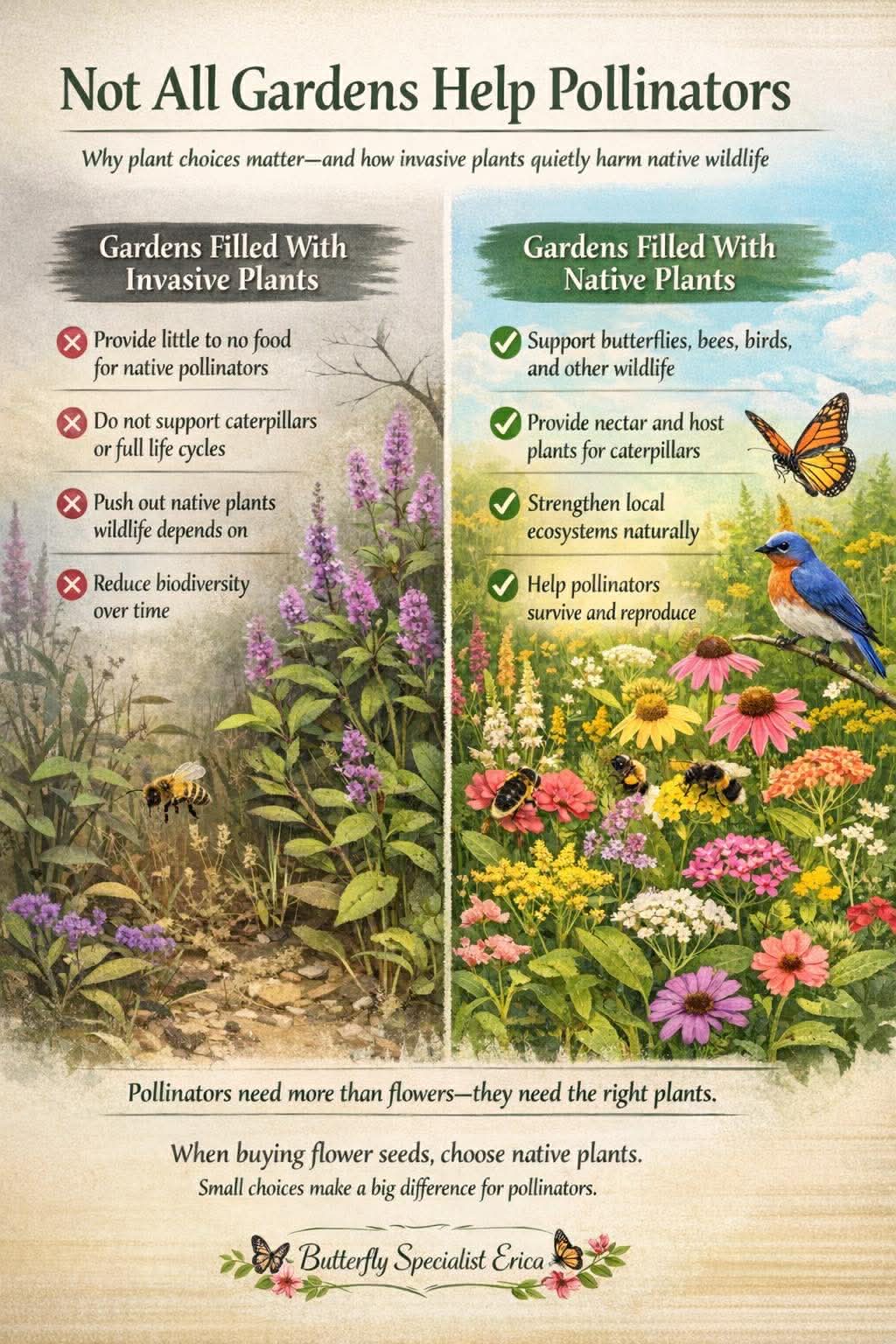
This poster was especially made for this section of the article, to spread more awareness and to have a visual for readers. You are more than welcome to save this poster to use it in your own post. If you do end up using it for your own post, please give me (Butterfly Specialist Erica) the credit for this poster. Thank You 🙏!
When Host Plants Disappear
Many butterflies and moths are host plant specific, meaning their caterpillars can only survive on certain native species. If those plants are replaced by invasive or aggressive non-native species, the next generation of pollinators has nowhere to grow and develop. Adult butterflies may still appear, but without host plants, their life cycle is interrupted.
Native bees can face similar challenges. Some species collect pollen only from certain plant families, and when those plants decline, bee populations can decline with them. The loss of even a single native plant species can have ripple effects throughout local ecosystems.
When host plants disappear, pollinators lose more than food they lose the foundation that sustains their populations.
How Invasive Plants Alter Ecosystems
Invasive plants do more than crowd out native flowers. Some can alter soil chemistry, changing nutrient levels in ways that make it harder for native plants to re-establish. Others grow densely enough to block sunlight, preventing native seedlings from germinating.
Invasive species can also shift bloom timing within an ecosystem. When aggressive plants dominate, they may create gaps in seasonal food availability or concentrate blooms into shorter periods. This disrupts the natural rhythm that pollinators rely on throughout spring, summer, and fall.
These subtle changes compound over time, transforming once-diverse habitats into simplified landscapes that support fewer species overall.
A Garden Full Of Invasive Plants :
A garden dominated by invasive species may appear vibrant at first, especially if those plants produce abundant flowers. However, beneath the surface, native plants may be struggling to survive or disappearing entirely. As invasive plants spread beyond garden boundaries, they can impact nearby natural areas as well.
Pollinators may still visit the flowers, but reduced plant diversity limits nesting options, host plants, and seasonal food sources. Wildlife that depends on native insects for food, including birds and small mammals, can also be affected.
What begins as an attractive planting can unintentionally contribute to long-term ecological imbalance.
A Garden Full Of Non - Native Plants :
Not all non-native plants are invasive, but a garden composed entirely of non-native species often provides limited ecological value. While these plants may offer nectar, they typically lack the deep evolutionary relationships shared between native plants and local wildlife.
Without native host plants, specialist butterflies, moths, and bees may be unable to reproduce successfully. Over time, landscapes dominated by non-native species can support fewer insect species, even if they appear colourful and well-maintained.
Beauty alone does not equal biodiversity!
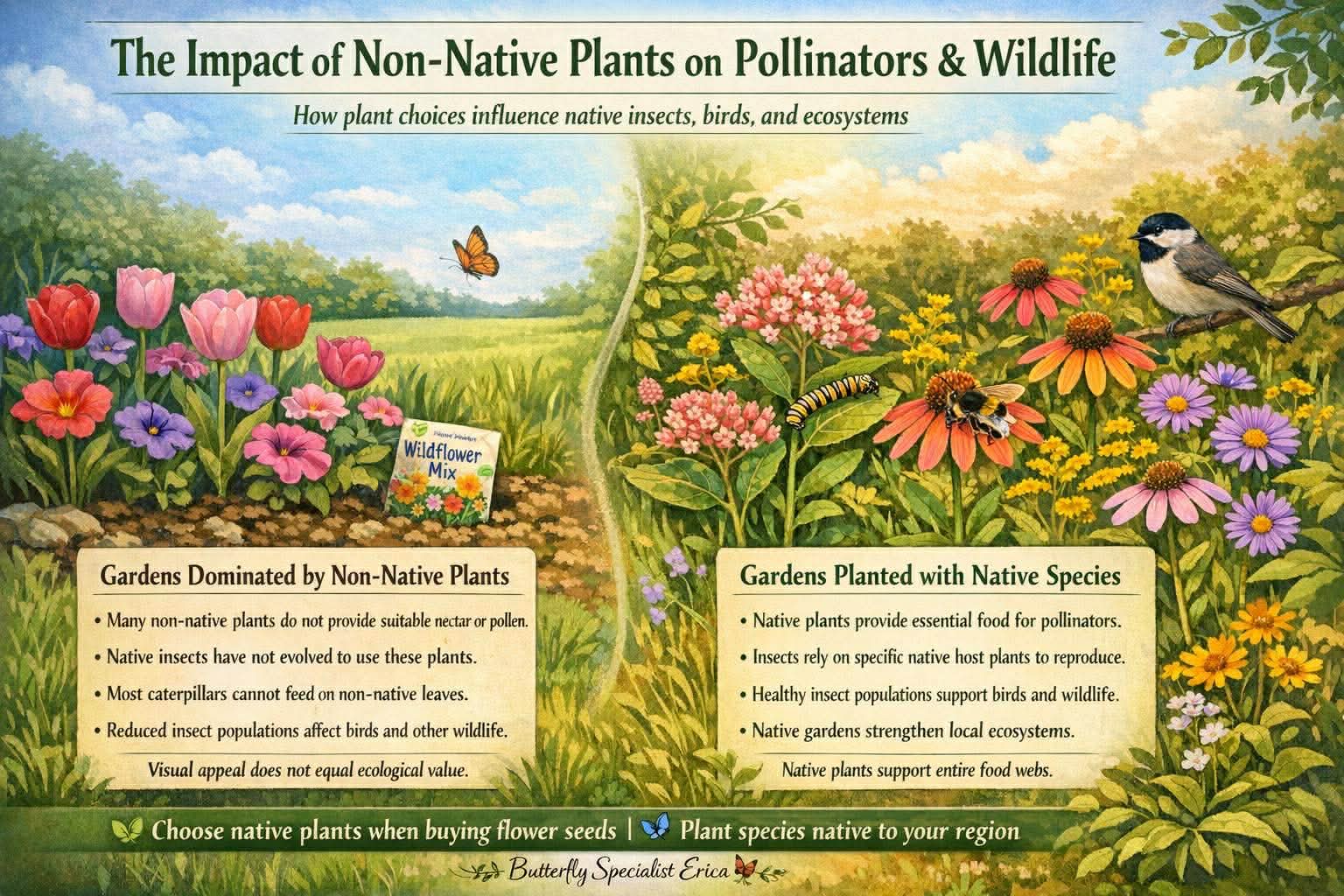
This poster was especially made for this part of the article to spread more awareness, and to have a visual for the readers of the article. You are more than welcome to use this poster for your own post regarding this issue. If you do end up using this poster for your post, please give me (Butterfly Specialist Erica) the credit for this poster. Thank You 🙏!
A Garden Full Of Native Plants :
A garden planted with native species supports pollinators at every stage of life. Native plants provide nectar, pollen, host sites for caterpillars, nesting materials for bees, and habitat structure for countless other organisms. These plants evolved alongside local wildlife and form the foundation of healthy ecosystems.
Native gardens also promote seasonal balance, offering blooms that align naturally with pollinator activity throughout the growing season. By restoring native plant diversity, gardeners can help rebuild ecological relationships that invasive and non-native species often disrupt.
When thoughtfully designed, a native garden becomes more than a collection of flowers it becomes a living, functioning habitat that benefits butterflies, moths, native bees, and the broader web of life.
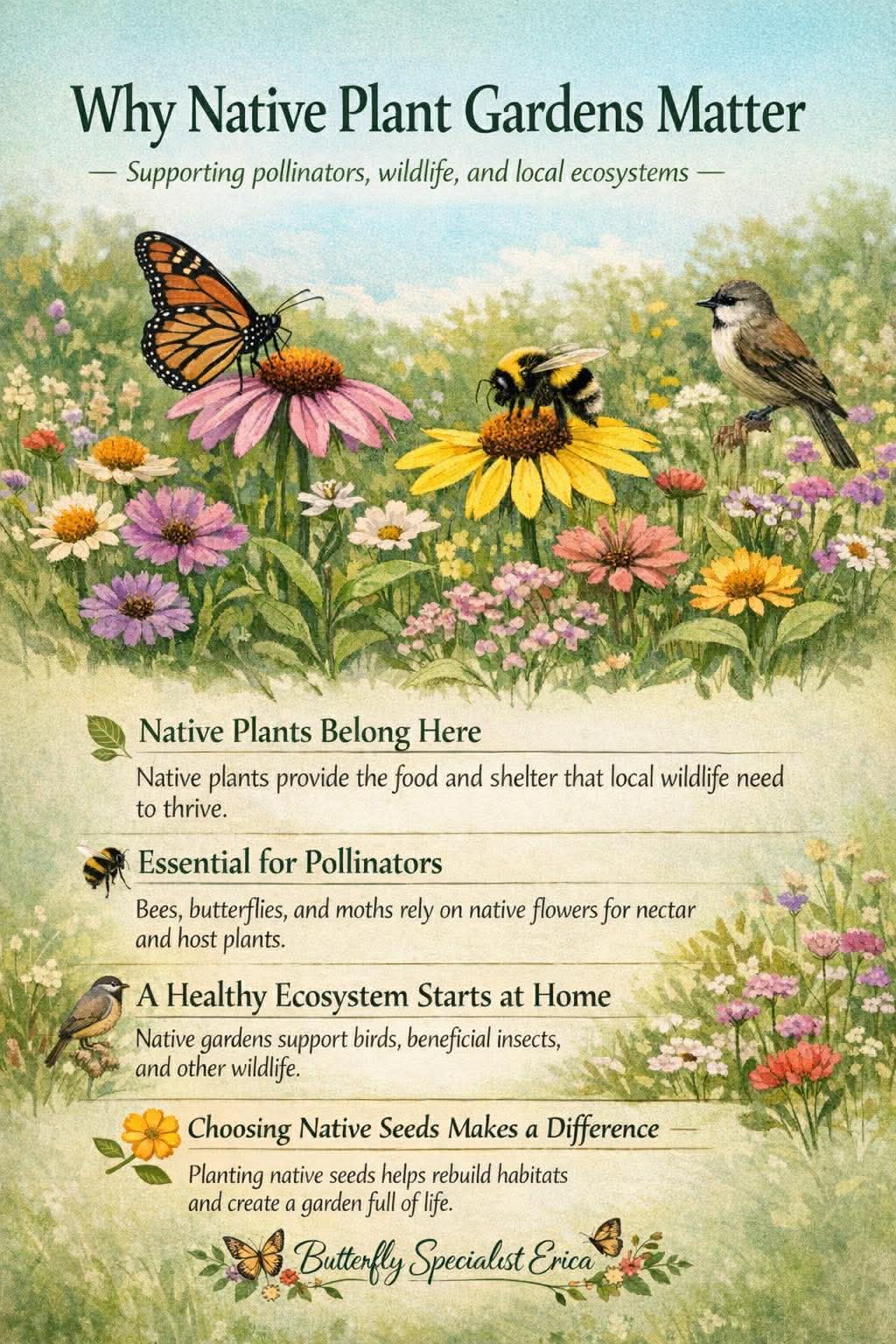
This poster was especially made for this part of the article to spread more awareness, and to have a visual for the readers of the article. You are more than welcome to use this poster for your own post. If you do end up using this poster please give me (Butterfly Specialist Erica) the credit for this poster. Thanks 🙏
How To Read A Seed Packet Like A Conservationist
Seed packets are small, colourful, and easy to overlook but they hold important information that can shape the health of local ecosystems. While marketing language is designed to attract buyers, the details printed on the back of a packet often tell a much more complete story. Learning how to read those details carefully can make all the difference.
Becoming a conservation-minded gardener doesn’t require advanced training or scientific expertise. It simply means slowing down, looking past the buzzwords, and asking thoughtful questions before planting. With a little awareness, seed packets become more than gardening supplies they become opportunities to protect biodiversity.
In the subsections below, we’ll explore practical tips for evaluating seed mixes, what information to look for, and the red flags that may signal a product isn’t suited for your region. With the right tools, you can shop confidently and plant with purpose.
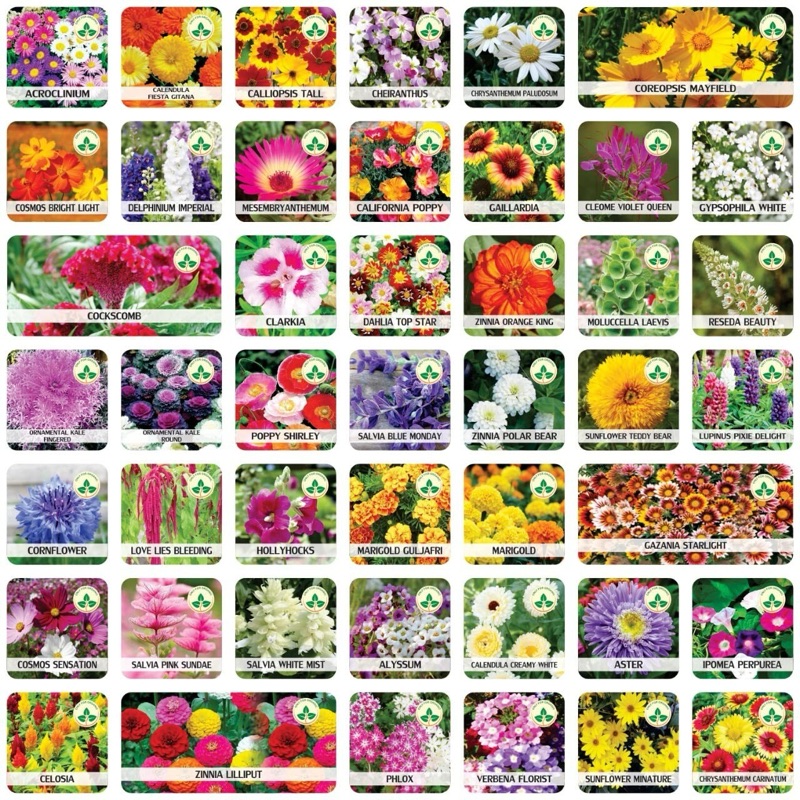
Photo Credits: aquatica enterprises (650) on EBay
Start With The Plant List
The most important part of any seed packet is the plant list. Turn the packet over and look for the full names of the species included in the mix. If a product does not clearly list the plants inside, that is your first sign to pause.
A conservation-minded gardener looks beyond the front label and focuses on the details. Common names can sometimes be misleading, so scientific names are especially helpful when researching a plant’s origin and ecological impact. Knowing exactly what you are planting is the foundation of responsible gardening.
If you cannot identify what is inside the packet, it becomes difficult to know whether those plants belong in your local ecosystem.
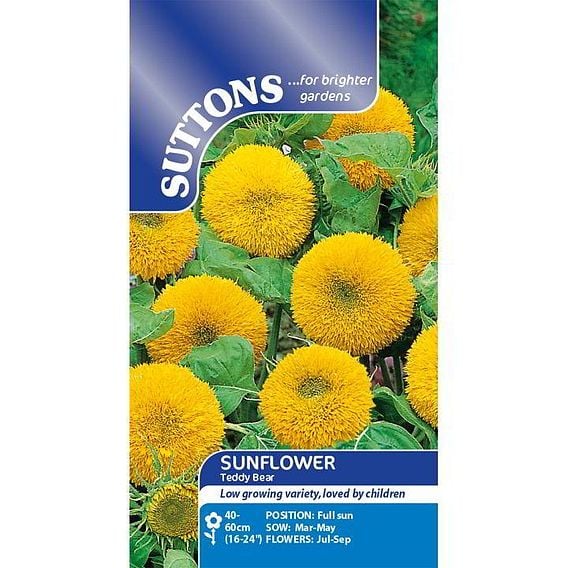
The front of a Teddy Bear Sunflower Seed Packet
Photo Credits: SUTTON Seeds
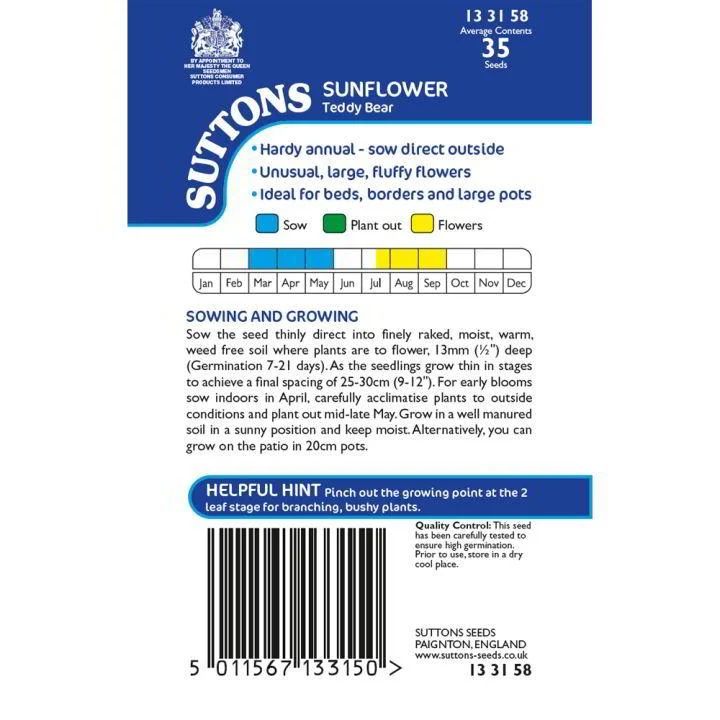
The back of a Teddy Bear Sunflower Seed Packet.
Photo Credits: SUTTON Seeds
Check For Regional Specificity
A truly responsible seed mix should be labeled for a specific region. Phrases such as “Designed for Ontario,” “Prairie Native Mix,” or “Atlantic Canada Wildflowers” indicate that the blend may be tailored to local growing conditions and ecosystems.
Be cautious of generic labels like “North American Wildflower Mix” or “All-Purpose Meadow Blend.” Canada spans multiple climate zones and ecosystems, and a plant that is appropriate in one region may be problematic in another. Regional specificity shows that the supplier has considered ecological differences.
When in doubt, look for mixes produced by local native plant growers who understand your area’s environment.
Watch For Vague Marketing Language
Words like pollinator-friendly, bee blend, butterfly mix, and wildflower garden sound reassuring but are not regulated terms. These phrases are designed to attract attention and suggest environmental benefits, but they do not guarantee that the plants are native or non-invasive.
A conservationist reads these words as marketing cues rather than ecological proof. Instead of relying on the front of the package, turn to the detailed plant list and research each species individually.
Clear information builds trust. Vague promises require closer inspection.
Research Before You Plant
Once you have the plant list, take a few minutes to research each species. Search the plant name along with your province or territory to see whether it is native, naturalized, or listed as invasive in your area.
Many provincial governments and conservation organizations provide public invasive species databases. These resources can help you determine whether a plant is appropriate for your local ecosystem. Even a quick search can prevent long-term ecological harm.
Planting with knowledge protects both your garden and the natural spaces around you.
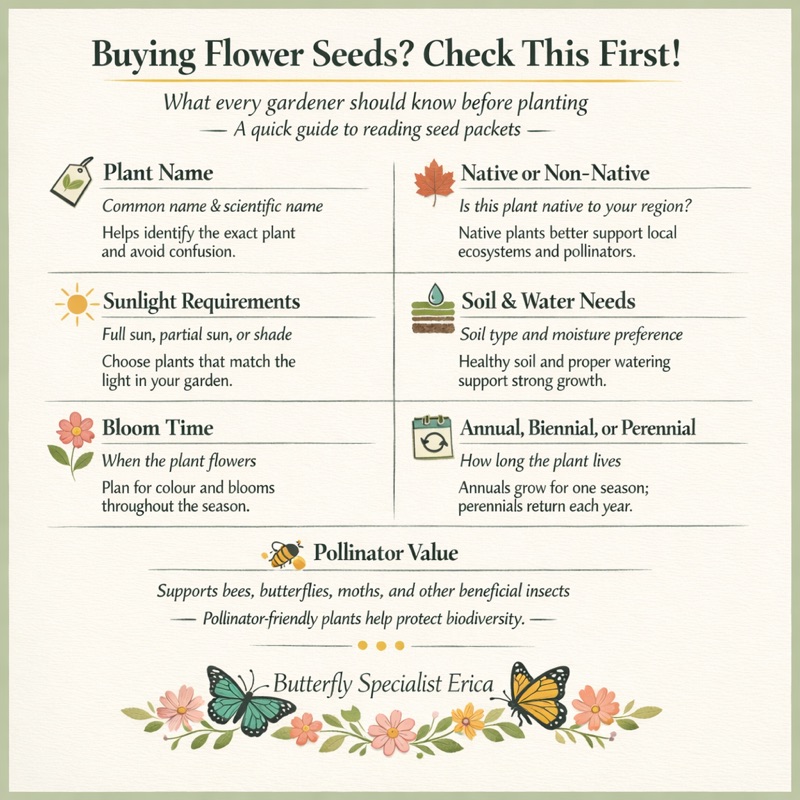
This poster was specially created for this section of the article to spread more awareness, and to have a visual for the readers of the article. You are more than welcome to save this poster, and use it in your own post regarding this issue. If you do end up using this poster for your post please give me (Butterfly Specialist Erica) full credit for this poster. Thank You 🙏
Red Flags To Walk Away From 🚩
Some warning signs suggest a seed mix may not be suitable. Be cautious if the packet does not list individual species, uses only broad marketing terms, or highlights fast growth and low maintenance without mentioning native status.
Other red flags include plants known to spread aggressively, mixes sold across vastly different climate regions without adaptation, or packaging that lacks clear origin information. If transparency is missing, it is reasonable to question the product.
When something feels unclear, it is better to pause than to plant!
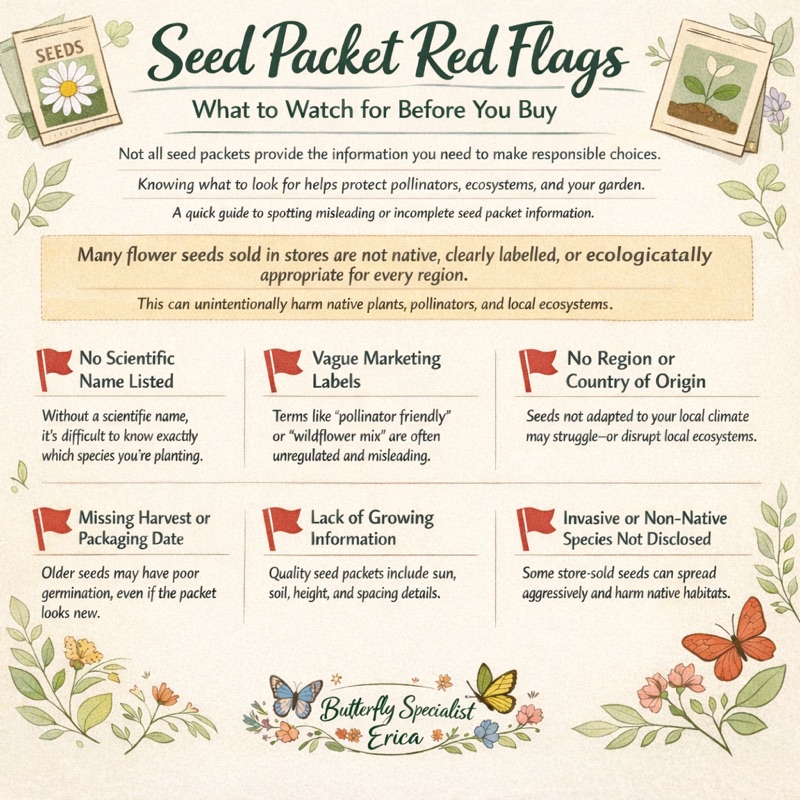
This poster was specially made for this section of the article. You are more than welcome to save this poster, and use it for your own post that is related to this issue. If you do end up saving this poster and using it for your own post regarding this issue, please give me (Butterfly Specialist Erica) full credit for the poster. Thank You 🙏
Green Flags To Look For ✅
Positive signs can help guide your decision. Look for clear labeling that identifies plants as native to your specific region. Transparent plant lists, educational information about host plants, and guidance on supporting local ecosystems are all encouraging indicators.
Suppliers that specialize in native plants or partner with conservation organizations often provide more detailed information about ecological value. These products may emphasize biodiversity, seasonal bloom timing, and long-term habitat support rather than just visual appeal.
When a seed packet prioritizes ecological integrity over marketing language, you are far more likely to be planting with conservation in mind.
Quick Reference: Choosing Seeds Responsibly
Before You Buy:
✔ Turn the packet over and read the full plant list
✔ Look for scientific names when possible
✔ Check if the plants are native to your specific region in Canada
✔ Be cautious of vague terms like “pollinator-friendly” or “wildflower blend”
✔ Research unfamiliar species before planting
Red Flags 🚩
• No plant list provided
• Sold broadly across multiple climate regions without regional labeling
• Focus on fast growth and bright colour without mentioning native status
• Contains species listed as invasive or problematic in your province
Green Flags 🌱
• Clearly labeled as native to your region
• Transparent species list
• Produced by a local or conservation-focused supplier
• Emphasis on host plants and biodiversity, not just nectar
Remember:
Nectar is helpful but native host plants are essential.
The right seeds don’t just grow flowers they grow habitat.
Native Vs. Non Native Vs. invasive : Understanding The Difference
Throughout conversations about gardening and conservation, the terms native, non-native, and invasive are often used interchangeably. While they may sound similar, they describe very different ecological roles. Understanding these distinctions is essential for making responsible planting decisions.
Not all non-native plants are invasive, and not all introduced species cause harm. However, when certain plants spread aggressively and disrupt ecosystems, they move beyond being simply “non-native” and become invasive. The difference lies in how they interact with local environments and whether they support or displace native biodiversity.
In the subsections below, we’ll break down what each term means, look at examples relevant to Canada, and compare how native, non-native, and invasive plants function within ecosystems. Clear definitions help gardeners move forward with confidence and avoid confusion.
What Is A Native Plant? :
A native plant is a species that occurs naturally in a specific region and has evolved there over thousands of years. In Canada, native plants are those that existed in local ecosystems prior to large-scale European settlement and introduction of foreign species. These plants developed alongside native insects, birds, mammals, and soil systems, forming complex ecological relationships.
Because native plants evolved with local wildlife, they provide essential resources such as nectar, pollen, seeds, shelter, and most importantly host plants for caterpillars and specialist pollinators. Many butterflies, moths, and native bees rely on specific native plant species to complete their life cycles.
Examples of native Canadian plants (depending on region) may include milkweed species, wild bergamot, black-eyed Susan (native strains), serviceberry, goldenrod, and native asters. These plants support biodiversity and help maintain balanced ecosystems.
What Is A Non Native Plant? :
A non-native plant, also called an introduced or exotic species, is a plant that originates from another region or continent and was brought intentionally or unintentionally into a new area. Many non-native plants were introduced for agriculture, landscaping, erosion control, or ornamental gardening.
Not all non-native plants are harmful. Some coexist without spreading aggressively or disrupting ecosystems. However, because they did not evolve alongside local wildlife, they often provide limited ecological value. Many non-native plants offer nectar but do not serve as host plants for native insects.
Examples of non-native plants commonly found in Canadian gardens include certain European poppies, oxeye daisy, bachelor’s button, and some ornamental grasses. While these plants may add colour, they typically do not support native biodiversity to the same degree as native species.
What Is An Invasive Plant? :
An invasive plant is a non-native species that spreads aggressively and causes ecological, environmental, or economic harm. Unlike non-native plants that remain contained, invasive species establish quickly, reproduce in large numbers, and outcompete native vegetation. In their introduced range, they often lack the natural predators, diseases, and controls that would normally keep their populations in balance.
Invasive plants can reduce biodiversity, alter soil chemistry, change water availability, and disrupt food webs that local wildlife depends on. Once established, they are often difficult and costly to remove, and their impacts can persist for many years. Even small garden plantings can contribute to wider spread if seeds escape into nearby natural areas.
In Ontario and other parts of Canada, well-known invasive plants include species such as purple loosestrife, garlic mustard, common buckthorn, and certain knapweeds. Understanding what makes a plant invasive helps gardeners make informed choices that protect native ecosystems rather than unintentionally putting them at risk.
Native Vs. Non - Native Vs. Invasive : Quick Comparison
🌿 Native Plants :
• Naturally occur in a specific Canadian region.
• Evolved alongside local wildlife and ecosystems.
• Provide nectar, pollen, seeds, shelter, and host plants.
• Grow within ecological balance
• Strengthen biodiversity and ecosystem resilience.
🌼 Non Native Plants :
• Introduced from another region or continent.
• Did not evolve with local wildlife
• May provide nectar but often lack host value.
• Usually manageable in garden settings.
• Offer limited ecological benefit compared to native plants.
🚨 Invasive Plants :
• Non-native species that spread aggressively.
• Outcompete and displace native plants.
• Reduce biodiversity and disrupt ecosystems.
• May alter soil, water systems, or bloom timing.
• Difficult and costly to control once established.
🪴 Canadian Native Plants To Look For (Ontario & Canada Based)
There are hundreds of native plant species across Canada, and many are excellent choices for supporting butterflies, moths, native bees, and other wildlife. The plants below are well-known among native plant gardeners in Ontario and are commonly recommended for habitat restoration and pollinator support. While some may occasionally appear in seed mixes, they are often underrepresented compared to non-native species.
• Pale Purple Coneflower (Echinacea pallida) – A long-blooming prairie native that supports a wide variety of pollinators.
• Dense Blazing Star (Liatris spicata) – A favourite nectar source for butterflies and native bees.
• Spotted Joe Pye Weed (Eutrochium maculatum) – A late-season bloomer that provides critical nectar for migrating butterflies.
• Tall Ironweed (Vernonia gigantea) – Vibrant purple blooms that support many pollinators in late summer.
• Common Milkweed (Asclepias syriaca) – An essential host plant for Monarch caterpillars.
• Swamp Milkweed (Asclepias incarnata) – A moisture-loving milkweed that supports Monarchs and other insects.
• Butterfly Weed (Asclepias tuberosa) – A drought-tolerant milkweed species and Monarch host plant.
• False Sunflower (Heliopsis helianthoides) – Bright yellow blooms that attract native bees.
• Wild Indigo (Baptisia species) – A host plant for several native butterflies.
• Purple Prairie Clover (Dalea purpurea) – Supports native bees and thrives in prairie-style gardens.
• Golden Alexander (Zizia aurea) – An important early-season nectar source and host plant for Black Swallowtails.
• Black-Eyed Susan (Rudbeckia hirta, native strains) – A pollinator-friendly native wildflower when locally sourced.
• Pearly Everlasting (Anaphalis margaritacea) – A host plant for the American Lady butterfly.
• Wild Geranium (Geranium maculatum) – An early woodland bloomer beneficial to native bees.
• Wild Rose (Rosa species native to Ontario) – Provides pollen for bees and hips for birds.
• Swamp Rose Mallow (Hibiscus moscheutos) – A striking native plant that supports pollinators in wet areas.
• Red Cardinal Flower (Lobelia cardinalis) – A hummingbird favourite that also benefits insects.
• Wild Bergamot (Monarda fistulosa) – A highly valuable nectar plant for bees and butterflies.
• Scarlet Bee Balm (Monarda didyma, native populations) – Supports pollinators when sourced from native stock.
• Wild Strawberry (Fragaria virginiana) – Provides early nectar and habitat value.
• Riverbank Grape (Vitis riparia) – A host plant for several moth species.
• Common Yarrow (Achillea millefolium, native strains) – A widespread native plant that supports many beneficial insects.
There are many more native species across Ontario and Canada, but these examples highlight how diverse, beautiful, and ecologically valuable native plant gardens can be.
One Sentence Definition Of Invasive Plants :
Invasive plants are non-native species that spread aggressively and cause harm to ecosystems, native wildlife, or local economies.
One Sentence Definition Of Non Native Plants :
Non-native plants are species introduced from another region or continent that did not originally evolve in the local ecosystem.
One Sentence Definition Of Native Plants :
Native plants are species that occur naturally in a specific region and have evolved alongside local wildlife and ecosystems.
🍁 Ontario Specific Note :
In Ontario, invasive plant status is tracked by organizations such as the Invasive Species Centre and the Ontario Ministry of Natural Resources and Forestry. Because invasive risk can vary by region within the province, gardeners are encouraged to check Ontario-specific invasive species lists before purchasing or planting unfamiliar species. What may be sold in garden centres is not always ecologically safe for Ontario landscapes.
🇨🇦 Canada Wide Note :
Across Canada, invasive plant designations can vary by province and ecozone. A species that is highly invasive in one region (such as coastal British Columbia or parts of the Prairies) may be less aggressive elsewhere. Gardeners should consult provincial invasive species councils, conservation authorities, or federal resources like the Canadian Food Inspection Agency (CFIA) to confirm whether a plant is considered invasive in their specific location.
🍁 Where To Check In Ontario
Ontario gardeners have several excellent province-specific tools for verifying plant status before purchasing seed mixes.
Trusted Ontario resources:
• 🟢 Invasive Species Centre (ISC) – Ontario-focused invasive species profiles and alerts
• 🦋 Ontario Invasive Plant Council (OIPC) – Detailed invasive plant lists and look-alikes
• 🌿 Ontario Ministry of Natural Resources and Forestry (MNRF) – Provincial guidance and regulations
• 🗺️ EDDMapS Ontario – Track and report invasive species sightings
• 🌸 Ontario Native Plant Society (ONPS) – Native plant recommendations for Ontario gardens
Checking these sources before planting helps ensure your garden supports Ontario’s ecosystems rather than unintentionally putting them at risk.
🔎 🇨🇦 Where To Check In Canada
Before planting unfamiliar species, consult trusted Canadian resources to confirm whether a plant is native, non-native, or invasive in your region.
Helpful national resources:
• 🇨🇦 Canadian Food Inspection Agency (CFIA) – Regulated plant pest and invasive species information
• 🌿 Invasive Species Centre (Canada) – National invasive species education and resources
• 🗺️ EDDMapS Canada – Distribution maps and reporting for invasive species
• 📚 Native Plant Societies (by province) – Regional native plant guidance
• 🌱 Local conservation authorities and watershed groups – Region-specific recommendations
Because Canada spans many ecozones, always cross-check with your provincial resources as well.
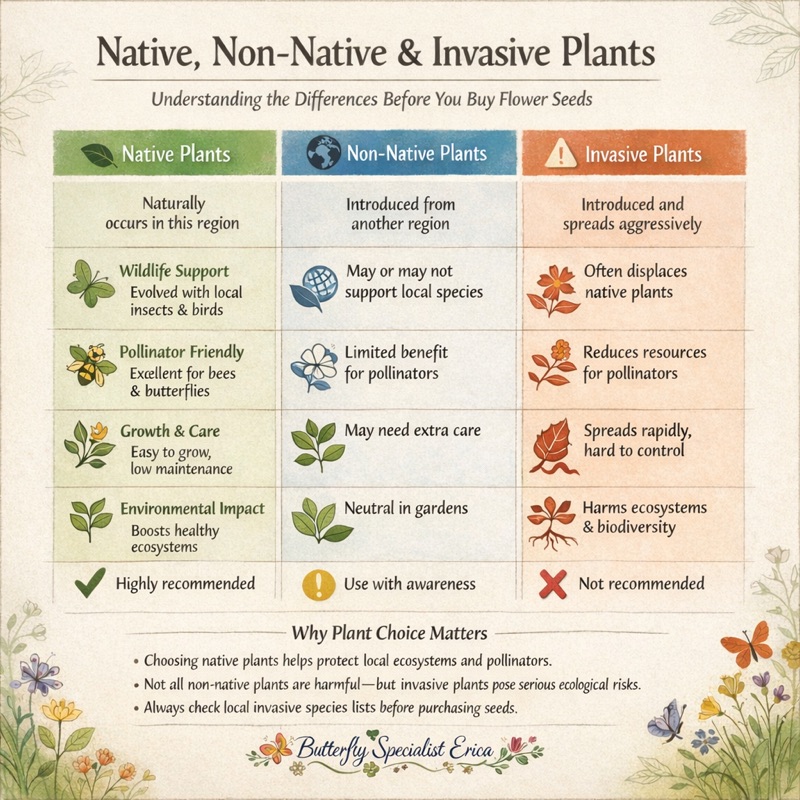
This Comparison Chart was specially made for this section of the article to spread more awareness about this issue, and to have a visual for the readers of the article. You are more than welcome to save this image, and use it for your own post regarding this issue. If you do end up saving this photo and using it for your post, please give me (Butterfly Specialist Erica) full credit for this image. Thank You 🙏
Better Alternatives to Big Box Store Seed Packets
After learning how misleading some commercial seed mixes can be, many gardeners begin asking an important question: What should I buy instead? The good news is that there are many environmentally responsible options that truly support pollinators and local ecosystems. With a little guidance, it becomes much easier to choose seeds and plants that align with conservation goals.
Not all seed sources are created equal. Some suppliers focus primarily on fast-growing, visually appealing mixes designed for mass distribution, while others prioritize regional native plants, biodiversity, and ecological integrity. Knowing where to shop and what to look for can dramatically improve the habitat value of your garden.
In the subsections below, we’ll explore better alternatives to typical big box seed packets, where to find high-quality native seeds and plants in Canada, and how to identify companies that genuinely support pollinator health. Small purchasing decisions can have a meaningful impact on the landscapes we share with butterflies, moths, and native bees.
What Makes A Seed Packet Environmentally Responsible
Not all seed packets are created with ecosystems in mind. An environmentally responsible seed packet does more than promise bright blooms or pollinator appeal, it provides clear, transparent information about what you are planting and how those plants interact with local habitats. Learning to spot these details helps gardeners move from guesswork to informed decision-making.
One of the most important signs of a responsible seed packet is a complete and accurate plant list, ideally including scientific names. This allows gardeners to research whether the species are native, non-native, or invasive in their region. High-quality suppliers are typically transparent about what is inside their mixes and where those plants are native.
Regional relevance is another key factor. Responsible seed companies often label their products for specific provinces, ecozones, or growing regions rather than marketing one generic mix across the entire country. Because Canada spans many climates and ecosystems, regionally adapted native plants provide far greater ecological value than broad, one-size-fits-all blends.
It is also helpful to look for packets that emphasize native species, host plant value, and biodiversity support, rather than focusing only on colour, fast growth, or low maintenance. Educational language, sourcing transparency, and connections to conservation goals are strong indicators that a company is prioritizing ecological health alongside garden performance.
By choosing seed packets that meet these criteria, gardeners can feel confident that their planting choices are contributing to healthier habitats for butterflies, moths, native bees, and other wildlife.
✅ Quick Checklist: Is This Seed Packet Eco Responsible?
Before purchasing, ask yourself:
✔ Does the packet list all plant species clearly?
✔ Are scientific names provided for accuracy?
✔ Is the mix labeled for my specific region or province?
✔ Does it emphasize native plants or host plant value?
✔ Is the company transparent about sourcing and ecology?
Proceed with caution if you notice:
🚩 No detailed plant list
🚩 Heavy use of vague buzzwords only
🚩 One generic mix sold across all of Canada
🚩 Focus on fast growth with no ecological information
Remember:
The best seed packets support not just blooms but complete habitat.
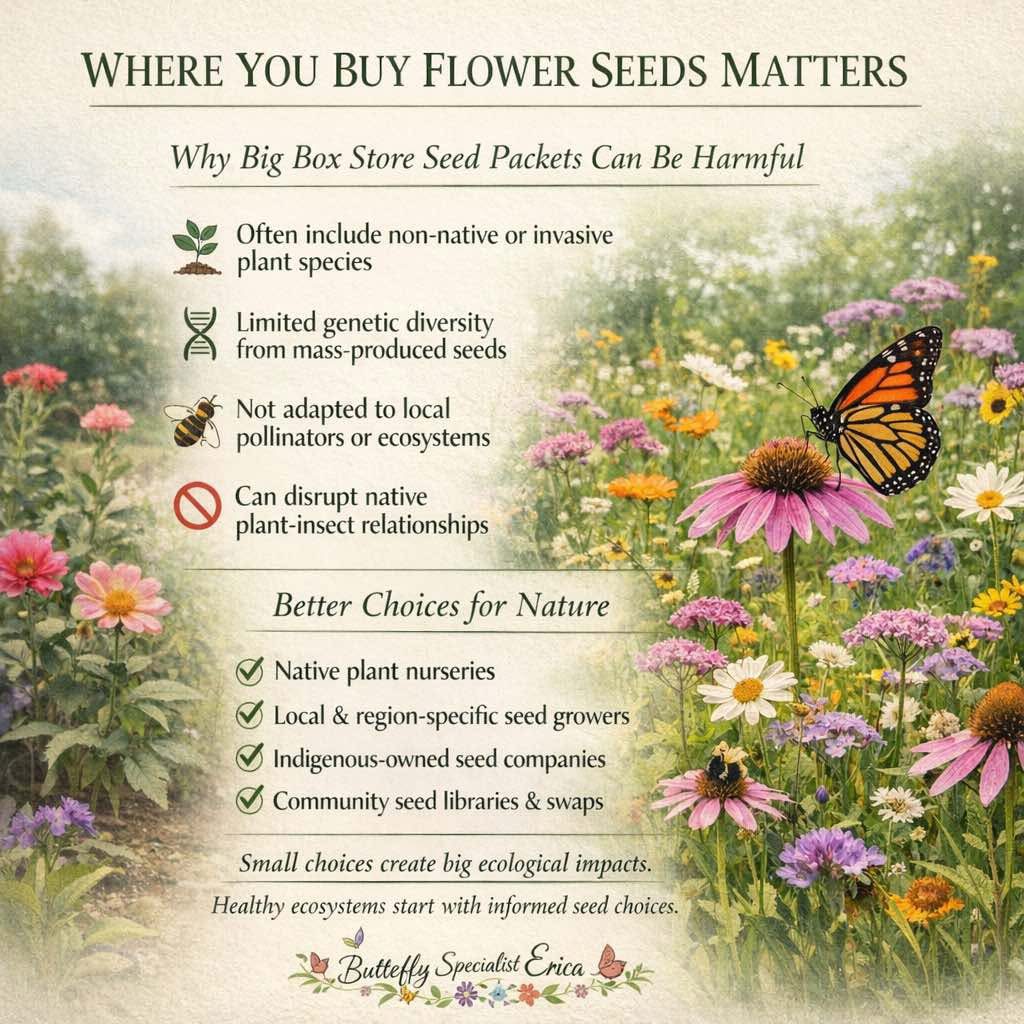
This poster was specially made for this section of the article to spread more awareness about this common issue, and to have a visual for the readers of this article. You are more than welcome to save this poster and use it for your post that relates to this issue. If you do end up using this poster for your post please give me (Butterfly Specialist Erica) the credits for this poster. Thank You 🙏
Where To Buy Better Seed Packets
Finding better seed packets often starts with looking beyond the typical big box store rack. While large retailers offer convenience, many of their seed mixes are produced for mass distribution rather than regional ecological value. Fortunately, there are many excellent alternatives that prioritize native plants, biodiversity, and pollinator health.
One of the best places to start is with native plant nurseries and native seed specialists. These growers typically focus on species that are appropriate for your region and are more likely to provide transparent plant lists and sourcing information. Many native seed companies also design mixes specifically for Ontario or Canadian ecozones, making them far more reliable for habitat support.
Local horticultural societies, conservation authorities, and native plant sales are also valuable resources. These organizations often partner with reputable growers and can help gardeners find species that truly benefit local butterflies, moths, and native bees. In many communities, spring native plant sales are one of the most affordable and trustworthy ways to build an ecologically supportive garden.
Online native seed suppliers can be another strong option, especially for gardeners in areas with limited local access. When shopping online, look for companies that clearly state the native range of their plants, provide full species lists, and emphasize ecological restoration or pollinator support rather than just ornamental appeal.
By choosing seeds from conservation-minded sources, gardeners help create demand for ecologically responsible products. Each thoughtful purchase supports not only your garden, but also the broader movement to restore native habitat across Canada.
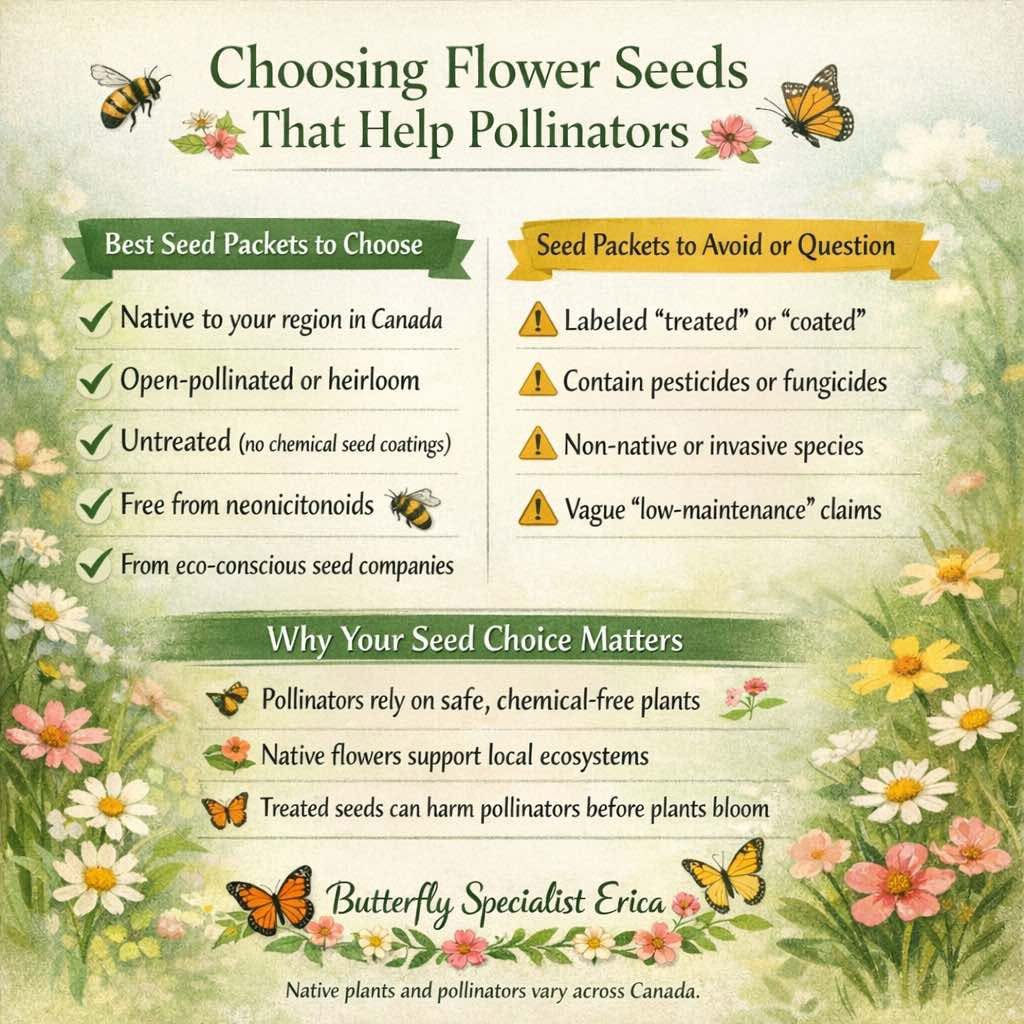
This poster was specially made for this section of the article to spread more awareness about this common issue, and to have a visual for the readers of the article. You are more than welcome to save this poster and use it for your educational post regarding this issue. If you do end up saving the poster to your phone and use it for your educational post, please give me (Butterfly Specialist Erica) the full credit for this poster. Thank You 🙏
Where To Buy Native Plants Locally
Sourcing native plants from reputable growers is one of the most impactful steps gardeners can take to support pollinators and local ecosystems. Native plant nurseries typically offer regionally appropriate species, knowledgeable staff, and plants grown with ecological integrity in mind.
Below are trusted options in Ontario and across Canada to help you get started.
🍁 In The Province Of Ontario
There are several excellent local garden centres and online sources that specialize in native plants. The businesses listed below are among the many options available to Ontario gardeners.
List Of Native Plant Garden Centres (Ontario) :
1. Bee Sweet Nature Company
4182 Sideroad 20 South, Puslinch, ON N0B 2J0
2. Kayanase Ecological Restoration
993 Highway #54, Ohsweken, ON N0A 1M0
📝 Note: Highly recommended for regionally native plants. They offer an excellent selection, knowledgeable and helpful staff, and plants grown in-house. Prices are reasonable and purchases are tax-exempt.
3. Grow Wild! Native Plant Nursery
3784 ON-7, Omemee, ON K0L 2W0
4. In Our Nature
Orangeville, ON
📝 Note: They maintain both a Facebook page and website for browsing availability.
5. Native Plant Source
1120 Wurster Pl, Breslau, ON N0B 1M0
6. Native Plants in Claremont
4965 Westney Rd N, Claremont, ON L1Y 1A2
7. Not So Hollow Farm
838369 4th Line East Mulmur, ON L9V 0J7
8. Ontario Flora
585538 Sideroad 10A, RR2 Markdale, ON N0C 1H0
9. Origin Native Plants
5420 Hwy 6, Guelph, ON N1H 6J2
10. Quiet Nature
1124 Nith Rd, Ayr, ON N0B 1E0
11. St. Williams Nursery & Ecology Centre
885 Norfolk County Hwy 24, St. Williams, ON N0E 1P0
12. Verbinnen’s Nursery
1504 Brock Road, RR4 Dundas, ON L9H 5E4
13. Willow Farm Grasses
597326 Grey Rd 29, Bognor, ON N0H 1E0
14. Rooted by the Bluffs
170513 Centre Road, Georgian Bluffs, ON N0H 2T0
💻 Places To Purchase Native Plants Online (Ontario) :
1. Ontario Native Plants
Wide selection of wildflowers, shrubs, trees, and grasses. Plants arrive young but establish well.
Website: http://onplants.ca
(Type the web address in the search bar of your web browser.)
2. Royal City Nursery (Guelph, ON)
Offers online ordering for pickup or delivery.
Website: http://royalcitynursery.com/online
(Type the web address in the search bar of your web browser.)
3. Native Plants in Claremont (Pickering, ON)
Over 150 species of native wildflowers, sedges, and shrubs.
Website: http://nativeplants.ca
(Type the web address in the search bar of your web browser.)
4. Hidden Habitat (Gravenhurst, ON)
Specializes in native plants for local ecosystems; offers delivery or pickup.
Website: http://hiddenhabitat.ca
(Type the web address in the search bar of your web browser.)
5. Knipple Garden Centre (Ottawa, ON)
Large selection of native plants with delivery and pickup options.
Website: http://www.knipplegardencentre.com
(Type the web address in the search bar of your web browser.)
Note 📝: There is a good chance that the links to these websites may not work here in this article, so it is best to type the website into the search bar of your web browser.
🇨🇦 In Other Parts Of Canada
There are many excellent native plant nurseries across Canada. Availability varies by province, so always prioritize plants native to your specific eco-region.
🌿 Native Plant Garden Centres (In Canada) :
1. Beaux Arbres Plantes Indigènes / Native Plants
29 Chemin Ragged Chute, Bristol, QC J0X 1G0
2. Prairie Flora Greenhouse
Hwy #7, Teulon, MB R0C 3B0
3. Satinflower Nurseries
Victoria, BC (Dooley Rd & Metchosin Rd locations)
4. Falk Nurseries
23062 Provincial Hwy 311, New Bothwell, MB R0A 1C0
5. Macphail Woods Ecological Forestry Project
81 Prince St., Charlottetown, PE C1A 4R3
6. Murray’s Garden Centre
Portugal Cove-St. Philip’s, NL
7. Holland Nurseries Florist & Garden Centre
St. John’s, NL
💻 Online Sources Shipping Within Canada :
1. Proven Winners Direct
Ships perennials, shrubs, and annuals suited for Canadian climates, including many native species.
Website: http://provenwinnersdirect.com
📝 Note: Does not ship to Yukon, Northwest Territories, or Nunavut.
(Type the web address in the search bar of your web browser.)
2. Solidago Farm — Native Plant Nursery
Focused on biodiversity in the National Capital Region.
Website: http://solidagofarm.ca
📝 Note: Email solidagofarm1@gmail.com to confirm shipping availability.
(Type the web address in the search bar of your web browser.)
3. ALCLA Native Plants
Specializes in Alberta native plant production and genetics.
Website: http://alclanativeplants.com
(Type the web address in the search bar of your web browser.)
4. Bamboo Plants
Large online nursery carrying a mix of ornamentals and some native species.
Website: http://bambooplants.ca
(Type the web address in the search bar of your web browser.)
Note 📝: Remember that there is a good chance that the website links don’t work in this article, so it is recommended to type in the website names in the search bar of your web browser.
✅ Tip : Whenever possible, choose plants grown from seed sources local to your eco-region for the greatest ecological benefit.
🚩 Seed Companies To Be Cautious Of
Many well-known seed companies sell a wide variety of products, including vegetables, ornamentals, and wildflower mixes. While these companies serve many gardeners well, some of their flower seed offerings may include non-native or regionally invasive species. For conservation-minded gardeners in Ontario and across Canada, it is important to review individual seed packets carefully rather than assuming all products labeled “pollinator-friendly” are ecologically appropriate.
The companies below are widely available in Canadian garden centres. They may offer quality products in many categories, but some of their wildflower mixes or ornamental flower seeds have included species that are invasive or potentially problematic in parts of Canada. Careful label reading and species research are strongly recommended when purchasing.
🔴 McKenzie Seeds :
McKenzie Seeds markets many products using pollinator-friendly and environmentally supportive language. However, some of their large wildflower mixes and bulk seed boxes have historically included a high proportion of non-native species, and in some cases plants considered invasive in parts of Canada.
These mixes are often designed for broad North American distribution rather than Ontario-specific ecosystems. Gardeners should review the species list closely, as only a small portion of the mix may be native to their region.
🔴 OSC (Ontario Seed Company) :
OSC offers many small individual seed packets as well as some wildflower blends. While the company provides a wide selection for home gardeners, certain flower packets have included species such as forget-me-not, dame’s rocket, and purple loosestrife, which are considered invasive or problematic in parts of Ontario.
As with any large supplier, checking the scientific names and verifying regional suitability before planting is an important step.
🔴 Vesseys :
Veseys sells a broad catalogue of seeds including vegetables, annual flowers, and perennial ornamentals. Among their extensive flower offerings are some species that are non-native or invasive in parts of Canada.
Because the catalogue is so large, ecological suitability varies by product. Gardeners focused on native planting should take extra care to research individual flower species rather than relying on category labels alone.
🔴 The Seed Company :
The Seed Company is known for friendly service and a diverse seed selection. However, like many general seed retailers, some flower offerings have included species such as forget-me-not and dame’s rocket, which can be invasive in parts of Canada.
Reviewing plant lists and cross-checking with provincial invasive species resources can help gardeners make informed choices when purchasing.
🌿 A Conservation - Minded Reminder :
Most large seed companies serve a wide gardening audience and are not exclusively focused on native ecosystem restoration. The responsibility often falls on gardeners to look beyond marketing language, read species lists carefully, and choose plants appropriate for their local environment.
With a little extra attention, it is still possible to shop widely while planting responsibly.
🟢 Seed Companies That Support Pollinators
Many seed companies are working to improve habitat options for gardeners by offering native species, transparent sourcing, and regionally appropriate seed selections. While no large supplier is perfect for every region, the companies below are widely recognized for offering native plant options and pollinator-supportive seeds.
As always, gardeners should still review individual species for regional suitability, but these companies are strong starting points for conservation-minded planting.
West Coast Seeds :
West Coast Seeds offers a range of native and pollinator-supportive flower seeds, with a particularly strong focus on organic growing practices. Their native selections are especially relevant for British Columbia and western regions, but they also carry species useful in other parts of Canada.
Gardeners can explore their full catalogue through their website to find regionally appropriate options.
Northern Wildflowers :
Northern Wildflowers focuses on helping people create joyful, ecologically supportive outdoor spaces. They grow and source more than 50 species of native wildflowers, grasses, shrubs, and trees.
Seed production takes place on their 40-acre ecological farm and through partnerships with small organic farmers and skilled wild seed collectors across Canada. Their mission-driven approach makes them a valuable resource for habitat-focused gardeners.
Individuals can flip through their seed inventory by looking on their website, and there is lots of different options when it comes to seeds.
Blazing Star Wildflower Seed Company :
Blazing Star Wildflower Seed Company has specialized in native wildflower seeds since 1992. They are well known among restoration practitioners and native plant gardeners for their focus on regionally appropriate species.
Their catalogue emphasizes native biodiversity and provides a strong option for gardeners looking to move beyond generic wildflower mixes.
Gardeners can check out their seed selection by going to their website, and exploring all kinds of different seeds they have to offer through their website.
Richter’s Herbs :
Richter’s Herbs offers an extensive selection of herb seeds, including both native and non-native species. They are widely respected for seed quality and plant diversity.
Because their catalogue is broad, conservation-minded gardeners should review species carefully and prioritize native options when shopping.
People can check out their seed and plant selection on their website. They have a wide variety of plant seeds, herb seeds, flower seeds, plants, herbs, and flowers to choose from.
Stems Flower Farm :
Stems Flower Farm is a small family farm located near Cookstown, Ontario. Inspired by growers such as Floret and Sarah Raven, they offer a curated selection of flower seeds, including some native options alongside specialty cut flowers.
Their small-scale approach and growing transparency make them a helpful source for gardeners seeking more intentional seed choices.
You can check out their website for more information and to see their seed selection or plants, flowering plants, wildflowers, and other seeds.
Nature’s Garden Seed Company :
Nature’s Garden Seed Company offers a large selection of ethically sourced Canadian wildflower seeds, including milkweed and prairie clover. Their catalogue includes wildflower seeds, tree seeds, lavender, and related products suited to Canadian growers.
They are a useful source for gardeners aiming to establish vibrant, pollinator-supportive plantings. You can check out their seed selection by going to their website.
Prairie Originals :
Prairie Originals is a Manitoba-based company specializing in native prairie plants and seeds. They are well regarded for their focus on prairie ecosystem restoration and native biodiversity.
Their offerings are especially valuable for gardeners in prairie regions, though many species may be suitable in other parts of Canada depending on local conditions.
Gardeners of all kinds can search their inventory and all of the seeds they have available, by going to their website that they have.
📦 Shipping Note :
Most of the companies listed above offer online ordering and will ship seeds directly to your door. Always review shipping zones and regional suitability before purchasing.
Choosing better alternatives to big box store seed packets helps protect local ecosystems by prioritizing plants that truly belong in the region. Native-focused seed sources are more likely to offer species that support the full life cycles of butterflies, moths, and native bees, rather than just providing short-term nectar. By purchasing from conservation-minded growers, gardeners reduce the risk of introducing invasive plants and help strengthen biodiversity where they live.
What Gardeners Can Do If They Have Already Planted A Problem Species
Discovering that a plant in your garden may be invasive or poorly suited to your local ecosystem can feel discouraging. The good news is that many situations can be managed successfully, especially when action is taken early. Thoughtful monitoring and timely intervention can greatly reduce the risk of a plant spreading beyond its intended space.
Many gardeners plant problematic species unknowingly, often because of misleading labels or incomplete information on seed packets. This section is not about blame, it is about empowerment. With the right steps, gardeners can protect nearby natural areas while continuing to grow and learn in their gardening journey.
In the subsections below, we’ll explore how to identify potential problem plants early, when and how to remove them safely, proper disposal methods, and how to monitor your garden moving forward. Small actions taken now can make a meaningful difference for local ecosystems.
How To Identify A Problem Plant Early
Early identification is one of the most effective ways to prevent a plant from becoming a larger issue. Start by observing any unfamiliar plants that appear especially fast-growing, unusually vigorous, or quick to spread beyond their intended planting area. Plants that form dense patches, crowd out neighbouring flowers, or appear where they were not originally planted may deserve a closer look.
When in doubt, compare the plant to reliable identification resources such as provincial invasive species databases, native plant society guides, or reputable plant ID apps. Pay close attention to both common and scientific names, since many seed packets list species using Latin names that may be unfamiliar at first glance.
Catching a potential problem early gives gardeners more options and makes management far easier. A few minutes of observation each season can prevent much bigger challenges later.
Remove Before Seed Set
If a plant is confirmed or strongly suspected to be invasive or overly aggressive in your region, timing matters. The most effective step is to remove the plant before it has a chance to flower and set seed. Once seeds are produced and dispersed, control becomes much more difficult and long-term monitoring may be needed.
For small garden populations, careful hand removal is often sufficient. Gently pull or dig the plant, aiming to remove as much of the root system as possible, especially for species known to spread underground. Disturb the surrounding soil as little as possible to avoid encouraging additional germination.
Acting early is key. Removing one plant before seed production can prevent hundreds or even thousands of future seedlings from establishing in your garden and nearby natural areas.
Safe Disposal Methods
Proper disposal is an important step when removing invasive or potentially invasive plants. Many species can continue to spread if plant material, roots, or seed heads are composted or left on the ground. When in doubt, it is safest to assume that any part of the plant could contribute to regrowth.
For most problem species, place the removed plants including roots and seed heads into black garbage bags that are sealed and dispose of them according to your municipality’s guidelines. Please don’t use the brown yard waste bags for any invasive species removal, because they can spread to other areas. Avoid home composting unless you are certain the species is safe to compost and has not gone to seed. Some municipalities provide specific instructions for invasive plant disposal, so checking local guidance is helpful.
Taking care with disposal helps ensure that your removal efforts truly stop the spread rather than accidentally moving the problem elsewhere.
Monitor For Spread
Even after removal, continued monitoring is important. Some invasive and aggressive plants can regrow from small root fragments or from seeds already present in the soil. Check the area regularly throughout the growing season and again the following year for any new sprouts.
Early follow-up makes management much easier. Small seedlings are far simpler to remove than established patches. Keeping a watchful eye on previously affected areas helps prevent re-establishment and protects nearby plantings.
Think of monitoring as a short-term habit that provides long-term peace of mind for your garden.
Quick Action Checklist ✅ 📋
If you discover a problem plant:
✔ Identify the species using reliable resources
✔ Confirm whether it is invasive or aggressive in your region
✔ Remove the plant before it flowers and sets seed
✔ Bag and dispose of plant material properly
✔ Monitor the area for regrowth in future seasons
✔ Replace with a regionally native alternative when possible
Remember:
Catching and addressing one plant early can prevent a much larger problem later.
🌱 Gentle Tip : Replace With Native Alternatives
If you’ve removed a plant that wasn’t well suited to your region, consider filling that space with a native species. Native plants help restore balance in the garden by providing the nectar, pollen, and host support that local butterflies, moths, and native bees truly need.
Start by choosing one or two native plants that match your garden conditions (sun, soil, and moisture). Even small changes like adding milkweed, native asters, or wild bergamot can significantly improve habitat value over time. Native plant nurseries and local conservation groups can help you select species appropriate for your area.
Gardening is always a learning process. Each thoughtful replacement is a positive step toward creating a healthier, more resilient landscape for the wildlife that depends on it.
Learn And Adjust Going Forward
Gardening is a continuous learning journey, and discovering a problem plant is simply part of that process. As awareness grows, many gardeners naturally begin to make more intentional choices about what they plant and where they purchase seeds. Small adjustments over time can greatly improve the ecological value of a garden.
Going forward, take a few moments to review seed packets more carefully, prioritize regionally native plants, and seek out reputable native plant suppliers when possible. Keeping notes on what performs well in your garden and what doesn’t can also help guide future planting decisions. Each season offers a new opportunity to refine and improve.
Most importantly, remember that positive change does not have to happen all at once. Every native plant added and every invasive species prevented from spreading is a meaningful step toward supporting healthier ecosystems for butterflies, moths, native bees, and other wildlife.
Gardening As An Act Of Conservation
Gardening is often seen as a personal hobby a way to add colour, grow food, or create a peaceful outdoor space. But every garden, no matter its size, is also a small piece of the larger ecosystem. The plants we choose, the seeds we sow, and the habitats we create can either support or unintentionally disrupt the web of life around us.
When gardeners begin to view their spaces through a conservation lens, even simple planting decisions take on new meaning. Choosing regionally appropriate plants, avoiding invasive species, and supporting native biodiversity are all powerful ways individuals can contribute to healthier landscapes. Small actions, repeated across many gardens, can add up to meaningful ecological change.
In the subsections below, we’ll explore how gardens function as tiny ecosystems, why every planting choice matters, and how conscious seed buying and community learning can help protect pollinators and native habitats for generations to come.
Your Garden Is A Tiny Ecosystem
Every garden, whether it is a balcony container or a large backyard planting, functions as a small ecosystem. Plants provide food and shelter, soil supports microorganisms, and insects, birds, and other wildlife interact in ways we may not always see. Even a modest garden can become an important stepping stone habitat in urban and suburban landscapes.
When native plants are included, gardens can help reconnect fragmented habitats and provide critical resources throughout the growing season. Conversely, when invasive or poorly suited plants dominate, the ecological value of that space can decline. Recognizing the living relationships within our gardens is the first step toward gardening with conservation in mind.
Every Planting Choice Matters
Each seed packet and plant purchase is more than a decorative decision, it is an ecological one. The species we introduce into our gardens can either strengthen local biodiversity or place additional pressure on already stressed ecosystems. While one garden may seem small, the combined impact of many gardens across a community is significant.
Choosing native plants, avoiding known invasive species, and being mindful of aggressive spreaders helps create landscapes that truly support wildlife. Thoughtful planting does not require perfection; it simply requires awareness and a willingness to make informed choices over time.
Conscious Seed Buying Protects Wildlife
Being intentional about where seeds come from is one of the simplest ways gardeners can support conservation. Seed packets that prioritize regional native plants are far more likely to provide the host plants, nectar sources, and seasonal diversity that pollinators need to thrive.
When gardeners choose responsibly sourced seeds, they also help shift market demand toward more ecologically sound products. Over time, this encourages more growers and retailers to expand their native plant offerings. In this way, conscious seed buying becomes a quiet but powerful form of environmental stewardship.
Growing Knowledge And Community
Conservation gardening is not about knowing everything at once. It is about continuing to learn and share along the way. As more gardeners become aware of invasive species issues and the importance of native plants, communities grow stronger and more resilient.
Sharing knowledge with neighbours, participating in native plant sales, supporting local nurseries, and engaging in community education all help expand the positive impact of individual gardens. Every conversation, garden bed, and seed choice contributes to a broader culture of care for the natural world.
Together, small, informed actions can grow into meaningful change for pollinators, wildlife, and the ecosystems we all depend on.
Conclusion
The seeds we plant today shape the landscapes of tomorrow. While many store-bought seed mixes are marketed with good intentions, the reality is that some can unintentionally introduce non-native or invasive plants into Canadian ecosystems. Research across North America has shown that habitat loss and invasive species are among the leading pressures on native biodiversity, making thoughtful gardening choices more important than ever.
The encouraging news is that gardeners have tremendous power to help. Even small spaces like backyard beds, balcony containers, and community gardens can provide meaningful habitat when planted with regionally appropriate native species. Studies consistently show that native plants support significantly more native insects than non-native ornamentals, and those insects form the foundation of healthy food webs for birds, bats, and other wildlife.
By learning to read seed packets carefully, choosing responsible suppliers, and prioritizing native plants, gardeners become active participants in conservation. Every milkweed planted, every invasive species prevented, and every conversation shared with a neighbour helps rebuild the ecological connections that pollinators depend on.
Gardening has always been an act of care. With a little added awareness, it can also be an act of restoration. One thoughtful planting decision at a time, gardeners across Ontario and Canada can help grow landscapes that are not only beautiful, but truly alive and resilient for generations to come.
🌿 Key Takeaways for Gardeners :
🌼 Not all “wildflower” or pollinator seed mixes are regionally appropriate.
🌼 Native plants provide the most complete support for butterflies, moths, and native bees.
🌼 Nectar alone is not enough, many pollinators require specific native host plants.
🌼 Some non-native plants can escape gardens and become invasive over time.
🌼 Reading seed packets carefully helps prevent accidental ecological harm.
🌼 Choosing regionally native seeds strengthens biodiversity in your community.
🌼 Removing problem plants early is far easier than managing established invasives.
🌼 Every garden, no matter the size, can contribute to conservation.
Remember: Small, informed choices add up to meaningful change.
✅ Responsible Actions Gardeners Can Take :
🌱 Read seed packets carefully before purchasing or planting.
🔍 Research unfamiliar species using provincial or Canadian invasive species resources.
🌿 Prioritize regionally native plants whenever possible.
🚫 Avoid planting species listed as invasive in your province or eco-region.
✂️ Remove aggressive or invasive plants early, before they set seed.
🗑️ Dispose of problem plants properly — never dump garden waste in natural areas.
🛒 Support native plant nurseries and ethical seed companies.
🦋 Include host plants, not just nectar flowers, in pollinator gardens.
👀 Monitor your garden each season for unexpected spread.
🤝 Share what you learn with neighbours, garden groups, and community spaces.
Encouraging reminder:
You don’t have to do everything at once — every thoughtful step helps protect native ecosystems.
🐝 Pollinator & Native Plant Facts :
🌱 Native plants can support significantly more native insect species than non-native ornamentals because they evolved together.
🌿 Invasive species are considered one of the top threats to biodiversity in Canada and globally, alongside habitat loss.
🦋 Many butterflies and moths are host plant specialists, meaning their caterpillars can only survive on specific native plants.
🐝 Native bees often collect pollen from a narrow range of plant species, not just any flower that produces nectar.
🪴 Even small native plant gardens can act as stepping-stone habitats in urban and suburban areas.
Preventing the spread of invasive plants is far more effective and affordable than trying to remove large established populations.
🌼 Consumer demand is helping drive the growing availability of native plant seeds across Canada.
💐 Encouraging note: Every native plant added to a garden helps rebuild habitat.
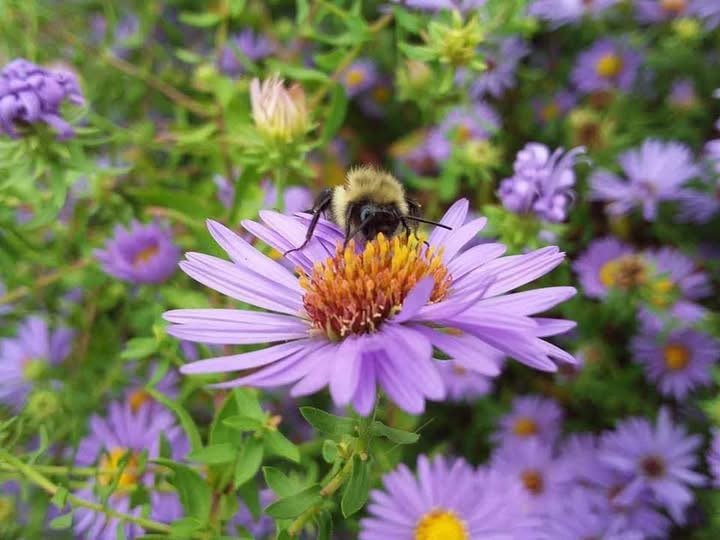


Comments
Post a Comment