Gardening With Purpose: Ontario’s Natural Pest Repellents
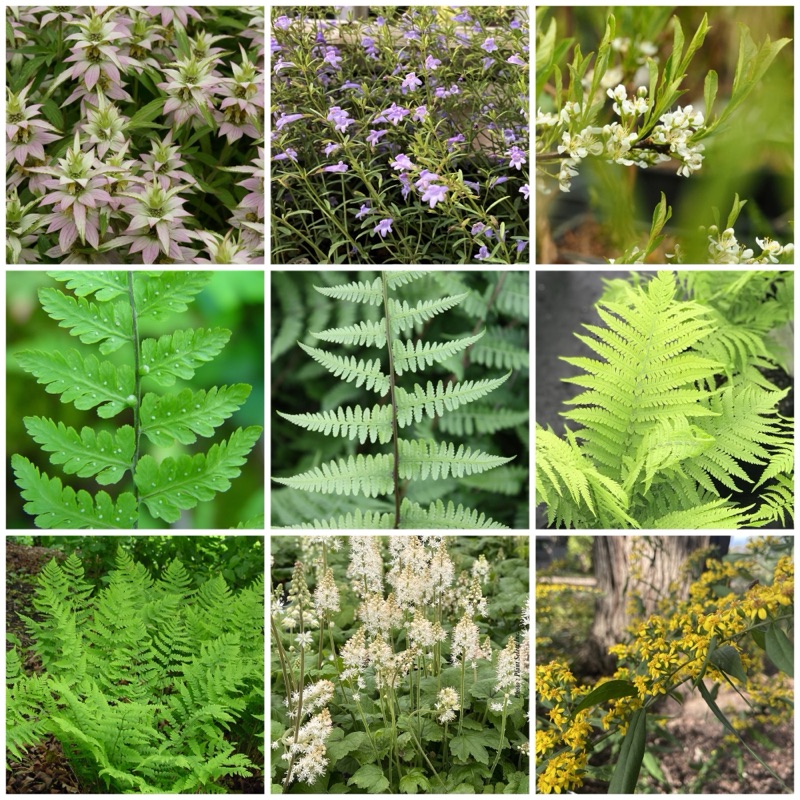
Gardening in Ontario can be a battle against uninvited guests such as aphids, beetles, and other pesky intruders that threaten your hard earned greenery. But nature has its own defense system, and the secret lies in native plants that not only thrive in the local climate but also keep pests at bay. Imagine a garden where vibrant blooms and lush foliage act as natural protectors, reducing the need for chemical pesticides. From fragrant herbs to striking wildflowers, Ontario’s ecosystem offers a range of plants that safeguard your garden while supporting biodiversity. Ready to discover how these natural defenders can transform your outdoor space? Let's dig in!
Spotted Beebalm (Monarda punctata)
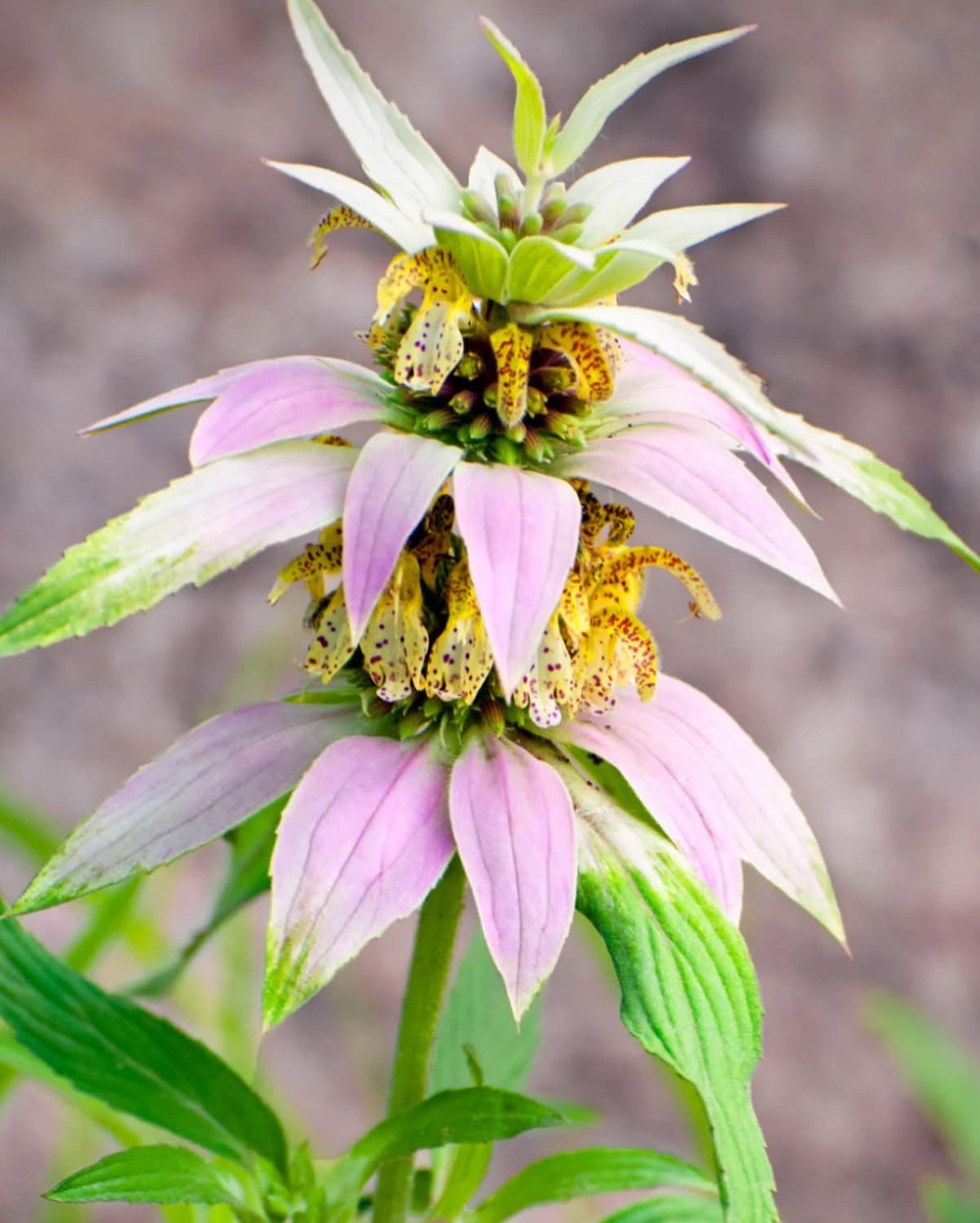 Photo Credits: Glass Gardens by Stacey
Common Name: Spotted Bee Balm
Scientific Name: Monarda punctata
Other Common Names: Horsemint, Dotted Horsemint, Dotted Mint, or Bee Balm.
Genus: Monarda
Native Range: Is native to North America, but specifically The Eastern United States, and parts of Canada. Its range extends from Quebec to Vermont and Florida, and westward to Ontario, Minnesota, Kansas, and New Mexico. This plant is also found throughout the province of Ontario.
Colours: pale yellow, maroon, pink, purple, white, and light green to medium green.
Flower: pagoda - like flower clusters that are typically pale yellow with purple spots, arranged in whorls and are surrounded by showy leaf like bracts that can be pink, lavender, or creamy white in colour.
Foliage: hairy lance - shaped leaves that are mid green in colour which are 10 cm long.
Height: 18 - 24 (45 - 60 cm) inches tall.
Width: 9 - 12 inches (22 - 30 cm) wide.
Bloom Time: Typically blooms from mid summer to early fall, which usually occurs from July through September.
Most Distinctive Feature: it’s unusual flower arrangement.
Moisture Requirements: Consistently moist conditions, but it can tolerate some dry spells. It prefers the area to have moist conditions frequently.
Soil Type: Thrives in sandy soils that have well drained conditions. While it can grow in heavier soils, well-drained, sandy conditions are ideal for optimal growth and health.
Light Exposure: Thrives in full sun, where it requires at least six to eight hours of direct sunlight daily for optimal growth and flowering.
Spread: Moderately spreader where it can spread 3 feet once it reaches maturity.
Host Plant: Yes, Spotted Beebalm is a host plant. It is a host plant for some of our local moth species including the hermit sphinx moth, raspberry pyrausta moth, grey marvel moth, and snout moths.
Wildlife Benefits: The flowers on this plant provides a rich source of nectar for bees, butterflies, hummingbirds, and hummingbird moths.
The plant attracts predatory insects such as parasitic wasps, green lace wings, and lady beetles who prey on garden pests.
The foliage provides a food source for the caterpillars of the hermit sphinx moth, raspberry pyrausta moth, grey marvel moth, and snout moths.
The seeds that this plant produces after flowering provide a food source for birds during the fall and throughout the winter months.
Hardiness Zones: Zones 3 to 9
Season Interest:
Summer 💐 into Fall 🍂
Repels: Deer 🦌, Rabbits 🐇, and Mosquitoes 🦟.
The Spotted Bee Balm (Monarda punctata L.) is a stout native perennial that grows on hairy stems and is a member of The Mint Family.
The leaves are opposite, lance-like, with shallow teeth and a pointed tip. The undersides of the leaves are hairy and paler in color from fine hair. Leaves have short stalks with fine hair, and base of the leaf tapers to the stalk with a wing effect. Smaller leaf growths are frequently seen at the base of the leaf stalk.
The inflorescence consists of dense whorl-like axillary clusters of flower heads that appear above the axils of the upper bracts, but not usually at the top of the stem. These clusters are distinctly separated from each other on the stem. In the mint family this arrangement is called a verticillaster, where the flowers look like a whorl arrangement but are actually in separate cymes that rise from the axils of opposite bracts. Only several of the flowers in each cyme are open at one time. This arrangement is similar to that seen on the Wild Mint.
The flowers are quite conspicuous, the corolla being tubular, 3/4 to 1 inch long, yellowish with purple spots. The upper corolla lip is stiff and strongly arched, the lower lip is broader. Both have hair on the outer surface. The two stamens and style are tucked tightly against the inside of the upper lip and are slightly shorter than the lip and thus do not protrude except when the anthers are with mature pollen at which point the anthers are visible. The calyx tube is green, hairy, with 5 small pointed lobes. Even more conspicuous are the whitish to lilac colored bracts that surround the cyme at its base. These growths look like leaves but are called bracts.
Calamint (Clinopodium arkansanum)
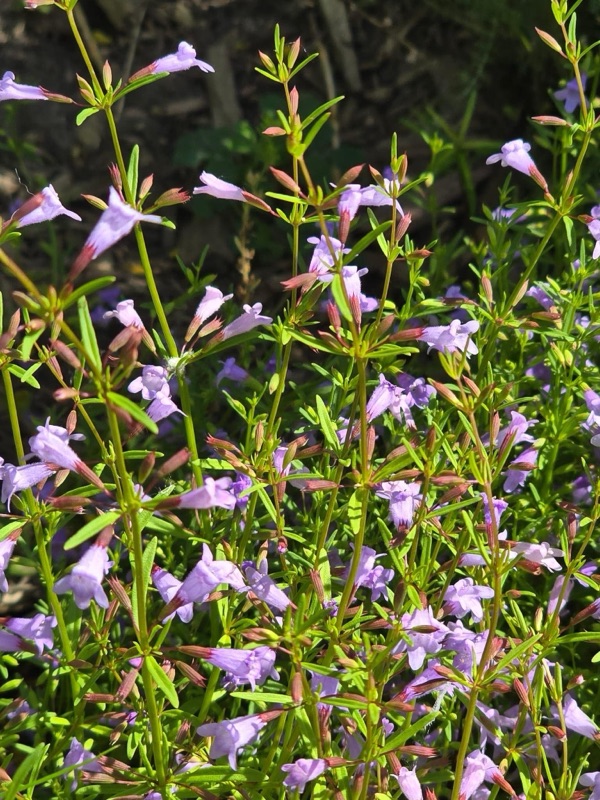 Photo Credits: Karen Blackwell from Ontario Native Plant Gardening Facebook Group.
Common Name: Calamint
Scientific Name: Clinopodium arkansanum
Other Common Names: Lesser Mint, Basil Thyme, Lime - stone Calamint, or Nepitella.
Genus: Clinopodium
Native Range: Central North America and Eastern North America, specifically from Ontario and Minnesota, south to Texas and Arkansas.
Colours: white, lavender, purple, and yellowish green to medium green.
Flower: small lavender to purple flowers that are trumpet shaped.
Foliage: small linear and opposite leaves that are typically 1/2 to 1 inch long. They are smooth along the margins and can have a yellowish - green to medium green in colour.
Height: 12 - 36 inches (30 - 90 cm) tall.
Width: 12 - 36 inches (30 - 90 cm) tall.
Bloom Time: late spring into midsummer
Most Distinctive Feature: It’s aromatic grey green foliage and lavender blue flowers.
Moisture Requirements: consistent moisture during the growing season (every 1 - 2 weeks) is beneficial, especially during dry spells. Avoid overwatering to prevent root rot.
Soil Type: sandy, loamy, and even slightly alkaline soils.
Light Exposure: thrives in full sun ☀️ to partial shade ⛅️.
Spread: spreads slowly by rhizomes, which allows it to form dense mats of foliage.
Host Plant: No, Calamint is not a host plant for native insects and pollinators.
Wildlife Benefits: It attracts a wide range of pollinators including bees, butterflies, and hummingbirds.
Hardiness Zones: Zones 4 to 7
Season Interest:
Summer 💐 into Fall 🍂
Repels: It repels furry visitors such as deer 🦌 and rabbits 🐇. Calamint also repels insects including aphids, spider mites, and potentially other small insects.
The Calamint (Clinopodium arkansanum) is a low growing prolific bloomer that is mound forming.
The leaves are small, green, and fragrant with a a mint-oregano scent. They are arranged oppositely along the stems.
The flowers are tubular often lavender or white, appearing in whorls along the stems. They bloom from early summer to early fall.
Sand Cherry (Prunus pumila)
 Photo Credits: Ontario Native Plants
Common Name: Sand Cherry
Scientific Name: Prunus pumila
Other Common Names: Appalachian Sand Cherry, Susquehana Sand Cherry, Dwarf American Cherry, Western Sand Cherry, Eastern Sand Cherry, or Great Lakes Sand Cherry.
Genus: Prunus
Native Range: Eastern Canada, Central Canada, Southern Canada, and The Northern United States.
Colours: dark green, greyish green, white, black, greyish brown, reddish purple, and dark purple or nearly black.
Flower: small white flowers that typically appear in clusters of 2 - 4, and are about 15 - 25 millimetres in diameter and they have a total of 5 petals.
Foliage: narrow, elliptical, alternate, and tooth leaves that are typically 4 - 7 cm long and 5 - 14 mm wide. They are dark green and glossy on the top side, and then on the bottom they are a paler green colour.
Height: 1 to 6 feet tall
Width: 3 to 10 + feet wide
Bloom Time: May to June
Most Distinctive Feature: Is it’s low, sprawling or prostrate growth habit.
Moisture Requirements: moderate moisture
Soil Type: sandy, loamy, rocky, or even clay soils are suitable for this plant.
Light Exposure: Thrives in full sun ☀️, and generally needs at least 6 - 8 hours of direct sunlight daily for optimal growth.
Spread: spreads rapidly once it is established, where this plant is capable of growing up to 3 feet per year.
Host Plant: Yes, Sandy Cherry is a host plant for several native insect species. It is a host plant for the clearwing hummingbird moth, eastern tiger swallowtail butterfly, red spotted purple butterfly, cecropia moth, polyphemus moth, and promethea moth.
Wildlife Benefits: The flowers provide rich nectar for a variety of native pollinators such as bees, butterflies, hummingbirds, and hummingbird moths.
The foliage of the plant provides a food source for caterpillars of the clearwing hummingbird moth, eastern tiger swallowtail butterfly, red spotted purple butterfly, cecropia moth, polyphemus moth, and promethea moth.
The showy appearance and the dense foliage provides cover and nesting sites for various wildlife species such as songbirds, squirrels , and other wildlife.
The fruit (berries) that this plant produces after the flowering is complete provide a long lasting food source for a variety wildlife including birds, squirrels, chipmunks, and other small mammals.
Hardiness Zones: Zones 3 to 7
Season Interest: Spring 🌸, Summer 💐, Fall 🍂, and Winter ❄️.
Repels: It repels mosquitoes 🦟, aphids, spider mites, and other small insects.
The Sand Cherry (Prunus pumila) is a low growing spreading shrub that is a native species to the province of Ontario and other parts of Canada.
Leaves are simple and alternate, 1½ to 2½ inches long and up to 1 inch wide, the blade narrowly elliptic or widest near the tip (obovate) depending on the variety, with a pointed tip and tapering at the base to a ¼ to ½ inch stalk. The upper surface is dark green and somewhat shiny, the lower surface lighter and smooth. Edges are finely toothed except near the base. Twigs are red to reddish brown, shiny smooth developing a flaky, waxy cuticle. Branches are spreading to ascending from low, sprawling basal stems, the bark grayish brown, smooth becoming roughish with conspicuous horizontal pores (lenticels). Basal stems are about ¾ inch diameter.
Numerous flat to convex clusters from lateral buds along the branches, each cluster a 1 to 3-flowered umbel (stalks all arising from the same point) and emerging before the leaves in spring. Flowers are about ½ inch across with 5 white, round to egg-shaped petals with a single slender style and a spray of slender, white, yellow-tipped stamens in the center.
The 5 sepals are about 1/3 the length of the petals, lance-oblong, rounded at the tip, spreading, with several small glands along the edges near the tip. Inner and outer surfaces are smooth. Flower stalks are slender and hairless.
Fruit is a shiny drupe, reddish purple maturing to nearly black, 1/3 to ½ inch in diameter with a single hard seed inside.
Berry Bladder Fern (Cystopteris bulbifera)
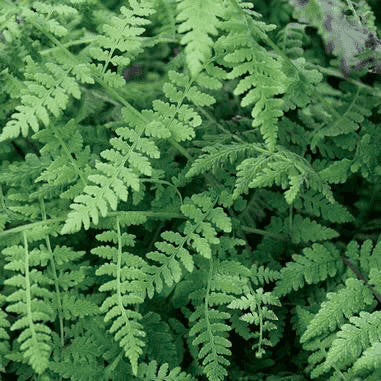 Photo Credits: Natural Communities
Common Name: Berry Bladder Fern
Scientific Name: Cystopteris bulbifera
Other Common Names: Bulblet Bladder Fern, Bulblet Fern, Bulblet Fragile Fern, or Bladder Fern.
Genus: Cystopteris
Native Range: Eastern Canada, Midwestern United States, Eastern United States, Southern United States, and Southwestern United States.
Colours: has distinctive colour changes throughout it’s lifecycle from bright red, light green, and dark green.
Flower: It does not produce any flowers and seeds since this plant is a species of fern.
Foliage: light green, slender, and often drooping fronds, which are long and narrow.
Height: 2 feet tall
Width: 2 feet wide
Bloom Time: There is no bloom time for this plant since it is a species of fern. Instead they reproduce through spores, not by flowering. The spores appear from June to September.
Most Distinctive Feature: Is its ability to reproduce vegetation by producing tiny, bulb like structures (bulblets) on the underside of their fronds, which then detach and grow into new plants.
Moisture Requirements: consistently moist
Consistently moisture is crucial for the thriving of this plant, but waterlogging should be avoided.
Soil Type: It can tolerate a range of soil types including sandy, clay, or loam soils with a neutral to slightly alkaline ph. The soil needs to have good drainage and is well drained, because the plant doesn’t like to be waterlogged.
Light Exposure: low to medium light conditions
Spread: It spreads easily and fast, but this fern species is not aggressive.
Host Plant: It is not a host plant in the traditional sense in providing food for local insects and pollinators.
Wildlife Benefits: Offers wildlife benefits through providing shelter, food, and contributing to a healthy ecosystem.
Berry Bladder Fern provides cover and camouflage for various small animals including insects, spiders, and frogs.
Occasionally fronds of the Berry Bladder Fern provide a food source for some animals including white - tailed deer, rabbits, and turkeys. Additionally, certain insects and their larvae, like the Sensitive Fern Borer, may feed on the plant's stems and fronds.
Hardiness Zones: Zones 3 to 7
Season Interest:
Spring 🌸 through Fall 🍂
Repels: Spider Mites, Aphids, Whiteflies, Mealybugs, Scale Insects, Fungus Gnats, and Slugs.
The Berry Bladder Fern (Cystopteris bulbifera) is deciduous fern that is unique looking, and it is a fern species that is native to the province of Ontario and other parts of Canada.
The compound frond that can be up to 2' long is widest at the base while the tip is long and slender. There are 10-25 pairs of nearly sessile leaflets that have 5-15 pairs of subleaflets up to 6" long. Each leaflet is lanceolate to lanceolate-deltoid. The subleaflets have serrated margins. Sori appear on the fertile fronds on each subleaflet. A round green bulblet may form at the base of some leaflets on the undersides. They may fall to the ground and form a new plant.
Lady Fern (Athyrium filix - femina)
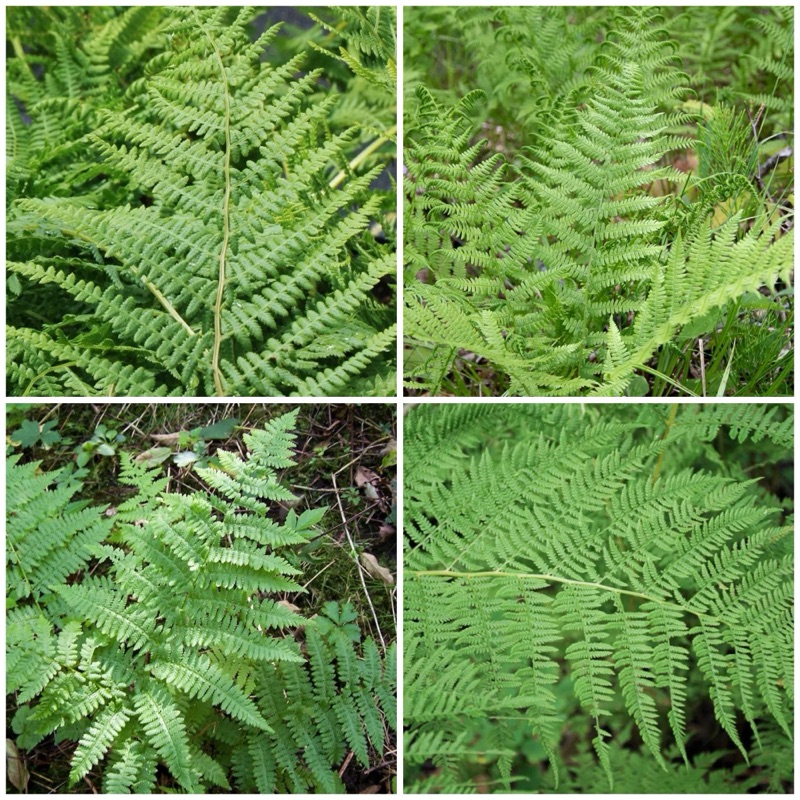 Photo Credits: Prairie Nursery
Common Name: Lady Fern
Scientific Name: Athyrium filix- femina
Other Common Names: Common Lady Fern
Genus: Athyrium
Native Range: It is found across Canada including Quebec, Ontario, and Newfoundland. This species of fern is native to every state in The United States except for Hawaii.
Colours: the colouration changes throughout the different seasons from the summer months into the fall months from a vibrant green during the summer then change to a golden yellow after the first frost.
Flower: It does not produce any flowers or seeds because this plant is a species of fern.
Foliage: lacy, finely divided fronds that are typically bright green and can be quite large in size, with individual fronds reaching up to 3 feet in length and 1 foot in width.
Height: 1 to 3 feet (30 to 90 cm) tall.
Width: 12 to 30 inches (30 to 75 cm) wide.
Bloom Time: It does not have a bloom time in the traditional sense, since this plant is a species of fern where they don’t produce flowers. Lady Fern has fronds that appear in the spring and remain throughout the summer, until the first frost during the fall season.
Most Distinctive Feature: the lance - shaped fronds that are widest in the middle and taper at both ends, giving them a delicate and lacy appearance.
Moisture Requirements: consistently moist conditions
While lady fern needs regular watering to prevent the soil from drying out, they should not be waterlogged.
Soil Type: It can tolerate a range of soil types including clay, loam, or sandy soils that are organically rich and are well drained.
Light Exposure: partial shade ⛅️ to full shade ☁️
Spread: Is know to spread but does not spread aggressively or rapidly. When the fern grows it clump forms where it creates new plants.
Host Plant: Yes, lady fern is a host plant for some local moth species. It is a host plant for the brown angle shades moth, conifer swift moth, and florida fern moth.
Wildlife Benefits: The lady fern fonds provide a food source for grizzly bears, elk, deer, and insects.
The plant’s foliage provide a food source for the caterpillars of the brown angle shades moth, conifer swift moth, and florida fern moth.
The dense foliage of lady fern provides cover for various animals including small mammals, amphibians, and insects protecting them from heat and predators.
The spent stalks of lady fern are used by a variety of bird species especially ground nesting birds for building their nests.
Hardiness Zones: Zones 4 to 8
Season Interest: Spring 🌸, Summer 💐, and Fall 🍂
Repels: Spider Mites, Aphids, Whiteflies, Mealybugs, Scale Insects, Fungus Gnats, Slugs, Deer, and Rabbits.
The Lady Fern (Athyrium filix-femina) is a native species of fern, which is a low growing evergreen plant.
Fiddleheads emerge in early spring.The slender stem is covered in dark brown scales.
Leaf is twice compound, lance-elliptic in outline, broadest at or slightly below the middle, tapering to a point at the tip, 16 to 40 inches long and 4 to 14 inches wide, with 20 to 30 pairs of branches (pinnae). Branches are linear-oblong in outline, gradually tapering to a point, with a minimum of 8 pairs of leaflets (pinnules) in an opposite or alternate formation.
Leaflets have rounded or pointed lobes and tips, rounded or pointed (but not bristly) teeth, and forked veins that do not typically extend quite all the way to the leaflet edge. The opposing lobes at the base of a leaflet are often unequal in size.
Stems are slightly grooved, green to straw colored, darker at the base, with light to dark brown scales scattered on the lower stem. One distinctive form has red stems. Leaves form a circular cluster or asymmetrical clump.
The sori (cluster of spores) develops on the back of the leaf blade in summer and is typically curved to hook-shaped, though is sometimes straight. A translucent tissue (indusium) partly covers the spores and is visible long before the spores develop.
Mature sori are brown. Spores are only present on some leaves; fertile and infertile fronds are indistinguishable from the front though, when sori mature, the leaflet edge can roll around the sori some.
Ostrich Fern (Matteuccia struthiopteris)
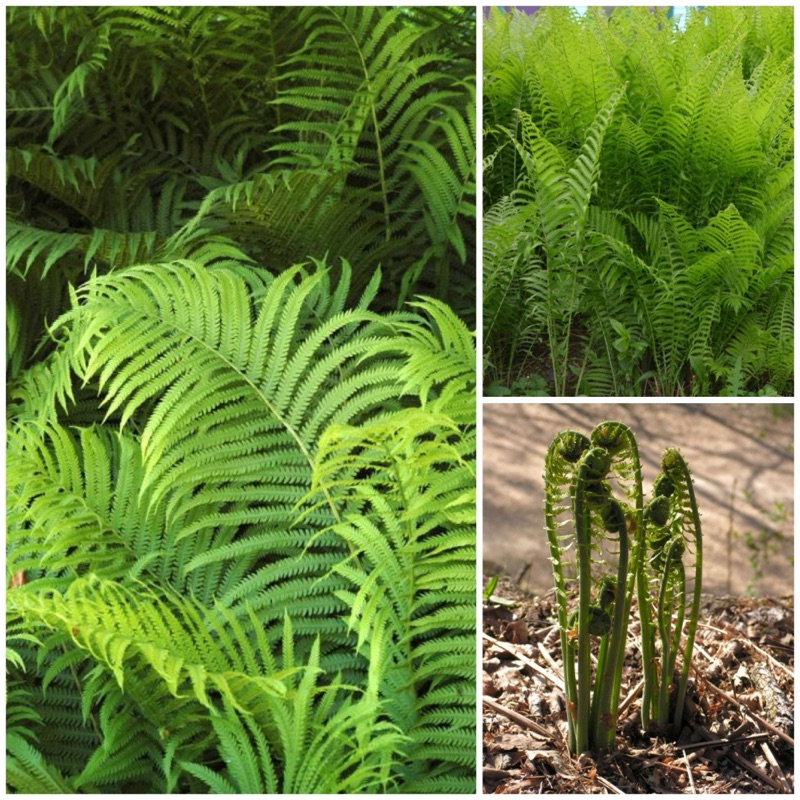 Photo Credits: Prairie Moon Nursery
Common Name: Ostrich Fern
Scientific Name: Matteuccia struthiopteris
Other Common Names: Fiddlehead Fern, Ostrich - Feather Fern, or Shuttlecock Fern.
Genus: Matteuccia
Native Range: Northeastern United States, Canada, Southern Alaska, Europe, and Asia.
Colours: green, bright green, dark green, dark brown, and bronze gold.
Flower: It does not produce any flowers because this plant is a species of fern. This plant reproduces through spores, not seeds like flowering plants.
Foliage: large, arching fronds that resemble ostrich plumes.
Height: Typically reaches a height of 3 - 6 feet (36 - 72 inches) tall.
Width: Typically reaches a width of 3 - 5 feet (36 - 60 inches) wide.
Bloom Time: The Ostrich Fern doesn’t have traditional blooms, since it doesn’t produce any flowers. This plant does produce unique fertile fonds during the summer that persist into winter.
Most Distinctive Feature: it’s large arching fronds that resemble ostrich plumes.
Moisture Requirements: It thrives in consistently moist areas that have good drainage, but they don’t tolerate soggy conditions.
Soil Type: They prefer sandy or clay loam soils as long as moisture and organic matter are sufficient.
Light Exposure: Partial Shade ⛅️ to Full Shade ☁️.
They need to experience 3 hours or less of full sun.
Spread: It is a fast growing and spreading species of fern.
Host Plant: Yes, Ostrich Fern is a host plant to a local moth species. It is a host plant to the Ostrich Fern Borer Moth.
Wildlife Benefits: Ostrich Fern offers several benefits to wildlife including providing habitat, shelter, and food.
The dense fronds of ostrich ferns provide excellent shelter and hiding places for small mammals, amphibians, and ground-dwelling birds, creating microhabitats within the garden.
The emerging fiddleheads and fronds of Ostrich Fern become a food source for some animals that are herbivores.
This species of fern hosts several insect species which provides a food source for birds, frogs, and other insectivores.
Hardiness Zones: Zones 3 through 7
Season Interest:
Spring 🌸, Summer 💐, and Fall 🍂.
Repels: Deer 🦌 and rabbits 🐇
The Ostrich Fern (Matteuccia struthiopteris) is a very showy and upright growing fern that is native to the province of Ontario, other parts of Canada, and other areas in North America.
The fiddleheads (Croziers) are stout and can be confused with those of Interrupted Fern except these do not have the whitish hair of the Interrupted Fern and unlike that fern the emerging fiddleheads of Ostrich Fern are edible and frequently sold commercially.
The sterile fronds are pinnae- with second section -the pinnules- not completely divided). They form a vase shape, tapering toward the base and toward the tip. The lowest pinnae (the branches off the main rachis [stem]) are reduced in size and usually pointing downward which gives this tapered appearance. Fronds are widest in the middle section. Each pinnae is attached alternately to the rachis giving a staggered appearance. There can be 20 to 60 pairs of pinnae with the upper ones slightly ascending. On each pinna there can be 20 to 40 pairs of lobes (pinnules) which are deeply cut, but not completely cut down to the central vein (the costa) of the pinna. These individual pinnules have a very noticeable v-shape vein pattern radiating from the midvein of the pinnule to the margin of the pinnule. These lateral veins do not branch. The rachis can have whitish hairs. The stipe (lower portion of the frond that does not have pinnae) is much shorter than the blade portiond and has brown scales at the base. Both the stipe and the rachis are deeply grooved on one side and rounded on the other but the groove on the rachis does not merge with the central vein on each pinnae costa.
The fertile fronds emerge much later and are much shorter, erect, green initially then turning brown in color with the fertile pinnae having inrolled segments (sori) to enclose the sporangia (spore forming organs) and these fronds have very stiff pinnae. The stipe of a fertile frond is about as long as the blade portion, quite stout and erect, dark in color with brown scales. In summer, these may be obscured by the taller sterile fronds. Like the Sensitive Fern, these fertile fronds will persist through the winter, providing landscape interest, and release their spores in the spring before the new fronds form.
The sori (which contain the spores) are on the margins of the fertile pinnae. The pinnae curl around the sori, enclosing them and forming a shape somewhat resembling a curved pea-pod about 2 inches long. These overwinter and break open in the spring to release the spores. Release is prior to the new sterile fronds unfolding. Spores germinate in 2 to 5 days.
Marginal Wood Fern (Dryopteris marginalis)
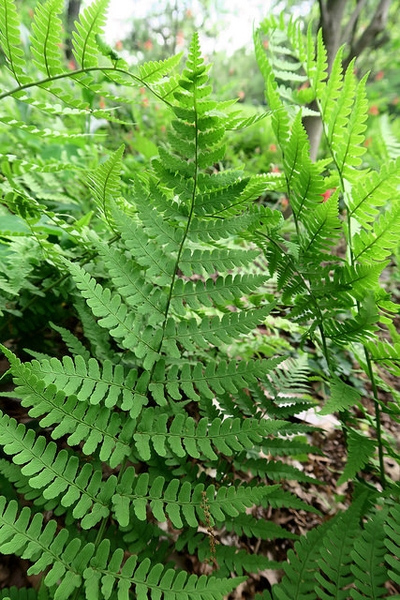 Photo Credits: Kristine Paulus
Common Name: Marginal Wood Fern
Scientific Name: Dryopteris marginalis
Other Common Names: Marginal Shield Fern, Evergreen Wood Fern, Leather Wood Fern, or Leather - leaf Fern.
Genus: Dryopteris
Native Range: Newfoundland, New Brunswick, Nova Scotia, Prince Edward Island, Quebec, Ontario, Georgia, Texas, Minnesota, Eastern Kansas, Connecticut, Maine, New Hampshire, Rode Island, Vermont, and Massachusetts.
Colours: golden brown, dark blue - green, light green, and green.
Flower: It does not produce any flowers because this plant is a species of fern. This plant reproduces through spores, not seeds like flowering plants.
Foliage: evergreen, leathery, and blue false- green fronds that form a neat, vase - shaped clump.
Height: Typically reaches a height of 1 to 3 feet (12 - 36 inches) tall.
Width: Typically reaches a width of 1 to 3 feet (12 - 36 inches) wide.
Bloom Time: It does not have a bloom time in the traditional sense, but it does however puts on a show and has foliage that provides year round interest.
Most Distinctive Feature: Is the location of its sori, which are the spore producing structures. They are found at the margins (edges) of the leaflets on the underside of the fronds.
Moisture Requirements: consistently moist conditions
While it appreciates consistent moisture, it's not overly demanding and can adapt to different types of moisture conditions, and the occasional dryness.
Soil Type: loamy, sandy, or gravelly soil that is rich in organic matter and slightly acidic which has good drainage.
Light Exposure: Partial Shade ⛅️ to Full Shade ☁️.
Prefers dappled sunlight or locations with limited direct sun exposure.
Spread: slow spreader
Host Plant: Yes, the Marginal Wood Fern is a host plant to three local moth species. It is a host plant for the Ghostly Fern Moth, Marsh Fern Moth, and Conifer Swift Moth.
Wildlife Benefits:
The foliage provides a food source for caterpillars of local moth species including the ghostly fern moth, marsh fern moth, and conifer swift moth.
The fern provides year-round cover for small animals like toads and lizards. The arching fronds can offer protection from predators and harsh weather.
Various species of local songbirds incorporate parts of Marginal Wood Fern into their nests.
The Marginal Wood Fern contributes to the overall habitat structure of woodland and rocky areas, providing shelter and potential food sources for a variety of wildlife.
Hardiness Zones: Zones 3 through 8
Season Interest: Spring 🌸, Summer 💐, Fall 🍂, and Winter ❄️.
Repels: Deer, Rabbits, Groundhogs, and Squirrels.
The Marginal Wood Fern (Dryopteris marginalis) is a herbaceous perennial ground cover fern that is broadleaf evergreen.
The fronds are bluish green to dull olive green arching in a vase shape. They rapidly taper to a point. The blade is lance-shaped, bipinnate to bipinnate-pinnatified and leathery. The pinna are lance-shaped and rapidly taper to a point. The pinnules are heavy veined and have a blunt tip. The sori are located very near the margin of the pinnules. The stipe is one fourth to one third the frond length. The stipe is swollen at base and covered with golden brown scales. Provides winter interest.
Foam Flower (Tiarella cordifolia)
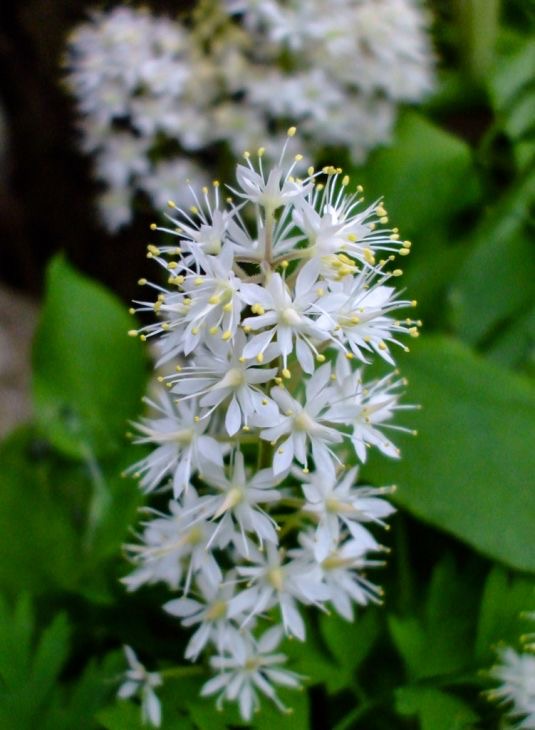 Photo Credits: Prairie Moon Nursery
Common Name: Foam Flower
Scientific Name: Tiarella cordifolia
Other Common Names: Coolwort, False Mitrewort, White Coolwort, Heart - leaf Foamflower, or Clumping Foamflower.
Genus: Tiarella
Native Range: Nova Scotia, New Brunswick, Quebec, Ontario, Connecticut, Georgia, Kentucky, Massachusetts, Maryland, Maine, Michigan, Minnesota, North Carolina, New Hampshire, New Jersey, New York, Ohio, Pennsylvania, Rhode Island, South Carolina, Tennessee, Virginia, Vermont, Wisconsin, and West Virginia.
Colours: white, pink, green, red, and bronze.
Flower: delicate, and frothy white or pale pink that resemble foam.
Foliage: heart - shaped or maple - shaped leaves that are typically with 3 - 5 lobes. The leaves are green in colour during the growing season, but they turn to a reddish bronze hue during the fall.
Height: Typically reaches 6 to 12 inches (1/2 foot to 1 foot) tall.
Width: Typically reaches 12 to 24 inches (1 foot to 2 feet) wide.
Bloom Time: Typically blooms from late spring to early summer which usually is from May to June.
Most Distinctive Feature: Is their delicate, frothy, and feathery flower clusters which resemble foam on a stick.
Moisture Requirements: consistently moist conditions, but not soggy conditions.
Foam flower likes the area to retain moisture, but doesn’t like to be waterlogged.
Soil Type: clay, loam, or clay loam soils that are rich in organic matter and are slightly acidic that have good drainage.
Light Exposure: Partial Shade ⛅️ to Full Shade ☁️.
Prefers to be planted in a location that has dappled sunlight and has a good amount of shade.
Spread: slow spreading plant
Host Plant: No, Foam Flower is not a host plant to local butterflies, moths, and other beneficial insects.
Wildlife Benefits: They attract pollinators like bees and butterflies with their early blooming flowers.
The dense growth habitat of this plant provides shelter and habitat for small animals and insects.
The seeds that the plant produces after the flowering has finished provide a food source for some ground feeding birds such as sparrows, juncos, and finches.
Hardiness Zones: Zones 3 through 7
Season Interest: Spring 🌸, Summer 💐, and Fall 🍂.
Repels: Deer 🦌 and Rabbits 🐇
The Foam Flower (Tiarella cordifolia) is an erect perennial forb that has a flowering stem that grows up to 14 inches high.
The leaves are basal, heart shape at the base, with an acute tip and then with 5 to 7 palmately divided shallow lobes. The leaf stalks have glandular hair, some dense. The leaf surfaces usually have hair along the veins. The upper surface is a dark green, sometimes with purplish-brown mottling, the underside is much paler in colour. Leaves on the flowering stem are absent or reduced to 1 smaller leaf.
The inflorescence is an upright raceme of 5 to 70 stalked flowers rising above the basal leaves. It is hairy like the leaf stalks.
The flowers are 5-parted with a bell shaped hypanthium, 5 whitish petals that are ovate to lanceolate in shape, tips 3-toothed and a narrowed clawed base.
The five sepals are of the same color but sometimes more pinkish while the petals remain white. These are spreading outward in flower and reflexed back in the fruiting state.
The lobes of the calyx (the sepals) and the flower stalk are hairy. There are 10 very conspicuous stamens with white linear filaments and yellow oval anthers, two styles. Styles and stamens are well exserted from the calyx making a feathery or 'foamy' appearance.
The fertile flowers produce a 2-valved (chambered) seed capsule that is winged. One of the valves is 1.5 to 2x longer than the other. They contain 4 to 15 shiny black ellipsoid shaped seeds. The wings on the capsule allow for the wind to shake and disperse the seeds when the capsule splits apart along the inside seam.
Bluestem Goldenrod (Solidago caesia)
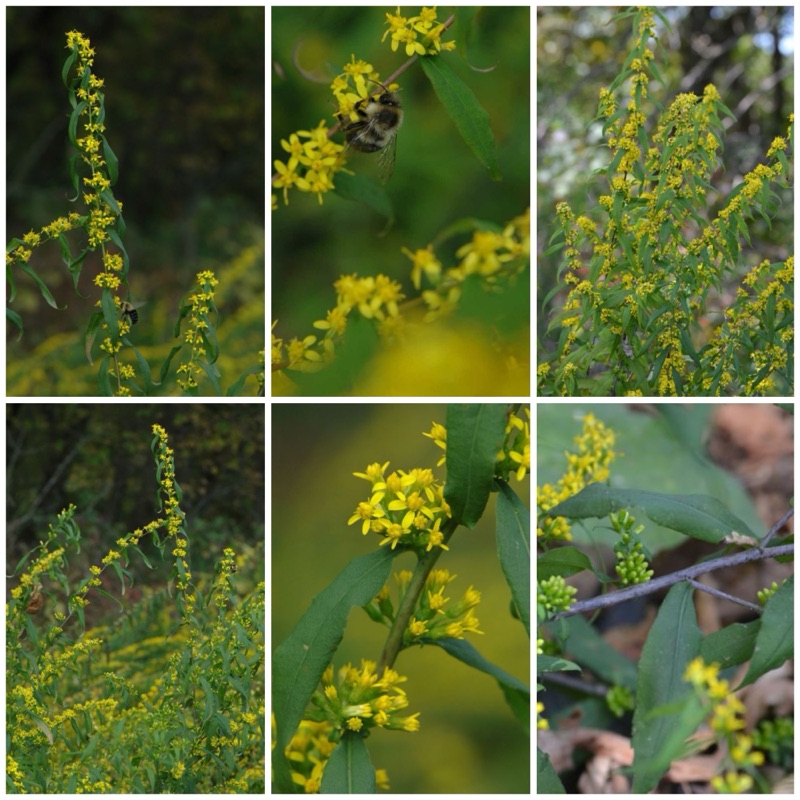 Photo Credits: Prairie Moon Nursery
Common Name: Bluestem Goldenrod
Scientific Name: Solidago caesia
Other Common Names: Blue - stemmed Goldenrod, Wreath Goldenrod, or Woodland Goldenrod.
Genus: Solidago
Native Range: Ontario, Quebec, New Brunswick, Alabama, Arkansas, Connecticut, Delaware, Florida, Georgia, Illinois, Indiana, Kentucky, Louisiana, Massachusetts, Maryland, Maine, Michigan, Missouri, Mississippi, North Carolina, New Hampshire, New Jersey, New York, Ohio, Oklahoma, Pennsylvania, Rode Island, South Carolina, Tennessee, Texas, Virginia, Vermont, Wisconsin, and West Virginia.
Colours: bright yellow, green, and bluish purple or greenish purple.
Flower: small flower clusters that are bright yellow in colour, that emerge from the leaf axils along the stem and at the tip.
Foliage: alternate, and lance - shaped leaves that are medium green in colour, and are toothed as well as sharply pointed.
Height: Typically reaches a height of 2 - 4 feet (60 - 120 cm) tall.
Width: Typically reaches a width of 1 to 2 feet (30 - 60 cm) wide.
Bloom Time: Typically from late summer into fall, which is usually from August to October.
Most Distinctive Feature: Is their smooth arching stems that often have a bluish or purplish hue due to a whitish waxy coating.
Moisture Requirements: moist to dry conditions.
Soil Type: sand, loam, or clay soils that are well drained.
Light Exposure: Full Sun ☀️ to Partial Shade ⛅️.
It prefers to be in an area that has partial shade, especially if it is in a hotter climate. This species of goldenrod can tolerate full sun, but but may require more supplemental watering in those conditions. Morning sun is generally better tolerated than intense afternoon sun.
Spread: slow spreading plant
Host Plant:Yes, Bluestem Goldenrod is a host plant for a few local moth species. It is a host plant for the Goldenrod hooded Owlet Moth, Brown hooded Owlet Moth, Wavy - lined Emerald Moth, Bilobed dichomeris Moth, and Isabella Tiger Moth.
Wildlife Benefits: It serves as a host plant for the Goldenrod hooded Owlet Moth, Brown hooded Owlet Moth, Wavy - lined Emerald Moth, Bilobed dichomeris Moth, and Isabella Tiger Moth.
The flowers of Bluestem Goldenrod are rich in nectar and pollen making them attractive to a wide variety of of pollinators which includes honeybees, native bees, wasps, flies, beetles, and butterflies.
This plant attracts beneficial insects that are predatory insects such as fireflies, green lacewings, parasitic wasps, and dragonflies where they will feed on the garden pests that are on Bluestem Goldenrod.
The Bluestem Goldenrod provides critical late season nectar for migratory butterflies such as the monarch, painted lady, and american lady.
The seeds of Bluestem Goldenrod provide an excellent food source for songbirds including juncos, goldfinches, pine siskins, cardinals, baltimore orioles, sparrows, nuthatches, and chickadees.
Hardiness Zones: Zones 3 through 7
Season Interest: late summer 🌻 and fall 🍂.
Repels: Deer 🦌 and Rabbits 🐇
The Blue Stem Goldenrod (Solidago caesia) is a herbaceous perennial wildflower that is deciduous and has a clump forming habitat.
Scattered clusters of tiny yellow flowers with 3-5 rays form in axils of leaves along the length of the stem with terminal clusters being the largest.
Blue to purple stem; 2-5 in. smooth, slender, stalkless, toothed, sharply pointed lance-shaped leaves with feather veins; tapers at both ends.
Hop Tree (Ptelea trifoliata)
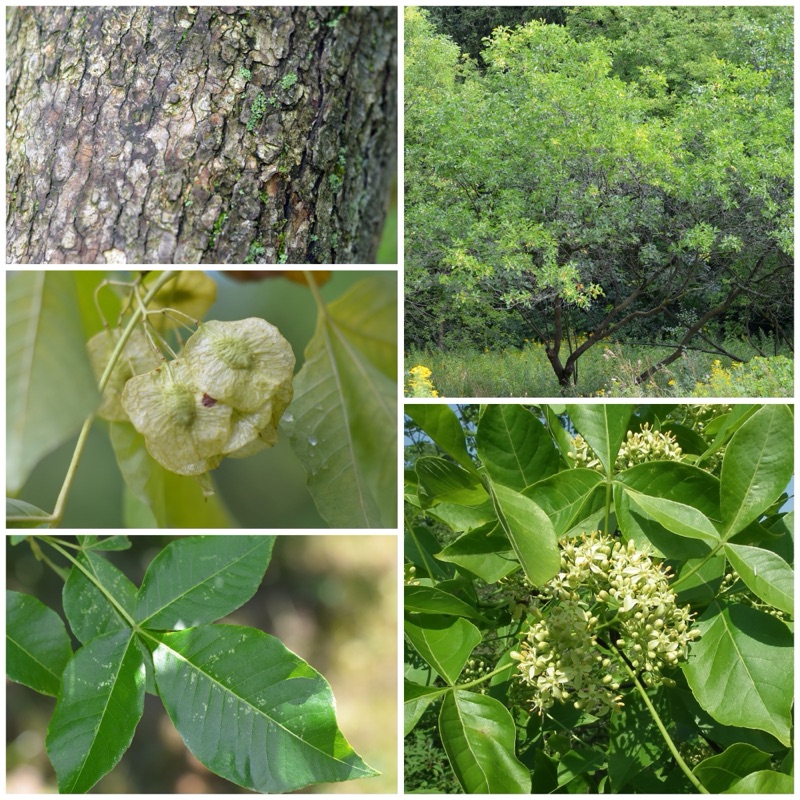 Photo Credits: Ontario.ca
Common Name: Hop Tree
Scientific Name:Ptelea trifoliata
Other Common Names: Common Hop Tree, Wafer - ash, Stinking Ash, Shrubby trefoil, Prickaway - anise, Quinine Tree, Sang - Tree, or Swamp Dogwood.
Genus: Ptelea
Native Range: Southern Ontario, Quebec, Eastern United States, Southwestern United States, and Mexico.
Colours: reddish brown, grey brown, dark green, pale green, rusty yellow, and greenish white.
Flower: small greenish - white that appear in clusters at the tips of branches.
Foliage: alternate and compound leaves where each leaf has three leaflets. The leaves are glossy dark green on the upper surface, and on the bottom surface they are more pale green in colour.
Height: Typically reaches a height of 15 - 20 feet (180 - 240 inches) tall.
Width: Typically reaches a width of 15 - 20 feet (180 - 240 inches) wide.
Bloom Time: Late spring to early summer, which usually occurs during the first two weeks of June.
Most Distinctive Feature: Is their trifoliate leaves
Moisture Requirements:moist to dry conditions.
Soil Type: sandy, loam, or clay soils that are slightly acidic or alkaline that have good drainage.
Light Exposure: Full Sun ☀️ to Partial Shade ⛅️.
Spread: slow to medium spreader
Host Plant: Yes, the Hop Tree is a host plant to a local butterfly species. It is a host plant for the Giant Swallowtail Butterfly.
Wildlife Benefits: The tree’s flowers provide nectar for various insects such as bees, butterflies, and flies.
It is a host plant for the Giant Swallowtail Butterfly where the females of this butterfly species lay their eggs on the leaves, and the caterpillars of this butterfly species feed on the foliage of this tree.
The fruit and seeds of the Hop Tree provide an excellent food source for birds and small mammals.
Hardiness Zones: Zones 4a through 7
Season Interest: Spring 🌸, Summer 💐, and Fall 🍂.
Repels: Deer 🦌
The Hop Tree (Ptelea trifoliata) is an aromatic shrub that can grow into a small tree with a rounded crown. It can also be shrubby with multiple stems. Crushed twigs and foliage produce an unpleasant odour.
The bark is a thin brownish-grey to reddish-brown in colour, smooth to slightly scaly, with horizontal lenticels and with warty corky ridges on larger trunks.
The twigs are a lighter brown, covered with fine hair, with short fuzzy buds and U-shaped leaf scars.
The leaves are are alternate and palmately compound with 3 leaflets on a long leaf stalk. The individual leaflets are ovate to elliptical in shape, 2 to 4 inches long, the lateral leaflets without stalks, the terminal leaflet on a short stalk, shiny blue-green above, paler below, either with smooth margins or slightly toothed. The undersides are marked with little gland dots which produce the chemical giving off the aromatics. Fall colour is yellow.
The flowers are male, female, and sometimes perfect, and appear in the spring in terminal compound clusters (cymes), each stalked flower 1/4 to 1/2 inch wide with 4 or 5 narrow greenish-white hairy petals, 4 to 5 stamens on the male flowers. The sepals are much shorter than the petals. Female flowers have a single flattened pistil. Flowers also have an unpleasant odour.
Flowers mature in summer into drooping clusters of one inch wide, light brown, round samaras that are wafer thin, hence the old common name of 'wafer-ash'. The samara contains 2 to 3 brown seeds which are surrounded by the thin rounded wing that shows many reticulated membranes. These remain on the tree into winter which helps with identification of this tree. The samaras have the odour of hops.
Kentucky Coffee Tree (Gymnocladus dioicus)
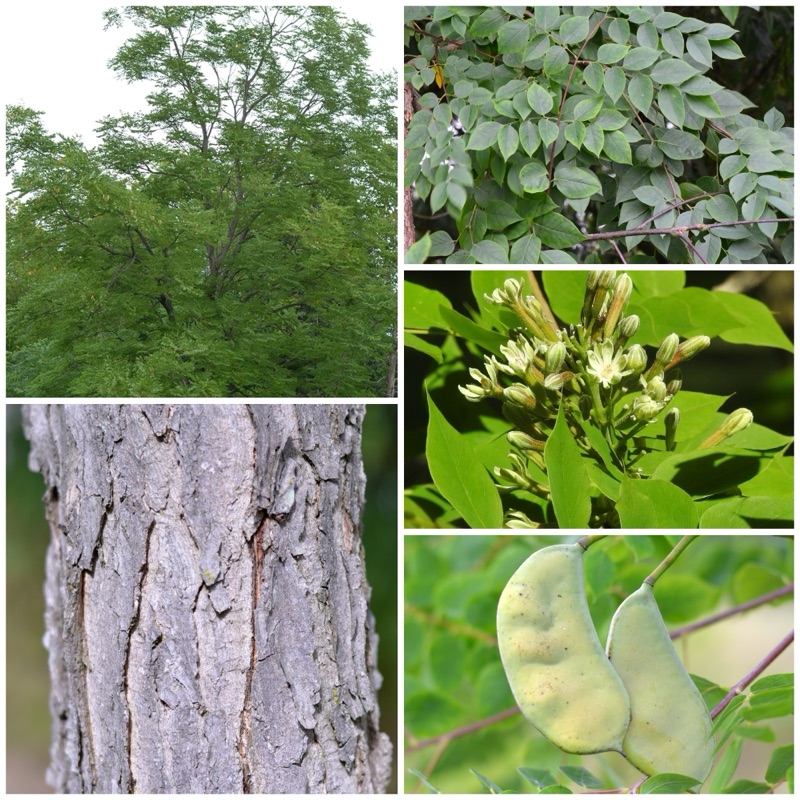 Photo Credits: Ontario.ca
Common Name:Kentucky Coffee Tree
Scientific Name:Gymnocladus dioicus
Other Common Names: Kentucky Mahogany, Mahogany Bean, Chicot, Nicker Tree, Stump Tree, Nettle Tree, Antler Tree, or American Coffee Berry.
Genus: Gymnocladus
Native Range: Southern Ontario, Eastern United States, Central United States, and The Southern Great Lakes Regions.
Colours: pinkish - brown hue, blue - green, bright yellow, brown, greenish - white, and reddish brown.
Flower: greenish white flowers that grow in clusters at the end of branches.
Foliage: large, and bi - pinnately compound leaves that are blueish green in colour during the summer and then change to a vibrant yellow in the fall.
Height: Typically reaches a height of 60 - 80 feet (18 - 24 meters) tall.
Width: Typically reaches a width of 40 - 50 feet (12 - 15 meters) wide.
Bloom Time: Typically the bloom time is from late spring to early summer, which usually occurs from late May to June.
Most Distinctive Feature: Is its large, coarse, and deeply furrowed bark.
Moisture Requirements: moist to dry conditions that have good drainage.
Soil Type: loamy, sandy, or clay soils that are slightly acidic or alkaline and are well drained.
Light Exposure: Full Sun ☀️
Spread: slow to medium spreading tree
Host Plant: Yes, the Kentucky Coffee Tree is a host plant to three local moth species. It is a host plant for the Bicoloured Honey locust Moth, Bisected Honey locust Moth, and White - marked Tussock Moth.
Wildlife Benefits: It acts as a host plant for the Bicoloured Honey locust Moth, Bisected Honey locust Moth, and White - marked Tussock Moth.
The tree’s flowers attract pollinators such as bumblebees, digger bees, butterflies, and hummingbirds.
The dense foliage and the branches of the Kentucky Coffee Tree provide nesting sites for various bird species and small animals.
Hardiness Zones: Zones 3 through 5
Season Interest: Spring 🌸, Summer 💐, Fall 🍂, and Winter ❄️.
Repels: Deer, Rabbits, Groundhogs, Bears, and some Insects.
The Kentucky Coffee Tree (Gymnocladus dioicus) is a woody perennial tree.
Loose clusters of stalked flowers at branch tips, with male and female flowers on separate trees, though some trees can have perfect flowers (both male and female parts). Male clusters tend to be shorter with fewer flowers, females up to 7½ inches long with 25 to 50 flowers. Flowers are greenish white, ½ to 5/8 inch across with 5 narrow, oblong petals alternating with 5 sepals that are narrower than and about as long as the petals. In the center is a column about half as long as the petals, containing 10 stamens and/or a single style depending on the sex of the flower.
The calyx tube (hypanthium) at the base of a flower is about ½ inch long, green to dark purplish. Surfaces of petals, sepals and the calyx tube are densely covered in short hairs. Flower stalks are up to 1 inch long, hairless, stiff and erect.
Leaves are alternate, twice compound, up to 3 feet long and 2 feet wide with 5 to 9 pairs of pinnae (branches), each with 3 to 7 pairs of leaflets. Often at the base of the compound leaf are 1 or 2 pair of opposite leaflets that are larger than the pinnae leaflets. Leaflets are mostly egg-shaped, tapering to a pointed tip and rounded at the base, 1½ to 3½ inches long, ¾ to 1½ inches wide, toothless, the edges smooth or with a fine fringe of hairs. Upper surfaces are smooth or with scattered hairs, the lower surface hairy along the main veins. Leaflet stalks are about 1/8 inch long and smooth to hairy. Fall colour is a deep gold.
Young twigs are brown, hairless with light brown to orange lenticels (pores), stout and knobby, the main leaf stalks of the previous season often persisting in winter, giving branches a finer twiggy appearance.
Branches become dull gray or gray-brown, the bark coarsely textured with shallow fissures and scaly plates. The trunk can reach 24 inches in diameter at breast height.
Fruit is a large, leathery, flattened pod up to 6 inches long and 1½ inches wide, green in summer drying to purplish brown.
Inside are dark brown seeds surrounded by a sticky pulp. Seeds are smooth and very hard, oval but somewhat flattened, 3/8 to ½ inch long and about 5/8 inch diameter.
Marsh Marigold (Caltha palustris)
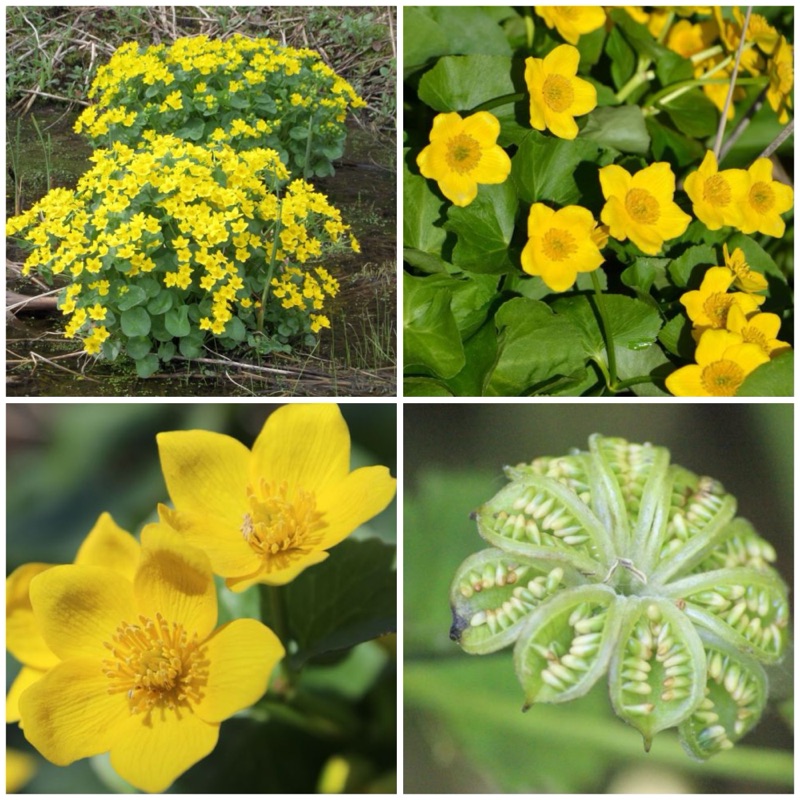 Photo Credits: Prairie Moon Nursery
Common Name: Marsh Marigold
Scientific Name:Caltha palustris
Other Common Names: Cowslip, Kingcup, Water Gowan, and Yellow Marsh Marigold.
Genus: Caltha
Native Range: In Canada it is found in Newfoundland to Alaska, and all of the provinces and territories.
In The United States it is found in Connecticut, Delaware, Iowa, Illinois, Indiana, Kentucky, Massachusetts, Maryland, Maine, Michigan, Minnesota, Missouri, Montana, North Carolina, North Dakota, Nebraska, New Hampshire, New Jersey, New York, Ohio, Oregon, Pennsylvania, Rhode Island, South Dakota, Tennessee, Virginia, Vermont, Wisconsin, and West Virginia.
Marsh Marigold is also found in Europe and Asia.
Colours: bright yellow and dark green.
Flower: small, vibrant or bright yellow buttercup like flowers that consist of 5 to 9 petals.
Foliage: shiny, round or kidney shaped dark green leaves.
Height:Typically reaches a height of 12 - 18 inches (30 - 45 cm) tall.
Width: Typically reaches a width of 12 - 24 inches (30 - 61 cm) wide.
Bloom Time: Mid April to Mid May
Most Distinctive Feature: Is their bright yellow petal like sepals that make up their showy flowers.
Moisture Requirements:consistently moist to wet conditions
Marsh Marigold needs an area that is constantly moist to wet conditions , because it grows best in those conditions.
Soil Type: sandy loam, loam, clay, or clay loam soils that are rich in organic matter and are constantly moist or wet.
Marsh Marigold loves soils that are boggy.
Light Exposure: Full Sun ☀️ to Partial Sun ⛅️
Spread: slow spreader
Host Plant: Yes, Marsh Marigold is a host plant for a local butterfly species. It is a host plant for the Baltimore Checkerspot Butterfly.
Wildlife Benefits: It’s early blooming bright yellow flowers are a valuable source of nectar and pollen for various pollinators such as bees, flies, and butterflies.
The females of the Baltimore Checkerspot Butterfly lay their eggs on the foliage, and the foliage provides a food source for the caterpillars of this butterfly.
The seeds that this plant produces once the flowering is finished provide an excellent food source for small mammals and waterfowl.
The plant’s foliage provides shelter for frogs and other small creatures.
Hardiness Zones: Zones 3 through 7
Season Interest: spring and early summer
Repels: aphids, certain beetles, deer, and rabbits.
The Marsh Marigold (Caltha palustris) is a perennial wildflower that is native to North America including the province of Ontario, other parts of Canada, and The United States.
2 to 5 flowers on stout naked stalks at the ends of branching stems, usually rising a bit above the leaves. Flowers are bright yellow, 1 to 1½ inches across with 5 to 9 (usually 5) rounded petal-like sepals with distinct veins radiating from the base. In the center is a ring of numerous yellow stamens.
Leaves are mostly basal, mostly round to kidney shaped and deeply heart-shaped at the base, up to 4 inches long, on stalks 2 to 6 inches long. Leaf edges may be toothless but are more often scalloped. The few stem leaves are alternately attached, usually smaller than the basal leaves and less deeply cleft at the base, becoming stalkless as they ascend the stem. Stems are hairless, hollow and much branched. Plants tend to grow in clumps.
The Fruit is a curved capsule called a follicle, about 3/8 inch long, initially green and erect, spreading out as they mature, drying to light greenish brown and eventually splitting open to release the numerous seeds.
Michigan Lily (Lilium michiganense)
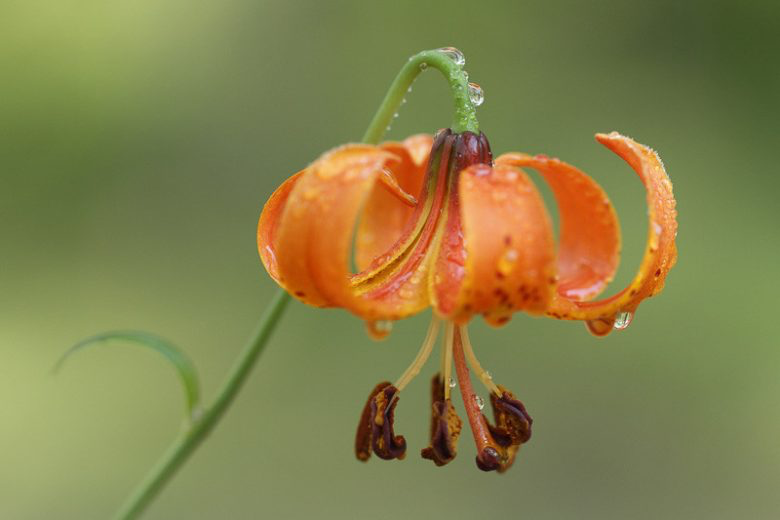 Photo Credits: Brian Lasenby, Shutterstock
Common Name: Michigan Lily
Scientific Name:Lillium michiganense
Other Common Names: Turk’s Cap Lily or Turk’s Lily
Genus: Lillium
Native Range: In Canada it is only found in the province of Ontario.
For The United States this lily is found in Alabama, Arkansas, Iowa, Illinois, Indiana, Kansas, Kentucky, Michigan, Minnesota, Missouri, Mississippi, Nebraska, New York, Ohio, Oklahoma, Pennsylvania, South Dakota, Tennessee, and Wisconsin.
It is also found in the southeastern part of New Hampshire.
Colours: orangish red, deep orange, purplish brown, yellowish orange, medium green, and light medium green or whitish green.
Flower: Bright orange red flowers with backward curving petals that are often spotted with maroon or purple which can reach up to 3 inches wide in length.
Foliage: Narrowly elliptic to sword shaped leaves arranged in whorls around the stem. The leaves can reach up to 6 inches long and 1 inch wide.
Height:Typically reaches a height of 3 - 6 feet (90 - 180 cm) tall.
Width: Typically reaches a width of 1 - 2 feet (30 - 60 cm) wide.
Bloom Time:Late June through July
Most Distinctive Feature: Is their strongly recurved orange red petals with dark spots, in which is resembling a Turk’s cap.
Moisture Requirements:consistently moist conditions
Michigan Lily loves an area that is well moist, but does not like to be waterlogged.
Soil Type: Prefers loam soil that is rich in organic matter and is well drained.
Light Exposure: Full Sun ☀️ to Part Shade ⛅️
Michigan Lily needs at least 6 to 8 hours of direct sunlight daily for optimal growth and flowering. Reduced sunlight can lead to weaker stems and fewer blooms.
Spread: slow spreader
Host Plant: Yes, the Michigan Lily is a host plant for three local insects. It is a host plant for the Burdock Borer, Golden Borer Moth, and Lily leaf Beetle.
Wildlife Benefits: The flowers provide both nectar and pollen for local pollinators such as hummingbirds, butterflies, sphinx moths, hummingbird moths, and bees.
The foliage provides food for deer, rabbits, cattle, and horses where they tend to graze at the leaves of this plant.
The females of the Burdock Borer Moth and Golden Borer Moth lay their eggs on the foliage, then the foliage provides a food source for the caterpillars of these moth species. The foliage also provides a food source for the Lily Leaf Beetle.
Hardiness Zones: Zones 3 through 7
Season Interest: summer
Repels: Japanese Beetles, some other beetles, and Chipmunks.
The Michigan Lily (Lilium michiganense) is a perennial wildflower that is native to the province of Ontario in Canada, and some parts of The United States.
One to 11 nodding flowers in a whorl at the top of the stem, each flower at the end of a long ascending stalk, often also arising from leaf axils on the upper stem. Flowers are 2½ to 3 inches diameter with 6 petal-like tepals that strongly curve back, the color ranging from yellow-orange to deep red-orange, with numerous purplish-brown spots. 6 long brown-tipped stamens and a long reddish style extend from the flower throat and flare out.
Leaves are whorled in groups of 3 to 13, up to 6 inches (5 to 15 cm) long, up to ~1 inch (6 to 22 mm) wide, narrowly elliptic to sword-like, tapering to a pointed tip, hairless, toothless, stalkless, with prominent parallel veins that are roughened on the underside. Stems are erect, unbranched, and smooth.
Flower stalks quickly become erect after pollination. Fruit is a 3-valved capsule up to 2 inches (2.8 to 5 cm) long, cylindric to broadly club-shaped at maturity and containing many seeds.
Mountain Mint (Pycnanthemum virginianum)
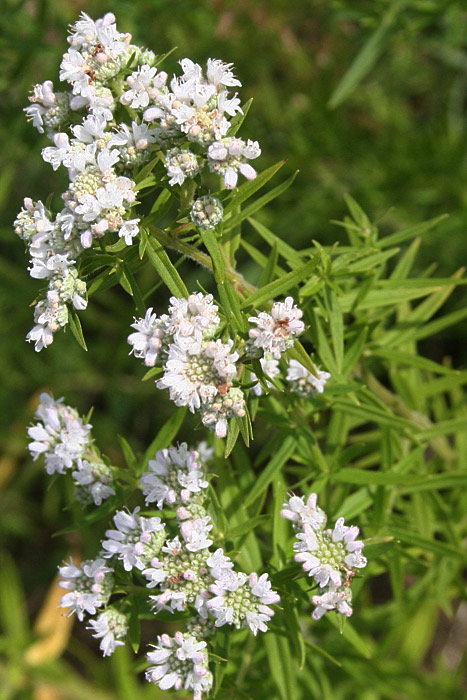 Photo Credits: Wildflower Farm
Common Name:Mountain Mint
Scientific Name:Pycnanthemum virginianum
Other Common Names: American Mountain Mint or Common Mountain Mint.
Genus:
Pycnanthemum
Native Range: In Canada it is only found in the province of Ontario.
For The United States it is found in Maine,Georgia,Wisconsin, Iowa, eastern Kansas, and eastern Texas,
Colours: white, purple, greyish green, greenish grey, green, and red.
Flower:Small tubular flowers that are white in colour but often have spots or speckles that are purple in colour.
Foliage: Narrow and have a slightly fuzzy or hairy texture that is greyish green or greenish grey in colour.
Height:Typically reaches a height of 2 to 3 feet (60 - 90 cm) tall.
Width: Typically reaches a width of 1 to 1.5 feet (30 - 45 cm) wide.
Bloom Time:Typically is from mid summer to early fall, which usually occurs from July to September.
Most Distinctive Feature: Is their very narrow toothless leaves, the minty odour that comes from the plant, and the clusters of small white flowers that form at the stem tips.
Moisture Requirements:moist to average conditions
Soil Type: sandy, loamy, or clay soils that are moist.
Light Exposure: Full Sun ☀️ to Part Shade ⛅️
Spread:slow spreader
Host Plant: Yes, the Mountain Mint is a host plant for three local insect species. It is a host plant for the Grey Hairstreak Butterfly, Wavy - lined Emerald Moth, and Wedge shaped Beetle larvae.
Wildlife Benefits: Its dense clusters of white flowers provide a rich source of nectar and pollen for local pollinators such as bumblebees, small solitary bees, wasps, butterflies, and flies.
The females of the Grey Hairstreak Butterfly, Wavy - lined Emerald Moth, and Wedge Shaped Beetle lay their eggs on the foliage then the foliage on this plant provide a food source for the larvae of these insects.
The plant attracts predatory wasps such as the Noble Scoliid Wasp and Four - banded Stink Bug Wasp to keep the beetle population and stink bug population in check.
Mountain Mint also attracts beneficial insects such as Assassin Bugs, Spiders, Pink Spotted Lady Beetle, and Fireflies to help control populations of other garden pests that are insects.
Hardiness Zones: Zones 3 through 7
Season Interest: summer 💐, fall 🍂, and winter ❄️.
Repels: Deer, Rabbits, Voles, Mosquitoes, Aphids, Japanese Beetles, Spider Mites, and Whiteflies.
The Mountain Mint (Pycnanthemum virginianum) is an erect, many branched, and aromatic perennial flowering plant that is native to the province of Ontario, and some parts of The United States.
Small, tightly packed, flat clusters about 1 inch diameter at the top of the plant, the tips of branching stems, and arising from the upper leaf axils, the flowers in the outer ring of a cluster opening first. Flowers are less than ¼ inch long and tubular with 2 lips, the upper lip notched or not, the lower lip with 3 lobes all about the same size. Color is white, usually with purple spots; the outer surface is finely hairy. Extending from the short tube are 4 white or purple-tipped stamens. The calyx cupping a flower is light green, hairy and has 5 triangular teeth.
Leaves are opposite, up to ~2½ inches (3 to 6.5 cm) long and ½ inch (3 to 12 mm) wide, lance-linear, toothless, tapering to a blunt or pointed tip, and are stalkless. Surfaces are gland-dotted and hairless except for short hairs along the midvein on the underside. Clusters of small leaves may form in the leaf axils.
Stems are erect, green to reddish, square with short hairs mostly along the angles, usually branched in the upper plant. Mature plants may have many branches and take on a bushy appearance. Colonies may form from short, spreading rhizomes.
The fruit (persistent calyx) holds 4 black 1-seeded nutlets.
Nodding Onion (Allium cernuum)
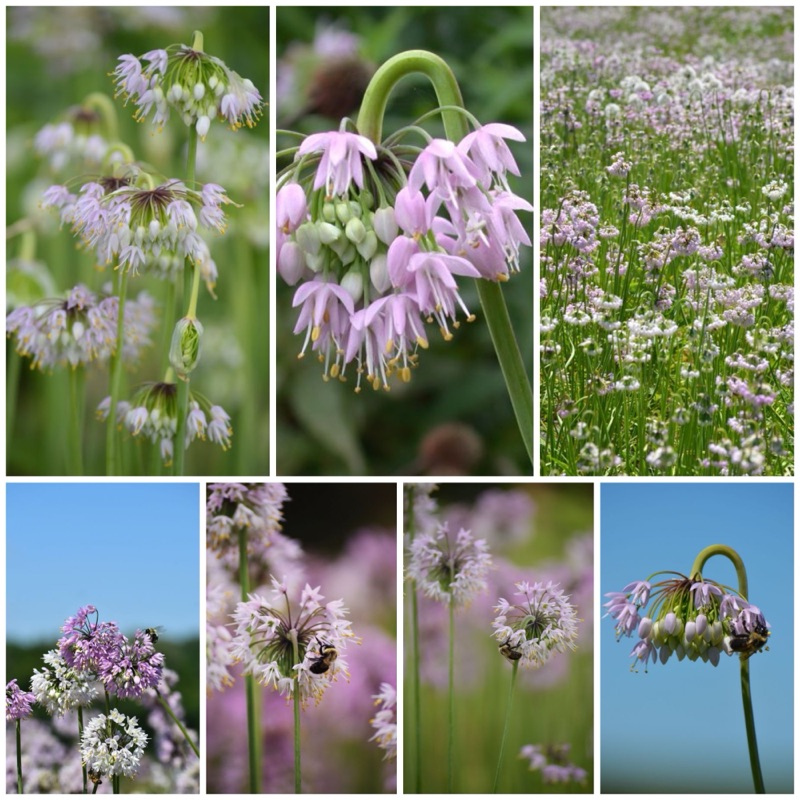 Photo Credits: Prairie Moon Nursery
Common Name:Nodding Onion
Scientific Name:Allium cernuum
Other Common Names: Lady’s Leek or Nodding Wild Onion
Genus: Allium
Native Range: In Canada it is native to Alberta, British Columbia, Ontario, and Saskatchewan.
For The United States it is native to Alabama, Arkansas, Arizona, Colorado, Georgia, Idaho, Illinois, Indiana, Kentucky, Maryland, Michigan, Minnesota, Missouri, Mississippi, Montana, Nebraska, New Jersey, New Mexico, New York, Ohio, Oregon, Pennsylvania, South Carolina, South Dakota, Tennessee, Texas, Utah, Virginia, Washington, Wisconsin, West Virginia, and Wyoming.
It is also native to the cooler and mountainous regions of Mexico.
Colours: pale pink, purple, white, and bright green.
Flower:Bell shaped and hang downward in an umbrella like cluster that can be white, pink, or purple in colour.
Foliage: Flat, and narrow grass like leaves that emerge at the base of the plant, and they’re typically bright green in colour that grow in a clump on the plant.
Height: Typically reaches a height of 12 - 18 inches (30 - 45 cm) tall.
Width: Typically reaches a width of 12 - 18 inches (30 - 45 cm) wide.
Bloom Time:June to August
The peak bloom of this plant is from July to August.
Most Distinctive Feature: Is it’s nodding, downward facing umbel (cluster) of flowers.
Moisture Requirements:dry to medium conditions
Soil Type: sandy, loamy, or rocky soils with a neutral or alkaline ph that is well drained.
Light Exposure: Full Sun ☀️ to Partial Shade ⛅️
Spread:slow spreader
Host Plant: Yes, the Nodding Onion is a host plant for local butterfly species. It is a host plant for some hairstreak butterfly species.
Wildlife Benefits: Its unique shaped flower clusters provide a good source for nectar and pollen for various local pollinators such as bees, hummingbirds, and butterflies.
The females of some hairstreak butterfly species lay their eggs on the foliage, and once their caterpillars hatch the foliage of the Nodding Onion provides a food source for them.
The seeds that this plant produces after the flowering is finished provide a great food source for local wildlife such as various bird species, small mammals, and ground squirrels.
The leaf litter from this plant can offer a small amount of habitat, and shelter for various small critters and insects.
Hardiness Zones: Zones 3 through 8
Season Interest: Throughout the summer
Repels: Deer, Moles, Voles, Rabbits, Mosquitoes, Other Biting Insects, and Japanese Beetles.
The Nodding Onion (Allium cernuum) is a wildflower herb that is edible and has medicinal properties.
Pompom-like cluster, 1½ to 2 inches across, at the top of a smooth stem. Flowers are ¼-inch across, light pink to deep rose on long slender stalks, with 6 oval-elliptic tepals (3 petals and 3 sepals all similar) and 6 white stamens with yellow tips. Flowers are mostly bell-shaped with the tepals erect or slightly spreading. The stem is hooked or bent just below the cluster, causing the cluster to hang or nod, and the individual flowers typically also nod to some degree. The flowers and cluster can become more erect as they develop but the tip of the stem remains bent through fruiting. The pair of bracts at the base of the cluster tend to wither away by flowering time.
Leaves are grass-like, up to 22 inches long and ¼ inch wide, keeled along the mid-rib and sheathing the stem near the soil line, appearing to be basal. The central flowering stem, which rises above the leaves, is stiff and smooth. One or more stems may arise from the underground bulbs, which are elongated and taper to the stem.
Fruit is a 3-valved capsule about 1/8 inch across with one shiny black seed per valve.
Sweet White Violet (Viola blanda)
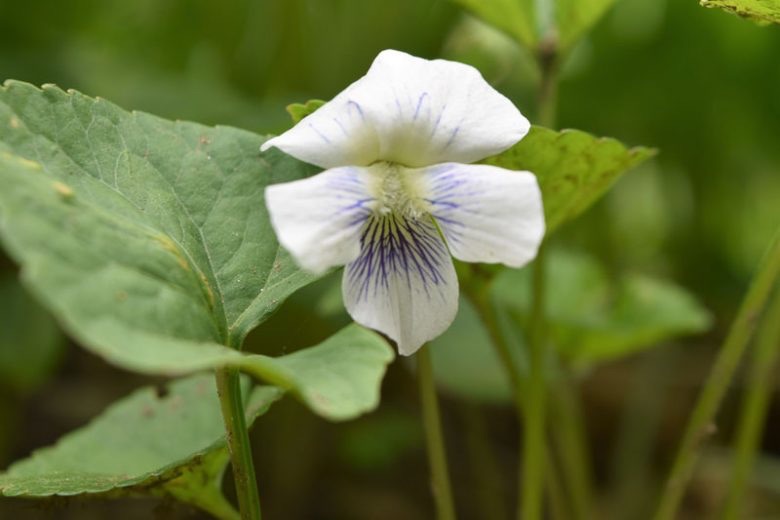 Photo Credits: Kerrie W, Shutterstock
Common Name:Sweet White Violet
Scientific Name:Viola blanda
Other Common Names: Common Sweet White Violet or Large - leaved White Violet
Genus: Viola
Native Range: Southeastern Canada, South - central Canada, Eastern United States and North - central United States.
Colours: white, purple, and green
Flower:Small white flowers that are often with a faint purple tint and yellow throat.
Foliage: Heart shaped leaves that are dark green in colour and are arranged in a basal rosette.
Height:Typically reaches a height of 3 to 6 inches (7.5 to 15 cm) tall.
Width: Typically reaches a width of 10 to 12 inches (25 to 30 cm) wide.
Bloom Time:Mid Spring to Late Spring
Most Distinctive Feature: Is their delicate, and fragrant white flowers.
Moisture Requirements:consistently moist conditions
Sweet White Violet thrives in an area that is consistently moist, but does not do well when the area is waterlogged.
Soil Type: loam, clay, or sandy soils that are rich in organic matter that is slightly acidic to neutral ph and is well drained.
Light Exposure: Part Shade ⛅️ to Full Shade ☁️
Spread:slow spreader
Host Plant: Yes, the Sweet White Violet is a host plant for several local fritillary butterfly species. It is a host plant for the Great Spangled Fritillary, Aphrodite Fritillary, Silver - Bordered Fritillary, Arctic Fritillary, Meadow Fritillary, and Atlantis Fritillary.
Wildlife Benefits: Their white flowers provide a valuable nectar source for various pollinators such as bees, butterflies, fireflies, and beetles.
The females of the Great Spangled Fritillary, Aphrodite Fritillary, Silver - Bordered Fritillary, Arctic Fritillary, Meadow Fritillary, and Atlantis Fritillary lay their eggs on the foliage of this violet species. Once the caterpillars hatch from the eggs the leaves of the Sweet White Violet will provide a food source for these caterpillars.
The foliage of this plant provides both habitat and shelter for various insects and small animals.
Hardiness Zones: Zones 3 through 9
Season Interest: Spring 🌸
Repels: Deer 🦌
The Sweet White Violet (Viola blanda) is a low growing native wildflower to some parts of Canada and The United States.
Single irregular 5-petaled flower at the end of a naked or sparsely hairy stem that typically rises above the leaves. Flowers are white with a greenish throat, up to ½ inch (≤ 13 mm) long. The upper two petals are erect or bent back, the two lateral petals have short hairs at the base (bearded), the lower petal is hairless, has purple veins near the base, and forms a short rounded spur at the back.
The 5 sepals around the base of the flower are hairless, the two lower largest, lance to egg-shaped, rounded to blunt at the tip, and have a short extension at the base (auricle) that is straight across to rounded along the end and does not elongate in fruit.
Leaves are all basal, held ascending to spreading, heart to kidney-shaped, usually rounded to blunt at the tip, with deeply cleft basal lobes that may be overlapping when young but tend to separate with age, forming a broad sinus. Largest leaves are up to about 2½ inches (61 mm) long, about as wide or slightly wider.
The upper surface is hairless or sparsely to moderately hairy, the lower surface usually hairless. Edges have shallow teeth and lack a fringe of hairs. Leaf stalks are hairless to sparsely hairy.
In mid to late summer above ground stems (stolons) are produced that are very slender, often naked or may have a leaf or two along its length, sometimes also fruiting capsules but usually not. The stolon ends in a new plantlet.
Both petalled (chasmogamous) and petal-less, self-pollinating (cleistogamous) flowers produce fruit, in a hairless, ovoid capsule that is initially nodding, becoming erect just before splitting into 3 sections and releasing its seed. Chasmogamous capsules are typically green. Chasmogamous flowers bloom in spring. Cleistogamous flowers are produced all summer into fall on prostrate stalks much sorter than the leaf stalks and arch up just before seed release; capsules are up to ~1/3 inch (5 to 9 mm) long and green or purple spotted. The seeds are light to medium brown, up to about 2 mm long.
PawPaw (Asimina triloba)
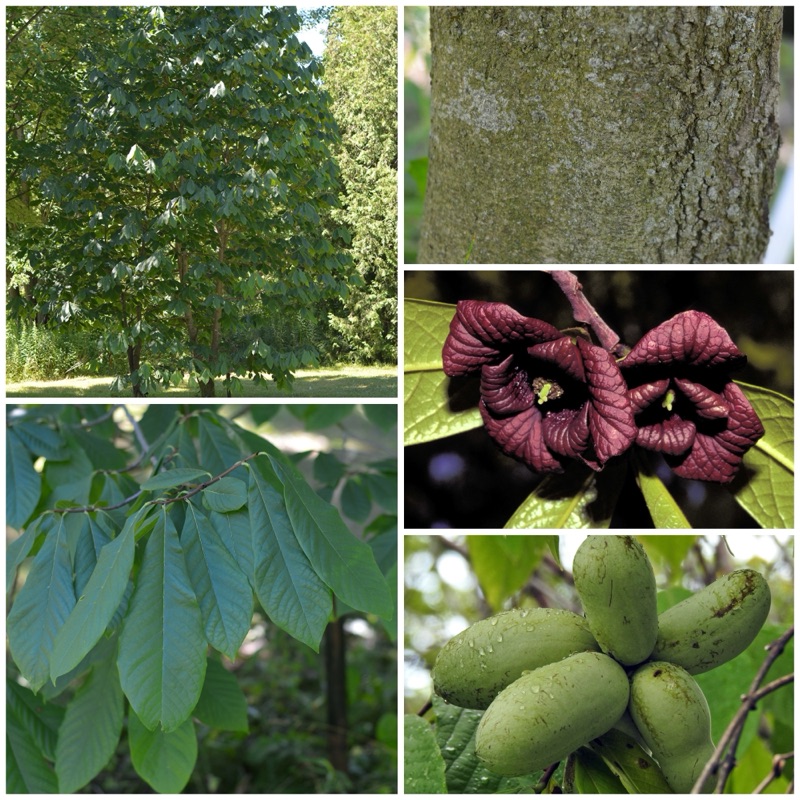 Photo Credits: Ontario.ca
Common Name:PawPaw
Scientific Name:Asimina triloba
Other Common Names: American Papaw, Common Papaw, Custard Apple, or PawPaw.
Genus: Asimina
Native Range: Southern Ontario in Canada and The Eastern United States.
Colours: yellowish green, reddish purple, dark green, pale green, yellow, golden brown, and dark brown.
Flower:Cup shaped or bell shaped with six petals that are deep reddish purple in colour, and they can reach up to 1 - 2 inches in diameter.
Foliage: large, alternate, and simple deciduous leaves that are typically 6 - 12 inches long and 3 - 6 inches wide. The leaves are medium to dark green in colour during the summer, but change to a bright yellow or golden brown in the fall.
Height:Typically reaches a height of 15 to 25 feet tall.
Width: Typically reaches a width of 15 to 25 feet wide.
Bloom Time:April and May
Most Distinctive Feature: Is their large edible fruit
Moisture Requirements:moist conditions
Common Pawpaw thrives in an area that is consistently moist, but does not like to be waterlogged.
Soil Type: sandy or loamy soils that is slightly acidic to neutral ph, and is well drained.
Light Exposure: Full Sun ☀️ to Part Shade ⛅️
Spread:moderate spreader
Host Plant: Yes, the PawPaw is a host plant for a local butterfly species. It is a host plant for the Zebra Swallowtail.
Wildlife Benefits: The tree’s flowers attract various flies and beetles, which are important pollinators for the PawPaw.
The females of the Zebra Swallowtail lay their eggs on the foliage of this tree, and then once the caterpillars hatch out of the eggs the leaves will provide a good source of food for them.
The fruit from the PawPaw Tree are a nutritious food source for local wildlife such as many mammals. Opossums, raccoons, foxes, squirrels, and even black bears.
The dense foliage and leaf cover this tree has provides a habitat and shelter for small mammals and birds.
Hardiness Zones: Zones 5 through 7
Season Interest: spring 🌸, summer 💐, and fall 🍂.
Repels: deer, small mammals, and some insects.
The Pawpaw (Asimina triloba) is a small short-trunked tree or large, multi-stemmed shrub that is native to Southern Ontario and the eastern part of The United States.
The burgundy flowers bloom in spring but are not showy. They are purplish brown with 6 petals and are 1 to 1.5 inches in diameter. They have a fowl odour where flies, and beetles are the only pollinators who pollinate them.
The leaves are alternate, simple, obovate to oblong 6-12 inches long 2-3 inches wide with a green pepper odour when crushed. The leaves are in two ranks and hang pendulously from the stem. The leaf underside is pale and glaucous.
The bark is smooth, brown splotched with wart-like lenticels. Becomes fissured and scaly with age.
The buds are pubescent with no scales. Young buds and stems are cinnamon brown.
The fruit is a fleshy fruit that is edible and is a big sized berry like fruit that is 3 inches in length and 3 inches wide. it is usually green or golden yellow, and when is overripe it is a brown colour.
Pearly Everlasting (Anaphalis margaritacea)
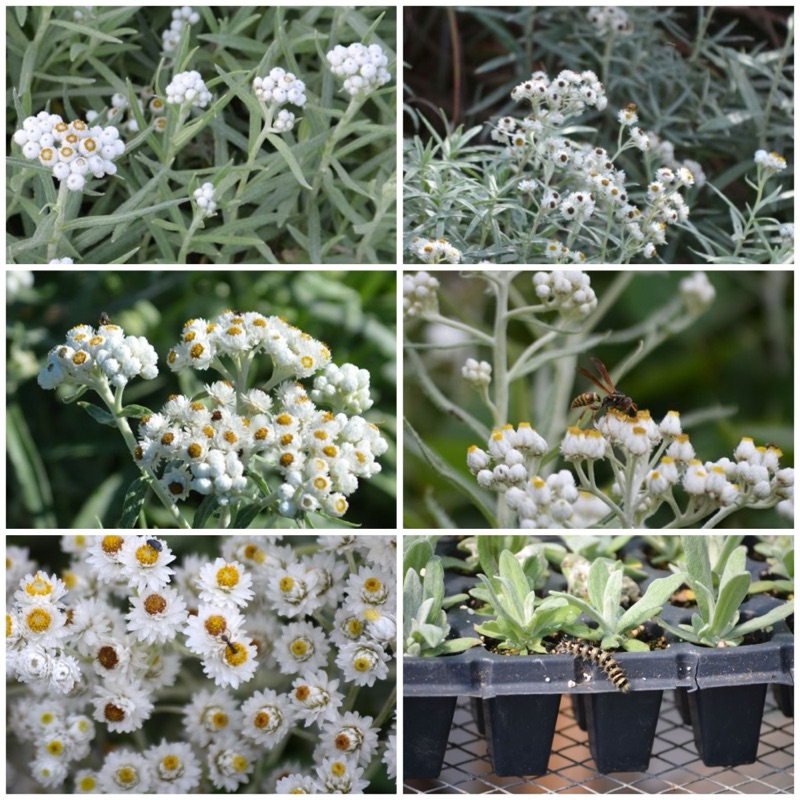 Photo Credits: Prairie Moon Nursery
Common Name:Pearly Everlasting
Scientific Name:Anaphalis margaritacea
Other Common Names: Western Pearly Everlasting, Sweet Everlasting, or Large - flowered Everlasting.
Genus: Anaphalis
Native Range: New England, Eastern Canada, Western Great Lakes Regions, North Eastern United States, Western United States, and Northwestern United States.
Colours: white, yellow, blue green, and grey green.
Flower:Small, white, and papery flowers that surround yellow centres.
Foliage: Narrow, and grey green to woolly white leaves that are thin where they’re 3 to 5 inches long, and 3/4 inch wide.
Height:Typically reaches a height of 1 to 3 feet (30 - 90 cm) tall.
Width: Typically reaches a width of 1 to 2 feet (30 - 60 cm) wide.
Bloom Time:Typically blooms from mid summer to early fall, which usually occurs from July to September.
Most Distinctive Feature: Is their involucre bracts, which are the white petal like structures that surround the yellow central disk flowers.
Moisture Requirements:dry to medium moisture conditions
Soil Type: sandy or rocky soils that is well drained
Light Exposure: Full Sun ☀️
Spread:moderate spreading plant
Host Plant: Yes, Pearly Everlasting is a host plant for two local butterfly species. It is a host plant for the American Lady and the Painted Lady.
Wildlife Benefits: It’s small white flowers that are in clusters attract bees, and butterflies where they provide nectar and pollen for these insects.
Female American Lady Butterflies and Painted Lady Butterflies lay their eggs on the leaves of Pearly
Pearly Everlasting, and the foliage becomes a food source for the caterpillars one they hatch out of their eggs.
The dense foliage of Pearly Everlasting offers shelter and habitat for various small creatures to protect them from inclement weather, as well as their natural predators.
Hardiness Zones: Zones 2 through 7
Season Interest: Summer 💐, Fall 🍂, and Winter ❄️
Repels: deer, rabbits, aphids, spider mites, japanese beetles, and thrips.
The Pearly Everlasting (Anaphalis margaritacea) is a perennial wildflower that is a member of The Aster Family.
Generally flat-topped clusters of numerous ¼ to 1/3-inch flower heads at the top of the plant. There are separate male and female flowers, usually on separate plants. Male flowers are globular with numerous slender, erect yellowish brown staminate flowers in the yellow center disc.
Female flowers are globular to egg-shaped with a yellowish to dark brown bristly ring around the top of the flower head. Both genders have what appear to be numerous tiny white petals in many layers around the center. These are actually bracts. The bracts on the female flowers do not spread out much until seed starts forming.
Leaves are 3 to 5 inches long, to ¾ inch wide, toothless, often with wavy or rolled edges, covered in white woolly hairs on both surfaces but especially on the underside, sharply pointed at the tip with no leaf stalk. Stems are densely covered in woolly white hairs.
Fruit is a small brown seed with a tuft of white hairs to carry it off in the wind.
Red Cedar (Juniperus virginiana)
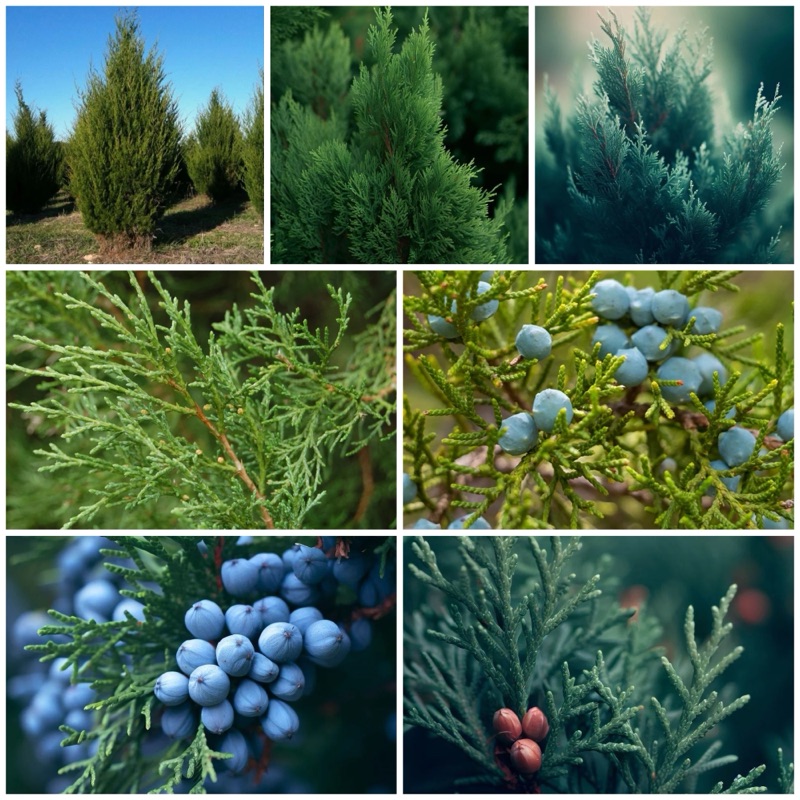 Photo Credits: MySeeds.Co
Common Name:Red Cedar
Scientific Name:Juniperus virginiana
Other Common Names: Western Red Cedar, Eastern Red Cedar, Pacific Red Cedar, Canoe Cedar, or Shinglewood.
Genus: Juniperus
Native Range: Eastern United States and Canada
Colours: grey green, blue green, light or dark green, grey, red brown, blue grey, and dark purple blue.
Flower:It varies depending on the gender of the tree. Male trees produce small, yellowish pollen-producing cones. Female trees produce greenish flowers that develop into berry like cones.
Foliage: Aromatic, over lapping, scale like leaves that are typically bluish green in the summer but can change to a bronze or yellowish brown during the winter.
Height:Typically reaches a height of 40 to 50 feet tall.
Width: Typically reaches a width of 8 to 20 feet wide.
Bloom Time:Late Winter to Early Spring
Most Distinctive Feature: Is it’s aromatic reddish brown wood, and the evergreen foliage on the branches.
Moisture Requirements:moderate moist conditions
The Red Cedar does not do well in overly wet or waterlogged environments.
Soil Type: sandy, loamy, or rocky soils that are slightly acidic to neutral and is well drained.
Light Exposure: Full Sun ☀️
Spread:moderate spreading tree
Host Plant: Yes, the Red Cedar is a host plant for a local butterfly species and moth species. It is a host plant for the Juniper Hairstreak Butterfly and the Imperial Moth.
Wildlife Benefits: The evergreen branches of Red Cedar provide excellent shelter from wind and snow, which creates warm habitats for birds and small mammals.
The branches of the Red Cedar provide a great nesting site for various bird species including sparrows, robins, mockingbirds, bluejays, and cardinals.
The dense foliage of the Red Cedar provides roosting cover for bird species such as juncos, sparrows, and myrtle warblers.
The females of the Juniper Hairstreak Butterfly and Imperial Moth lay their eggs on the foliage of the Red Cedar, and once the caterpillars hatch the leaves become food for them.
The berry like cones that the Red Cedar produces are a key food source for numerous bird species such as cedar waxwings, bob white quails, ruffed grouse, and wild turkeys. Mammals like rabbits, foxes, raccoons, skunks, opossums, and coyotes consume the berry like cones as well.
The seeds that the Red Cedar produces provide an excellent food source for birds such as chickadees and finches.
Hardiness Zones: Zones 2 through 7
Season Interest: Spring 🌸, Summer 💐, Fall 🍂, and Winter ❄️.
Repels: moths, ants, termites, cockroaches, rats, mice, fleas, and ticks.
The Red Cedar (Juniperus virginiana) is a coniferous evergreen tree that is a member of The Conifers Family.
Male and female flowers are cone like structures called strobili, borne on separate trees. Male cones are oval to egg shaped, 1/8 to 1/6 inch long with yellowish brown scales holding the yellow pollen, at the tips of 2nd year branches.
Female flower cones appear as several ranks of yellowish-tan to blue-green scales at branch tips, little more than 1/16 inch long.
Leaves are of two kinds. Leaves on older, slower growing twigs are lance-oval, scale-like tapering to a pointed tip, crowded together in opposite pairs, overlapping and tightly appressed to the branch, 1/10 inch long or less (1-3 mm).
Leaves on young, fast growing branches are awl-like, up to 1/3 inch long, spaced some distance apart, opposite or in whorls of three, with the sharp tip spreading making them very prickly. Early season the foliage turns green but by late summer and through winter, turns a dark bronzy red, often with a waxy bloom. Leaves can persist 4 to 6 years.
Trunks are up to 20 inches in diameter. Older bark is thin, grayish brown in long, thin and flattened vertical ridges that peel off in long stringy strips over time. Branchlets on fast juvenile growth are long, thin and straight, on older growth they are short and much divergent, forming branched coral-like clusters at branch tips.
Fruit is an irregularly round berry-like cone, up to ¼ inch diameter with a waxy bluish coating similar to blueberries. Immature cones are fleshy becoming dry and pithy.
A cone contains 1 to 3 seeds; seeds are irregularly egg-shaped and remain within the closed cone until dispersed by animals.
Shrubby St. John’s Wort (Hypericum prolificum)
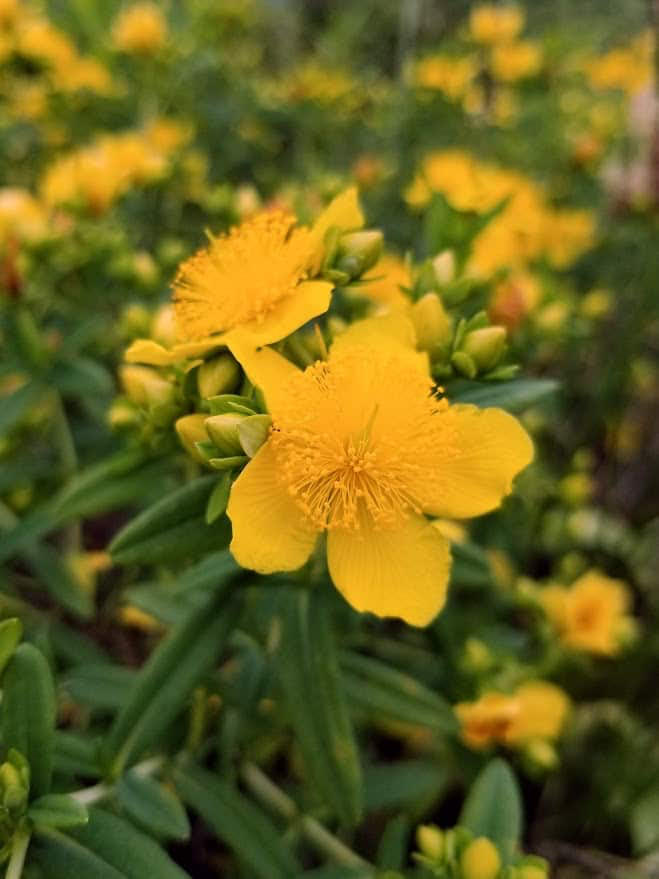
Photo Credits: Ontario Native Plants
Common Name:Shrubby St. John’s Wort
Scientific Name:Hypericum prolificum
Other Common Names: Common St. John’s Wort or Golden St. John’s Wort
Genus: Hypericum
Native Range: Ontario Canada, Eastern United States, Northern United States, and Midwestern United States.
Colours: red or purple, blue green, deep red, and bright yellow.
Flower:Bright yellow showy flowers that are typically in clusters of 3 to 7 at the tips of the branches.
Foliage: Simple, elliptical, blue green leaves that are oppositely arranged along the branches and are typically 3 to 7 cm long.
Height:Typically reaches a height of 1 to 4 feet (12 - 48 inches) tall.
Width: Typically reaches a width of 1 to 4 feet (12 - 48 inches) wide.
Bloom Time:Typically from late spring through summer, which usually occurs from June to August.
Most Distinctive Feature: Is its profuse bright yellow flowers that have five petals which bloom during the summer time.
Moisture Requirements:dry to moist area that has medium moisture conditions.
Soil Type: sandy, loamy, rocky, or clay soils that are slightly acidic, neutral, or alkaline that is well drained.
Light Exposure: Full Sun ☀️ to Part Shade ⛅️
Spread:moderate spreading plant
Host Plant: Yes, the Shrubby St. John’s Wort is a host plant for a local butterfly species, and a few moth species. It is a host plant for the Grey Hairstreak Butterfly, Scallop Moth, Grey half - spot Moth, Common Pug Moth, and Wavy - lined Emerald Moth.
Wildlife Benefits: The bright yellow showy flowers attract bees, syrphid flies, beetles, beewolves, and butterflies where they provide both nectar and pollen to these pollinators.
The females of the grey hairstreak butterfly, scallop moth, grey half - spot moth, common pug moth, and wavy lined emerald moth lay their eggs on the foliage, and then once the caterpillars hatch from their eggs the foliage of the Shrubby St. John’s Wort becomes food for them.
The leaf cutter bees cut half moon shaped pieces from the foliage of Shrubby St. John’s Wort for lining and dividing brood sells.
Hardiness Zones: Zones 3 through 8
Season Interest: Spring 🌸, Summer 💐, Fall 🍂, and Winter ❄️.
Repels: deer, rabbits, aphids, gall flies, leaf beetles, weevils, and scale.
The Shrubby St. John’s Wort (Hypericum prolificum) is a deciduous shrub that is a member of The Hypericaceae Family.
Dark green 3 inch leaves with no appreciable fall color. Opposite or whorled, decussate, simple, entire; sessile or petiole short.
The bark is light brown in colour and the older bark is exfoliating.
The stem contains 2 to 4(up to 6) ridges on newer growth, smooth and rounded on older growth. The lower stems are woody with shredded gray-brown bark, while the upper stems are green and slightly winged on opposite sides.
Bright yellow flowers in summer on current season's growth; dry capsules persist all winter. Solitary or cymose, terminal or axillary. Yellow 5-petaled (rarely 4), 5 sepals (rarely 4) stamens numerous, in bundles or in showy boss. Blooms from early summer to mid fall. The 5-petaled flowers have numerous stamens. The upper stems terminate in small clusters of 3-7 flowers, additional clusters of flowers may appear along the 2 upper pairs of opposite leaves. Each flower is ¾ to 1 inch across. The petals are much larger than the sepals.
The fruit is a 2 3 -5 celled ovoid 1/2 inch capsule, sometimes fleshy. Displays from mid summer to late fall.
Snakeroot (Ageratina altissima)
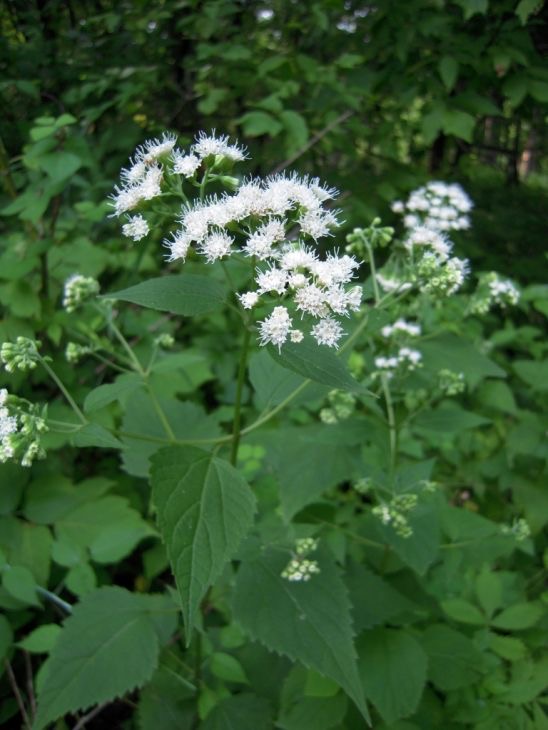 Photo Credits: Prairie Moon Nursery
Common Name:Snakeroot
Scientific Name:Ageratina altissima
Other Common Names: White Snakeroot, Richweed, or White Sanicle
Genus: Ageratina
Native Range: In Canada it is native to the province of Ontario, Quebec, The Northwest Territories, Nova Scotia, New Brunswick, and Saskatchewan.
In The United States it is native to The Eastern United States, The Northern United States, The Western United States, and The Southern United States.
Colours: white, medium green, and black
Flower:Small, fluffy, and white flowers that are arranged in flat topped clusters.
Foliage: Opposite, and simple leaves that are 2 to 5 inches long and 1 to 3 inches wide are medium green on the top and are a lighter green on the underside.
Height:Typically reaches a height of 2 to 5 feet (60 to 150 cm) tall.
Width: Typically reaches a width of 2 to 4 feet (60 to 120 cm) wide.
Bloom Time:Typically blooms from late summer into fall, which usually occurs August to October.
Most Distinctive Feature: Is it’s fluffy, white, flat - topped flower clusters which appear in late summer into fall.
Moisture Requirements:moist to moderately moist conditions
Soil Type: sandy, loamy, or clayey soils that is rich in organic matter and is well drained.
Light Exposure: Partial Sun ⛅️ to Partial Shade ⛅️
Spread:moderate spreading plant
Host Plant: Yes, the Snakeroot is a host plant for a few local moth species. It is a host plant for the Clymene Moth, Snakeroot Leaf miner Moth, and Hitched dart Moth.
Wildlife Benefits: The small white flower clusters attract butterflies, bees, pollinating flies, and pollinating moths where they provide both nectar and pollen to these pollinators.
The females of the clymene moth, snakeroot leaf miner moth, and hitched dart moth lay their eggs on the foliage and once the caterpillars hatch out of their eggs the leaves of Snakeroot provide a food source for them.
This plant blooms during the late season from the end of summer till mid fall, which provides an important food source for pollinators such as monarch butterflies, painted lady butterflies, american lady butterflies which are the butterflies who migrate for the winter. The late blooming flowers also provide a great food source for specialized bees such as leaf cutter bees, mason bees, mining bees, bumble bees, and sweat bees.
Hardiness Zones: Zones 3 through 7
Season Interest: Summer 💐 through Fall 🍂
Repels: deer, cattle, bears, foxes, and other grazing animals.
The Snakeroot (Ageratina altissima) is a perennial herb that is poisonous, and it is a member of The Aster Family.
Green leaves are up to 5 inches long and 3.5 inches across. The larger lower leaves are cordate to cordate-ovate and have more promenade veins. The smaller upper leaves are lanceolate. All leaves are hairless and have serrate to crenate margins.
The light green to tan stems are terete and mostly hairless.
Blooms on a terminal flat-topped corymb in late summer to fall. Each flower head is about 2-6 inches across and contains many 5-lobed, tubular disk flowers. There are no ray florets. They are densely packed creating a showy display.
The fruit is often referred to as an achene but is actually a cypsela. The seeds are small, oblong, ribbed and black with a tuft of white hair. They are distributed by the wind.
Spicebush (Lindera benzoin)
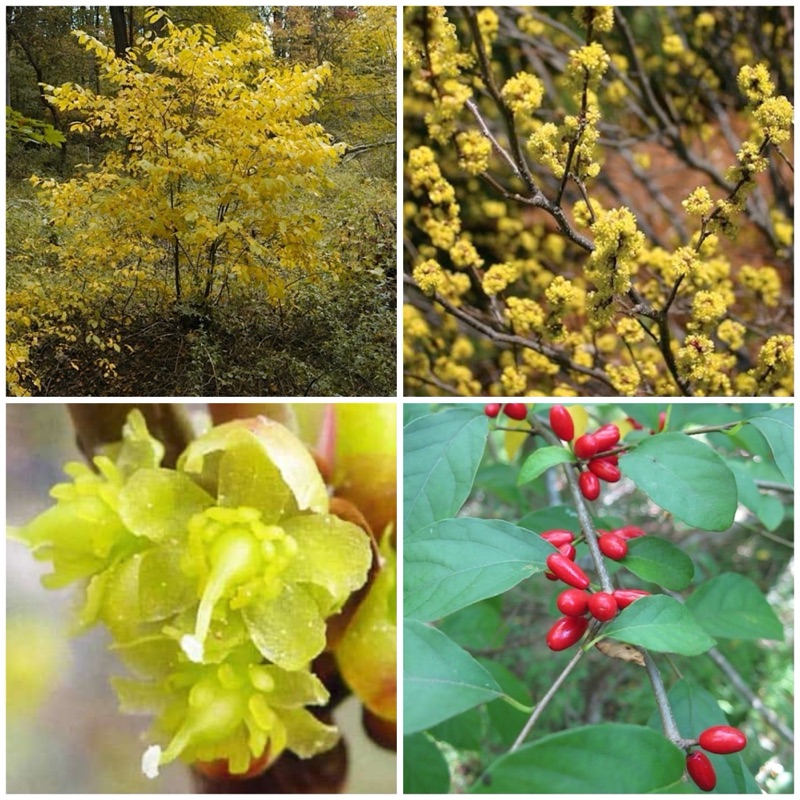 Photo Credits: bambooplants.ca
Common Name:Spicebush
Scientific Name:Lindera benzoin
Other Common Names: Northern Spicebush, Common Spicebush, Wild Allspice, or Benjamin Bush.
Genus: Lindera
Native Range: Southern Canada, Eastern United States, Southern United States, Northern United States, and Northeastern United States.
Colours: greenish yellow, medium green, golden yellow, bright red, and light grey.
Flower:Tiny, bright yellow and fragrant flowers.
Foliage: Simple, oval to slightly obovate leaves that are medium green in colour during the summer and then change to a golden yellow during the fall.
Height:Typically reaches a height of 6 to 12 feet (72 - 144 inches) tall.
Width: Typically reaches a width of 6 to 12 feet (72 - 144 inches) wide.
Bloom Time:April to May
Most Distinctive Feature: Is it’s fragrant leaves and twigs, which release a spicy sent when crushed.
Moisture Requirements:moist to wet conditions, but can also tolerate occasionally dry conditions.
Soil Type: loamy, sandy, or clay soils that is rich in organic matter and is well drained.
Light Exposure: Full Sun ☀️ to Partial Shade 🌥️
Spread:slow spreader
Host Plant: Yes, the Spicebush is a host plant for two local moth species, and a butterfly species. It is a host plant for the lo Moth, Polyphemus Moth, and Spicebush Swallowtail Butterfly.
Wildlife Benefits: The early blooming flowers on the Spicebush provide an important nectar source during the early spring for local bees and butterflies who emerge or come out early.
The females of the lo Moth, Polyphemus Moth, and Spicebush Swallowtail Butterfly lay their eggs on the foliage then once the caterpillars hatch out of their eggs the leaves provide a food source for them.
The shrub provides cover and nesting sites for birds and other small mammals, offering protection from predators and harsh weather.
The bright red berries that are produced by the female Spicebush during the fall season are a valuable food source for local bird species such as thrushes, woodpeckers, flycatchers, vireos, cardinals, chickadees, and bluejays. Some local small mammals also consume the berries.
Hardiness Zones: Zones 4 through 9
Season Interest: Early Spring 🌸, Summer 💐, Fall 🍂, and Winter ❄️.
Repels: deer and mosquitoes
The Spicebush (Lindera benzoin) is a deciduous shrub that is a member of The Laurels Family.
It has thick, alternate, oblong-obovate, light green leaves (to 5" long) turn an attractive yellow in autumn. Leaves are aromatic (spicy fragrance) when crushed.
The bark of this shrub is a light brown or light grey in colour, and it has a lenticels surface.
The stem is conspicuous and has a spicy fragrance when it is bent or broken, and the aroma can be smelled when close to the shrub as well.
The Spicebush has clusters of tiny, apetalous, aromatic, greenish-yellow flowers that bloom along the branches in early spring before the foliage emerges (March-April). It has dioecious (male and female flowers on separate plants), with the male flowers being larger and showier than the female ones. The flowers of female plants give way to bright red drupes. Female plants need a male pollinator in order to set fruit (scarlet red), however. Its drupes are very attractive, but are largely hidden by the foliage until the leaves drop.
A drupe, scarlet red spicy scented fruit in late Summer/early Fall (August-September) 1/2' wide.
Woodland Strawberry (Fragaria vesca)
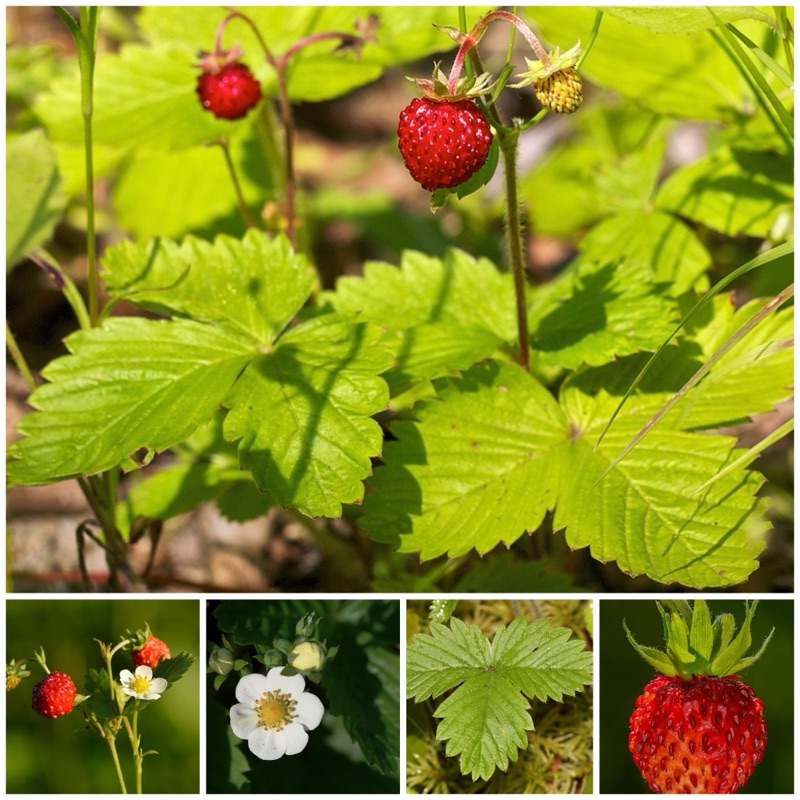 Photo Credits: Jorg Hempel, Ivar Leidus,Karelj,Walter Siegmund (talk), and Ermell from Wikipedia.
Common Name:Woodland Strawberry
Scientific Name:Fragaria vesca
Other Common Names: Alpine Strawberry, European Strawberry, Carpathian Strawberry, or Wild Strawberry.
Genus: Fragaria
Native Range: Canada, Southeastern United States, Europe, Asia, and Guatemala.
Colours: white, yellow, bright green, and bright red.
Flower:Small white flowers that have a yellow centre and a total of five petals that surround the centre.
Foliage: Bright green trifoliate leaves with toothed edges that are oval to egg shaped.
Height:Typically reaches a height of 6 to 12 inches (15 - 30 cm) tall.
Width: Typically reaches a width of 12 to 18 inches (30 - 45 cm) wide.
Bloom Time:Typically blooms from late spring to midsummer, which usually occurs from May to August.
Most Distinctive Feature: Is the small, conical fruit with seeds projecting out of the surface.
Moisture Requirements:consistently moist conditions
Soil Type: sandy, loamy, or sandy loam soils that are slightly acidic and well drained.
Light Exposure: Full Sun ☀️ to Partial Shade 🌥️
Spread:fast spreading plant
Host Plant: Yes, the Woodland Strawberry is a host plant for three local butterfly species. It is a host plant for the Grey Hairstreak, Grizzled Skipper, and Cobweb Skipper.
Wildlife Benefits: The small white flowers of Woodland Strawberry attract a variety of pollinators such as mason bees, green metallic bees, cuckoo bees, bumble bees, butterflies, and pollinating flies where they provide both nectar and pollen to these pollinators.
The females of the Grey Hairstreak Butterfly, Grizzled Skipper Butterfly, and Cobweb Skipper lay their eggs on the foliage of Woodland Strawberry, and once the caterpillars hatch from their eggs the leaves provide a reliable food source for them.
The foliage also provides shelter and a habitat for small insects, reptiles, and small mammals from predators and harsh weather.
The berries (strawberries) that the Woodland Strawberry produces after the flowering is finished provides an excellent food source for a variety of wildlife including songbirds, chipmunks, squirrels, opossums, box turtles, and wood turtles.
Hardiness Zones:Zones 5 through 9
Season Interest: Spring 🌸 through Summer 💐
Repels: deer 🦌 and rabbits 🐇
The Woodland Strawberry (Fragaria vesca) is a compact, stemless tall wildflower plant which produces fruit that are berries (strawberries). This species of strawberry plant is a member of The Rose Family.
Clusters of 2 to 5 flowers, generally blooming 1 or a few at a time, on a slender stem that usually exceeds the height of surrounding leaves. Flowers are typically less than ½ inch wide with 5 round to oval white petals, about 20 yellow stamens surrounding a yellow center, and sharply pointed sepals as long as or longer than the petals. A small leaflet-like bract is usually present where flower stalks diverge at the top of the stem.
Leaves are evergreen, basal and palmately compound in groups of 3. Leaflets are 1 to 1½ inches long, ¾ to 1 inch wide, coarsely toothed, nearly hairless on upper surface, prominently veined, oval to egg-shaped, rounded towards the tip and tapered toward the base. Leaflets are stalkless, the compound leaf on a long sparsely hairy stem. The tooth at the very tip of a leaflet is mostly about equal in size and extending beyond the teeth on either side of it, though may be somewhat smaller on some leaflets. Stems are above ground runners (stolons) that root at tips from which a crown of leaves emerge.
Small red strawberries are egg shaped to conic, the tiny seeds (achenes) raised on the surface. These berries are really tasty!
Fragrant Sumac (Rhus aromatica)
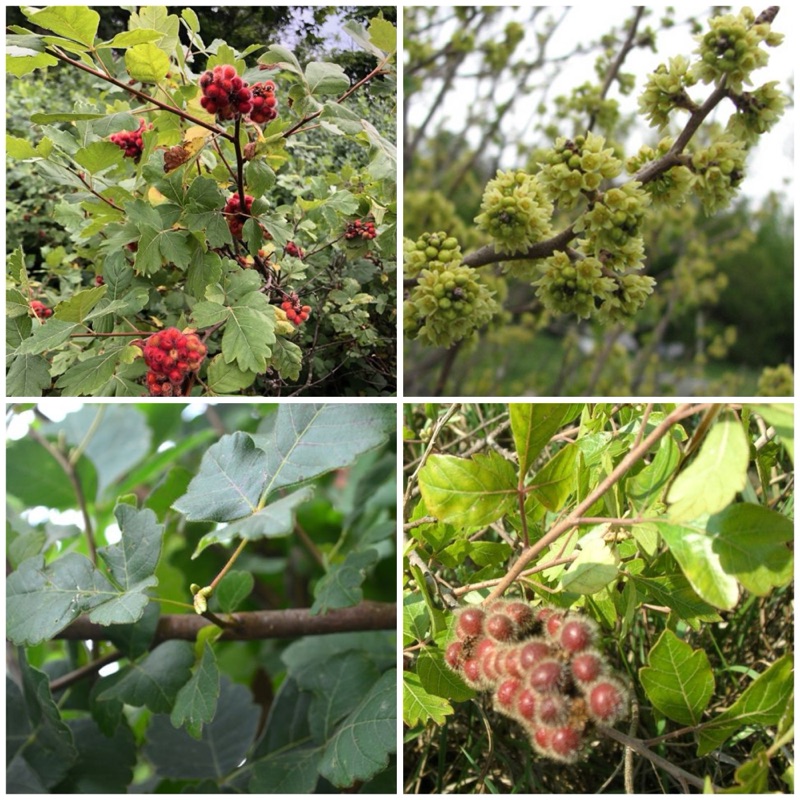 Photo Credits: Prairie Moon Nursery
Common Name:Fragrant Sumac
Scientific Name:Rhus aromatica
Other Common Names: Aromatic Sumac, Lemon Sumac, Skunkbush, Pole - cat Bush, Polecat Sumac, or Sumac.
Genus: Thus
Native Range: Southern Canada, Eastern Canada, Northeast United States, Southeast United States, Midwest United States, and Northern Mexico.
Colours: green, orange, yellow, red, purple, bright red, and brown.
Flower:Small and yellow that appear in clusters on the ends of branches.
Foliage: Three part leaves which are typically medium green in colour during spring and summer but they turn vibrant orange, red, and purple in the fall.
Height:Typically reaches a height of 6 to 12 feet (72 - 144 inches) tall.
Width: Typically reaches a width of 4 to 6 feet (48 - 72 inches) wide.
Bloom Time:Typically blooms from April to May, sometimes this species of Sumac can bloom through the month of June in some locations.
Most Distinctive Feature: Is their aromatic foliage and twigs. When they’re crushed or brushed, the leaves and twigs release a fragrant that is often lemony or citrus like scent.
Moisture Requirements:dry to moist conditions
Fragrant Sumac does not tolerate being waterlogged, so please avoid over watering or extra watering.
Soil Type: sandy, loamy, rocky, or clay soils that have a ph of slightly acidic or neutral, and have good drainage where the soil is well drained.
Light Exposure: Full Sun ☀️
Spread:slow spreading plant
Host Plant: Yes, the Fragrant Sumac is a host plant for two local butterfly species and two local moth species. It is a host plant for the Banded Hairstreak Butterfly, Spring Azure Butterfly, Luna Moth, and Regal Moth.
Wildlife Benefits: The small flowers of the Fragrant Sumac attracts local pollinators such as bees and butterflies, and they provide both nectar and pollen to these pollinators.
The dense and low growing habitat of Fragrant Sumac provides excellent cover for small mammals and birds, offering them protection from predators and harsh weather.
The females of the Banded Hairstreak Butterfly, Spring Azure Butterfly, Luna Moth, and Regal Moths lay their eggs on the foliage of the Fragrant Sumac. Once the caterpillars hatch out of the eggs, the foliage becomes food for them.
The small red berries that Fragrant Sumac produces provide a crucial food source for local wildlife including turkeys, grouse, robins, chickadees, cardinals, bluejays, woodpeckers, flickers, raccoons, opossums, chipmunks, and squirrels.
The structure of Fragrant Sumac especially the branches, twigs, and foliage can also be used by some local birds and other small mammals for nesting.
Hardiness Zones: Zones 3 through 8
Season Interest: Spring 🌸, Summer 💐, Fall 🍂, and Winter ❄️.
Repels: deer, rabbits, and aphids.
The Fragrant Sumac (Rhus aromatica) is a low growing spreading shrub with distinctive three part leaves that are fragrant.
Compact branching clusters of short-stalked flowers at branch tips, usually emerging before the leaves, with male and female flowers on separate plants,sometimes a plant has perfect (bisexual) flowers.
All flowers are 1/8 inch long with 5 pale yellow to greenish petals. Male flowers have 5 yellow-tipped stamens, female flowers have a 3-parted style in the center, perfect flowers have both. The calyx cupping the flower has 5 short, pointed to rounded lobes and is variously hairy.
Leaves are alternate and palmately compound with 3 leaflets, the terminal leaflet largest. Leaflets are up to 3 inches (to 8 cm) long and 1 inch wide, somewhat variable in shape from egg-shaped to oval-elliptic to diamond-shaped in outline, tapered to rounded at the base, and stalkless or nearly so. Edges have a few shallow, rounded lobes or large pointed teeth. The upper surface is hairless, glossy or dull, the lower short-hairy when young. Leaves are fragrant when crushed and turn red in fall.
Twigs are hairy and reddish brown the first year. Showy flower buds develop in summer, cylindric clusters of reddish scales that will open the following spring.
Older bark is thin, gray to gray-brown and smooth with scattered lenticels (pores). Stems are single or multiple from the base, usually much branched. Thickets are often formed from root suckers.
Fruit is a tight cluster of hairy, berry-like drupes, each less than ¼ inch (4 to 5 mm) in diameter and containing a single seed. Fruit ripens to deep red and may persist through winter and into the next season.
Sweet Fern (Comptonia peregrina)
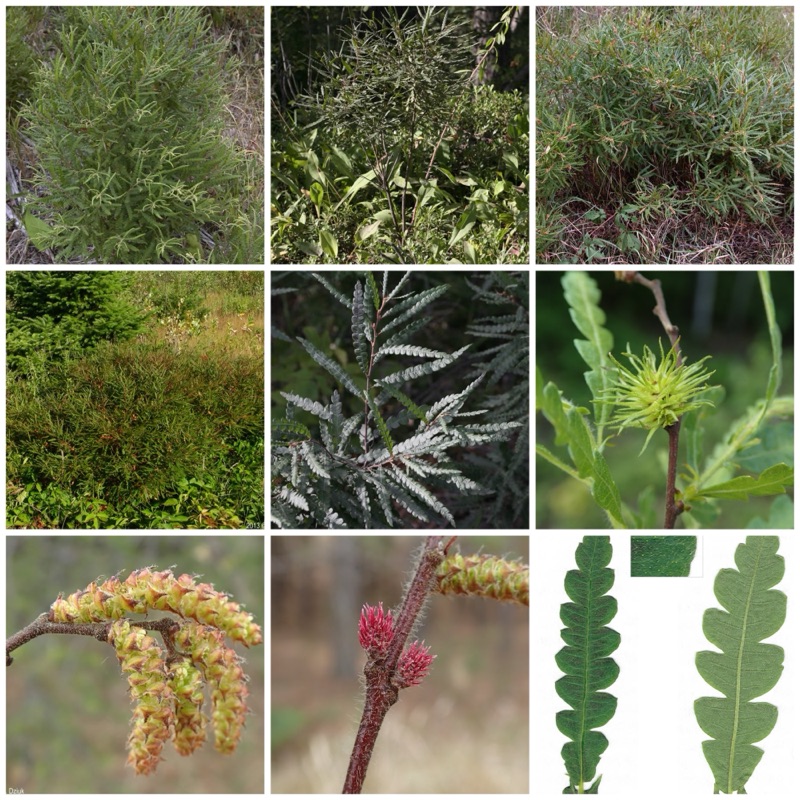 Photo Credits: Peter M. Dziuk, in Carlton Pine and St. Louis Counties
Common Name:Sweet Fern
Scientific Name:Comptonia peregrina
Other Common Names: Fern Gale or Sweet Fern Gale
Genus: Comptonia
Native Range: Southeastern Canada, Southern Canada, and Northeastern United States.
Colours: dark green, bronze, and brown
Flower:Inconspicuous flowers that are typically small and yellowish catkins that appear in late spring and early summer.
Foliage: Narrow, oblong, or lance linear leaves that are deeply notched and have fern like appearance.
Height:Typically reaches a height of 2 to 5 feet (60 - 150 cm) tall.
Width: Typically reaches a width of 4 to 8 feet (120 - 240 cm) wide.
Bloom Time:Early Summer
Most Distinctive Feature: Is it’s aromatic fern like foliage
When crushed the leaves release a sweet and spicy fragrance.
Moisture Requirements:moderate moisture conditions
Soil Type: sandy or gravelly soil that is well drained.
Light Exposure: Full Sun ☀️ to Partial Shade 🌥️
Spread:moderate spreading plant
Host Plant: Yes, the Sweet Fern is a host plant for a local butterfly species, and a few moth species. It is a host plant for the Grey Hairstreak Butterfly, Sweet Fern Underwing Moth, lo Moth, and several Sphinx Moth species.
Wildlife Benefits: The shrub provides cover and shelter for small animals and birds.
Sweet Fern serves as a host plant for the Grey Hairstreak, Sweet Fern Underwing Moth, lo Moth, and several Sphinx Moth species. The females of these insects will lay eggs on the foliage, and once the caterpillars hatch the leaves will become food for them.
It is a valuable food source for a variety of wildlife including birds, white ruffed grouse, small mammals, and moose.
Hardiness Zones: Zones 2 through 6
Season Interest: Spring 🌸, Summer 💐, Fall 🍂, and Winter ❄️.
Repels: deer, rabbits, mosquitoes, and other insects.
The Sweet Fern (Comptonia peregrina) is a deciduous shrub with fern like leaves which are aromatic.
Male and female flowers are borne separately on the same plant (monoecious) or different plants (dioecious) in clusters called catkins; flowering occurs before leaves emerge. Male catkins are drooping and cylindrical, ½ to 1¼ inches long, single from lateral buds, mostly crowded at tips of one-year-old twigs, with 25 to 50 flowers each with a sharply pointed scale-like bract and 3 to 8 pale stamens.
Female catkins are erect, round to egg-shaped, 1/16 to 1/6 inch long, from lateral buds immediately below the male catkins when present and at branch tips when not. Catkins have 20 to 45 flowers each with 2 red filament-like stigmas subtended by a broad bract.
Leaves are simple and alternate, the blades linear-oblong or lance-linear, 1¼ to 5 inches long, 1/3 to ¾ inch wide, the base and tip sometimes blunt or tapered to a sharp point, short-stalked or stalkless, the edges toothless but fern-like with deep, rounded to squarish lobes with blunt or pointed tips. The upper surface is dark green, hairy or becoming smooth, lower surface pale green, hairy or becoming smooth. Both surfaces are heavily dotted in yellow glands. At the base of the leaf are a pair of leafy appendages (stipules) that are somewhat heart-shaped with a long taper to a sharply pointed tip. Twigs (see flower photos above) are very fine, brown to reddish or purplish, gland dotted, hairy with a few scattered lenticels (pores). Stems are much branched above, the tips lacking a terminal bud. Lower stems up to around 1/3 inch diameter with smooth, reddish-brown to grey bark.
Flowers develop into a round bur-like cluster, 1/3 to ¾ inch across, with 8 to 15 egg-shaped nutlets nestled among the bur-like bracts.
Northern White Cedar (Thuja occidentalis)
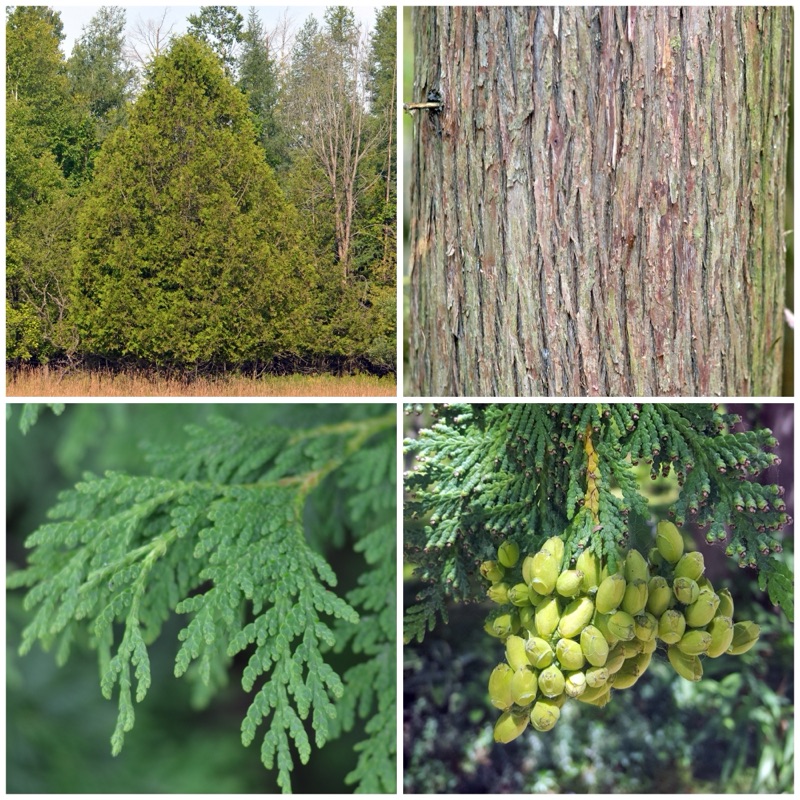 Photo Credits: Ontario.ca
Common Name:Northern White Cedar
Scientific Name: Thuja occidentalis
Other Common Names:Eastern White Cedar, Arborvitae, American Arborvitae, Eastern Arborvitae, Swamp Cedar, or American White Cedar.
Genus: Thuja
Native Range: Southern Canada, Eastern Canada, and Northern United States.
Colours: yellowish green, bright green, reddish brown, green, and brown.
Flower:The Northern White Cedar doesn’t have typical flowers like other plants do, because it is a species of Cedar. Instead this tree produces small cone like structures called strobili.
Foliage: Scale like leaves that are arranged in flat tended, and fan shaped sprays along the branches. They typically have a yellowish green colour.
Height:Typically reaches a height of 40 - 50 feet (12 - 15 meters) tall.
Width: Typically reaches a width of 10 - 20 feet (3 - 6 meters) wide.
Bloom Time:April
Most Distinctive Feature: Is their scale like foliage that is aromatic, which is arranged in fan shaped flattened sprays along the branches.
Moisture Requirements:moist to dry conditions
Northern White Cedar prefers consistently moist conditions, but it does not like to be waterlogged.
Soil Type: sandy, loamy, clay, or limestone soils that have a ph of neutral or slightly alkaline and is well drained.
Light Exposure:
Full Sun ☀️ to Partial Shade 🌥️
Spread:slow spreading plant
Host Plant: Yes, the Northern White Cedar is a host plant for a local butterfly species and moth species. It is a host plant for the Banded Hairstreak Butterfly, Cedar Leaf-miner Moth, Thuja Mining Moth, and Brown Cedar Miner Moth.
Wildlife Benefits: Its dense foliage offers excellent cover for various bird species and small mammals during inclement weather and harsh winters.
The dense branches of Northern White Cedar provide an excellent nesting site for various birds and small mammals.
The bark, and foliage of the Northern White Cedar provide a crucial food source for deer, rabbits, and porcupines especially during the fall and winter when other food sources are scarce.
The cones and the seeds that the Northern White Cedar provide an excellent food source for various birds such as chickadees, cardinals, bluejays, finches, sparrows, and woodpeckers. Small mammals such as squirrels, chipmunks, and rabbits may feed on the cones and seeds occasionally when other food sources are not available to them.
The Northern White Cedar acts as a host plant for the Banded Hairstreak Butterfly, Cedar leaf - miner Moth, Thuja Mining Moth, and Brown Cedar Miner Moth. The females of these butterfly species and moth species lay their eggs on the foliage, and once the caterpillars hatch from their eggs the leaves become a food source for them.
Hardiness Zones: Zones 2 through 7
Season Interest: Spring 🌸, Summer 💐, Fall 🍂, and Winter ❄️.
Repels: Termites, Carpet Beetles, Cockroaches, Fleas, Ticks, Ants, Aphids, and Mosquitoes.
The Northern White Cedar (Thuja occidentalis) is an evergreen conifer that is easily identified by its scale like leaves that form flat fan - like sprays.
Male and female flowers are cone like structures called strobili, both borne on separate twigs or branchlets of the same branch. Male cones are round, 1/16 inch long with brownish scales on a short, stout stem at the branchlet tip.
Female flower cones appear as several ranks of dark tipped tan scales at branchlet tips, also little more than 1/16 inch long.
Leaves are opposite, scale-like with abruptly pointed tips, 1/10 (or less) to ¼ inch long, in bead-like ranks along the branch in two pairs, each pair perpendicular to the other, the outer pair lateral and wrapping around the more flattened, inner pair. Leaves are bright green through the first winter then turn brown and woody and persist for several years.
Trunks are up to 50 inches in diameter, with thin, grayish brown bark in long, thin and flattened vertical ridges that can loosen in flat strips over time. Branchlets form a flat fan-like spray, covered with the green and brown scale-like leaves, bark on small twigs smooth and reddish brown. Branches may take root where they touch the ground.
Fruit is an egg-shaped cone, 1/3 to ½ inch long, green to pinkish brown when immature, turning dark brown at maturity with cone scales opening to release seeds in the fall.
Each cone contains about 8 seeds. The seeds are generally elliptic, flattened, winged, and about ¼ inch long including the wings.
Wild Bergamot (Monarda fistulosa)
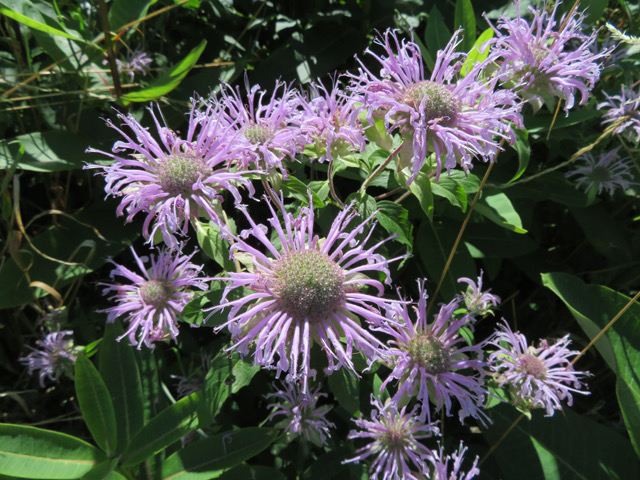 Photo Credits: Thomas L. Muller
Common Name:Wild Bergamot
Scientific Name:Monarda fistulosa
Other Common Names: Bee Balm, Oswego Tea, Horsemint, Mint - leaf Beebalm, or Purple Beebalm.
Genus: Monarda
Native Range: Eastern United States, Central United States, Southern Canada, Southwestern Canada, and Western Canada.
Colours: pink, lavender, white, purple, green, and yellow.
Flower: Fragrant and tubular flowers that are clustered in pom pom shaped heads that typically bloom in shades of pink, purple, lavender that sometimes have a whitish purplish tinge.
Foliage: Opposite, oval, or lance shaped leaves with finely toothed edges and a slightly fuzzy texture.
Height:Typically reaches a height of 2 to 4 feet (60 - 120 cm) tall.
Width:Typically reaches a width of 2 to 3 feet (60 - 90 cm) wide.
Bloom Time:July to September
Most Distinctive Feature: Is it’s unique, and fragrant foliage and flowers that smell like bergamot orange to mint.
Moisture Requirements:dry to medium moisture conditions
Wild Bergamot prefers normal to moist conditions in an area that it is planted.
Soil Type: sand, loam, or clay soils that is rich in organic matter or hummus and is well drained.
Light Exposure: Full Sun ☀️
Spread:moderate to fast spreading plant
Host Plant: Yes, the Wild Bergamot is a host plant for a few local moth species. It is a host plant for the Hermit Sphinx Moth, Orange Mint Moth, Snout Moth, and Raspberry Pyrausta Moth.
Wildlife Benefits: The flowers that the Wild Bergamot produces attracts pollinators such as bees, butterflies, hummingbird moths, and hummingbirds.
The plant provides both nectar and pollen in their flowers which are a crucial food source for pollinators such as hummingbirds, bees, butterflies, hummingbird moths, and other beneficial insects.
It acts as a host plant for local moth species such as the Hermit Sphinx Moth, Orange Mint Moth, Snout Moth, and Raspberry Pyrausta Moth. The females of these moth species will lay their eggs on the leaves, and once the caterpillars hatch the leaves become food for them.
Hardiness Zones: Zones 3 through 7
Season Interest: Mid Summer 💐 into Fall 🍂
Repels: Deer, Rabbits, Aphids, Japanese Beetles, Mosquitoes, other Beetles, and other biting Insects.
The Wild Bergamot (Monarda fistulosa) is a perennial herb that is native to North America including Canada and The United States.
The flowers are arranged in dense, rounded clusters at the ends of the stems. They are typically lavender to pinkish-purple, but can also be white. The individual flowers are tubular, with a curved lower lip and a straight upper lip. The stamens extend beyond the upper lip.
The leaves are opposite (paired), lance-shaped, and have toothed (serrated) edges. They are typically 2-4 inches long, green, and may have a reddish tinge on the edges, and are often hairy.
Wild bergamot has square stems, a characteristic of the mint family, which can be green or reddish-brown and may be smooth or hairy.
When crushed, the leaves and stems of wild bergamot have a distinct, aromatic, mint-like or oregano-like fragrance.
Wild Geranium (Geranium maculatum)
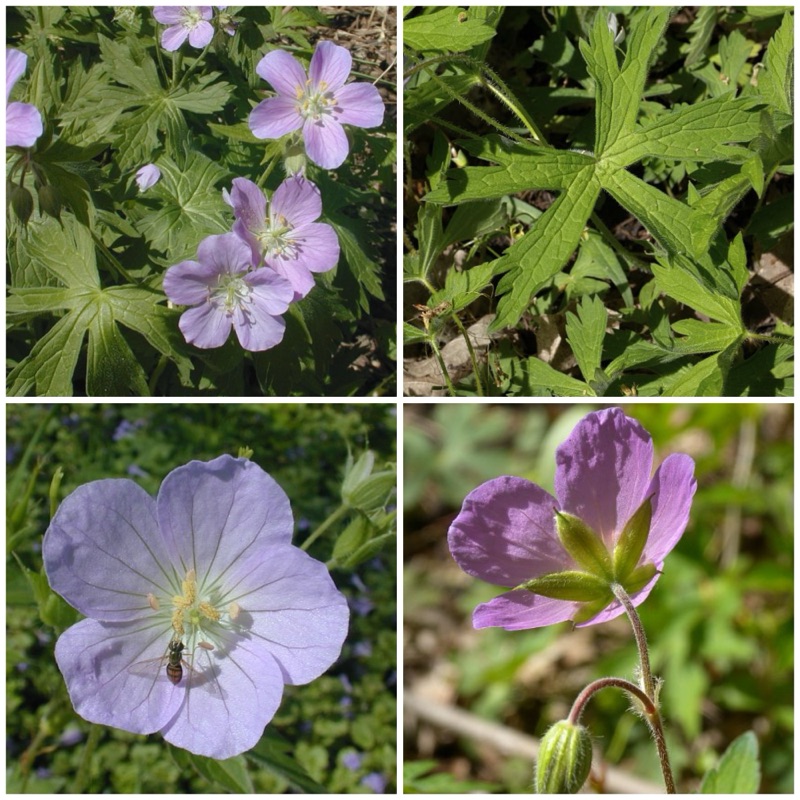 Photo Credits: Iillnoiswildflowers.info
Common Name:Wild Geranium
Scientific Name:Geranium maculatum
Other Common Names: Cranesbill, Spotted Geranium, Wood Geranium, or Alumroot.
Genus: Geranium
Native Range: Southern Ontario, Southwestern Quebec, Northern United States, Southern United States, Eastern United States, Northeastern United States, and Central United States.
Colours: pink to lavender, rose pink, and dark green.
Flower:Small flowers that are rounded and have a total of 5 petals, and the colours vary from pink, lavender, or rose pink.
Foliage: The leaves are deeply lobed, and palmately divided that form a mound. The colour of the leaves is typically dark green.
Height:Typically reaches a height of 18 - 24 inches (45 - 60 cm) tall.
Width: Typically reaches a width of 12 - 18 inches (30 - 45 cm) wide.
Bloom Time:May to June
Most Distinctive Feature: Is their five petaled pink to lavender flowers that are borne in loose clusters at the ends of stems.
Moisture Requirements: medium moisture
Soil Type: loam, sandy loam, or clay loam that has a ph of slightly acidic to neutral that is rich in organic matter, and has good drainage.
Light Exposure: Full Sun ☀️ to Partial Shade 🌥️
Spread:a fast spreading plant
Host Plant: Yes, the Wild Geranium is a host plant for two local moth species. It is a host plant for the White - marked Tussock Moth and the Leafmining Moth.
Wildlife Benefits: The small pink to lavender five petaled flowers attract bees, butterflies, and pollinating flies.
The flowers provide both nectar and pollen for a variety of pollinators such as bumblebees, mason bees, halictid bees, cuckoo bees, mining bees, leaf cutter bees, skipper butterflies, gossamer - winged butterflies, other small butterflies, pollinating flies, and pollinating beetles.
The females of the White - marked Tussock Moth and the Leafmining Moth lay their eggs on the foliage, and once the eggs hatch the caterpillars feed on the leaves of Wild Geranium.
The seeds that this plant produces once the flowering is complete provides an excellent food source for a variety of songbirds, and other bird species.
Hardiness Zones: Zones 3 through 8
Season Interest: Late Spring and Early Summer
Repels: deer, rabbits, cabbage worms, corn earworms, japanese beetles, and aphids.
The Wild Geranium (Geranium maculatum) is a low growing perennial flowering plant that is a native wildflower.
Small clusters of a few flowers each branching off the top of the plant. Flowers are 1 to 1½ inches across, 5 rounded pink to lavender (rarely white) petals and 10 stamens with yellow tips that turn brown with age. The petals are streaked with darker lines along the length, and often fade to white at the base. The 5 green sepals behind the flower are about half as long as the petals, and hairy.
Basal leaves are long stalked, 3 to 6 inches across and deeply divided into 3 to 7 lobes, which may be further divided with coarse, mostly rounded teeth. A pair of smaller, short-stalked leaves sits at the base of a flower cluster. Leaves and stems are both hairy.
Fruit is an erect capsule-like structure to 1½ inches long with the persistent sepals around the base. In the center is a slender column divided into five sections, each attached at its base to an oval shaped carpel containing a single seed.
At maturity, the sections split apart from the base along the seams, causing the dried carpels to spring up and eject the seeds away from the mother plant.
Wild Ginger (Asarum canadense)
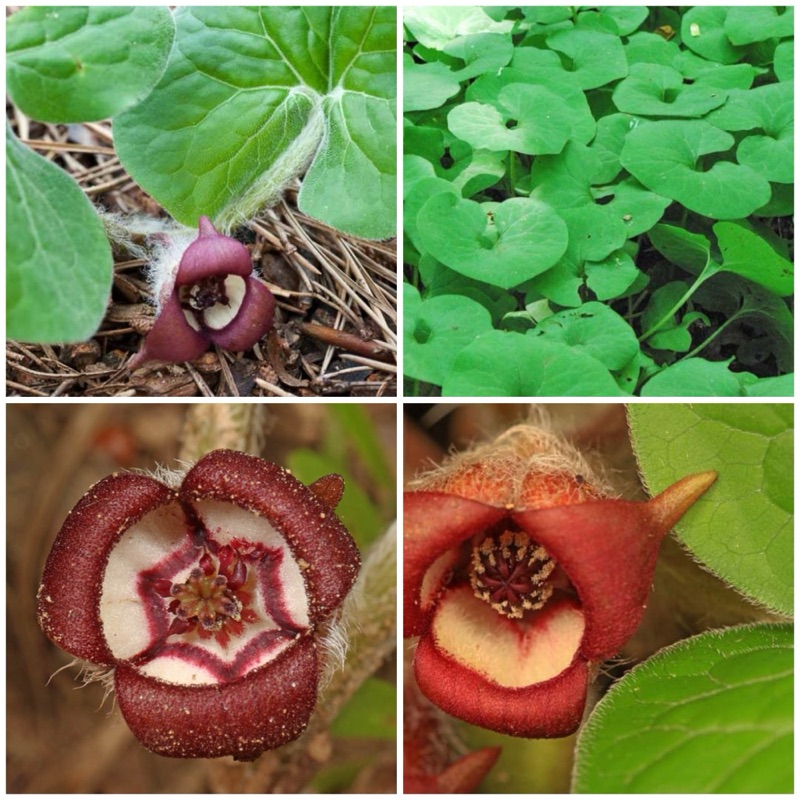 Photo Credits: Bruce Kirchhoff, Judy Gallagher, Flickr, and Gerry Bishop / Shutterstock
Common Name:Wild Ginger
Scientific Name:Asarum canadense
Other Common Names: Canadian Wild Ginger, Woodland Ginger, Heart Snakeroot, Indian Ginger, Ginger Root, Canadian Snakeroot, or Broad - leaved Ginger.
Genus: Asarum
Native Range: Southeastern Canada and Southeastern United States.
Colours: dark reddish purple, brownish red, and green.
Flower:The flowers are unique and inconspicuous that are typically a dark reddish brown or dark reddish purple colour, and are shaped like a bell or a three lobed cup.
Foliage: The leaves are large in size and are heart shaped to kidney shaped that are typically dark green and glossy.
Height:Typically reaches a height of 6 to 12 inches (15 to 30 cm) tall.
Width: Typically reaches a width of 12 to 18 inches (30 to 45 cm) wide.
Bloom Time:Typically blooms from late April to early May, and sometimes the bloom time extends into the month of June.
Most Distinctive Feature: Is it’s heart shaped or kidney shaped leaves that are dark green in colour.
Moisture Requirements:moist conditions but the location needs to have good drainage.
Soil Type: loamy or humus rich soils that has a ph of slightly acidic to neutral, and are well drained.
Light Exposure: Partial shade 🌥️ to Full Shade ☁️
Spread:It is a moderate or fast spreading and growing plant.
Host Plant: Yes, the Wild Ginger is a host plant to a local butterfly species. It is a host plant for the Pipevine Swallowtail, which is one of our species at risks here in Ontario.
Wildlife Benefits: The flowers of Wild Ginger attracts flies and beetles.
The Wild Ginger’s flowers provide nectar and pollen for pollinating flies and pollinating beetles.
The females of the Pipevine Swallowtail lay their eggs on the foliage and the stems of the plant, and once the caterpillars hatch the leaves on Wild Ginger become a food source for the caterpillars.
The seeds that this plant produces once the flowering is finished attracts ants, and these seeds provide an important food source for the ants. Once the ants eat a part of the seeds, they will discard them so new plants can be created.
The dense foliage and covering provides excellent shelter for insects, amphibians, reptiles, and small animals from inclement weather and predators.
Hardiness Zones: Zones 3 through 8
Season Interest: Spring 🌸, Summer 💐, and Fall 🍂.
Repels: deer, rabbits, some insects, garlic mustard (invasive plant), and other invasive plants.
The Wild Ginger (Asarum canadense) is a low growing shade loving perennial plant that has unique flowers and foliage.
Flower is tubular/bowl-shaped with 3 dark red to brown triangular petal-like sepals with elongated tips. The tube is ¾ to 1 inch across; the flower is up to 2 inches across from tip to tip. The inside of the tube is creamy white; in the center is a ring of 12 stamens around the 6 reddish brown styles. The outside of the tube is covered in long white hairs, especially near the base. A plant has a single flower that lies on the ground at the base of the plant.
Each plant has a pair of basal leaves on stalks up to 6 inches long. Leaves are heart to kidney shaped with a pointed or rounded tip and a deep cleft at the base, the underside densely covered in soft hairs. The leaf stalks are gray-white, also densely covered with soft white hairs. On a mature plant, leaves are 6 to 8 inches long and wide, but are less than half that size when the plant first blooms. When leaves first emerge they are folded up and flat like a book, but unfurl within a couple days.
Fruit is a capsule containing many seeds.
Scarlet Beebalm (Monarda didyma)
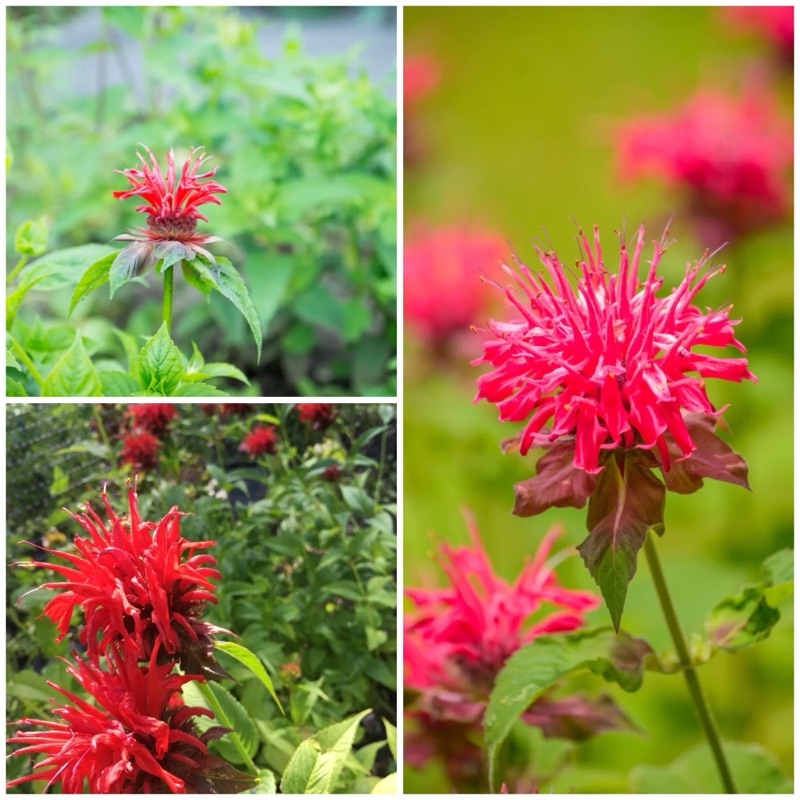 Photo Credits: directnativeplants.com
Common Name:Scarlet Beebalm
Scientific Name:Monarda didyma
Other Common Names: Oswego Tea, Crimson Beebalm, Red Bergamot, or Beebalm
Genus: Monarda
Native Range: Ontario Canada, Northeastern United States, Midwestern United States, and Southern United States.
Colours: scarlet red, red, purple, and green
Flower:Bright red tubular flowers that are arranged in dense rounded heads atop the square stems.
Foliage: The leaves are opposite, ovate, or ovate - lanceolate shaped and are dark green in colour that are 3 to 6 inches long.
Height:Typically reaches a height of 2 to 4 feet (0.6 to 1.2 metres) tall.
Width: Typically reaches a width of 1.5 to 2 feet (0.45 to 0.6 metres) wide.
Bloom Time:June to August
Most Distinctive Feature: Is it’s vibrant scarlet red tubular flowers that are arranged in dense rounded heads atop of the square hairy stems.
Moisture Requirements:moist conditions and the area needs to have good drainage.
Soil Type: loamy, clay, or sandy soils that have a ph of slightly acidic to neutral and is well drained.
Light Exposure: Full Sun ☀️
Spread:a fast spreading plant
Host Plant: Yes, the Scarlet Bee Balm is a host plant for three local moth species. It is a host plant for the Hermit Sphinx Moth, Raspberry Pyrausta Moth, and Orange Mint Moth.
Wildlife Benefits: The unique flowers attract a wide variety of pollinators such as butterflies, bees, pollinating moths, beetles, hummingbirds, and other pollinating insects.
The flowers of Scarlet Bee Balm provide both nectar and pollen for local pollinators such as bumblebees, mason bees, mining bees, sweat bees, leaf cutter bees, cuckoo bees, wasps, beetles,butterflies, hummingbirds, pollinating moths, and other pollinators.
The seeds that this plant produces once the flowering is complete provide an important food source for local songbirds and other bird species.
The dense foliage of Scarlet Bee Balm provides an excellent habitat and shelter for local insects and bugs.
The females of the Hermit Sphinx Moth, Raspberry Pyrausta Moth, and Orange Mint Moth lay their eggs on Scarlet Bee Balm and once the caterpillars hatch the leaves become a food source for them.
Hardiness Zones: Zones 4 through 9
Season Interest: Spring 🌸, Summer 💐, and Fall 🍂.
Repels: deer, rabbits, mosquitoes, aphids, and other insects.
The Scarlet Beebalm (Monarda didyma) is a herbaceous perennial wildflower that is deciduous and has a clump forming habitat.
The scarlet flowers are in a compact rounded 2-4 inch head, usually single and terminal. Each flower head is subtended by a whorl of showy, red-tinged, leafy bracts. Flowers are zygomorphic and are borne in 1-2 whorls. Flowers are 13-15 veined, have 5 teeth, and the corolla is narrowly tubular. Lobes of flowers are 2-lipped, erect and spreading. The upper lobe is longer than the lower lobe.
6 inch long lance-shaped to ovate fragrant leaves with serrated margins. Undersides have spreading hairs.
Stems are square and thinly pilose.
The fruit is ovoid nutlets display from September to October.
Incorporating native Ontario plants that naturally repel pests is more than just a gardening choice, it’s a step toward a healthier ecosystem, a more sustainable landscape, and a chemical-free future.
By embracing species like wild bergamot, wild ginger, and wild geranium homeowners can protect their gardens while supporting local pollinators and biodiversity. It’s time we rethink our approach to pest control and let nature do what it does best. Plant with purpose your garden and the planet will thank you.
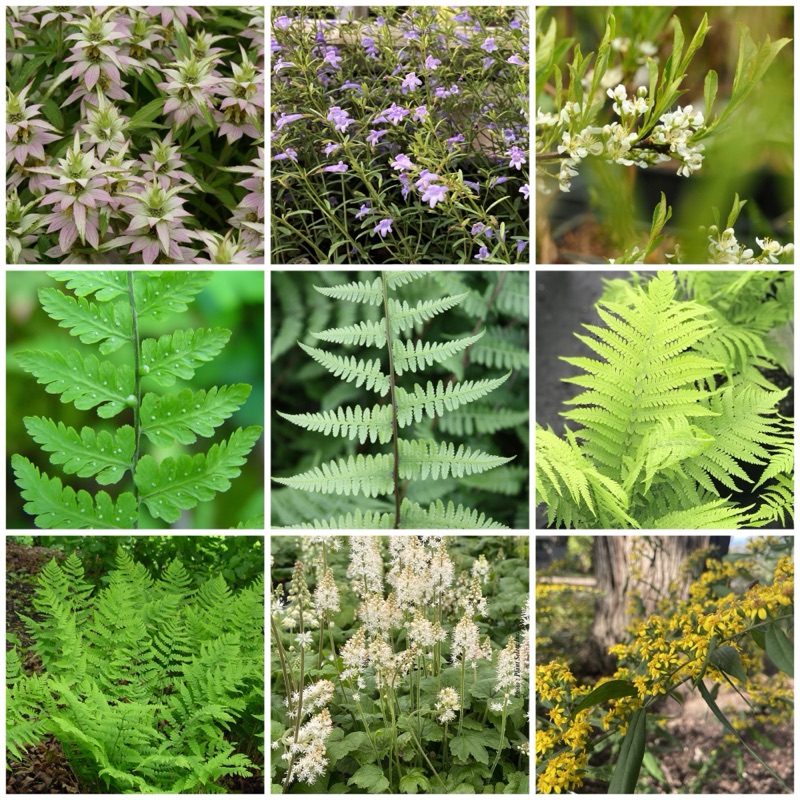
Photo Credits: bumbleseeds.com, Ontario Native Plants, Rooted By The Bluffs, Arthur Haines, Hoffie Nursery, Saunders Brothers, White Flower Farm, Jardin 2M, and midwestgroundcovers.com.
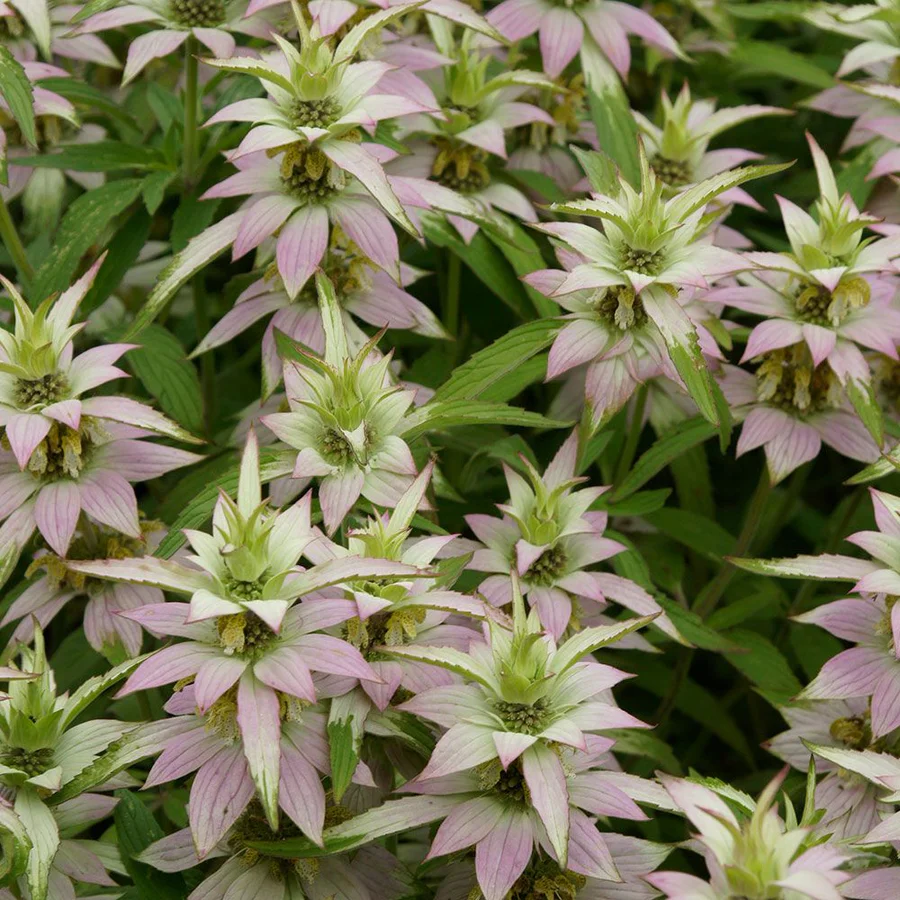
Photo Credits: bumbleseeds.com
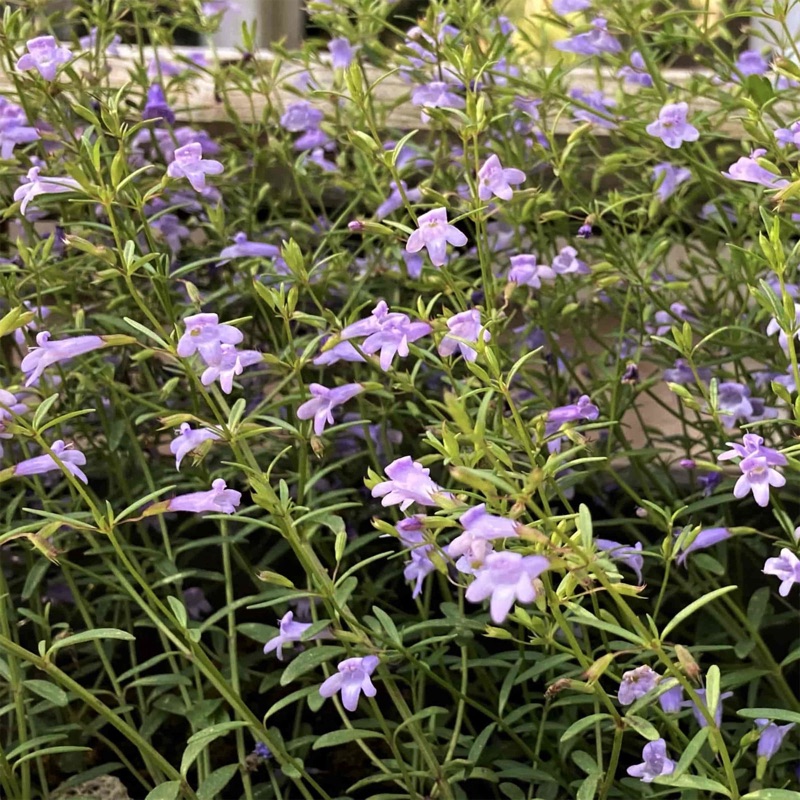
Photo Credits: Ontario Native Plants
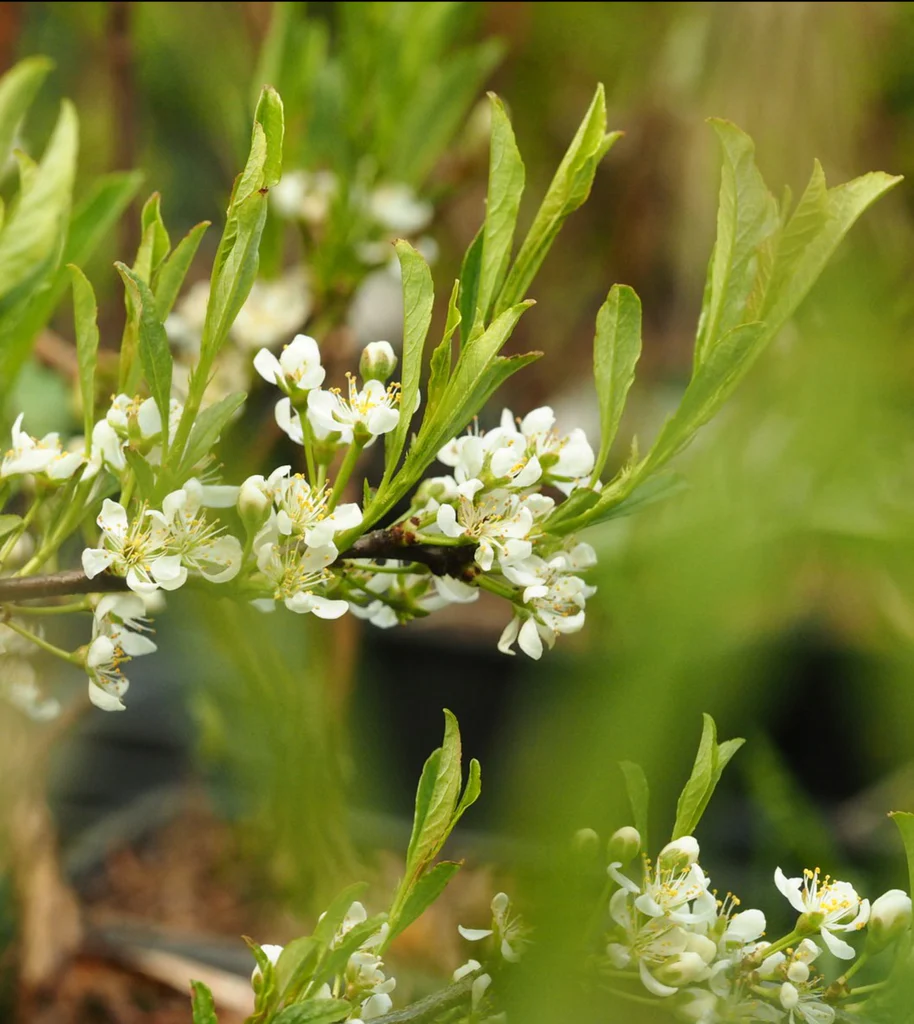
Photo Credits: Rooted By The Bluffs
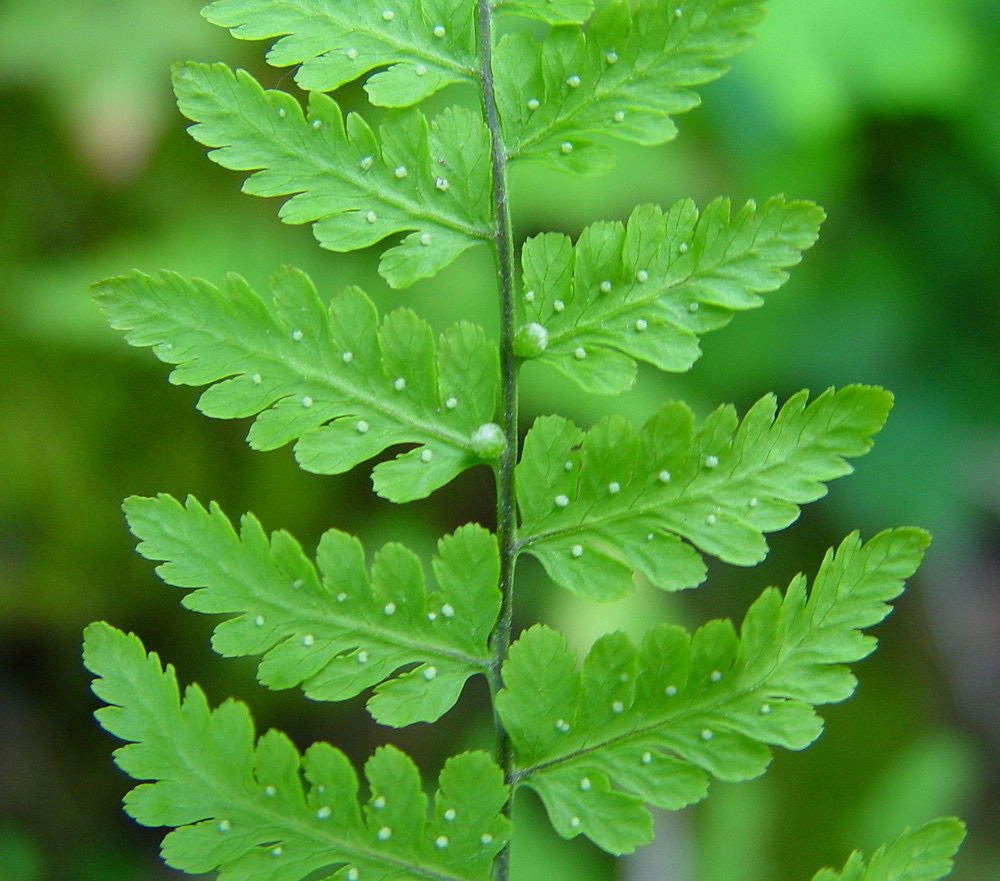
Photo Credits: Arthur Haines
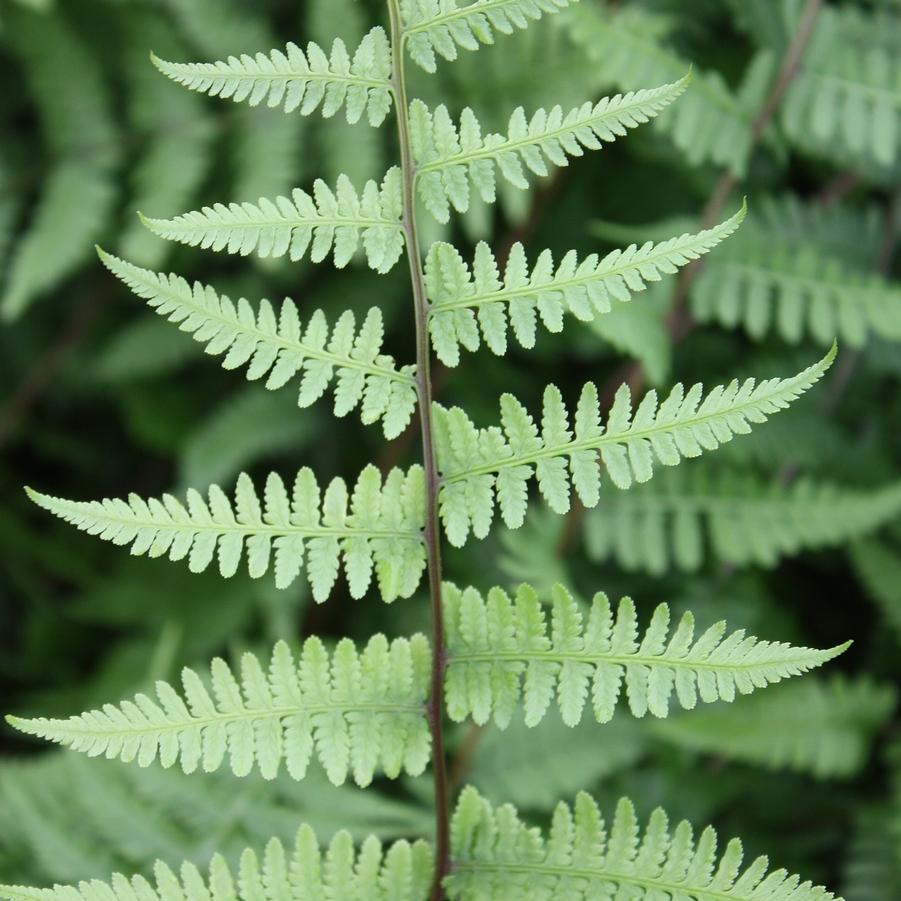
Photo Credits: Hoffie Nursery
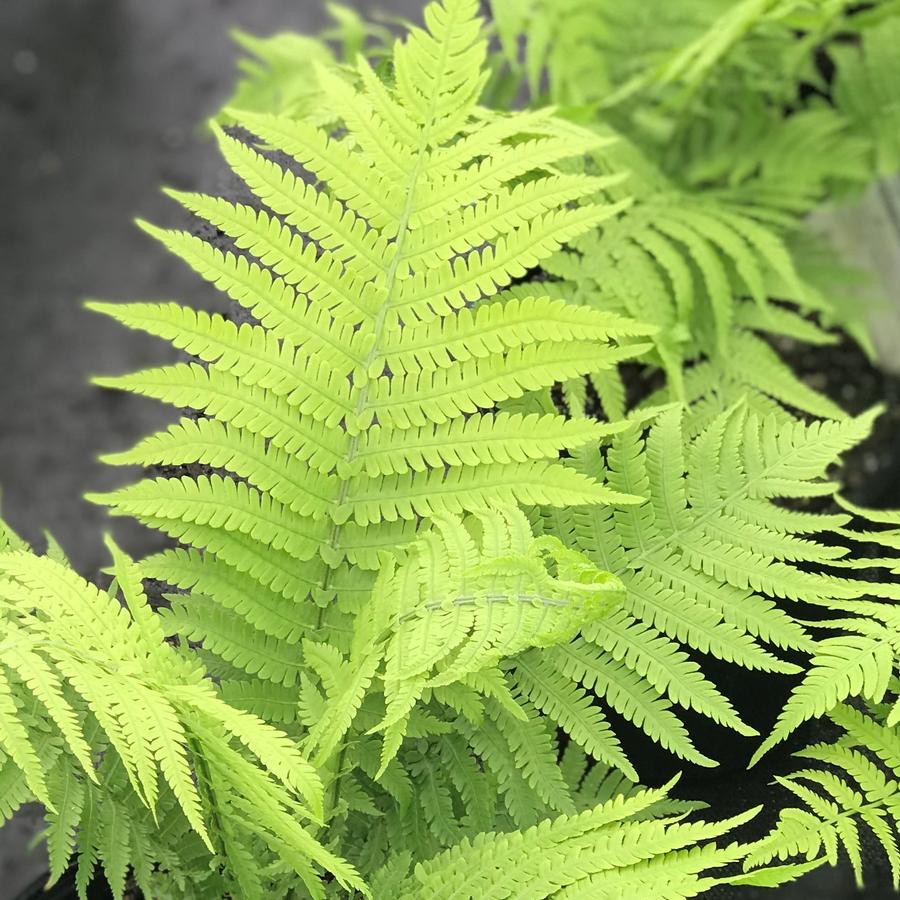
Photo Credits: Saunders Brothers
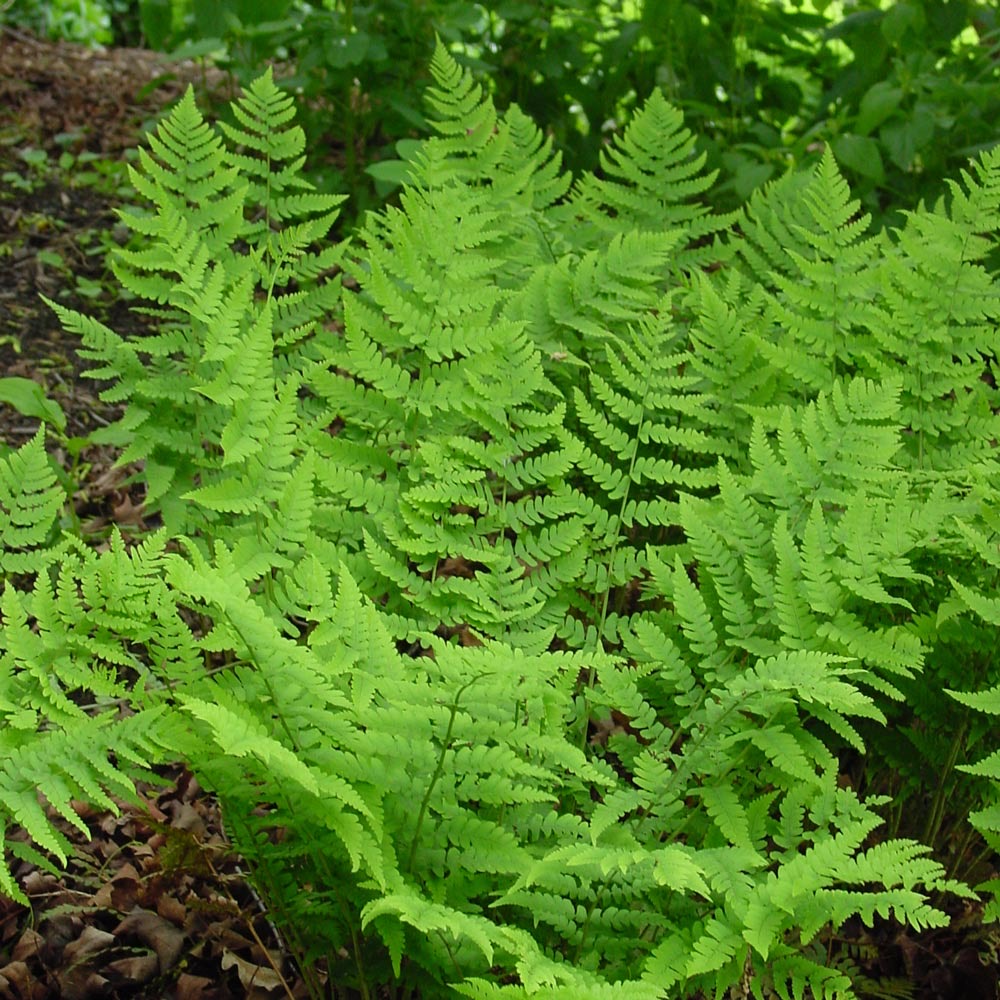
Photo Credits: White Flower Farm
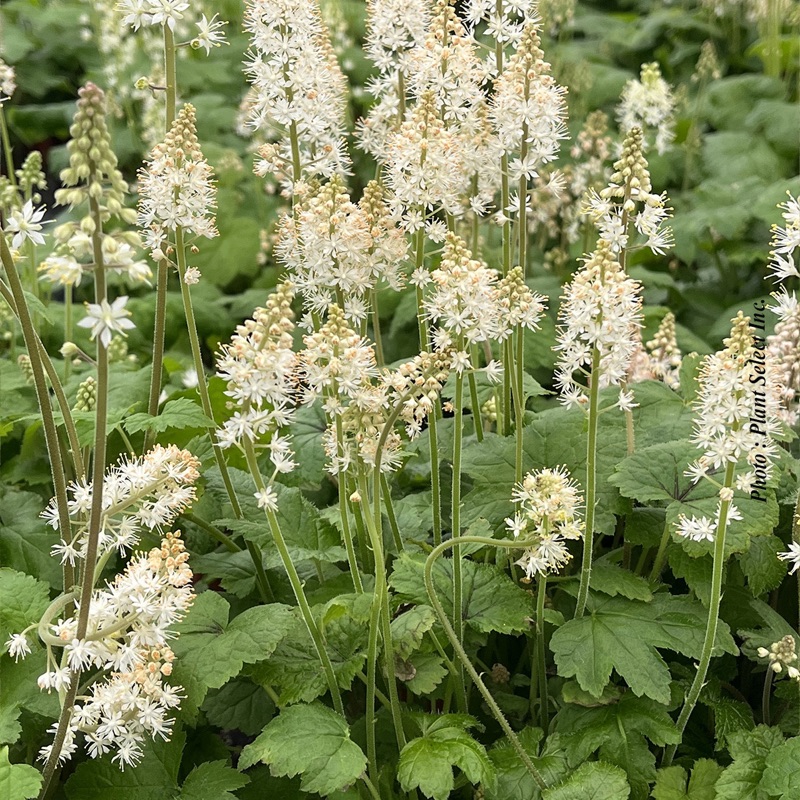
Photo Credits: Jardin 2M
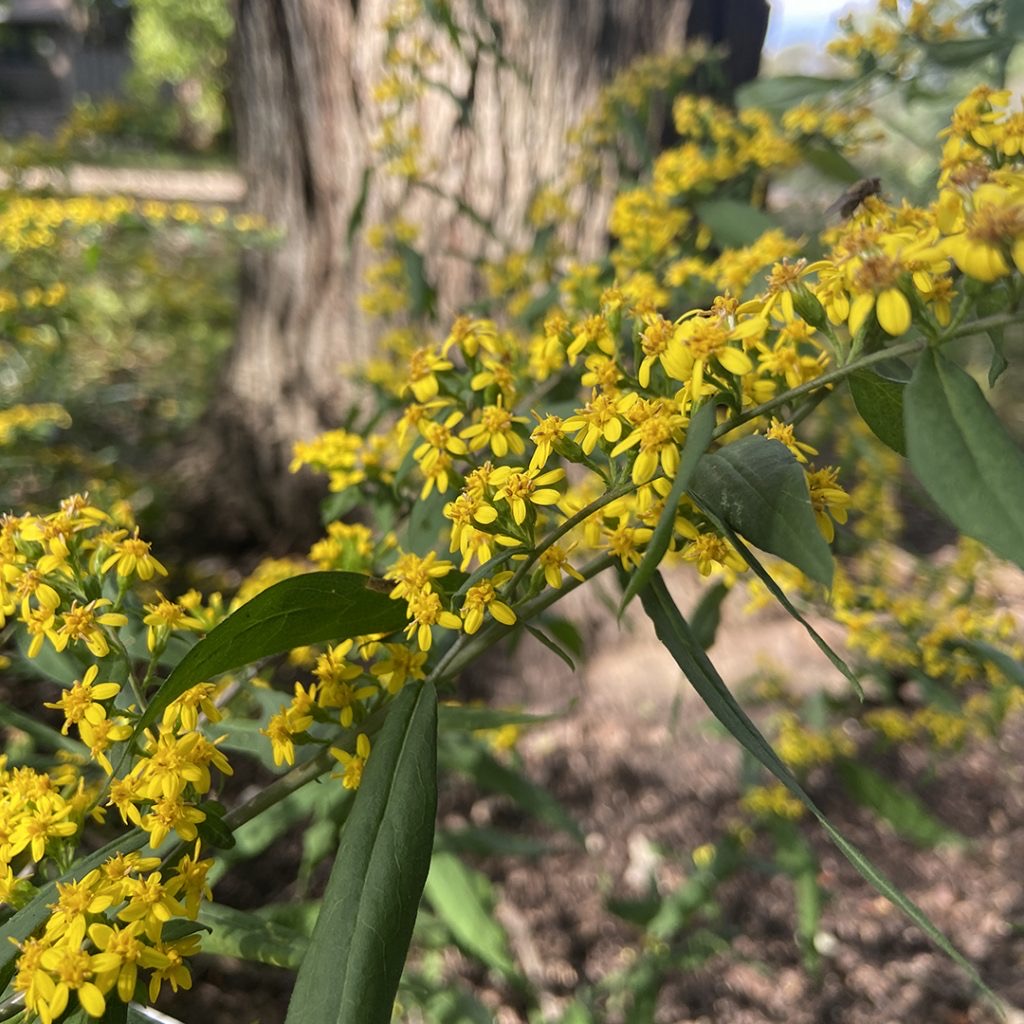
Photo Credits: midwestgroundcovers.com


Comments
Post a Comment