Wings of Ontario: A Guide to the Most Common Butterflies
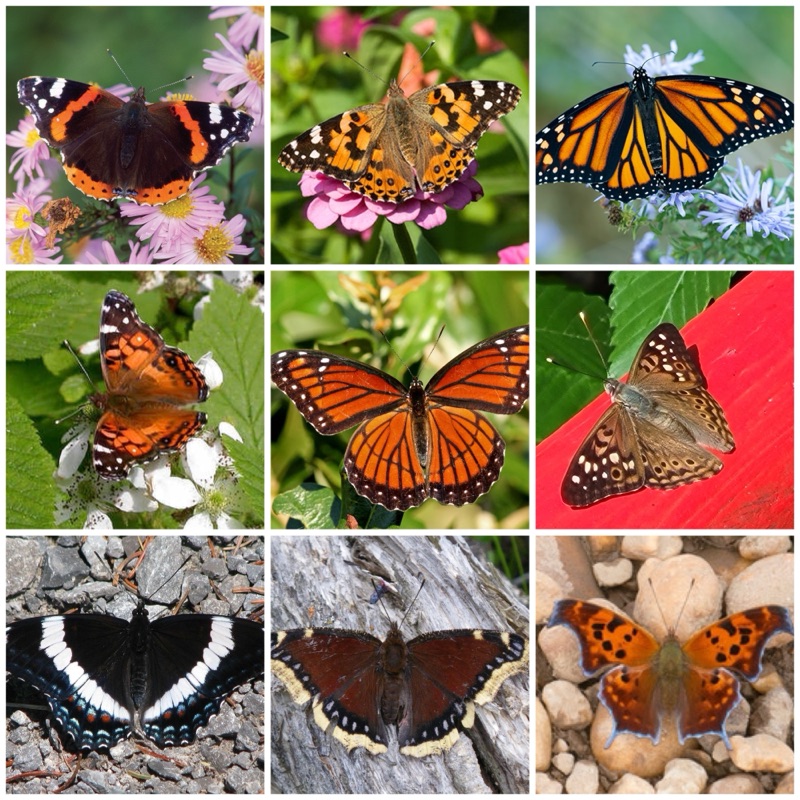
Ontario is a fluttering paradise for butterfly enthusiasts, boasting a dazzling array of species that paint the skies with vibrant hues. From the striking Monarchs gracefully migrating across the province to the delicate Eastern Tailed-Blues flitting through wildflower fields, these winged wonders are more than just beautiful, they play a vital role in pollination and ecosystem health. In this article, we'll take a closer look at Ontario's most common butterfly species, uncovering their unique traits, habitats, and the fascinating ways they contribute to the natural world. Get ready to be captivated by nature's most enchanting aerial artists!
Red Admiral (Vanessa atalanta)
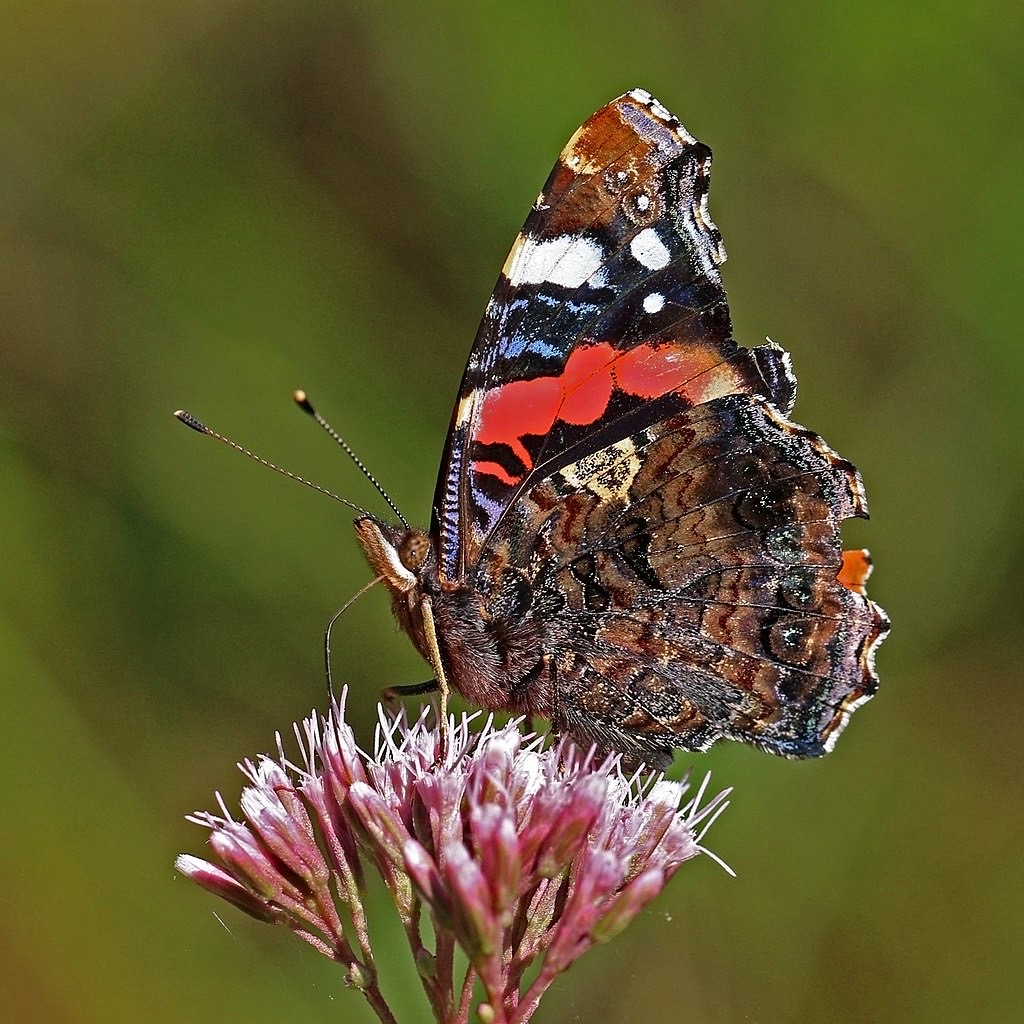 Red Admiral sipping nectar from the flowers on Joe Pye Weed with their wings closed. Photo Credits: Charles J. Sharp
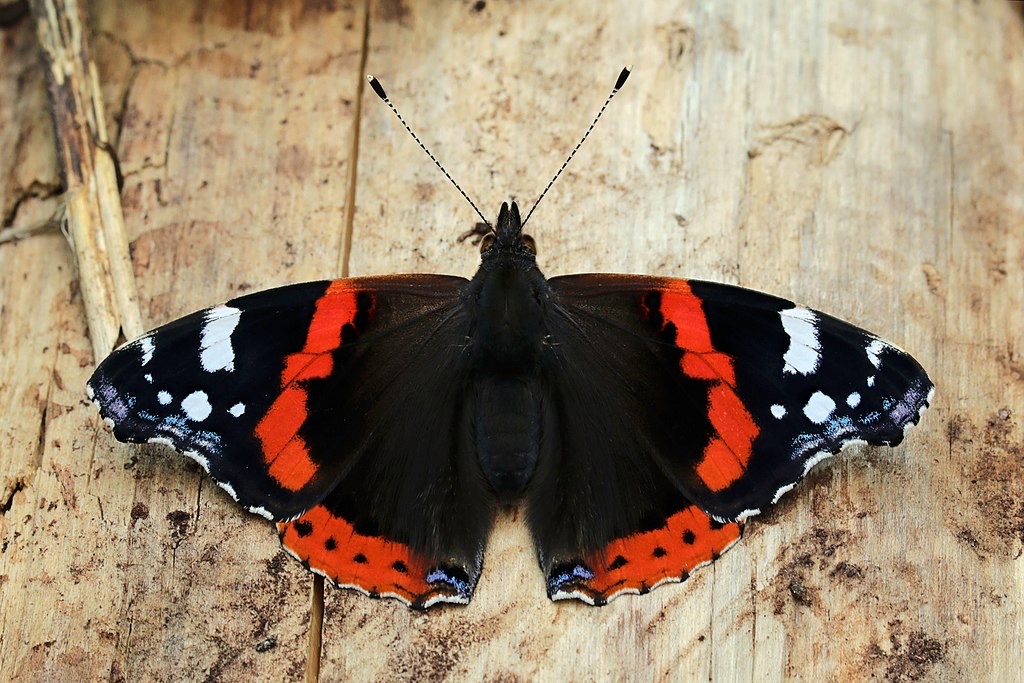 Red Admiral resting on wood with their wings opened. Photo Credits: Charles J. Sharp
Common Name: Red Admiral
Scientific Name: Vanessa atalanta
Other Common Names: Red Admirable
Genus: Vanessa
Most Commonly Seen: clearings in woods, vacant lots, gardens, and urban areas.
Colour: black, orange, and white
Wings: has vibrant black and bright orangish red wings with white spots or markings on the tips.
Most Distinctive Features: Is their striking black wings with broad bright orangish red bands on the forewings, and complemented by white spots on the tips of the forewings.
Wingspan: 1 3/4 to 3 inches (4.5 to 7.6 cm).
Some sources say that their wingspan can get up to 6.5 to 7.5 cm in length.
Native: Yes, the Red Admiral is a butterfly species that is native to the province of Ontario as well as other parts of Canada.
Native Range: In North America they range from southern Canada and the US to northern Mexico. They are also found in Europe and northern Asia. In Canada, they are seen from coast to coast, including Newfoundland and as far north as Churchill, Manitoba. They are also found in Yukon and the Northwest Territories.
Sightings: May through October
Flight Period: While they can be seen throughout their flight period, there are often three noticeable peaks which include May, July, and late August to early September.
Flight Pattern: erratic and rapid
Lifespan: The lifespan varies depending on the generation. For the summer generation, the butterflies that are in this generation live only for a few weeks up to a couple of months. Then for the winter generation (overwinters), the butterflies live up to 10 months.
Host Plants:
🌿 Stinging Nettle (Urtica dioica)
🌿 False Nettle (Boehmeria cylindrica)
🌿 Wood Nettle (Laportea canadensis)
Adult Food Source: The red admiral prefers sap flows on trees, fermenting fruit, and bird droppings. They visit flowers only when their main nectar sources are not available. The adults will nectar feed on common milkweed, red clover, aster, alfalfa, buttonbush, pussy willow, lavender, and sunflowers.
The Red Admiral (Vanessa atalanta) is a medium sized butterfly, which is one of the butterfly species that can be seen in gardens frequently. This butterfly is a member of The Brush - footed Butterflies Family.
The forewing of this butterfly bears on a black ground an oblique vermilion band and a group of white subapical spots. On the hindwing the larger portion of the distal margin is red, with a row of small black spots and at the anal angle an elongate blue spot.
The underside is partly variegated with blue; the forewing is on the whole similar in markings to the upper, while the hindwing is brightly variegated and clouded, bearing black markings, of which those in the cell resemble a figure (on the left wing 18 or 98, on the right 81 or 89); in the middle of the costal area there is a pale patch and in the distal marginal area a row of ocellus-like spots. Sometimes, especially in the female, the red band of the forewing bears a small white spot in the middle.
Painted Lady (Vanessa cardui)
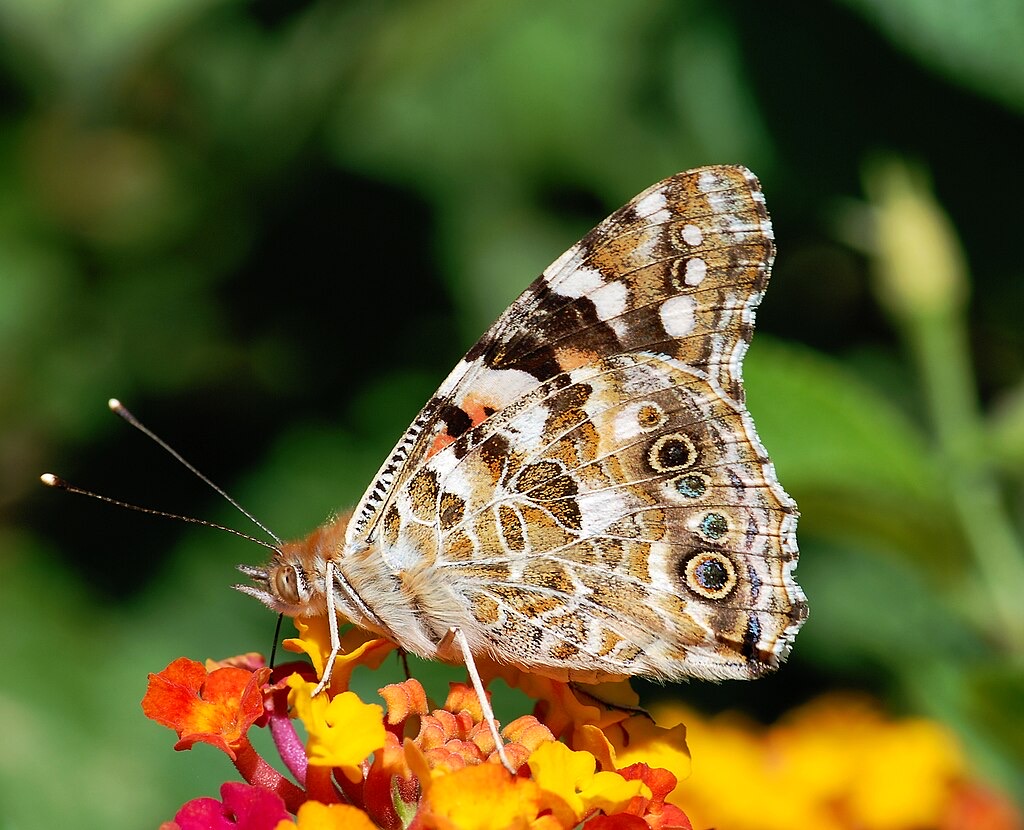 Painted Lady sipping nectar from lantana with their wings closed. Photo Credits: Alvesgaspar
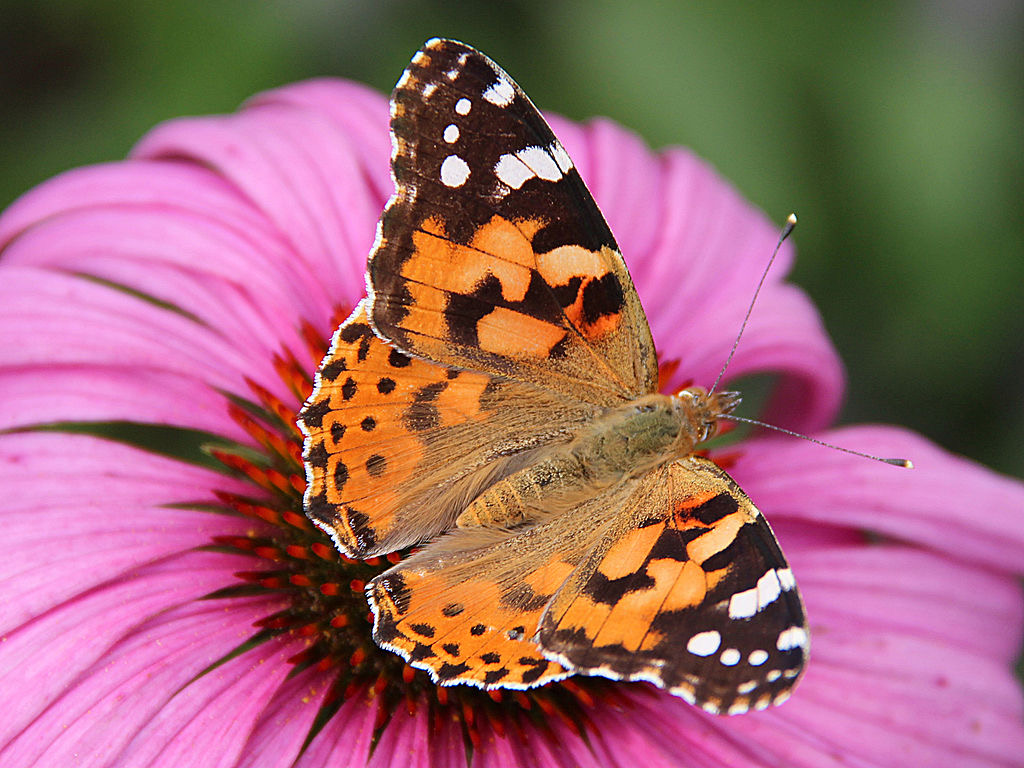 Painted Lady sipping nectar from a purple coneflower with their wings opened. Photo Credits: Jean Pol GRANDMONT
Common Name: Painted Lady
Scientific Name: Vanessa cardui
Other Common Names: Cosmopolitan Butterfly
Genus: Vanessa
Most Commonly Seen: In fields, meadows, gardens, roadsides, and even city streets.
Colour: orange, brown, black, white, and grey.
Wings: Has orange - brown wings with black tips on the forewings, featuring white spots. The hindwings have a row of black spots, and the underside is a mix of brown, grey, and black with small eyespots.
Most Distinctive Features: Their striking orange and brown wings with black and white markings.
Wingspan: 4 - 7.3 cm wide
Native: Yes, the Painted Lady butterfly is a native butterfly species in the province of Ontario and other parts of Canada.
Native Range: Their native range is worldwide where they’re found on all continents except for Antarctica and possibly Australia.
Sightings: May to October
Flight Period: They are generally flying from May to October, with peak numbers in early May and August.
Flight Pattern: They fly low to the ground often near nectar rich flowers to feed and to find a mate.
Lifespan: Typically lives for 2 to 4 weeks
Host Plants:
🌿 Field Pussytoes (Antennaria neglecta) Native
🌿 Pearly Everlasting (Anaphalis margaritacea) Native
🌿 False Sunflower (Heliopsis helianthoides) Native
🌿 Woodland Sunflower (Helianthus microcephalus) Native
🌿 Holly Hocks Non - Native
Adult Food Source: The painted lady prefers nectar from composites flowering plants that are 3 - 6 feet high especially field thistle (Cirsium discolor), dense blazing star (Liatris spicata), cylindrical blazing star (Liatris cylindracea), tall Ironweed (Vernonia gigantea), sweet joe pye weed (Eutrochium purpureum), spotted joe pye weed (Eutrochium maculatum), buttonbush (Cephalanthus occidentalis), swamp milkweed (Asclepias incarnata), butterfly weed (Asclepias tuberosa), new england aster (Symphyotrichum novae-angliae), smooth aster (Symphyotrichum laeve), and white wood aster (Eurybia divaricata).
The Painted Lady (Vanessa cardui) is a medium sized butterfly that is one of the most common butterfly species that can be seen in gardens. This butterfly is a member of The Brush - footed Butterflies Family.
The upperside of their wings has a background colour that is a pale orange - brown colour.
The forewings have black tips with white spots, particularly along the leading edge (costal margin).
On the hindwings of this butterfly they feature rows of black spots, sometimes with blue scales in the submarginal row.
The underside of their wings is a mix of brown, grey, and black with small eye spots on the hindwings.
Monarch (Danaus plexippus)
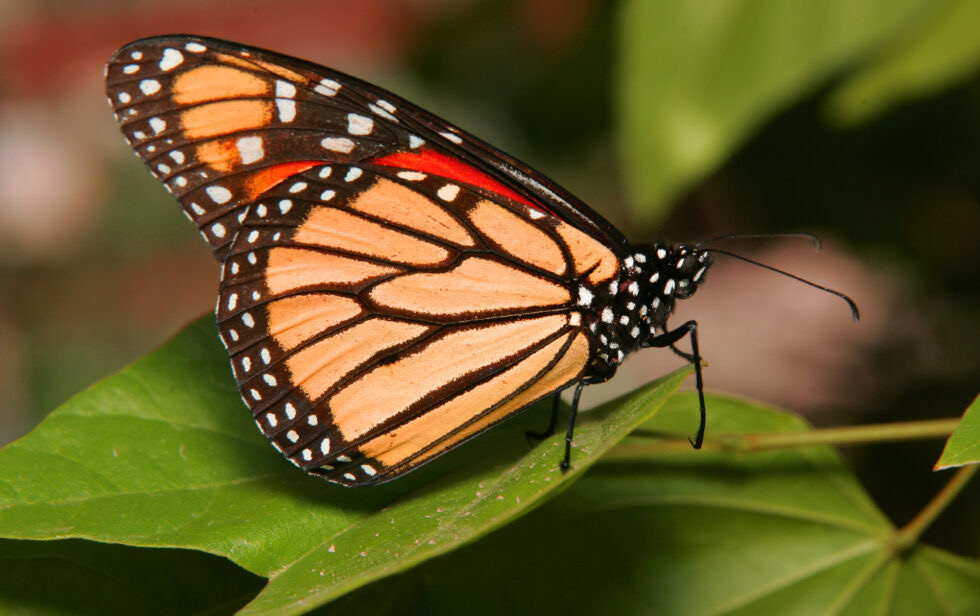 Monarch resting on a green leaf with their wings closed. Photo Credits: Garden Blog / DESERT BOTANICAL Garden
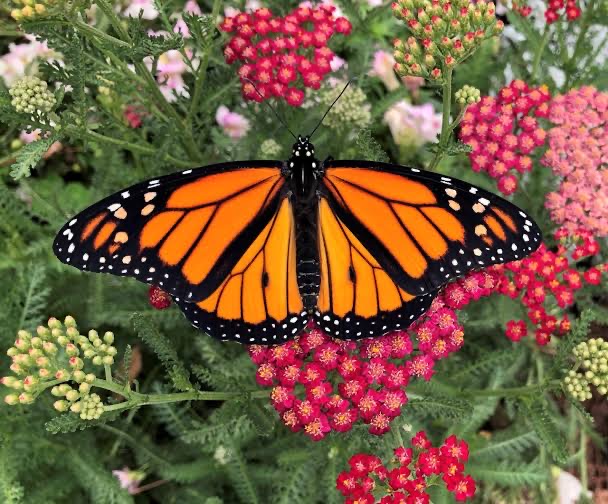 A male Monarch resting on Yarrow with his wings opened. Photo Credits: Sarah Reyner
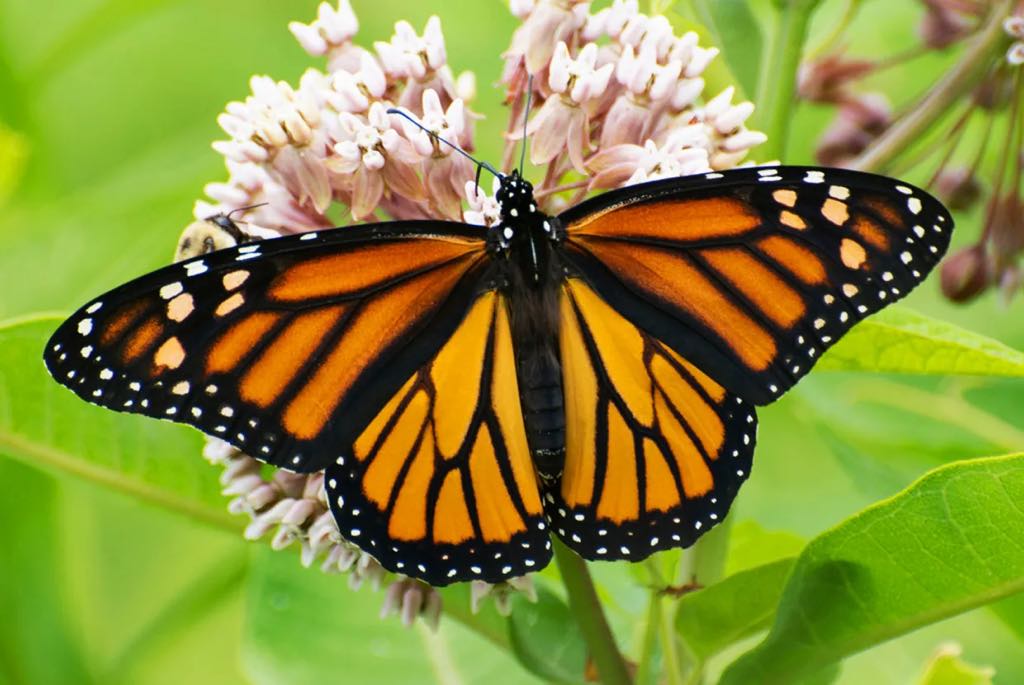 A female Monarch sipping nectar on a big flower cluster from a Common Milkweed plant. Photo Credits: Julie DeRoche - Design Pics / Getty Images
Common Name: Monarch
Scientific Name: Danaus plexippus
Other Common Names: Milkweed Butterfly, Common Tiger, Wanderer, or Black - veined brown.
Genus: Danaus
Most Commonly Seen: Can be spotted in various locations including prairies, meadows, grasslands, along roadsides, gardens, and backyards.
Colour: orange, black, and white
Wings: large brightly coloured orange wings with black veins and white spots along the edges.
Most Distinctive Features: Their bright orange and black wings with white spots.
Wingspan: 3.5 to 4 inches (8.9 to 10.2 centimetres).
Native: Yes, the Monarch butterfly is a native butterfly species in the province of Ontario and other parts of Canada.
Native Range: Central America northward through the continental United States to southern Canada, and from the Atlantic Coast westward to the Pacific Coast.
Sightings: Monarch butterflies are regularly sighted in Ontario during their migration between late May/ early June and mid to late September. They reach their peak in the middle of July and throughout the summer until late August into September.
Flight Period: Late May or early June through mid to late September.
Flight Pattern: flap, flap, and glide
Lifespan: The lifespan of the Monarch varies depending on the generation. The non migratory monarchs live for 14 days. For the migratory monarchs they live for 6 months up to 1 year.
Host Plants:
🌿 Common Milkweed (Asclepias syriaca)
🌿 Swamp Milkweed (Asclepias syriaca)
🌿 Butterfly Weed (Aslcepias tuberosa)
🌿 Purple Milkweed (Asclepias purpurascens)
Adult Food Source: They feed on specific flowers during different seasons, depending on their travels and where they are coming from.
In the spring they feed on lilacs, red clover, violets, peonies, and occasionally
In the summer time they feed on common milkweed (Asclepias syriaca), swamp milkweed (Asclepias incarnata), butterfly weed (Asclepias tuberosa), dense blazing star (Liatris spicata), cylindrical blazing star (Liatris cylindracea), Tall Ironweed (Vernonia gigantea), sweet joe pye weed (Eutrochium purpureum), spotted joe pye weed (Eutrochium maculatum), and Buttonbush (Cephalanthus occidentalis).
In the fall they feed on new england aster (Symphyotrichum novae-angliae), smooth aster (Symphyotrichum laeve), white wood aster (Eurybia divaricata), and zigzag goldenrod (Solidago flexicaulis).
The Monarch (Danaus plexippus) is a large sized butterfly species that is one of the most studied butterflies. It is a butterfly that is a member of The Brush - footed Butterflies Family.
Their wings are a vibrant orange with bold black veins and a black border dotted with white spots. The body is black with numerous white spots.
The female and male of the Monarch look quite similar to one another, but they do have some differences.
Males have two black, velvety spots on their hind wings, which are scent glands used for attracting females. Females tend to have thicker veins and may be a slightly darker shade of orange. The females don’t have the two velvety black spots on their hindwings.
American Lady (Vanessa virginiensis)
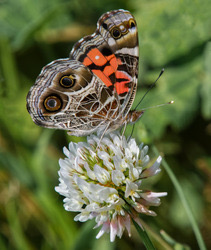
American lady sipping nectar from a white clover flower with their wings closed. Photo Credits: Karen Chiasson
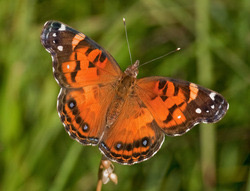
American lady resting with their wings opened. Photo Credits: Sarah Bright
Common Name: American Lady
Scientific Name: Vanessa virginiensis
Other Common Names: Hunter’s Butterfly or Virginia Lady
Genus: Vanessa
Most Commonly Seen: It is mostly seen in open habitats such as fields, meadows, roadsides, woodland clearings, and gardens.
Colour: tawny orange, brown, black, and white.
Wings: has small to medium sized wings that are orange and black with white spots on the forewings, and a complex pattern on the underside of the hindwings.
Most Distinctive Features: Is the two large black ringed eyespots on the underside of their hindwings.
Wingspan: 1 3/4 to 2 5/8 inches (4.45 to 6.6 cm).
Native: Yes, the American Lady butterfly is a native butterfly species in the province of Ontario and other parts of Canada.
Native Range: Has a native range that spans from southern Canada to northern South America, including Mexico and Central America. It is also found in the West Indies and is occasionally seen in Europe.
Sightings: Mid May to late October
Flight Period: Late April to early October
Flight Pattern: low and rapid, and somewhat erratic flight pattern. They are known to fluttering close to the ground.
Lifespan: 14 to 28 days
Host Plants:
🌿 Field Pussytoes (Antennaria neglecta) Native
🌿 Pearly Everlasting (Anaphalis margaritacea) Native
🌿 False Sunflower (Heliopsis helianthoides) Native
🌿 Woodland Sunflower (Helianthus microcephalus) Native
🌿 Holly Hocks Non - Native
Adult Food Source: They feed on nectar from various flowers including common milkweed (Asclepias syriaca), swamp milkweed (Asclepias incarnata), butterfly weed (Asclepias tuberosa), tall Ironweed (Vernonia gigantea), dense blazing star (Liatris spicata), cylindrical blazing star (Liatris cylindracea), Buttonbush (Cephalanthus occidentalis), new england aster (Symphyotrichum novae-angliae), smooth aster (Symphyotrichum laeve), white wood aster (Eurybia divaricata), and zigzag goldenrod (Solidago flexicaulis).
The American Lady (Vanessa virginiensis) is a medium sized butterfly that looks similar to the Painted Lady Butterfly. It is one of the common butterfly species to be spotted in gardens. This butterfly is a member of The Brush - footed Butterflies Family.
The upperside is orange brown with black and white markings, especially prominent white spots near the forewing tips. There is a row of five small black spots along the hindwing's edge.
The underside of the wings is dark brown and tan segmented design, with four or five small spots near the edge.
Viceroy (Limenitis archippus)
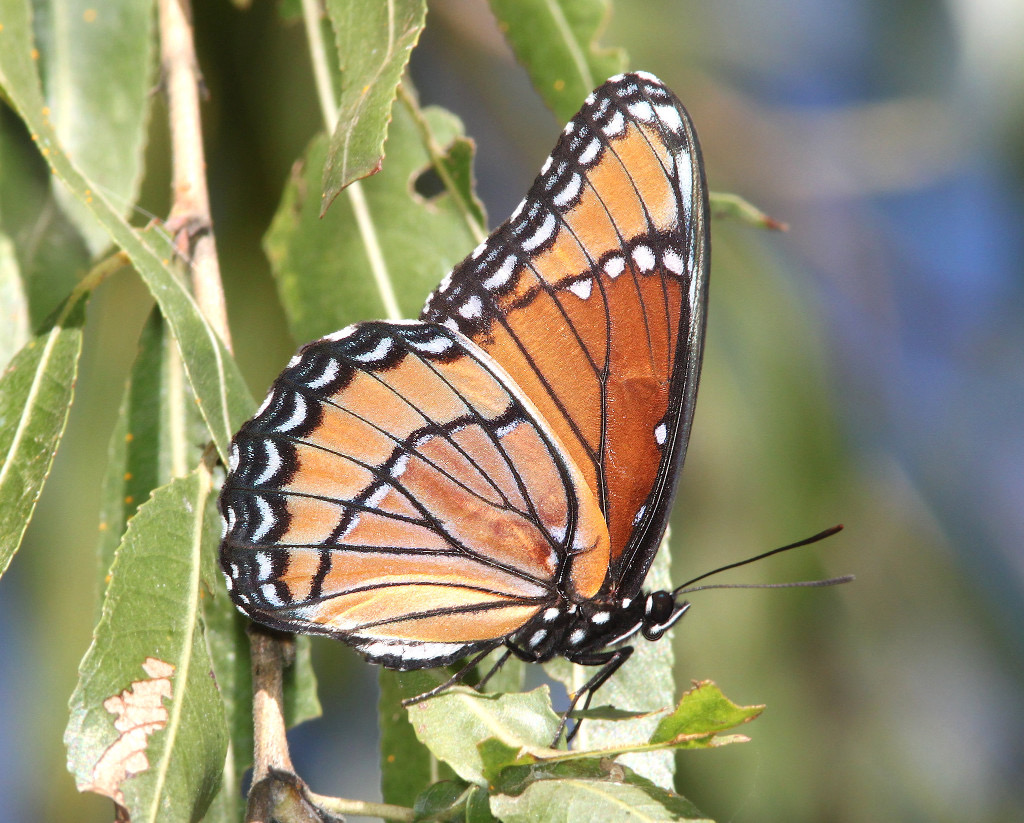 Viceroy resting on the foliage of a plant with their wings closed.
Photo Credits: Alan Schmierer
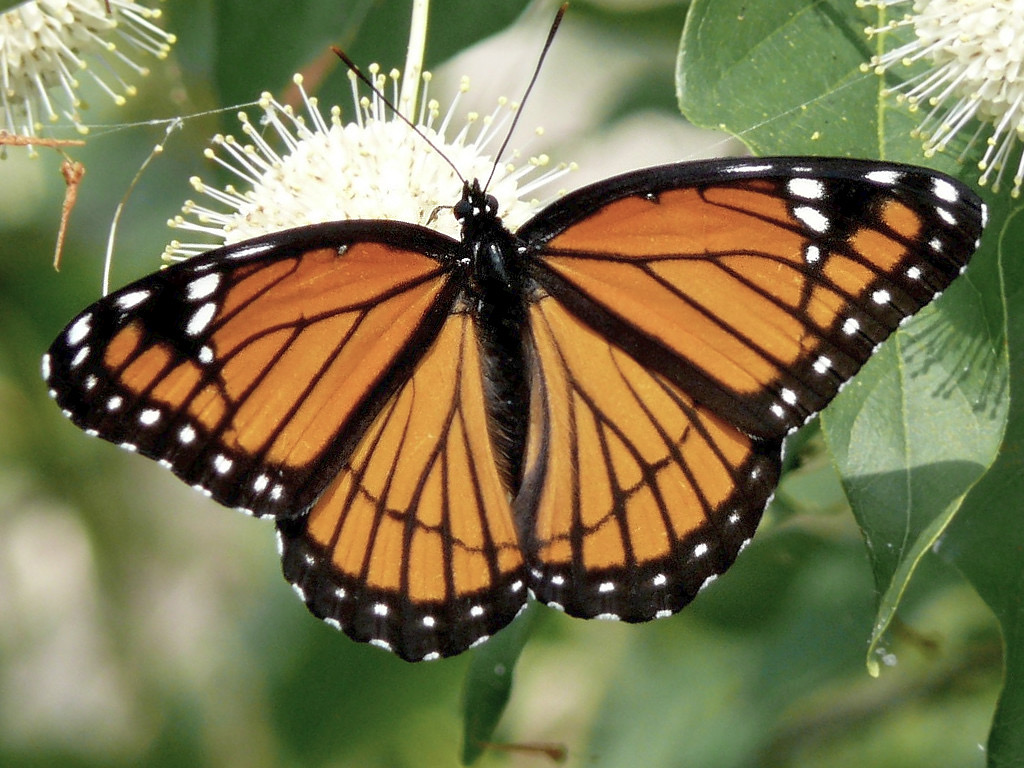 Viceroy sipping nectar from a flower on a Button Bush with their wings opened.
Photo Credits: Ranger Robb Hannawacker
Common Name: Viceroy
Scientific Name: Limenitis archippus
Other Common Names: Arizona Viceroy
Genus: Limenitis
Most Commonly Seen: Can be found in a variety of open and humid areas particularly near wet areas like willow bogs, marshes, and the edges of lakes and rivers. This butterfly species is also commonly seen in fields, along roadsides, forests, open woodlands where their host plants are, and gardens.
Colour: orange, black, and white
Wings: Their wings are medium to large in size. The wings are orange to mahogany with black - outlined veins and black borders enclosing small white spots. Dorsal hindwing with prominent black line through the centre.
Most Distinctive Features: Is the black line that crosses their hindwings.
Wingspan: 2.5 to 3.2 inches (6.4 to 8.1 cm).
Native: Yes, the Viceroy butterfly is a native butterfly species in the province of Ontario and other parts of Canada.
Native Range: In Canada they’re found from Nova Scotia to Quebec and Ontario, north to James Bay, and in the Prairie Provinces. There are even records from Fort Smith and Hay River in the Northwest Territories.
In The United States they are found throughout most of the continental United States.
In Mexico they are found in Central Mexico.
Sightings: Late May to September.
Flight Period: Late May to early September.
Flight Pattern: Faster and more erratic than the characteristic flap and guide of the Monarch butterflies.
Lifespan: 2 - 3 weeks
Host Plants:
🌿 Pussy Willow (Salix discolor)
- Native
🌳 Black Willow (Salix nigra)
- Native
🌳 Bebb’s Willow (Salix bebbiana)
- Native
🌳 Trembling Aspen (Populus tremuloides)
- Native
🌳 Balsam Popular (Populus balsamifera)
- Native
🌳 Large - toothed Aspen (Populus grandidentata)
- Native
🌳 Eastern Cottonwood (Populus deltoides)
- Native
🌳 Weeping Golden Willow (Salix × sepulcralis 'Chrysocoma')
- Non - Native
Adult Food Source: Early in the season when few flowers are available adult Viceroys feed on aphid honeydew, carrion, dung, tree sap, and decaying fungi.
Later generations feed more often on flowers, favouring asters, goldenrod, joe pye weed, and field thistle.
The Viceroy (Limenitis archippus) is a medium sized butterfly that is commonly seen along roadsides and gardens. It looks similar to the monarch butterfly, where this butterfly has the capability to mimic the monarch for their own protection. This butterfly species is a member of The Brush - footed Butterflies Family.
Their wings feature an orange and black pattern, and over most of its range it is a Mullerian mimic with the monarch butterfly.
It can be distinguished from the monarch by its smaller size and the postmedian black line that runs across the veins on the hindwing.
Hackberry Emperor (Asterocampa celtis)
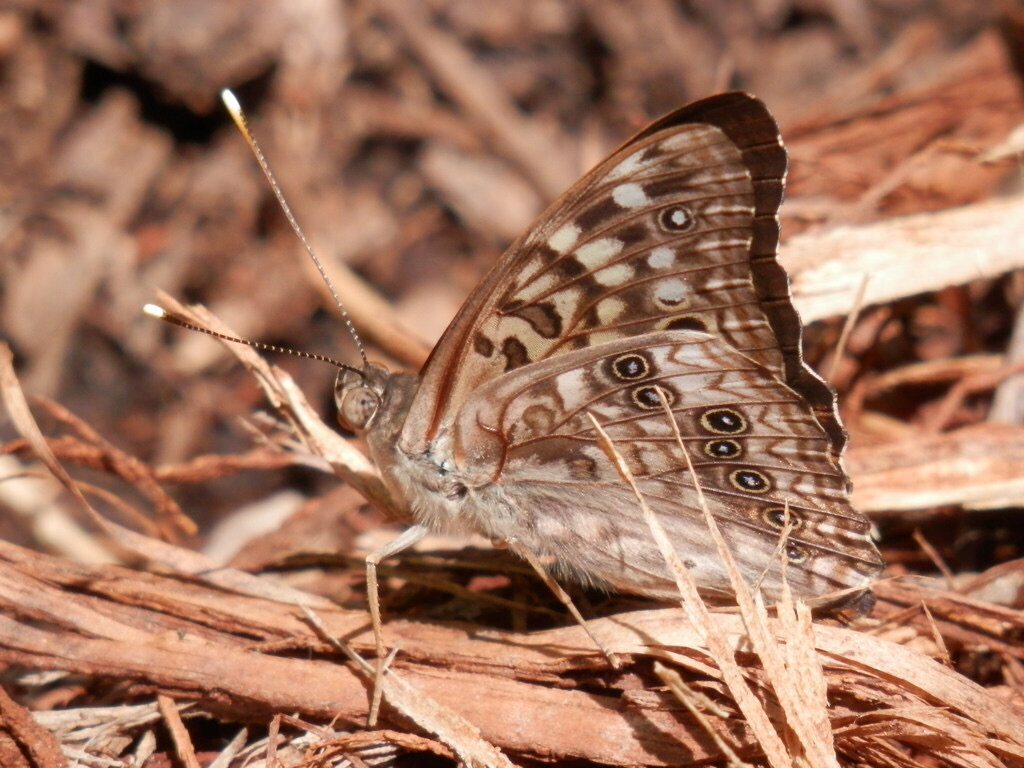 Hackberry Emperor resting on twigs with their wings closed. Photo Credits: amlambert11 from iNaturalist
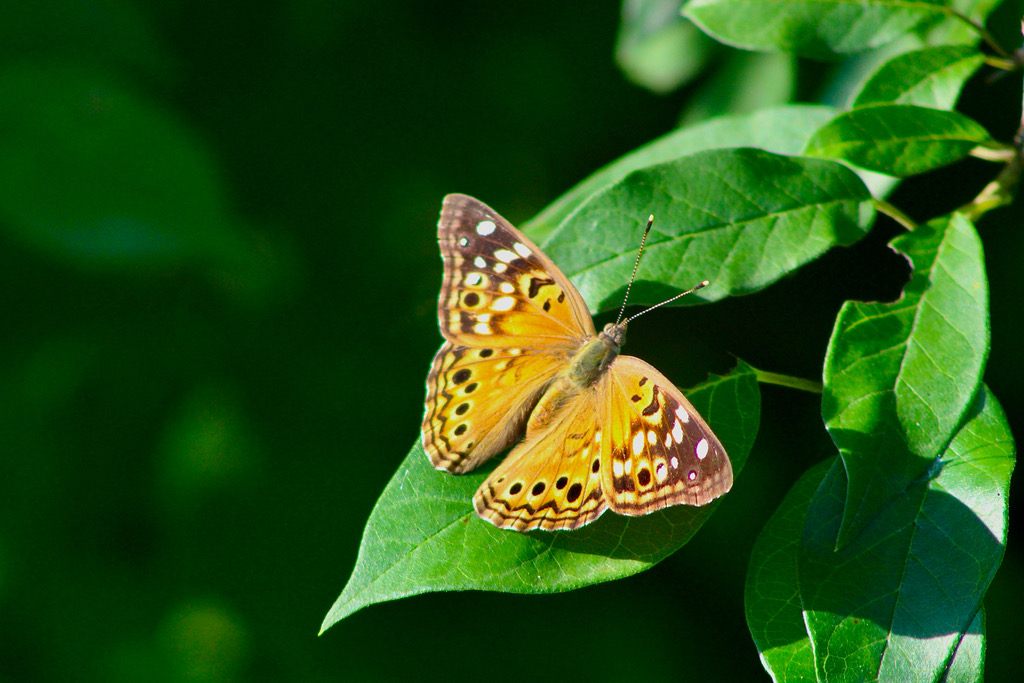 Hackberry Emperor resting on a green leaf with their wings opened. Photo Credits: joethenaturalist from iNaturalist
Common Name: Hackberry Emperor
Scientific Name:Asterocampa celtis
Other Common Names: Hackberry Butterfly or American Emperor
Genus: Asterocampa
Most Commonly Seen: During the summer months
Colour: Grey brown, orange - brown, brown, grey, white, and black.
Wings: light brown with darker areas near the tips of the forewings and a row of white spots near the apex of the forewing.
Most Distinctive Features:Is their white spots near the tips of its front wings.
Wingspan: 1.25 to 2.5 inches (3.5 to 6.3 cm).
Native: Yes, the Hackberry Emperor is a native butterfly species in the province of Ontario, and other parts of Canada.
Native Range: Central Mexico, Eastern Canada, Southwestern United States, and The Rocky Mountains.
Sightings: Late May through August
Flight Period: Early July to late August
Flight Pattern: fast and erratic
Lifespan: 6 to 14 days
Host Plants:
🌳 Common Hackberry (Celtis occidentalis) - Native
🌳 Sugar Berry (Celtis laevigata)
- Native
Adult Food Source: Sap from trees, rotting fruit, dung, carrion, and wet spots along roads as well as streams.
The Hackberry Emperor (Asterocampa celtis) is a small to medium sized butterfly that is a member of The Brush - footed Butterflies Family.
The upperside is reddish brown. The forewing has 1 eyespot and a cluster of white spots near the tip. Undersurfaces are more muted in color and the hindwing has a row of yellow-rimmed black spots near the outer edge.
The females and males of this butterfly species are similarly marked, and look a bit a like with the naked eye. They have a few differences that can be noticed with the naked eye.
The males have smaller darker bodies and more slender wings. The females have bigger bodies that are a bit lighter in colour, and they have broader wings.
Red Spotted Purple (Limenitis arthemis)
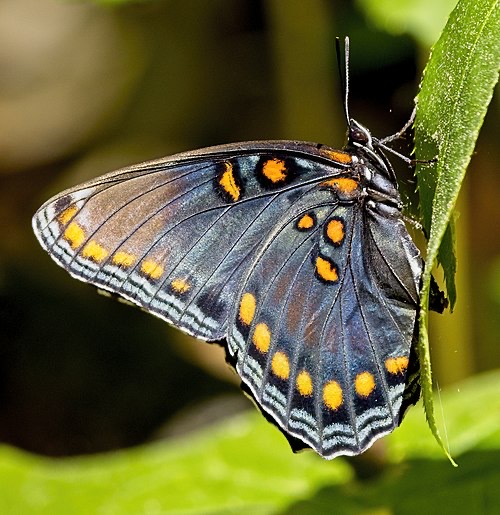 Red Spotted Purple resting on a leaf with their wings closed. Photo Credits: Michael Romagnoli from Wikipedia
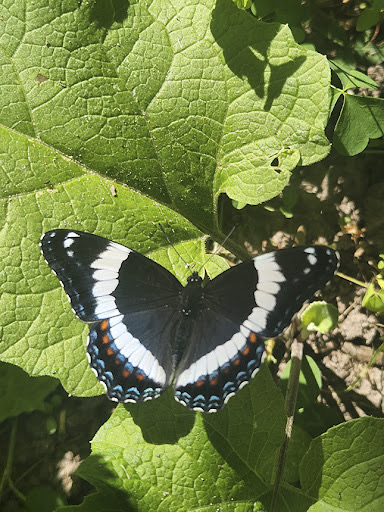 A white and black colouration of a Red Spotted Purple resting on a leaf with their wings opened. Photo Credits: Amanda Thelen from minnesotaseasons.com
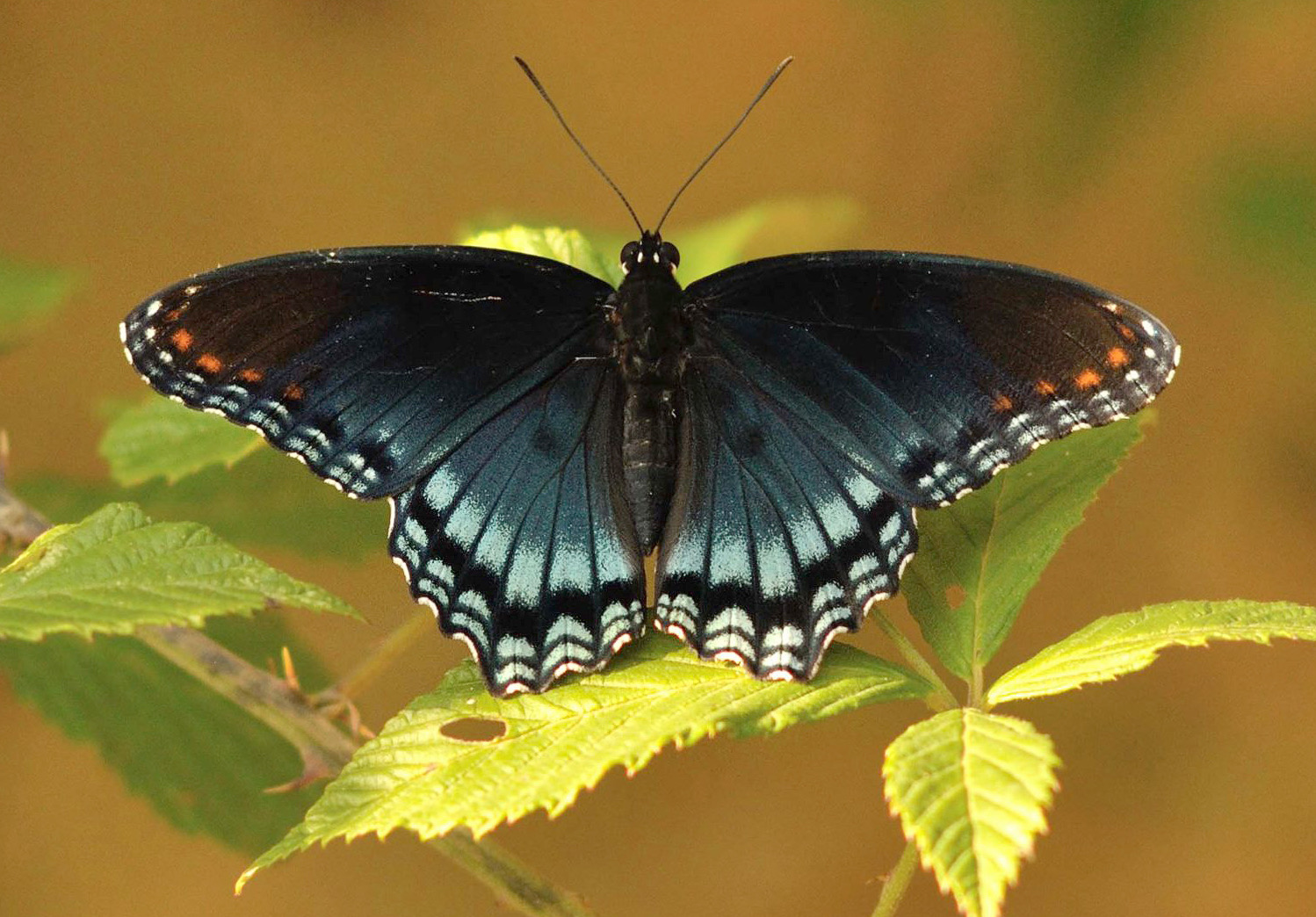 The blue, purple, and black colouration of a Red Spotted Purple with their wings opened. Photo Credits: John Morgan from alabama.butterflyatlas.usf.edu
Common Name: Red Spotted Purple
Scientific Name:Limenitis arthemis
Other Common Names: Red Spotted Admiral, Red Spotted Purple Admiral, or White Admiral.
Genus: Limenitis
Most Commonly Seen: During the summer months which is typically from late May through August.
Colour: dark iridescent blue, blue green, red, orange, dark brown, black, and white.
Wings: dark, blackish - blue wings with an iridescent blue or purple sheen, particularly noticeable on the hindwings.
Most Distinctive Features:It’s bright iridescent blue colouration on the hindwings, especially noticeable on the upper side.
Wingspan: 3 to 4 inches (7.6 to 10.2 centimetres).
Native: Yes, the Red Spotted Purple is a native butterfly species in the province of Ontario and other parts of Canada.
Native Range: Central Alaska, Canada, Central Mexico, Eastern United States, and Western United States.
Sightings: June to August
Flight Period: Is typically from June to August but it can extend into September.
Flight Pattern: quick wing strokes and a flap guide style of flight.
Lifespan:6 to 14 days
Host Plants:
🌳 Black Willow (Salix nigra)
- Native
🌳 Bebb’s Willow (Salix bebbiana)
- Native
🌳 Peachleaf Willow (Salix amygdaloides) - Native
🌳 Sandbar Willow (Salix interior)
- Native
🌳 White Willow (Salix alba)
- Native
🌳 Scouler’s Willow (Salix scouleriana) - Native
🌿 Pussy Willow (Salix discolor)
- Native
🌳 Weeping Willow (Salix babylonica) - Non - Native
🌳 Balsam Poplar (Populus balsamifera) - Native
🌳 Carolina Poplar (Populus X canadensis) - Non - Native
🌳 Eastern Cottonwood (Populus deltoides) - Native
🌳 Large - toothed Aspen (Populus grandidentata) - Native
🌳 Lombardy Poplar (Populus nigra) - Native
🌳 Trembling Aspen (Populus tremuloides) - Native
🌳 Wild Cherry (Prunus avium)
- Native
🌳 Black Cherry (Prunus serotina)
- Native
🌿 Chokecherry (Prunus virginiana) - Native
🌳 Red Oak (Quercus rubra)
- Native
🌳 White Oak (Quercus alba)
- Native
🌳 Bur Oak (Quercus macrocarpa)
- Native
🌳 Black Oak (Quercus velutina)
- Native
🌳 Chinquapin Oak (Quercus muehlenbergii) - Native
🌳 Dwarf Chinquapin Oak (Quercus prinoides) - Native
Adult Food Source: Their primary food source as an adult is sap flows from trees, rotting fruit, carrion, dung, and honeydew liquid from aphids. Occasionally they feed on small white flowers including white clover, button bush, common yarrow, chokecherry, sand cherry, pearly everlasting, foamflower, and field pussytoes.
The Red Spotted Purple (Limenitis arthemis) is a beautiful butterfly that is highly active. It is a member of The Brush - footed Butterflies Family.
The upperside is blue to blue-green with much iridescence on the outer part of the hindwing. The underside is dark brown. The forewing has 2 red-orange bars near the base of the leading edge; the hindwing has 3 red-orange spots near the base and a row of red-orange spots. Sometimes they have a lot of white on the inside of their wings with black colouration.
Mourning Cloak (Nymphalis antiopa)
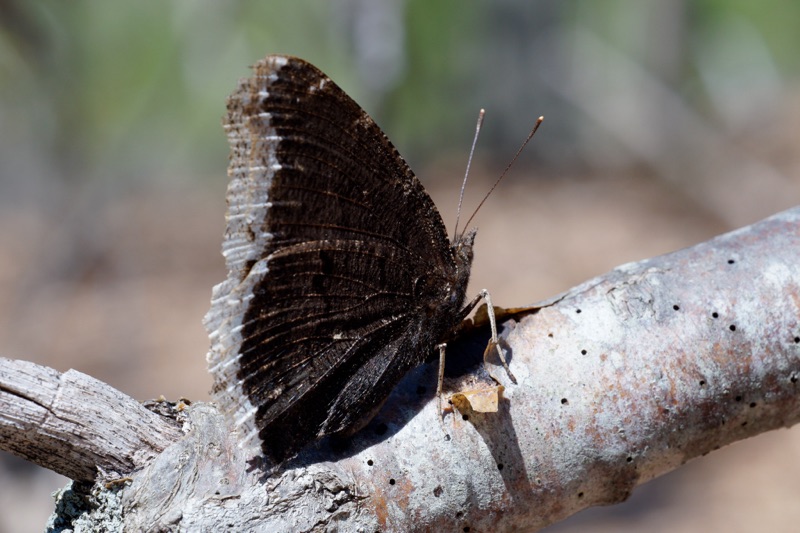 Mourning Cloak resting on a branch with their wings closed. Photo Credits: jackthropod from iNaturalist
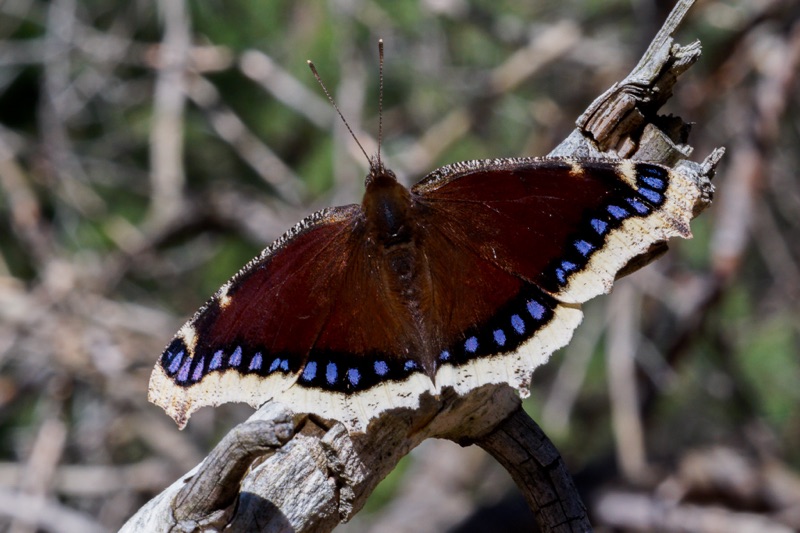 Mourning Cloak resting on a twig with their wings opened. Photo Credits: jackthropod from iNaturalist
Common Name: Mourning Cloak
Scientific Name:Nymphalis antiopa
Other Common Names: Camberwell Beauty
Genus: Nymphalis
Most Commonly Seen:Early Spring and late fall
Colour: reddish brown, maroon, bright yellow, pale white, iridescent blue, and dark brown.
Wings: a deep maroon or brownish black colour with a yellow or creamy white border.
Most Distinctive Features:Is their dark maroon or purple brown wings with a bright yellow band along the edges, and iridescent blue spots.
Wingspan: 2.25 to 4 inches (5.7 to 10.1 cm).
Native: Yes, the Mourning Cloak is a native butterfly species to the province of Ontario and other parts of Canada.
Native Range: Canada, Alaska, Central Mexico, Northern United States, South America, Eurasia, and Britain.
Sightings: Early Spring and late Autumn
Flight Period: Mid March through late October
Flight Pattern: erratic and circling
Lifespan: 10 - 12 months
Host Plants:
🌳 Black Willow (Salix nigra)
- Native
🌳 Bebb’s Willow (Salix bebbiana)
- Native
🌳 Peachleaf Willow (Salix amygdaloides) - Native
🌳 Sandbar Willow (Salix interior)
- Native
🌳 White Willow (Salix alba)
- Native
🌳 Scouler’s Willow (Salix scouleriana) - Native
🌿 Pussy Willow (Salix discolor)
- Native
🌳 Weeping Willow (Salix babylonica) - Non - Native
🌳 Balsam Poplar (Populus balsamifera) - Native
🌳 Carolina Poplar (Populus X canadensis) - Non - Native
🌳 Eastern Cottonwood (Populus deltoides) - Native
🌳 Large - toothed Aspen (Populus grandidentata) - Native
🌳 Lombardy Poplar (Populus nigra) - Native
🌳 Trembling Aspen (Populus tremuloides) - Native
🌳 American Elm (Ulmus americana) - Native
🌳 Rock Elm (Ulmus thosmasii)
- Native
🌳 Slippery Elm (Ulmus rubra)
- Native
🌳 Northern Hackberry (Celtis occidentalis) - Native
🌳 Dwarf Hackberry (Celtis tenuifolia) - Native
Adult Food Source: Their primary food source is tree sap from oak trees and rotting fruit. Occasionally they will feed on nectar from flowers.
The Mourning Cloak (Nymphalis antiopa) is a large butterfly that is very unique, in which is not seen in any other butterfly species. It is a member of The Brush - footed Butterflies Family.
In their adult form the Mourning Cloak showcases a rich maroon or brown hue, when their wings are spread open bordered by pale yellow edges and accented with black and iridescent blue spots.
The underside of their wings presents dull grey striations, maintaining the pale yellow borders. These butterflies do not exhibit sexual dimorphism, making males and females visually similar.
Question Mark (Polygonia interrogationis)
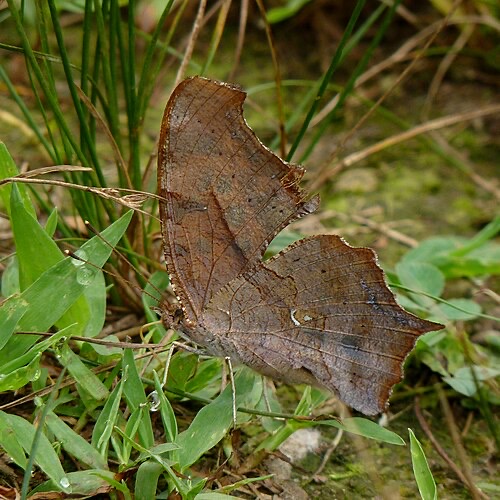 Question Mark resting in the grass with their wings closed. Photo Credits: John B from Wikipedia
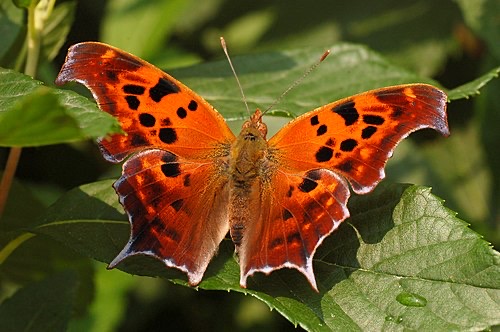 Question Mark resting on foliage with their wings opened. Photo Credits: Derek Ramsey (Ram - Man) from Wikipedia
Common Name: Question Mark
Scientific Name:Polygonia intereogationis
Other Common Names: Violet Tip or Violet Tip Butterfly
Genus: Polygonia
Most Commonly Seen: late spring 🌸,early summer 💐 , and fall 🍂.
Colour: orange red, black, mottled brown, and tan.
Wings: The upperside of the wings is typically orange with black markings. The undersides of the wings are mottled brown and leaf-like, providing camouflage resembling a dead leaf.
Most Distinctive Features: Is the silver question mark shaped mark on the underside of their hindwings.
Wingspan: 4.5 to 7.6 centimetres (1.8 to 3.0 inches).
Native: Yes, the Question Mark is a native butterfly species to the province of Ontario and other parts of Canada.
Native Range: Southern Canada, Eastern United States, Central Mexico, and the eastern edge of the Rocky Mountains.
Sightings: Late April until early November
Flight Period: Late May to September
Flight Pattern: swift, and gliding motions interspersed with rapid wing beats.
Lifespan: The average lifespan is 6 to 20 days for an adult Question Mark, but for the ones that overwinter as adults live up to a year.
Host Plants:
🌳 American Elm (Ulmus americana) - Native
🌳 Rock Elm (Ulmus thosmasii)
- Native
🌳 Slippery Elm (Ulmus rubra)
- Native
🌳 Northern Hackberry (Celtis occidentalis) - Native
🌳 Dwarf Hackberry (Celtis tenuifolia) - Native
🌿 Wild Hops (Humulus lupulus)
- Non - Native
🌿 Japanese Hops (Humulus japonicus) - Non - Native
🌿 Stinging Nettle (Urtica dioica)
- Non - Native
🌿 False Nettle (Boehmeria cylindrica) - Native
Adult Food Source: Their primary food source is rotting fruit, tree sap, dung, and carrion. When their primary food sources are scarce or unavailable they will feed on nectar from flowers such as common milkweed, swamp milkweed, asters, and buttonbush.
The Question Mark (Polygonia interrogationis) is a beautiful orange and black butterfly with a unique marking. It is a member of The Brush - footed Butterflies Family.
This butterfly has a reddish orange to orange brown background colour on their wings with dark spots on the wings.
Question Mark Butterflies exhibit seasonal dimorphism, meaning their appearance changes based on the time of year. The summer form has more black on the hindwings, while the winter form has more orange and longer tails.
Male Question Mark Butterflies are generally smaller and have more strongly hooked forewings. The dorsal wing pattern also tends to have a stronger contrast.
Female Question Mark Butterflies are generally bigger in size than the male. They tend to have broader and squarish hindwings. On their dorsal wing they exhibit less contrast in the patterns.
Eastern Comma (Polygonia comma)
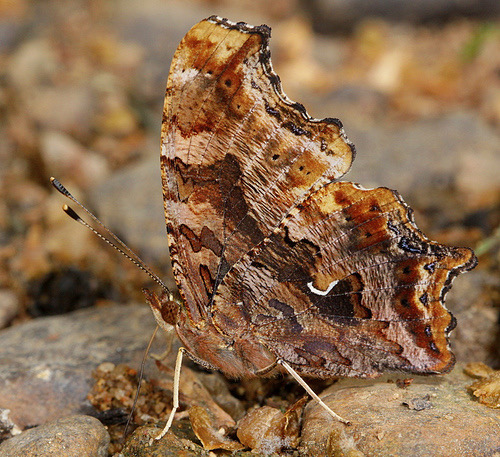 Eastern Comma resting on large rocks with their wings closed. Photo Credits: Patrick Coin from iNaturalist
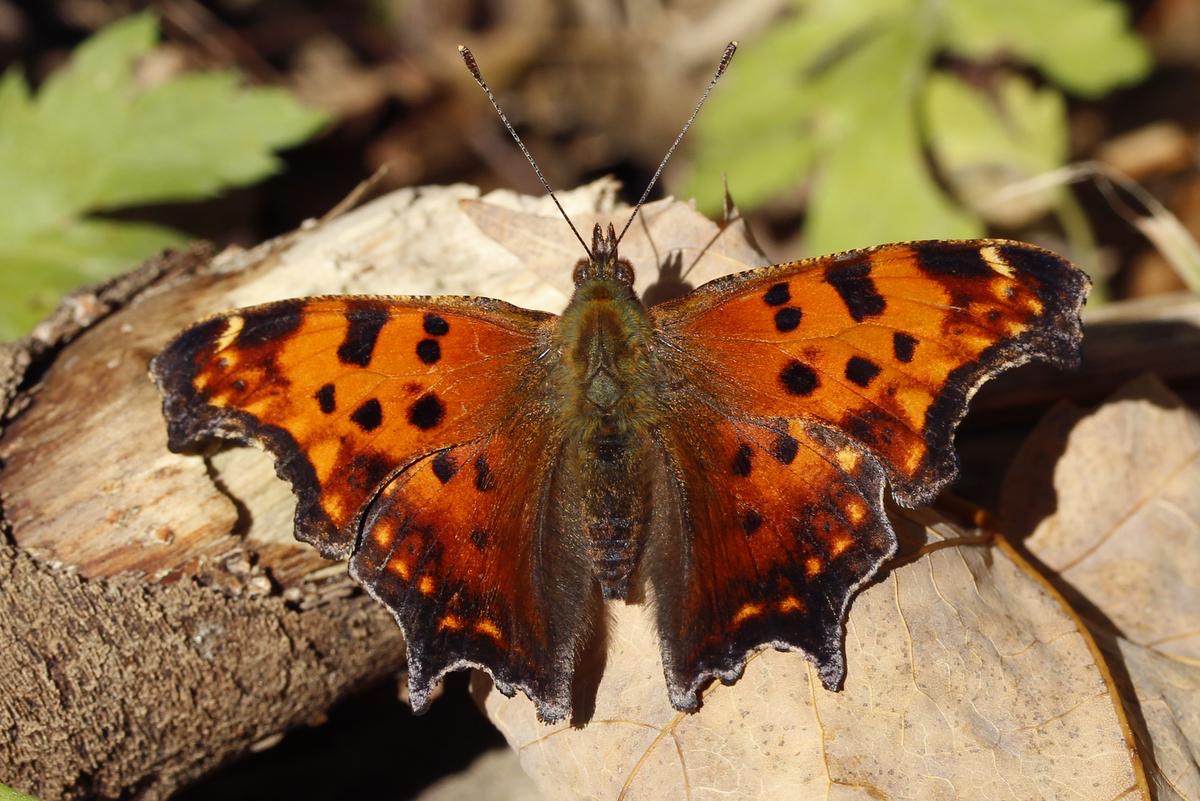 Eastern Comma resting in a sunny spot with their wings opened.
Photo Credits: Krista Sessions
Common Name: Eastern Comma
Scientific Name:Polygonia comma
Other Common Names: Comma Angelwing or Hop Merchant
Genus: Polygonia
Most Commonly Seen:During the summer and fall.
Colour: orange brown, black, violet, mottled brown, grey brown, and yellow brown.
Wings: Their wings are orange brown in colour with dark markings.
Most Distinctive Features:Is the silver or white comma shaped mark on the underside of their hind wings.
Wingspan: 1.75 to 2.5 inches (4.5 to 6.4 cm)
Native: Yes, the Eastern Comma is a native butterfly species in the province of Ontario and other parts of Canada.
Native Range: Southeastern Canada, Central Texas, The Gulf Coast, The Eastern United States, and east of The Rocky Mountains.
Sightings: Late Spring through Early Fall.
Flight Period: There are two flights in the province of Ontario. The first flight of this butterfly is from late June to July. The second flight of this butterfly is from August to October.
Flight Pattern: fast, erratic, and haphazard.
Lifespan:5 months
Host Plants:
🌳 American Elm (Ulmus americana) - Native
🌿 Stinging Nettle (Urtica dioica)
- Non - Native
🌿 False Nettle (Boehmeria cylindrica) - Native
🌿 Wood Nettle (Laportea canadensis) - Native
🌿 Wild Hops (Humulus lupulus)
- Non - Native
🌿 Japanese Hops (Humulus japonicus) - Non - Native
Adult Food Source: Rotting fruit and tree sap.
The Eastern Comma (Polygonia comma) is a medium sized butterfly that is dark orange to brown colour, and has a unique marking on their wings. It is a member of The Brush - footed Butterflies Family.
The open wings of the adult Eastern Comma reveal a brownish-orange base on the primary wings adorned with dark spots. The secondary wings display a summer pattern of primarily black and a winter pattern of orange with black spots, both edged with a dark border and pale spots. The ventral side features a distinctive comma-shaped mark and projections on the hind wings.
Great Spangled Fritillary (Speyeria cybele)
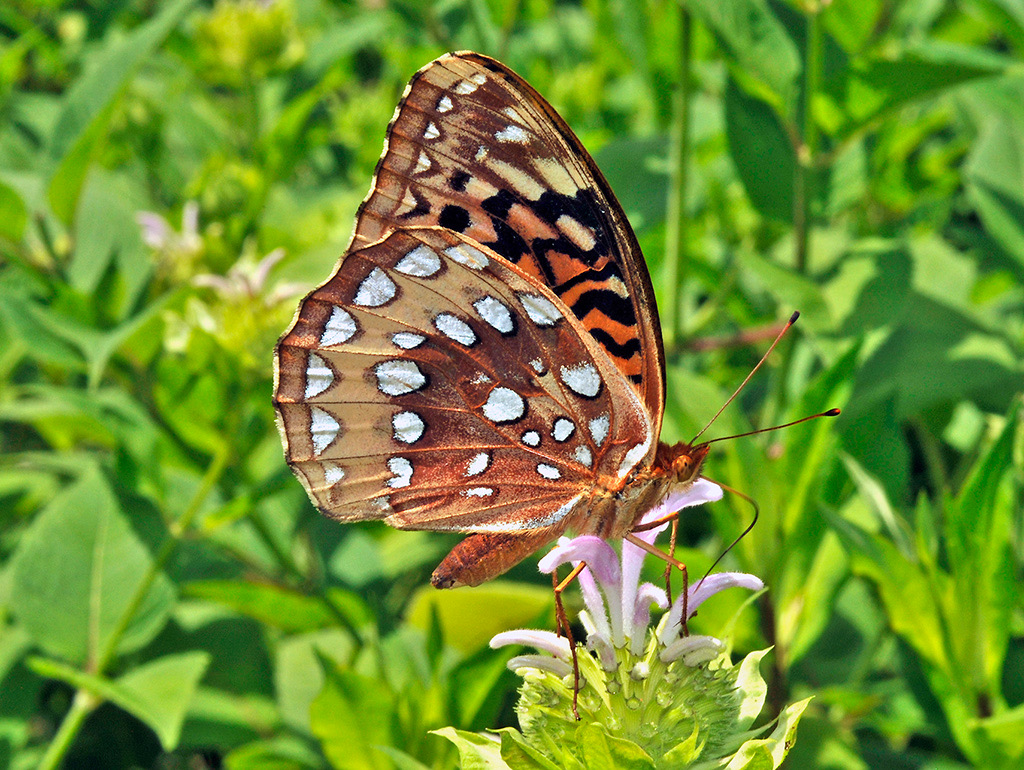 A Great Spangled Fritillary sipping nectar from small flowers with their wings closed. Photo Credits: Kim Hosen
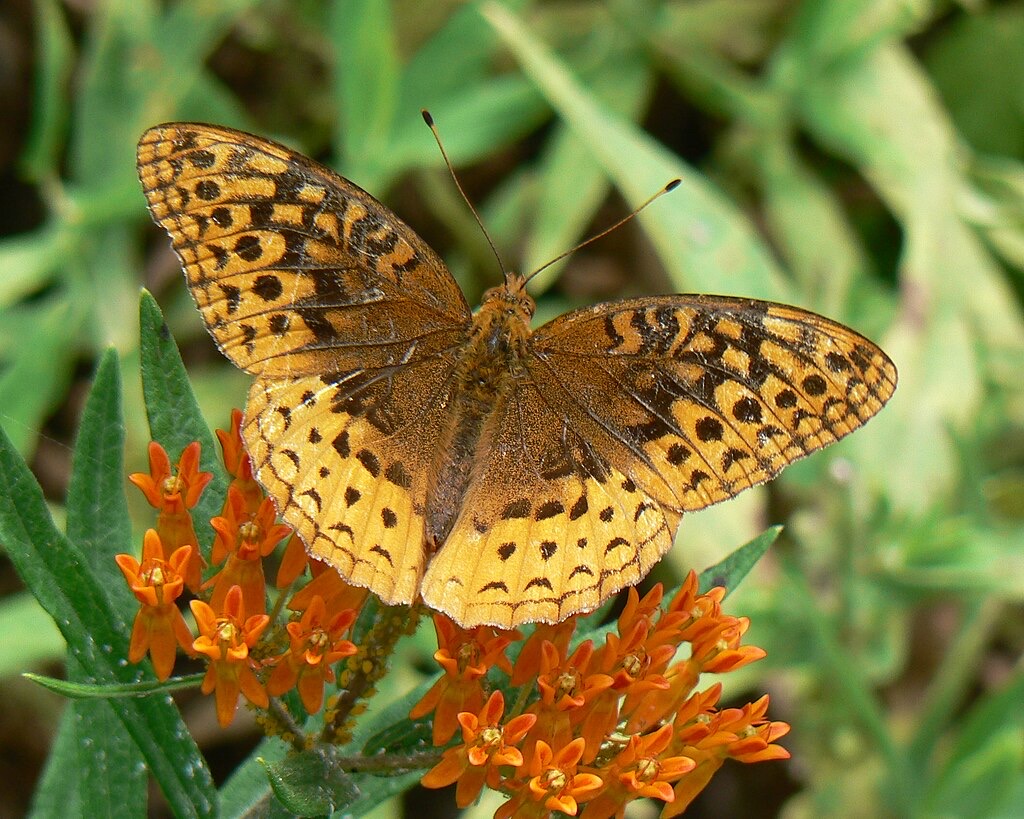 A Great Spangled Fritillary resting on Butterfly Weed with their wings opened. Photo Credits: MONGO from Wikipedia
Common Name: Great Spangled Fritillary
Scientific Name:Speyeria cybele
Other Common Names: Great Silverspot Fritillary or Simply Fritillary
Genus: Speyeria
Most Commonly Seen:during the month of July
Colour: orange, black, and dark brown
Wings: medium to large sized wings that are orange in colour having black patterns.
Most Distinctive Features:Is the wide, light coloured submarginal band on the underside of it’s hindwings.
Wingspan: 62 to 88 mm (2.4 to 3.5 inches)
Native: Yes, the Great Spangled Fritillary is native to the province of Ontario and other parts of Canada.
Native Range: Southern Canada, Northern United States, and Central United States.
Sightings: They are mostly spotted throughout the month of July, but can be spotted as early as early June.
Flight Period: Late June to mid September
Flight Pattern: medium speed, straight, strong, and determined.
Lifespan:2 to 10 weeks
Host Plants:
🌸 Downy Yellow Violet (Viola pubescens) - Native
🌸 Sweet White Violet (Viola blanda) - Native
🌸 Canada Violet (Viola canadensis) - Native
🌸 Common Blue Violet (Viola sororia) - Native
Adult Food Source: Nectar from various flowers including milkweeds, thistles, ironweed, verbena, vetch, bergamots, red clover, joe pye weed, and coneflowers.
The Great Spangled Fritillary (Speyeria cybele) is a medium sized butterfly that is the most common fritillary butterfly to be spotted across Ontario. This fritillary species is a member of The Brush - footed Butterflies Family.
The colour variation of this fritillary species depends on the gender of the butterfly.
On the upper surface of the wings on a male is orange in colour that is dappled with spots and lines. For the upper surface of the wings on a female is a darker orange in colour on the basal wing portion.
On the under surface of the wings on a male is pale brown in colour with a pale band, and large silver spots.
For the under surface of the wings on a female is a dark orange in colour with a pale band and large silver spots.
Meadow Fritillary (Boloria bellona)
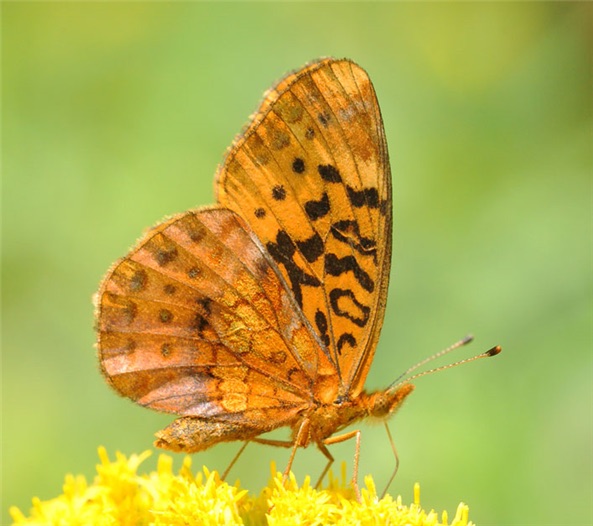 A Meadow Fritillary sipping nectar from a cluster of small yellow flowers with their wings closed. Photo Credits: Jeffrey Glassberg
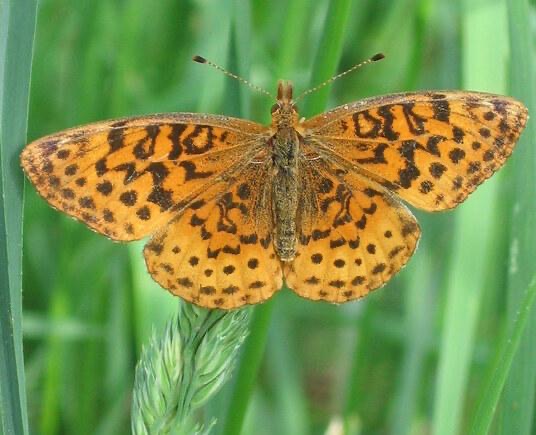 A Meadow Fritillary resting on an Ornamental Grass with their wings opened. Photo Credits: Shenandoah National Park Service
Common Name: Meadow Fritillary
Scientific Name: Boloria bellona
Other Common Names: American Meadow Fritillary
Genus: Boloria
Most Commonly Seen:Late Spring 🌸, Summer 💐, and Early Fall 🍂.
Colour: bright orange, red, black, and purple brown.
Wings: small wings that are bright orange to red in colour with black spots.
Most Distinctive Features:It’s bright orange wings with a heavy black pattern on the upperside of their wings, and a square off tip on the forewings.
Wingspan: 35 to 44 mm (1 3/8 to 1 7/8 inches)
Native: Yes, the Meadow Fritillary is a native butterfly species in the province of Ontario and other parts of Canada.
Native Range: Eastern British Columbia, Southern Canada, Northern United States, Western United States, and Eastern United States.
Sightings: Late April and early May
Flight Period: Late April through October
Flight Pattern: They typically fly low to the ground in a rapid and jerky manner, often patrolling open meadows.
Lifespan: 2 to 4 weeks
Host Plants:
🌸 Common Blue Violet (Viola sororia) - Native
🌸 Canada Violet (Viola canadensis) - Native
🌸 Northern White Violet (Viola pallens) - Native
🌸 Downy Yellow Violet (Viola pubescens) - Native
Adult Food Source: Nectar from certain flowers including black - eyed susans, ox - eye daisy, smooth oxeye, lance leaf coreopsis, false sunflower, woodland sunflower, annual sunflowers, milkweeds, and verbena.
The Meadow Fritillary (Boloria bellona) is a small sized fritillary butterfly that is a member of The Brush - footed Butterflies Family.
When resting with their wings open, the forewings display a squared off tip, and both pairs of wings boast a reddish orange hue with dense black markings. The underside of the hindwings reveals a complex pattern in orange and purplish brown, featuring an off-white basal patch.
This butterfly species exhibits sexual dimorphism, where males and females can be distinguished by physical appearance. The males are distinguished by a prominent, bright yellow border on the underside of their wings.
Silver - Bordered Fritillary (Boloria selene)
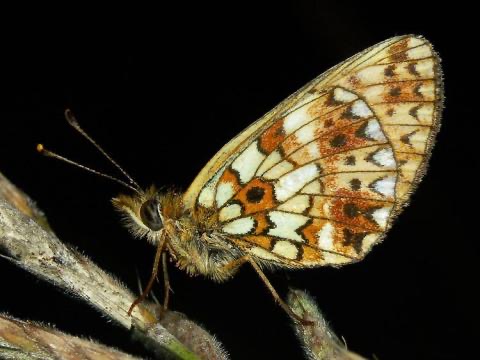 A Silver - Bordered Fritillary resting on old plant material with their wings closed. Photo Credits: Idaho Fish and Wildlife Information System
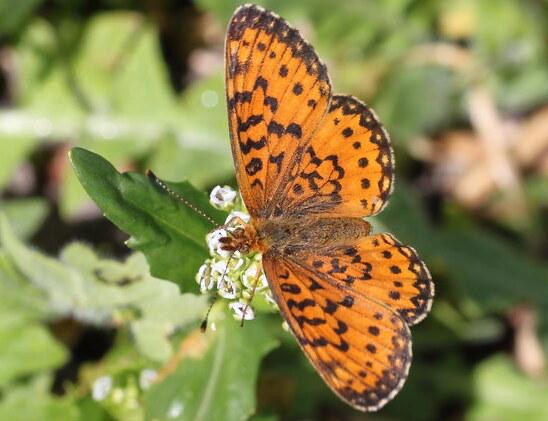 A Silver - Bordered Fritillary sipping nectar from white flowers with their wings opened. Photo Credits: Fish and Wildlife Service Service - Mountain Prairie Region
Common Name: Silver - Bordered Fritillary
Scientific Name:Boloria selene
Other Common Names: Silver Meadow Fritillary or Small Pearl - Bordered Fritillary
Genus: Boloria
Most Commonly Seen:Late Spring 🌸 to Early Fall 🍂.
Colour: orange, black, metallic silver, and reddish brown.
Wings: medium sized wings that are bright orange with black markings on the upper surface, and the underside of the wings is distinct with metallic silver spots on an orange-brown base.
Most Distinctive Features:The bright metallic silver spots on the underside of it’s hindwings.
Wingspan: 35 to 51 mm
Native: Yes, the Silver - Bordered Fritillary is a native butterfly species in the province of Ontario and other parts of Canada.
Native Range: Canada, Central United States, Northern United States, and Western United States.
Sightings: Late Spring 🌸 to Early Fall 🍂
Flight Period: With this butterfly species there are two flight periods, which is due to them having two broods a year. The first flight period for this butterfly is from late May to late July. For the second flight period of this butterfly is from late July to early September.
Flight Pattern: rapid patrolling and slow hovering flights.
Lifespan:Several weeks
Host Plants:
🌸 Northern Bog Violet (Viola nephrophylla) - Native
🌸 Birdfoot Violet (Viola pedata)
- Native
🌸 Downy Yellow Violet (Viola pubescens) - Native
🌸 Sweet White Violet (Viola blanda) - Native
🌸 Canada Violet (Viola canadensis) - Native
🌸 Woolly Blue Violet (Viola sororia)
- Native
Adult Food Source: Nectar from specific flowers such as goldenrods, black - eyed susans, asters, ox - eye daisy, coreopsis, and milkweeds.
The Silver - Bordered Fritillary (Boloria selene) is a medium sized orange fritillary butterfly species that is a member of The Brush - footed Butterflies Family.
On the upperside of the wings they are orange with black markings. On the underside of the wings there are rows of metallic silver spots, post median spots that are small and black.
Common Wood Nymph (Cercyonis pegala)
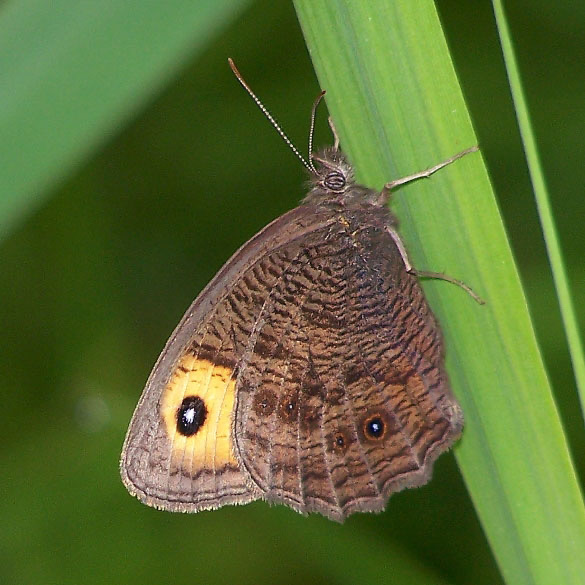 A Common Wood Nymph resting on green foliage with their wings closed. Photo Credits: Fred Goodwin
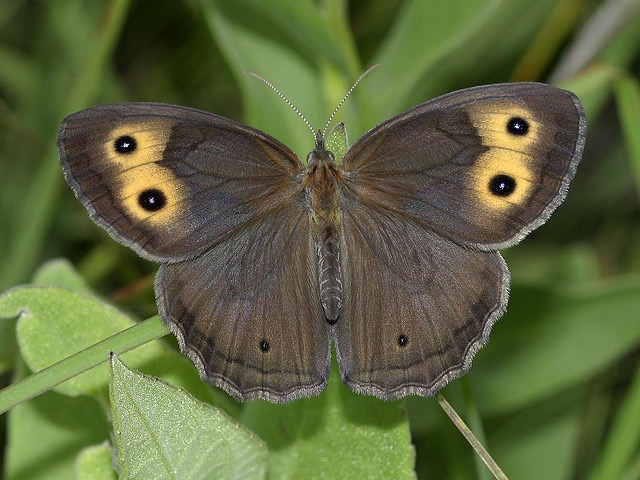 A Common Wood Nymph resting on foliage with their wings opened. Photo Credits: Bill Bouton on Flickr
Common Name: Common Wood Nymph
Scientific Name:Cercyonis pegala
Other Common Names: Wood Nymph, Goggle Eye, Blue - eyed Grayling, or Large Wood Nymph.
Genus: Cercyonis
Most Commonly Seen:Early Summer 💐 to Early Fall 🍂.
Colour: dark brown, light brown, white, black, and blue.
Wings: medium sized wings that are dark brown with two white pupil markings that looks like eyespots.
Most Distinctive Features:Is the pair of prominent dark eyes or eyespots on each forewing, that is often surrounded by a tawny or yellowish patch.
Wingspan: 1 3/4 to 3 inches (4.5 to 7.6 cm)
Native: Yes, the Common Wood Nymph is a native butterfly species in the province of Ontario and other parts of Canada.
Native Range: Eastern United States, Western United States, and it is native to all provinces in Canada except for Newfoundland.
Sightings: Mid Summer 💐 to Early Fall 🍂.
Flight Period: Typically is from late June to early September, but with the peak activity occurring in July and August.
Flight Pattern: lazy and bobbing flight
Lifespan:For this butterfly species the lifespan varies depending on the gender of the butterfly. For males they typically can live for 3 to 4 weeks, but for females they can live for several weeks up to 8 weeks.
Host Plants:
🌱 Poverty Oat Grass (Danthonia spicata) - Native
🌱 Little Bluestem (Schizachyrium scoparium) - Native
🌱 Big Bluestem (Andropogon gerardi) - Native
🌱 Purpletop Grass (Tridens flavus)
- Non Native
🌱 Kentucky Bluegrass (Poa pratensis) - Non Native
Adult Food Source: Tree Sap, Fermented Fruit, and Flower Nectar.
The Common Wood Nymph (Cercyonis pegala) is a small sized butterfly that is a member of The Brush - footed Butterflies Family.
The wings of this butterfly are brown in colour. The upperside of the forewing has 2 large yellow-ringed eyespots. The lowerside of the hindwing has a variable number of small eyespots.
Little Wood Satyr (Megisto cymela)
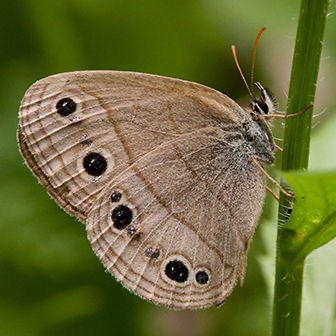 A Little Wood Satyr relaxing on the stem of a plant with their wings closed. Photo Credits: Mary Kay Rubey
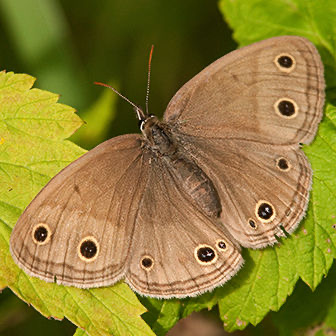 A Little Wood Satyr sun basking on a green leaf with their wings opened. Photo Credits: Mary Kay Rubey
Common Name: Little Wood Satyr
Scientific Name:Megisto cymela
Other Common Names: Wood Satyr, Wood Nymph, or Petit Satyre des bois (in french).
Genus: Megisto
Most Commonly Seen:Late Spring 🌸 to Early Summer 💐
Colour: medium brown, light brown, black, and yellow.
Wings: rounded brown wings with prominent eyespots.
Most Distinctive Features:It’s two prominent yellow - ringed black eyespots on both upper surfaces and lower surfaces of the forewings, and a similar eyespot on the upper hindwing.
Wingspan: 29 to 48 mm (1.1 to 1.9 inches)
Native: Yes, the Little Wood Satyr is a native butterfly species in the province of Ontario, and other parts of Canada.
Native Range: Southern Canada, Eastern United States, Western United States, and Northeastern United States.
Sightings: Early Summer to Mid Summer
Flight Period: Early June to Late July
Flight Pattern: bouncy or dancing
Lifespan:4 to 12 weeks
Host Plants:
🌱 Canada Wild Rye Grass (Elymus canadensis) - Native
🌱 Big Bluestem (Andropogon gerardi) - Native
Adult Food Source:Tree Sap, Honeydew from aphids, and occasionally flower nectar.
The Little Wood Satyr (Megisto cymela) is a small and unique butterfly that is a member of The Brush - footed Butterflies Family.
It is a light brown butterfly that is easily recognizable by their little markings that look like eyespots.
Forewing has 2 yellow-rimmed black eyespots both above and below. Hindwing has 2 eyespots on upper side but may have smaller spots below. Females are slightly larger. Dorsal and ventral forewings and hindwings have two distinct eyespots.
Eastern Tailed Blue (Cupido comyntas)
 An Eastern Tailed Blue resting on a green leaf with their wings closed. Photo Credits: Hectonichus from Wikipedia
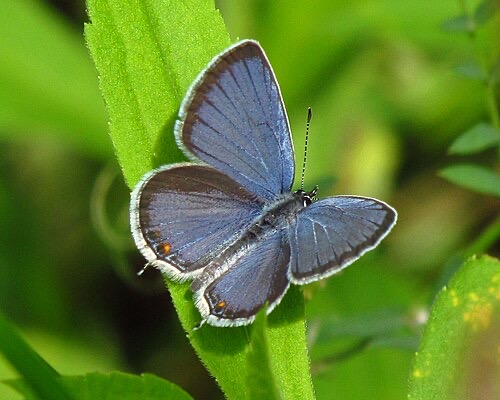
A male Eastern Tailed Blue resting on a long green leaf with his wings opened. Photo Credits: D. Gordon E. Robertson from Wikipedia
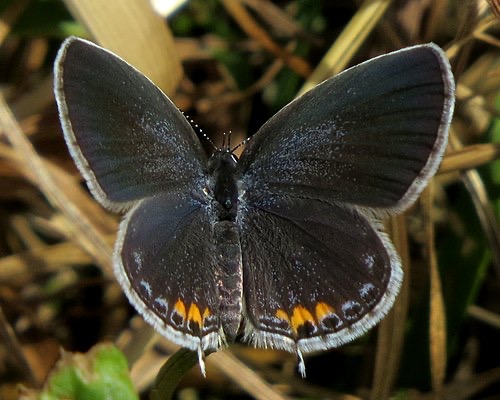 A female Eastern Tailed Blue resting on old plant material with her wings opened. Photo Credits: D. Gordon E. Robertson from Wikipedia
Common Name: Eastern Tailed Blue
Scientific Name:Cupido comyntas
Other Common Names: Tailed Blue Butterfly, Blue Butterfly, or Everes comyntas.
Genus: Cupido
Most Commonly Seen:In the summer months
Colour: iridescent blue, pale grey, black, orange, and brown.
Wings: small sized wings that are either blue or brown and a greyish blue on the outside. The colouration of the wings depends on the gender of this butterfly.
Most Distinctive Features:Is the small narrow tail like projection on the hindwing.
Wingspan: 3/4 of an inch to 1 inch (16 to 26 mm)
Native: Yes, the Eastern Tailed Blue is a native butterfly species in the province of Ontario and other parts of Canada.
Native Range: Southern Canada, Southwestern Canada, The Gulf States, Southern United States, and Western United States.
Sightings: Late Spring 🌸 to Early Summer 💐
Flight Period: For this butterfly species there are two different flight periods, which depends on the generation of the butterflies. The first flight period is for the first generation which occurs from early June to early August. The second flight period is for the second generation which occurs from August to mid September.
Flight Pattern: fast and low to the ground
Lifespan:4 to 10 days
Host Plants:
🌱 Showy Tick Trefoil (Desmodium canadense) - Native
🌱 Canada Milk Vetch (Astragalus canadensis) - Native
🌱 Round - headed Bush Clover (Lespedeza capitata) - Native
🌱 Slender Bush Clover (Lespedeza virginica) - Native
🌱 Hairy Bush Clover (Lespedeza hirta) - Native
🌱 White Clover (Trifolium repens)
- Non Native
🌱 Red Clover (Trifolium pratense)
- Non Native
🌱 Cow Vetch (Vicia cracca)
- Non Native
Adult Food Source: Since this butterfly has a low flight and has a short proboscis, it favourites low growing flowers such as asters, clovers, cinquefoils, and coreopsis.
The Eastern Tailed Blue (Cupido comyntas) is a small sized butterfly compared to other common butterfly species. It is distinguished by other blue butterflies in their range by their small thin tail on each of their bottom wings.
For this butterfly species the males and females look different from one another, making it easy for each gender to be identified.
The males are blue on the upperside of their wings, while the females are lighter blue to brown or even charcoal colouring.
The underside colouration ranges from bluish white to tan. There are two or three (outermost one often faint) black to orange chevron-shaped spots on the rear of the hindwings and a trailing tail off the innermost of the spots.
Banded Hairstreak (Satyrium calanus)
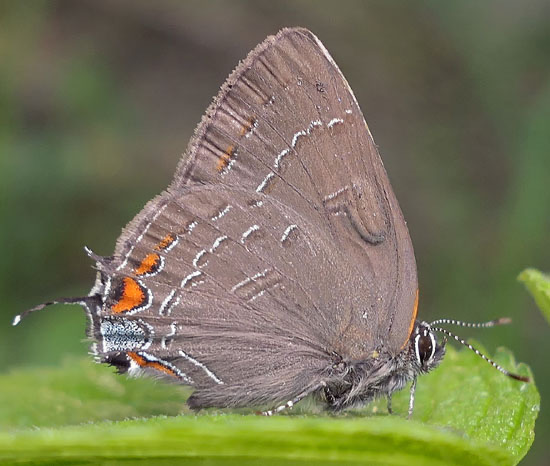 A Banded Hairstreak resting on a leaf with their wings closed. Photo Credits: Valerie G. Bugh
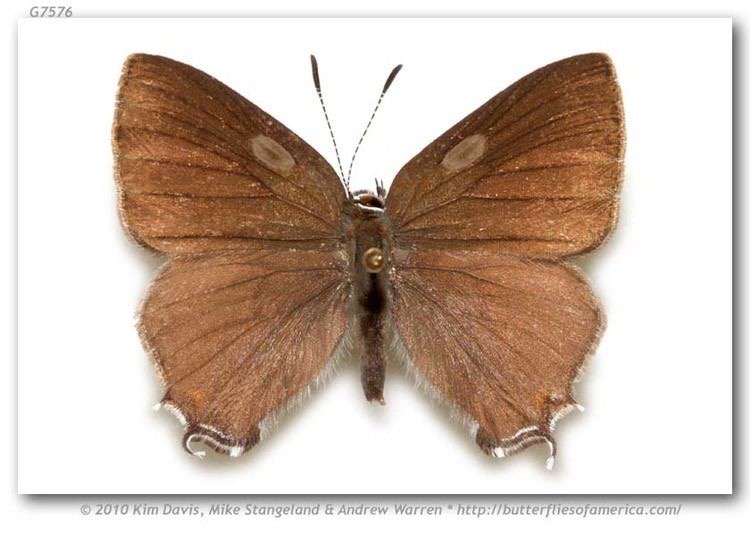 A specimen of a Banded Hairstreak with their wings opened. Photo Credits: Kim Davis, Mike Stangeland, and Andrew Warren from butterfliesofamerica.com
Common Name: Banded Hairstreak
Scientific Name:Satyrium calanus
Other Common Names: Eastern Banded Hairstreak, Florida Banded Hairstreak, Pale Banded Hairstreak, or Godart’s Banded Hairstreak.
Genus: Satyrium
Most Commonly Seen:Late Spring 🌸 into Late Summer 💐
Colour: dark grey brown, darker brown, blackish brown and orange.
Wings: The Banded Hairstreak has small wings, and the colouration varies depending on what wings on the butterfly are showing.
The upper side of the wings is typically a dark gray-brown, with the male having a dark stigma on the forewing.
The underside of the hindwing is brown, with a distinct white postmedian band edged with a reddish-orange band. There's also a prominent blue marginal patch, often with an eyespot, and two tails on the hindwing.
Most Distinctive Features:Is the row of darker brown, almost rectangular spots edged with white on the underside of its hindwings.
Wingspan: 23 to 34 mm
Native: Yes, the Banded Hairstreak is a native butterfly species in the province of Ontario and other parts of Canada.
Native Range: Eastern United States, Southern Canada, The Gulf States, Western United States, and Mexico.
Sightings: They are most commonly seen during the month of July.
Flight Period: Late June to early August
Flight Pattern: fast and erratic
Lifespan:One year or less
Host Plants: In Ontario, the Banded Hairstreak utilizes Oak Trees, Hickory Trees, and Walnut Trees as host plants.
Adult Food Source: As adults their primary food source is nectar from various flowers including milkweeds, new jersey tea, meadowsweet, sumac, yarrow, blue vervain, hoary vervain, and verbena. Occasionally when flower nectar is not available, some individuals will feed on tree sap.
The Banded Hairstreak (Satyrium calanus) is a small sized butterfly that is a member of The Gossamer - winged Butterflies Family.
The underside of the wings are dark grey - brown with a distinct band of dark rectangular spots edged in white. There is a blue spot on the underside hindwing is without an orange cap. On the upperside of the wings is uniformly dark blackish brown in colour.
Eastern Black Swallowtail (Papilio polyxenes)
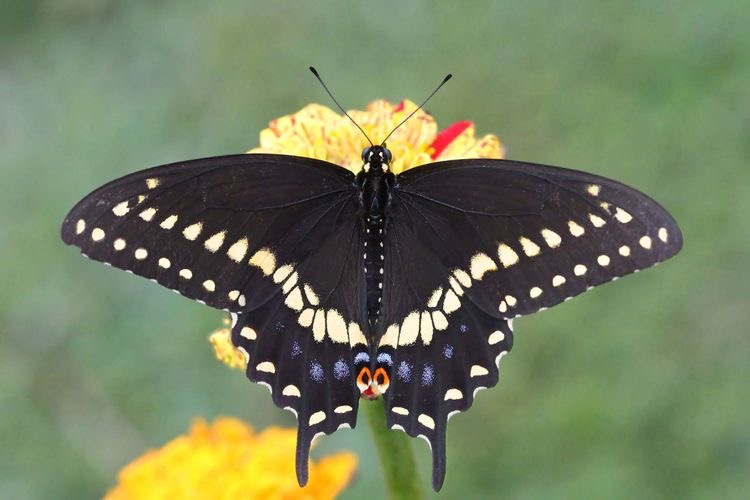
A Eastern Black Swallowtail resting on a branch or twig of a plant with their wings closed. Photo Credits: Siah St. Clair from All of Nature on blogspot.com
A male Eastern Black Swallowtail resting on a flower with his wings opened. Photo Credits: John Flannery on Flickr
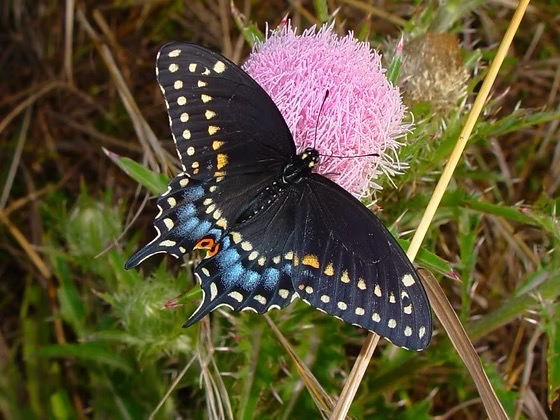 A female Eastern Black Swallowtail resting on a fluffy pink flower with her wings opened. Photo Credits: keysmoths.com
Common Name: Eastern Black Swallowtail
Scientific Name:Papilio polyxenes
Other Common Names: Black Swallowtail, American Swallowtail, Parsnip Swallowtail, Parsley Swallowtail, Carrot Swallowtail, or Celery Swallowtail.
Genus: Papilio
Most Commonly Seen:Late Spring 🌸 through the Summer
Colour: black, yellow, blue, and orange
Wings: Medium to large sized wings that are striking black adorned with two rows of yellow spots. The colouration of the wings change depending on the gender of the butterfly
Most Distinctive Features:Is it’s black wings with two rows of yellow spots.
Wingspan: For this butterfly the wingspan varies depending on the gender of the butterfly. For male Eastern Black Swallowtails their wingspan ranges from 6.9 to 8.4 cm (approximately 2.7 to 3.3 inches) in length. For female Eastern Black Swallowtails their wingspan reaches up to 9.4 cm (about 3.7 inches) in length.
Native: Yes, the Eastern Black Swallowtail is a native butterfly species in the province of Ontario and other parts of Canada.
Native Range: Southern Canada, Eastern United States, Midwestern United States, and Northern Mexico.
Sightings: Early Spring to Mid Summer
Flight Period: For this butterfly there are two different flight periods, and they depend on the brood that the butterfly is in.
The first flight for the first brood is from mid May to late June. The second flight for the second brood is from mid July through August.
Flight Pattern: quick and darting movements
Lifespan:Typically lives for 6 to 14 days, although some individuals may live up to 40 days.
Host Plants: Parsley, Dill, Carrot, Rue, Fennel, Queen Anne’s Lace, and Golden Alexander.
Adult Food Source: Their primary food source is nectar from various flowers such as milkweeds, thistles, coneflowers, joe - pye weed, beebalm, buttonbush, ironweed, blue vervain, hoary vervain, zinnias, lantana, verbena, and sunflowers. Individuals will also drink from moist and wet soils, and water puddles.
The Eastern Black Swallowtail (Papilio polyxenes) is a medium to large sized butterfly that is a member of The Swallowtail Butterfly Family.
This swallowtail is easily identified by its black wings with rows of yellow spots. Males and females exhibit sexual dimorphism, which means that they are slightly different from one another.
When the males of the Eastern Black Swallowtail have their wings opened they generally have larger and brighter yellow spots that are thicker on the wings, and less blue markings. They are normally smaller than the females.
When the females of the Eastern Black Swallowtail have their wings opened they generally are mostly black in colour with thinner yellow spots that are lighter in colour, as well as a bigger area of blue markings. They are usually bigger compared to the males.
While the wings of an Eastern Black Swallowtail are closed they feature a black background with two rows of pale yellow spots on the forewings, and a band of orange spots separated by blue on the hind wings.
Cabbage White (Pieris rapae)
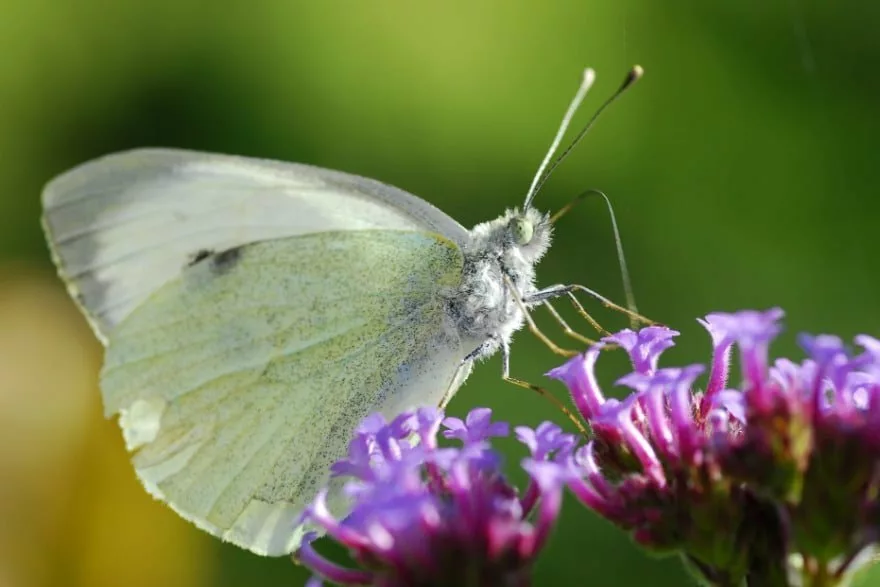 A Cabbage White sipping nectar from a cluster of light purple flowers with their wings closed. Photo Credits: Jean Vernon from Richard Jackson Garden
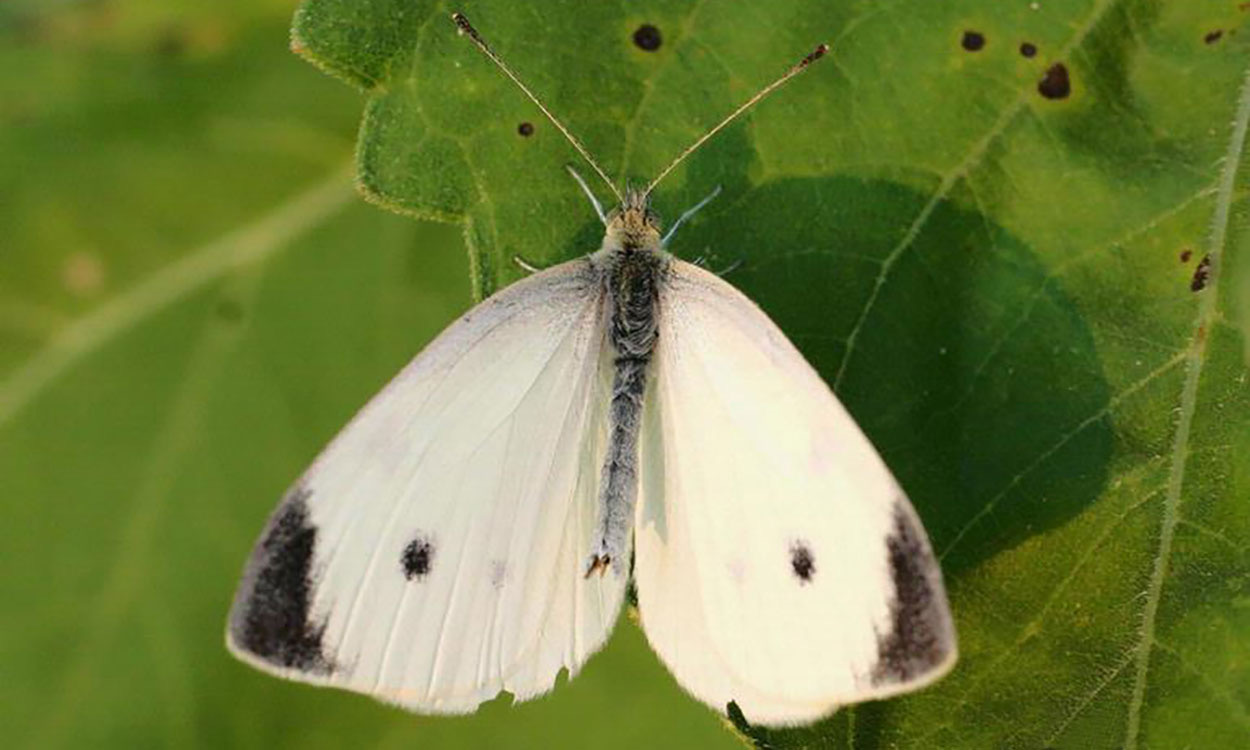 A male Cabbage White resting on green foliage with his wings opened. Photo Credits: Russ Ottens from University of Georgia and Bugwood.org
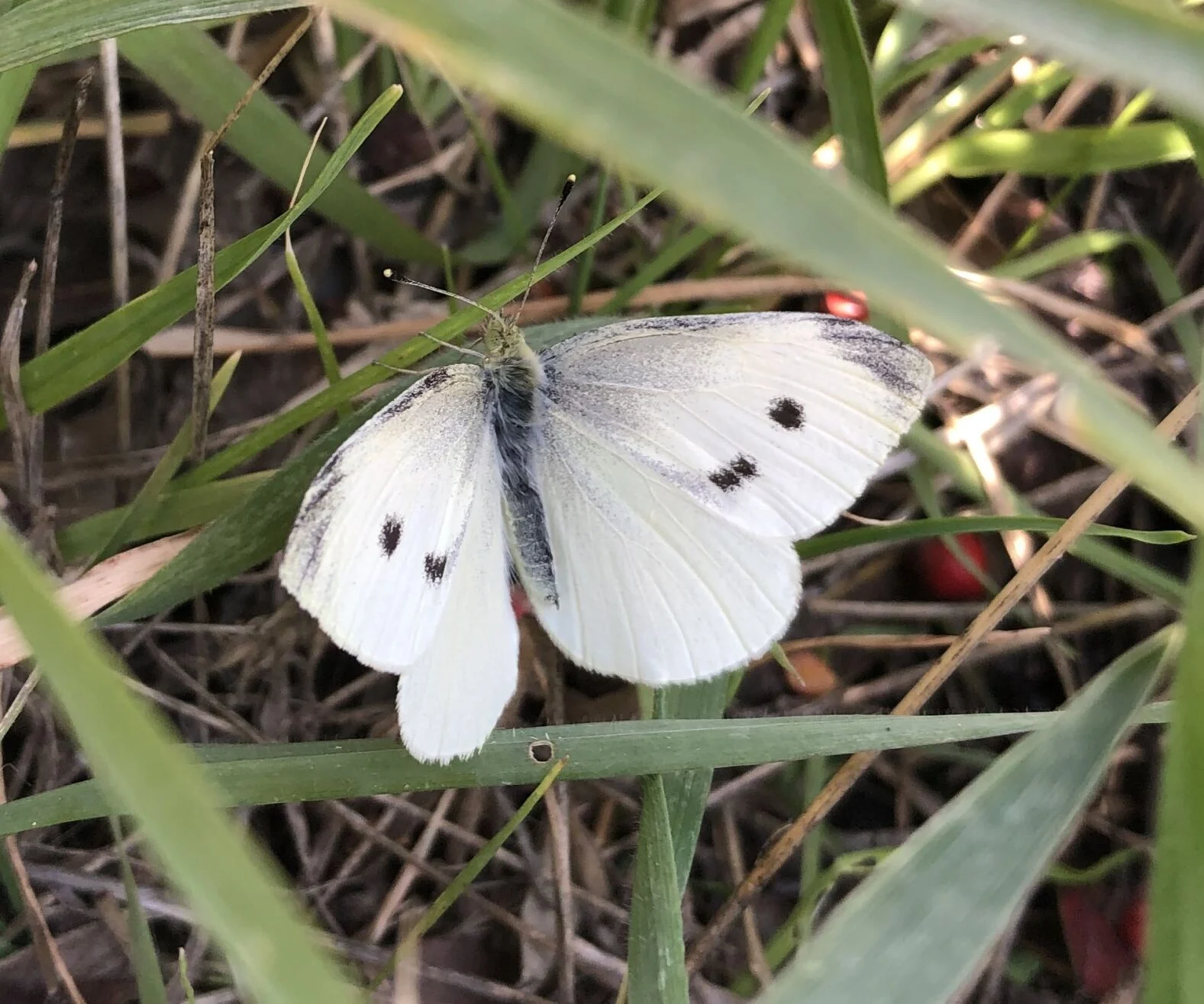 A female Cabbage White resting on grass with her wings opened. Photo Credits: John Hammond from Tehachapi News
Common Name: Cabbage White
Scientific Name:Pieris rapae
Other Common Names: Small White or Cabbage Butterfly
Genus: Pieris
Most Commonly Seen:Early Spring to Mid Fall
Colour: white, black, pale yellowish white, and light to dark grey.
Wings: Small wings that are white in colour with black markings. The colouration of the wings vary depending on what side of the wings is showing, and what gender the butterfly is.
Most Distinctive Features:Is it’s white wings with black spots
Wingspan: 3.2 - 4.7 cm
Native: No, the Cabbage White is a butterfly species that is not native to the province of Ontario and other parts of Canada. The Cabbage White Butterfly is an introduced species to Canada.
Native Range: Europe and Asia
Sightings: Early Spring to Mid Fall
Flight Period: Mid April to mid October
Flight Pattern: rapid and erratic
Lifespan:3 to 6 weeks
Host Plants: Cabbage, Brussel Sprouts, Cauliflower, Broccoli, Collard Greens, Kale, and Nasturtiums.
*If you don’t want the females to lay their eggs on your crops, plant a bunch of Nasturtiums around your crops and the butterflies will just use Nasturtiums for egg laying. *
Adult Food Source: As adults they primarily feed on nectar from various flowers including asters, mints, red clover, white clover, milkweeds, coneflowers, hoary vervain, blue vervain, ironweed, beebalm, verbena, and sunflowers.
The Cabbage White (Pieris rapae) is a small sized butterfly species that has both white and black colouration on their wings. It is a member of The Whites & Sulphurs Butterfly Family.
The males and females of this butterfly species resemble sexual dimorphism, which means that they are slightly different from one another.
The males of the Cabbage White flaunt creamy white wings adorned with a singular black spot.
The females of the Cabbage White display a paler yellow hue on their wings with two central black spots.
The undersides of the wings reveal a yellowish tinge sprinkled with black speckles.
Orange Sulphur (Colias eurytheme)
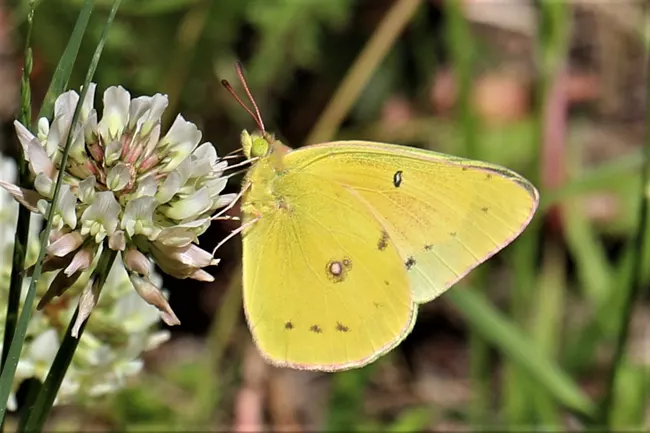
An Orange Sulphur sipping nectar from whitish pink flowers with their wings closed. Photo Credits: Charles Schelz
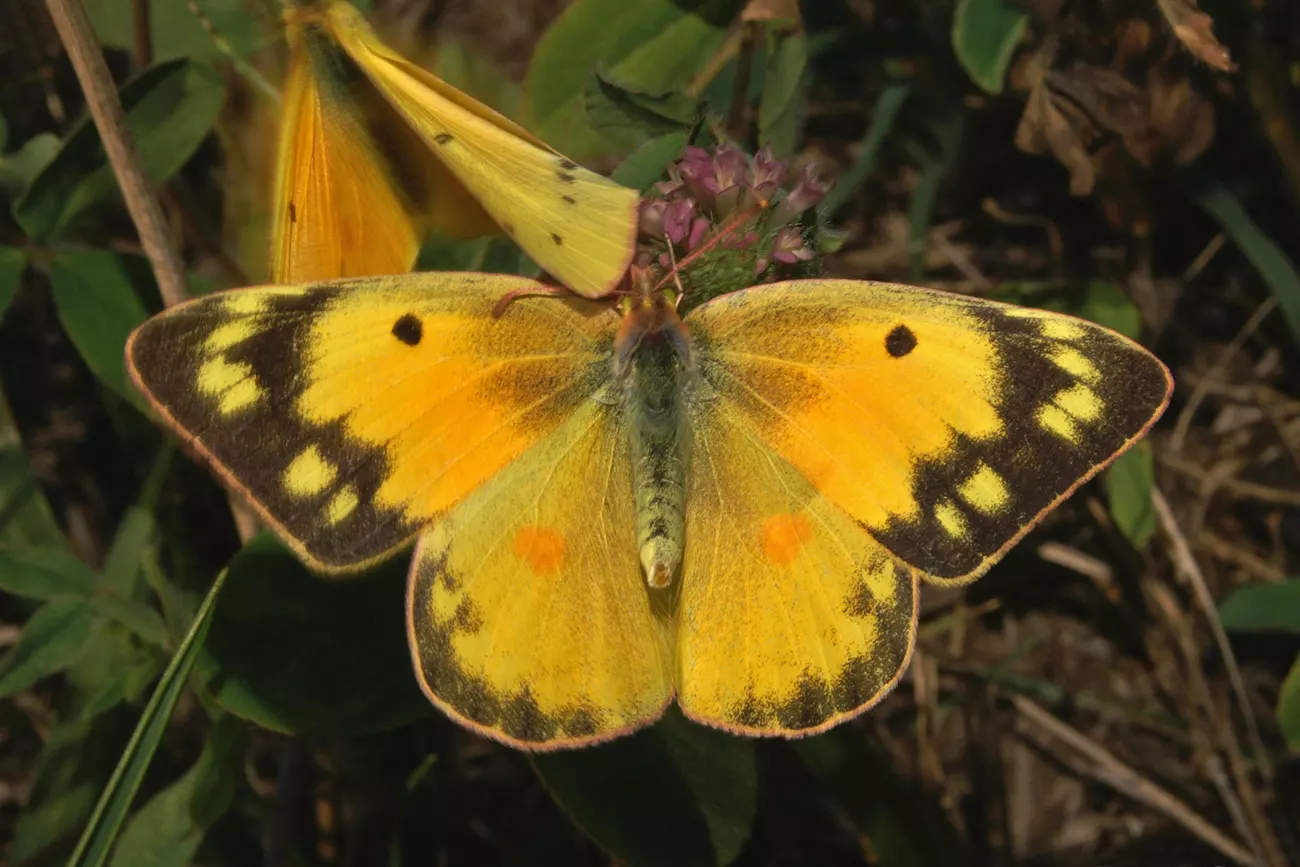
An Orange Sulphur resting on a low growing plant with purplish pink flowers with their wings opened. Photo Credits: Kenneth Dwain Harrelson
Common Name: Orange Sulphur
Scientific Name:Colias eurytheme
Other Common Names: Alfalfa Butterfly or Alfalfa Sulphur
Genus: Colias
Most Commonly Seen:Late Spring to Mid Fall
Colour: bright orange, yellow, orange, white, yellowish orange, and white.
Wings: The wings are small in size and are typically orange or yellow in colour with either a solid black border or a diffuse black border.
Most Distinctive Features:Is it’s bright orange and yellow wings with black borders.
Wingspan: 34 - 55 mm (approximately 1.3 to 2.2 inches)
Native: Yes, the Orange Sulphur is a butterfly species that is native to the province of Ontario and other parts of Canada.
Native Range: Southern Canada, from coast to coast in The United States, and Central Mexico.
Sightings: Late Spring 🌸 to Mid Fall 🍂
Flight Period: May to November
Flight Pattern: fast, low, and erratic
Lifespan:2 to 4 weeks
Host Plants: In Ontario, the Orange Sulphur utilizes alfalfa, white clover, red clover, white sweet clover, purple prairie clover, canada milkvetch, and beach pea.
Adult Food Source: As adults they primarily feed on nectar from various flowers including milkweeds, alfalfa, clovers, asters, sunflowers, coneflowers, ironweed, joe - pye weeds, lupines, and blue false indigo.
The Orange Sulphur (Colias eurytheme) is a small sized butterfly species, that is a widespread and common North American Butterfly. It is a member of The Whites & Sulphurs Butterfly Family.
In flight the adults reveal a dazzling yellow colour with hints of orange and bordered by black colouring.
At rest, the underwing presents a more subdued yellow-orange with a subtle pattern of spots, including a characteristic double spot at the wing’s center.
This butterfly displays sexual dimorphism, which means that the males and females of this butterfly species are very easy to identify from one another.
The males sport solid black wing borders, and the females display yellow spots in their stead.
Clouded Sulphur (Colias philodice)
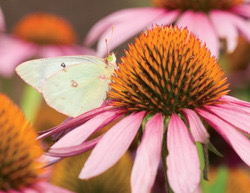
A Clouded Sulphur sipping nectar from a purple coneflower with their wings closed. Photo Credits: Sarah Bright
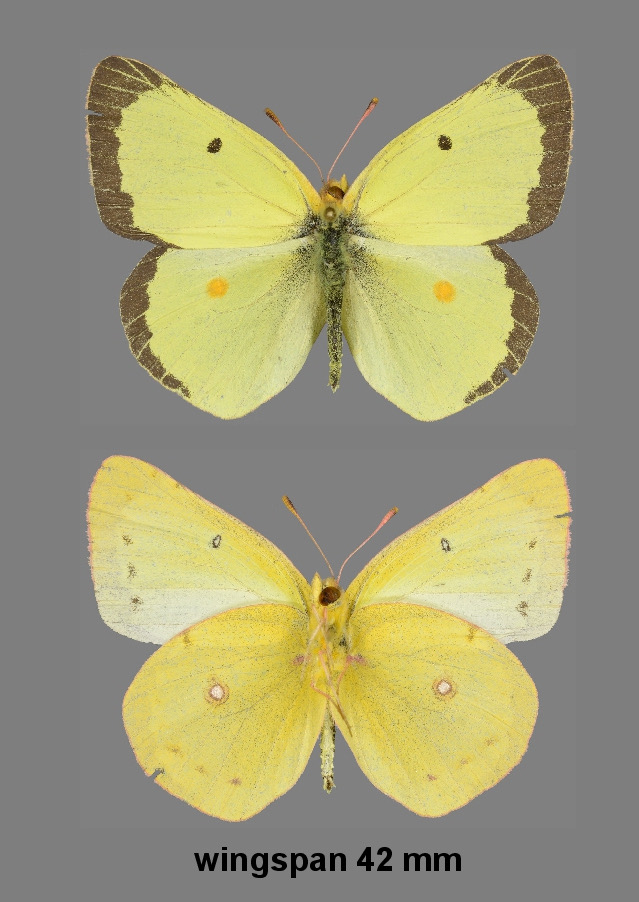
Specimens of male Clouded Sulphurs showing the upper surface wings colouration, and the under surface wings colouration. Photo Credits: norbertkondla from iNaturalist
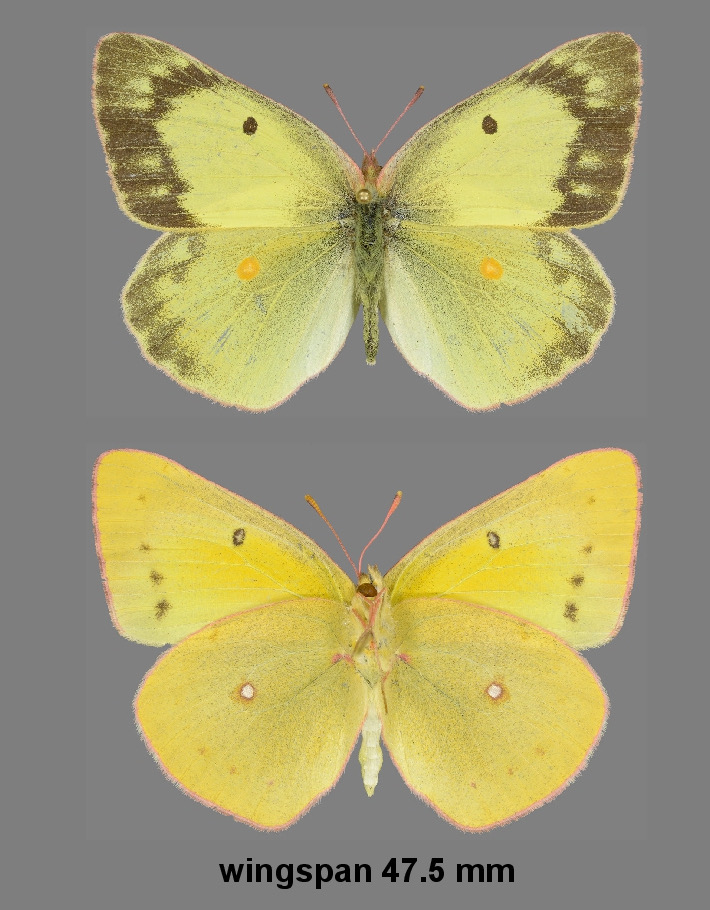
Specimens of female Clouded Sulphurs showing the upper surface wings colouration, and the under surface wings colouration. Photo Credits: norbertkondla from iNaturalist
Common Name: Clouded Sulphur
Scientific Name:Colias philodice
Other Common Names: Common Sulphur
Genus: Colias
Most Commonly Seen:Late Summer into Early Fall
Colour: bright yellow, duller yellow, white, greenish white, and black.
Wings: This butterfly has small to medium sized wings. The colouration of the wings vary depending on the wing surface that is being shown.
Above, the wings are yellow with black marginal borders. Below, the wings are a yellowish color with a faint row of small black marginal spots, more evident later in the year, and a double central spot.
Most Distinctive Features:Is their bright yellow wings with black borders.
Wingspan: 1 1/2 to 2 3/4 inches (3.8 - 7 cm)
Native: Yes, the Clouded Sulphur is a butterfly species that is native to the province of Ontario and other parts of Canada.
Native Range: Southeastern Canada, Central Canada, Southern Canada, Western Canada, Northern United States, Southern United States, Western United States, Central United States, Midwestern United States, and Guatemala.
Sightings: Spring 🌸 to Mid Fall 🍂
Flight Period: May into late October
Flight Pattern: rapid, low, and erratic
Lifespan:Typically they live for 2 to 7 days, but with some individuals living up to 24 days.
Host Plants: In Ontario, the Clouded Sulphur utilizes clovers, alfalfa, vetches, and sweet clovers as host plants.
Adult Food Source: As adults they primarily feed on nectar from various flowers such as clovers, milkweeds, goldenrods, asters, thistles, coneflowers, ironweed, joe - pye weeds, dogwood, cherries, and meadowsweet. Occasionally individuals can be found sipping from mud puddles and water puddles.
The Clouded Sulphur (Colias philodice) is a small sized butterfly species which is a delightful species, that graces much of North America with its presence. It is a member of The Whites & Sulphurs Butterfly Family.
This butterfly species displays sexual dimorphism, which means that males and females look different from another where it is quite easy to tell the difference from each of them.
The males boast pale yellow wings with solid black borders, while females have yellow-dotted borders. The underparts of their forewings feature dark spots, and the hindwings are highlighted by a silver cell spot surrounded by orange-pink, often doubled.
Males typically display a yellow underside when their wings are closed, whereas females may appear yellow or greenish white in colour.
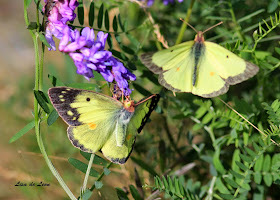
A male and female Clouded Sulphur on a plant that has purple flowers resting with their wings opened. The male Clouded Sulphur is up above, and the female Clouded Sulphur is down below. Photo Credits: Birding with Lisa de Leon on blogspot.com
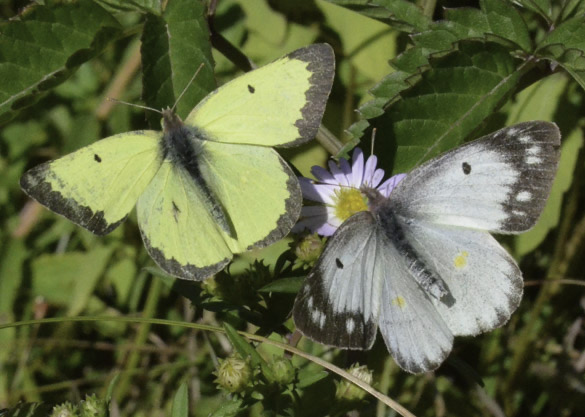
A male and female Clouded Sulphur resting on Aster flowers with their wings opened. The male Clouded Sulphur is the yellow butterfly that is up above, and the female Clouded Sulphur is the one below that has a white colouration. Photo Credits: Howard Hoople
Common Checkered Skipper (Burnsius communis)
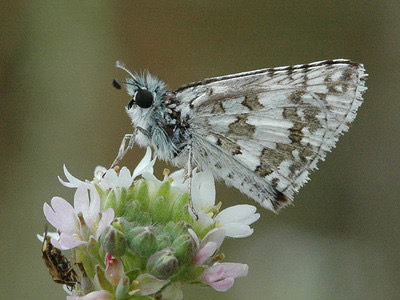
A Common Checkered Skipper resting on a cluster of pinkish white flowers with their wings closed.
Photo Credits: wisconsinbutterflies.org
Common Name: Common Checkered Skipper
Scientific Name: Burnsius communis
Other Common Names: White Checkered Skipper or Simply Checkerspot Skipper
Genus: Burnsius
Most Commonly Seen:Mid Spring to Mid Fall
Colour: black and white
Wings: Small wings that are black and white checkered pattern. The wing colouration varies depending on what wing surface is showing, and the gender of the butterfly.
On the upperside of the wings in males are blue grey with prominent white spots forming bands across both wings. For the females they are black with similar but often smaller white spots.
On the underside of the wings they are a dull white with dark grey or olive bands. The hindwing has small spots in the marginal row and larger spots in the submarginal row.
Most Distinctive Features:Is it’s bold black and white checkered pattern on their wings.
Wingspan: 1 to 1.5 inches (2.5 to 3.8 cm)
Native: Yes, the Common Checkered Skipper is a native butterfly species in the province of Ontario and other parts of Canada.
Native Range: Continental United States, Southern Canada, Southeastern Canada, and Northern Mexico.
Sightings: Mid Spring 🌸 to Mid Fall 🍂
Flight Period: Mid May to October
Flight Pattern: fast, erratic, and low to the ground
Lifespan:2 to 4 weeks
Host Plants: In Ontario, the Common Checkered Skipper utilizes globemallows, mallow, hollyhocks, velvet leaf, poppy mallow, rose mallow, and swamp rose mallow.
Adult Food Source: As adults they primarily feed on nectar from various flowers such as clovers, daisies, buttercup, hollyhock, fleabane, asters, milkweeds, joe - pye weed, ironweed, coneflowers, hoary vervain, blue vervain, sunflowers, phlox, and beebalm.
In addition to nectar from various flowers adults can also be drawn to rotting fruit, carrion, excrement, shorelines, and mud puddles.
The Common Checkered Skipper (Burnsius communis) is a small sized butterfly species that was rare in the past, but is becoming more and more common. It is a member of The Skipper Butterfly Family.
This butterfly displays sexual dimorphism which means that, the males and females look different from one another and are easily identified.
On the upper surface (dorsal) of the wings is a dark checkered pattern on both wings. Females are more darker than the males, while the males are more lighter than the females. Long, bluish white hairs over body and basal portion more extensive in male. Row of tiny spots along outer wing edges, and a final dot at forewing tip is absent or very faint.
On the under surface (ventral), the forewing like upper surface except paler. Hindwing dull white and crossed by three or four wavy, tan-colored bands (sometimes olive and tan) finely edged in black or brown. Checkered fringe.
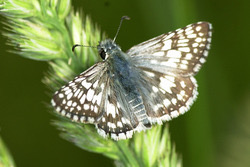
A male Common Checkered Skipper resting at the tip of a plant with his wings opened. Photo Credits: W. Mike Howell
A female Common Checkered Skipper resting and sipping nectar from a small yellow flower with her wings opened. Photo Credits: Sarah Bright
Least Skipper (Ancyloxypha numitor)
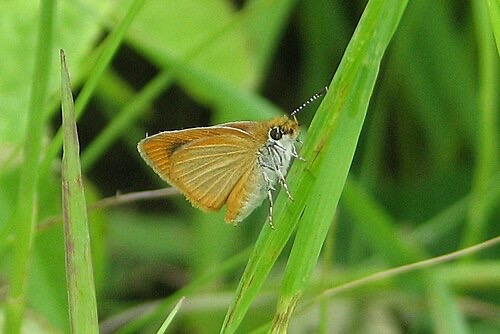 A Least Skipper resting on strands of an Ornamental Grass with their wings closed. Photo Credits: D. Gordon E. Robertson from Wikipedia
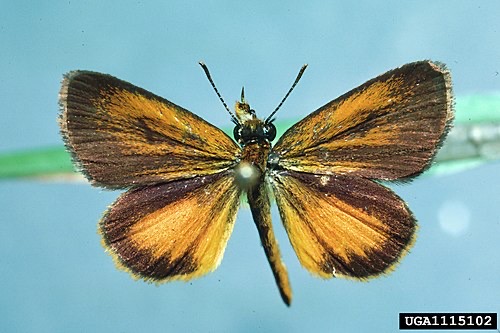 A Least Skipper resting on a green object with their wings wide opened. Photo Credits: Charles T. Bryson, USDA Agriculture Research, Bugwood.org
Common Name: Least Skipper
Scientific Name:Ancyloxypha numitor
Other Common Names: Common Least Skipper or Least Skipperling
Genus: Ancyloxypha
Most Commonly Seen:Late Spring through Early Fall
Colour: dark brown, orange, golden, and golden yellow.
Wings: This butterfly has small sized wings due to its size. The colouration of the wings vary depending on what surface is showing.
The forewings are primarily dark brown, with a small orange patch near the leading edge (costa).
The hindwings are orange with a wide dark brown border. The underside of the hindwing is a clear, but golden colour.
The wings of the Least Skipper are relatively rounded in shape, where all of their wings are this shape.
Most Distinctive Features:Is their rounded wings and slender body.
Wingspan: 3/4 - 1 inch
Native: Yes, the Least Skipper is a native butterfly species in the province of Ontario and other parts of Canada.
Native Range: Eastern United States, Southern Canada, Central Canada, and Southeastern Canada.
Sightings: Typically the Least Skipper is spotted during the early summer season through mid to late summer.
Flight Period: The Least Skipper has two different flight periods here in Ontario. The first flight period is from mid June to early July, and for the second flight it is from August to early September.
Flight Pattern: weak, low to the ground, and choppy.
Lifespan:Few days to a couple of weeks
Host Plants: The Least Skipper uses a variety of Ornamental Grass species as host plants including Little Bluestem (Schizachyrium scoparium) Native, Big Bluestem (Andropogon gerardii) Native, Canada Rye (Elymus canadensis) Native, Indian Grass (Sorghastrum nutans) Native, Rice Cutgrass (Leersia oryzoides) Native, Foxtail Grass (Alopecurus pratensis) Non - Native, and Marsh Millet (Zizaniopsis milliacea) Non - Native.
Adult Food Source: As adults the Least Skipper feed on nectar from various low growing flowering plants such as white clover, red clover, wild geranium, butterfly weed, pearly everlasting, wild mustard, swamp verbena, daisies, phlox, and other flowers.
The Least Skipper (Ancyloxypha numitor) is a very small sized butterfly species that is a member of The Skipper Butterfly Family.
The upperside of the forewing is orange with a wide, diffuse black border at the outer margin; hindwing is yellow-orange with a wide black margin. Underside of forewing is black with orange borders at the tip and leading edge, and the hindwing is yellow-orange.
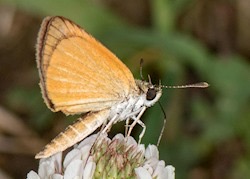
A male Least Skipper sipping nectar from a cluster of whitish pink flowers with his wings closed. Photo Credits: Gerry Green
A female Least Skipper resting on a big green leaf with her wings closed. Photo Credits: V. Charny
Silver - Spotted Skipper (Epargyreus clarus)
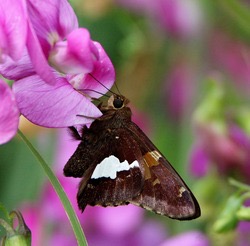
A Silver - Spotted Skipper sipping nectar from a big flower with their wings closed. Photo Credits: Carolyn Cavender Alexander
A Silver - Spotted Skipper resting with their wings opened. Photo Credits: Sarah Bright
Common Name: Silver - Spotted Skipper
Scientific Name:Epargyreus clarus
Other Common Names:Common Branded Skipper or Common Silver - Spotted Skipper
Genus: Epargyreus
Most Commonly Seen:Late Spring through Mid Summer
Colour: dark brown, golden yellow, brown, and silver white.
Wings: The wings of the Least Skipper are small in size, due to how small this butterfly species is. The colouration of the wings vary depending on what surface of the wings is showing.
The forewings are dark brown in colour with a gold or orange band, and the hindwings have a prominent silvery or white spot on the underside.
Most Distinctive Features:Is the large silver - white spot on the underside of its hindwings.
Wingspan: 1.75 to 2.25 inches (4.4 to 6.0 cm)
Native: Yes, the Silver - Spotted Skipper is a native butterfly species in the province of Ontario and other parts of Canada.
Native Range: Southern Canada, Southwestern Canada,The Continental United States(except for the Great Basin and Western Texas, and Northern Mexico.
Sightings: The Silver - Spotted Skipper is usually seen from late spring through mid summer.
Flight Period: The Silver - Spotted Skipper flies from early June to late July.
Flight Pattern: fast, erratic, and jerky
Lifespan:Two Months
Host Plants: The Silver - Spotted Skipper uses various of plants as host plants such as Blue False Indigo (Baptisia australis) Native, Showy Tick Trefoil (Desmodium canadense) Native, Slender Bush Clover (Lespedeza virginica) Native, Round - headed Bush Clover (Lespedeza capitata) Native, and Purple Prairie Clover (Dalea purpurea) Native.
Adult Food Source: As adults Silver - Spotted Skipper visits flowers for nectar as a food source. This skipper species favourites flowers that are blue, red, pink, purple, and sometimes white ones such as everlasting pea, common milkweed, swamp milkweed, red clover, white clover, buttonbush, blazing star, field thistle, tall ironweed, wild bergamot, blue vervain, hoary vervain, and others.
The Silver - Spotted Skipper (Epargyreus clarus) is a medium to large sized skipper, where it is bigger than most skippers. This butterfly is a member of The Skipper Butterfly Family.
The upper surface (dorsal) has a dark brown ground colour. A distinctive band of golden orange nearly crosses the central portion of the wing. A light checkered fringe occurs on hind and forewings.
The under surface (ventral), the forewing has a similar golden-orange band. Hindwing has a large silver-white patch. Both have frosted lavender margins. There are two short, stubby tails. The forewings on this butterfly species are pointed.
Eastern Giant Swallowtail (Papilio cresphontes)
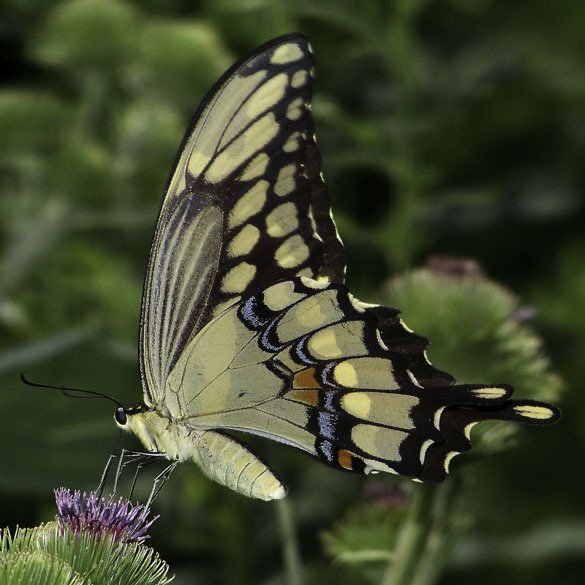
A Giant Swallowtail sipping nectar from a Thistle flower with their wings closed. Photo Credits: Frank Model
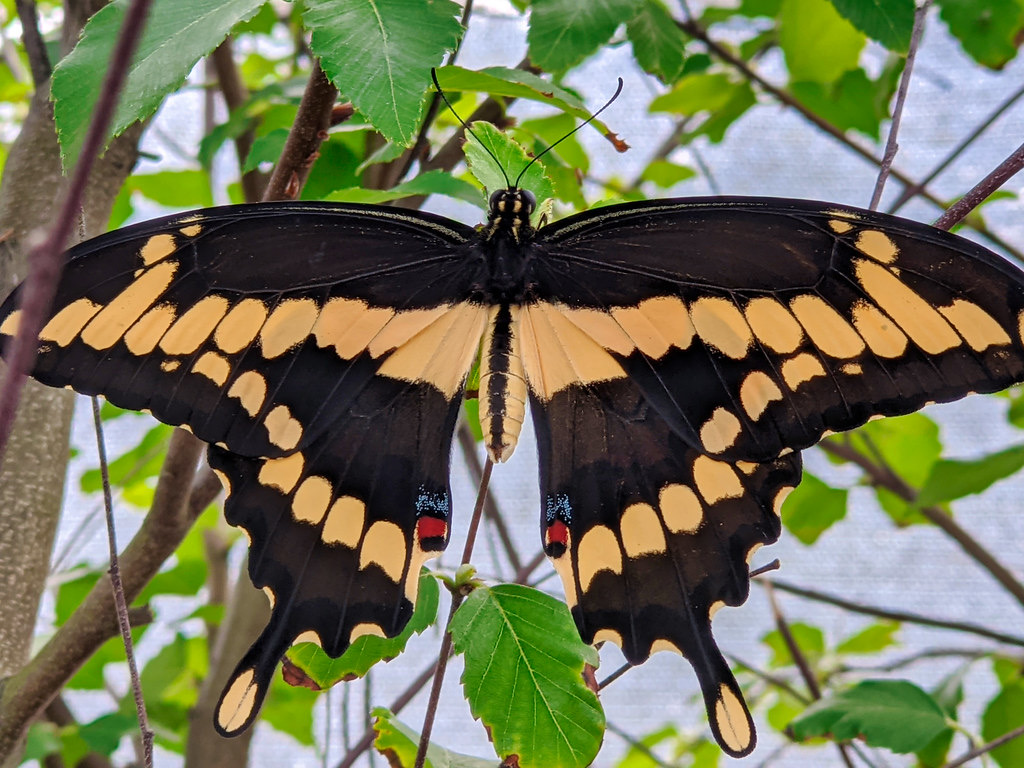 A Giant Swallowtail resting on a plant with their wings opened.
Photo Credits: fisherbray on Flickr
Common Name: Eastern Giant Swallowtail
Scientific Name:Papilio cresphontes
Other Common Names: Giant Swallowtail, Orange Dog, or Orange Puppy.
Genus: Papilio
Most Commonly Seen:Late Spring through Early Fall
Colour: black or dark brown, yellow, and orange.
Wings: The wings on the Eastern Giant Swallowtail are large and striking. The colouration of the wings vary depending on the wing surface that is showing.
Eastern Giant Swallowtail’s wings are predominantly blackish brown with bright yellow markings, when the wings are wide open while the butterfly is resting or relaxing.
The underside of the wings is primarily yellow with black venation with blue and orange spots.
Most Distinctive Features:The most distinctive feature of the Eastern Giant Swallowtail is its size.
Wingspan: For this butterfly species the wingspan varies depending on the gender of the butterfly.
The females have an average wingspan of 5.8 inches 15 cm) and up to 7.4 inches (19 cm) For the males they have an average wingspan of 5.5 inches (14 cm) up to 6.9 inches (18 cm).
Native: Yes, the Eastern Giant Swallowtail is a native butterfly species in the province of Ontario and other parts of Canada.
Native Range: The United States, Southern New England, Southern Canada, Mexico, Jamaica, and Cuba.
Sightings: The Giant Swallowtail is usually spotted from the end of spring through early fall.
Flight Period: For this butterfly they have two different flight periods throughout the year. Their first flight period is from late May into July, and then their second flight period is from late July into early September.
Flight Pattern: strong and agile flight
Lifespan:6 to 14 days
Host Plants: Common Rue (Ruta graveolens) Non - Native, Common Hoptree (Ptelea trifoliata) Native, and Prickly Ash (Zanthoxylum americanum) Native.
Adult Food Source: As adults Eastern Giant Swallowtails feeds on nectar from various flowers such as goldenrod, swamp milkweed, common milkweed, buttonbush, tall ironweed, wild bergamot, field thistle, butterfly weed, scarlet beebalm, blue vervain, hoary vervain, and coneflowers.
The Eastern Giant Swallowtail (Papilio cresphontes) is a large swallowtail species which is the largest butterfly in Canada. This butterfly is a member of The Swallowtail Butterfly Family.
The wings are black with a horizontal yellow line across the forewings, and a diagonal yellow line across the hindwing.
The underside of the wings is yellow with accents of black. A small patch of red on the ventral wing within the small blue band.
The females of this swallowtail species is bigger in size compared to the males, where the males are quite smaller in size.
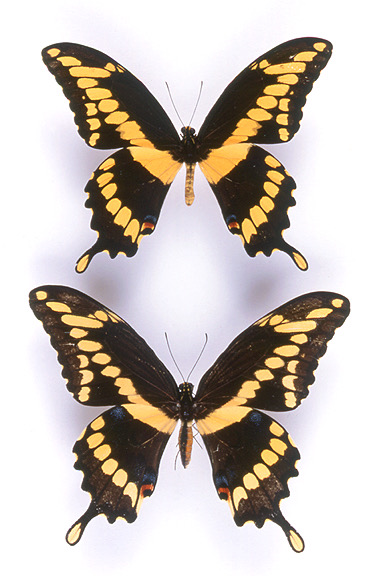
Male and Female Giant Swallowtail specimens with their wings opened. The male Giant Swallowtail is on the top, and the female Giant Swallowtail is on the bottom. Photo Credits: Barbara Strnadova
Peck’s Skipper (Polites peckius)
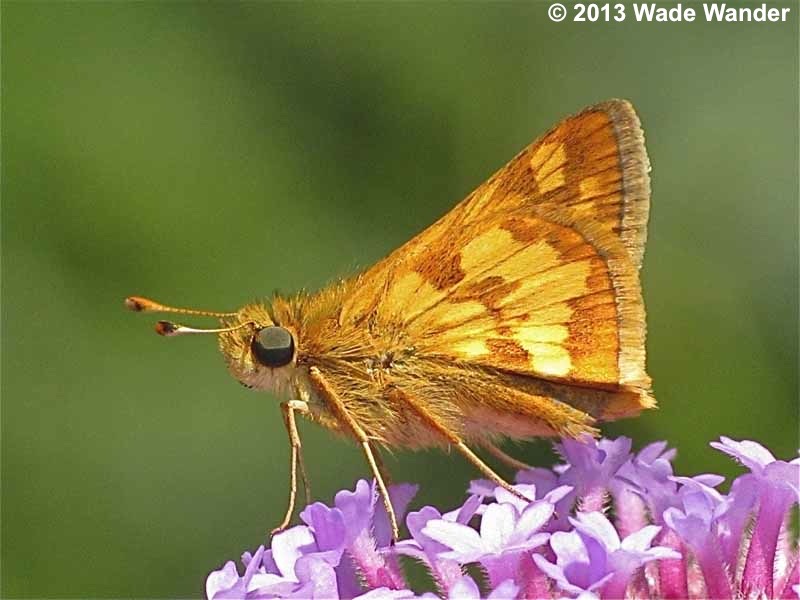
A Peck’s Skipper relaxing on a cluster of purplish pink flowers with their wings closed. Photo Credits: Wade Wander
Common Name: Peck’s Skipper
Scientific Name:Polites peckius
Other Common Names: Yellow Patch Skipper or Yellow Spotted Skipper
Genus: Polites
Most Commonly Seen:Early Summer through Mid Summer
Colour: dark brown, orange, and yellow
Wings: The Peck’s Skipper has small sized wings, and the colouration of the wings vary depending on the wing surface that is being shown.
The wings are dark brown with orange markings on the upperside. The underside of the hindwing is characterized by a large, dull yellow or straw coloured patch in the centre of the wings.
Most Distinctive Features:Is the large rectangular yellow patches on the hindwing.
Wingspan: 19 to 27 mm (approximately 3/4 to 1 inch)
Native: Yes, the Peck’s Skipper is a native butterfly species in the province of Ontario, and other parts of Canada.
Native Range: Northern United States, Central United States, Southern Canada, Eastern Canada, and Southwestern Canada.
Sightings: Early Summer through Mid to Late Summer
Flight Period: For this butterfly there are two different flight periods, which depends on where this butterfly is. The first flight period is from late June to late July in the eastern part of the province, and the second flight period is from early August to end of August or early September.
Flight Pattern: rapid, erratic, and darting
Lifespan:1 to 2 months
Host Plants: The Peck’s Skipper uses various ornamental grass species as a host plant such as Little Bluestem (Schizachyrium scoparium) Native, Big Bluestem (Andropogon gerardii) Native, Bottlebrush Grass (Elymus hystrix) Native, Rice Cutgrass (Leersia oryzoides) Native, and Bluegrass (Poa pratensis) Non - Native.
Adult Food Source: As adults the Peck’s Skipper feeds on various flowers for nectar including milkweeds, buttonbush, coneflowers, lupine, blazing star, black eyed susan, goldenrod, blue vervain, hoary vervain, ironweed, tick trefoil, and asters.
The Peck’s Skipper (Polites peckius) is a small butterfly which is a common skipper butterfly species. This butterfly species is a butterfly that is a member of The Skipper Butterfly Family.
The upperside of the male is brown with reddish-orange patches; forewing has a sinuous stigma. Female is darker with no stigma. Underside of the hindwing of both sexes has a patch of large yellow spots in the centre surrounded by dark brown.
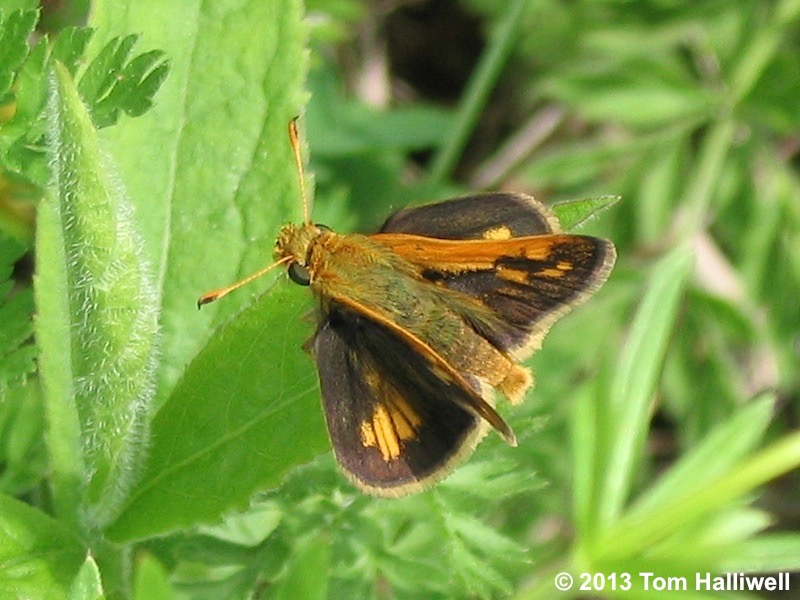
A male Peck’s Skipper resting on the foliage of a plant with his wings opened. Photo Credits: Tom Halliwell
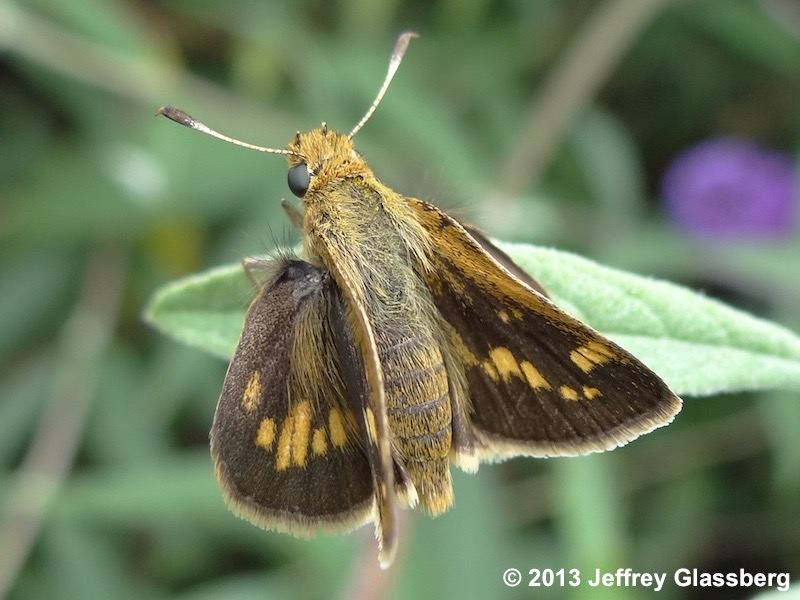
A female Peck’s Skipper resting on a small green leaf with her wings opened. Photos Credits: Jeffrey Glassberg
Baltimore Checkerspot (Euphydryas phaeton)
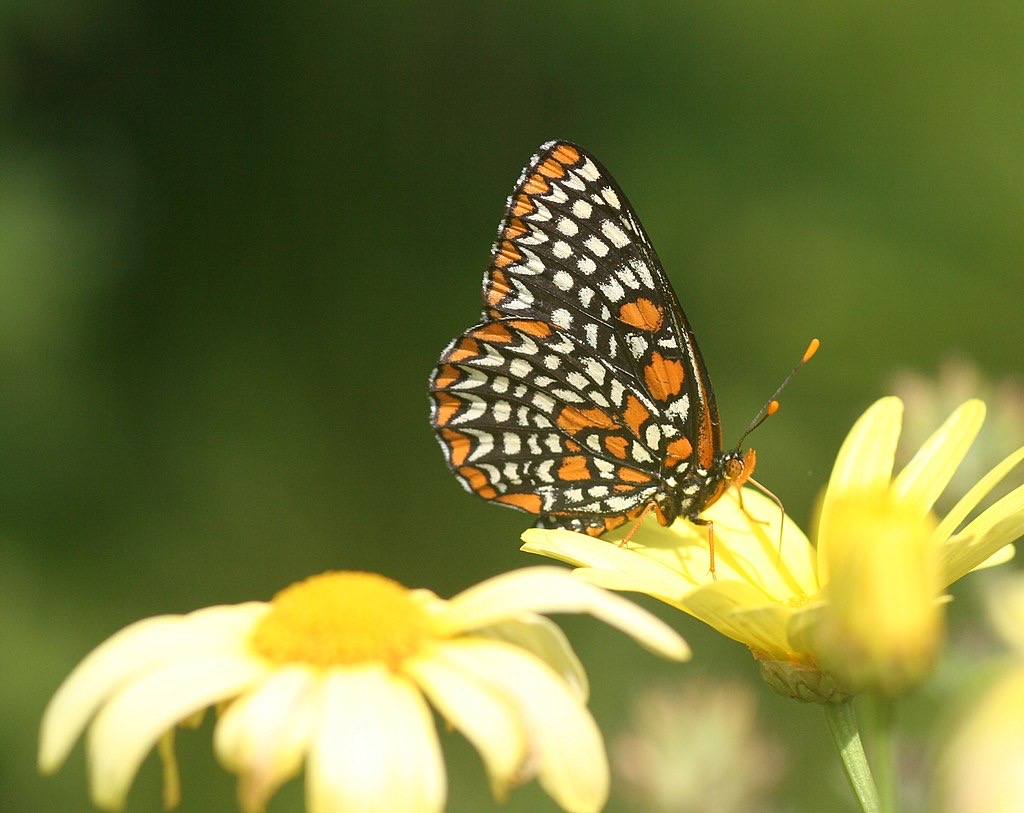
A Baltimore Checkerspot sipping nectar from a yellow flower with their wings closed. Photo Credits: Alison Hunter from Wikipedia
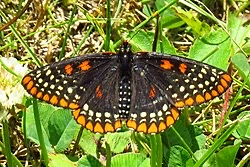
A Baltimore Checkerspot resting on foliage that is low to the ground with their wings opened. Photo Credits: D. Gordon E. Robertson from Wikipedia
Common Name: Baltimore Checkerspot
Scientific Name:Euphydryas phaeton
Other Common Names: Damier de Baltimore
Genus: Euphydryas
Most Commonly Seen:Late Spring through Mid Summer
Colour: black, orange, and white
Wings: The Baltimore Checkerspot has black wings that are adorned with rows of orange crescents and white spots.
Most Distinctive Features:Is it’s bold and contrasting wing patterns.
Wingspan: 1.75 to 2.75 inches (4.5 to 7 cm)
Native: Yes, the Baltimore Checkerspot is a native butterfly species in the province of Ontario and other parts of Canada.
Native Range: Southeastern Canada, Southern Canada, and Eastern United States.
Sightings: The Baltimore Checkerspot is usually seen from late spring or early summer to end of summer.
Flight Period: Mid June to Early August
Flight Pattern: fast and erratic
Lifespan:6 to 9 months
Host Plants: In the province of Ontario the Baltimore Checkerspot uses White Turtlehead (Chelone glabra) as a host plant.
Adult Food Source: As adults Baltimore Checkerspots feeds on various of flowers for nectar including milkweeds, mountain mint, wild blackberry, ironweed, blue vervain, hoary vervain, false sunflower, blue false indigo, buttonbush, lupines, zinnias, and lantanas.
The Baltimore Checkerspot (Euphydryas phaeton) is a small to medium sized butterfly that has a unique pattern on its wings. This butterfly is a member of The Brush - footed Butterflies Family.
This species does not show sexual dimorphism, so both the male and female of this butterfly species look a like.
With wings unfurled, the butterfly displays a black base accented by white and orange to yellowish-orange checkered borders. The patterns intensify when the wings are closed, making the butterfly appear even more vibrant.
Eastern Tiger Swallowtail (Papilio glaucus)
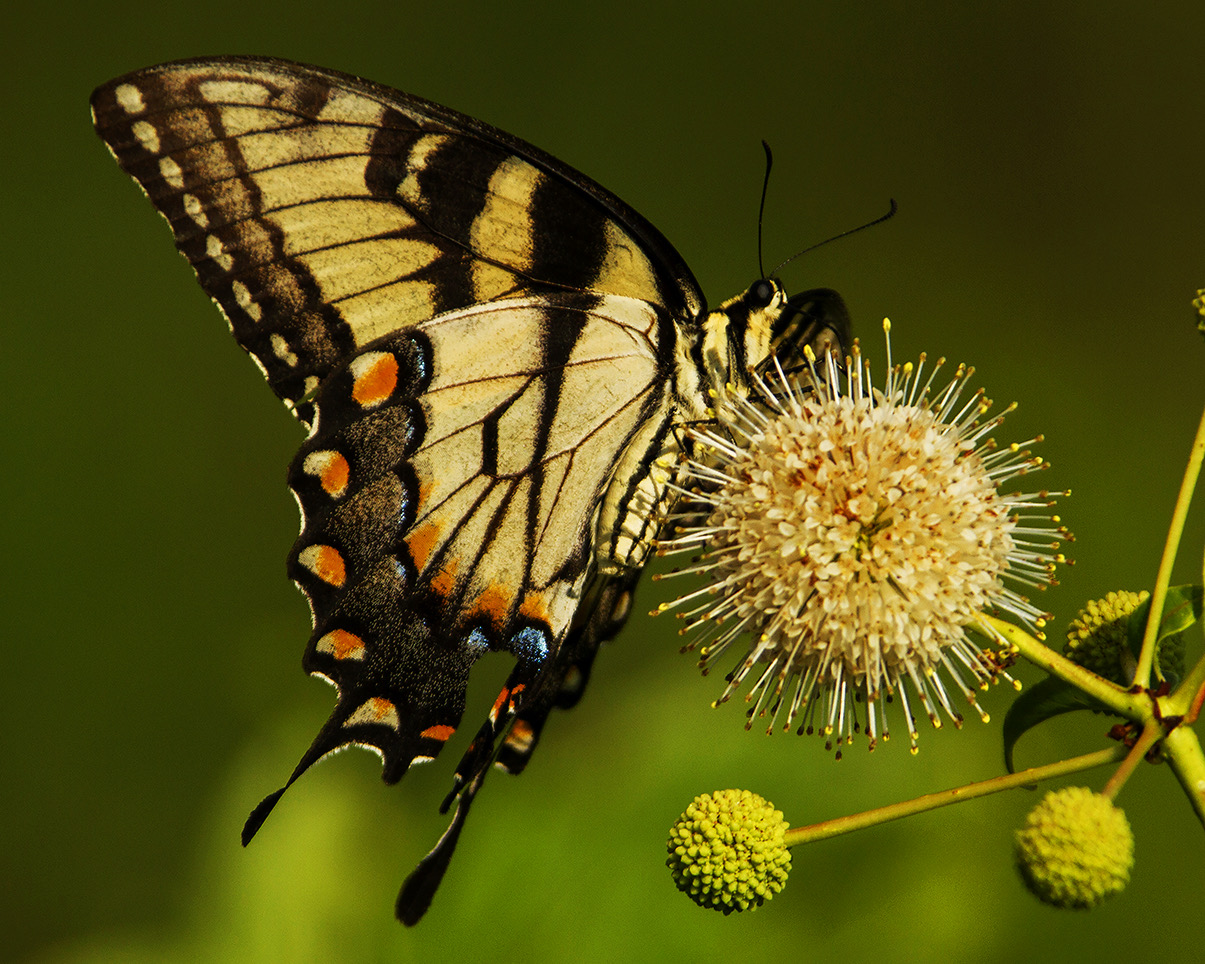 Eastern Tiger Swallowtail sipping nectar on a flower of a buttonbush with their wings closed. Photo Credits: Bird Shot
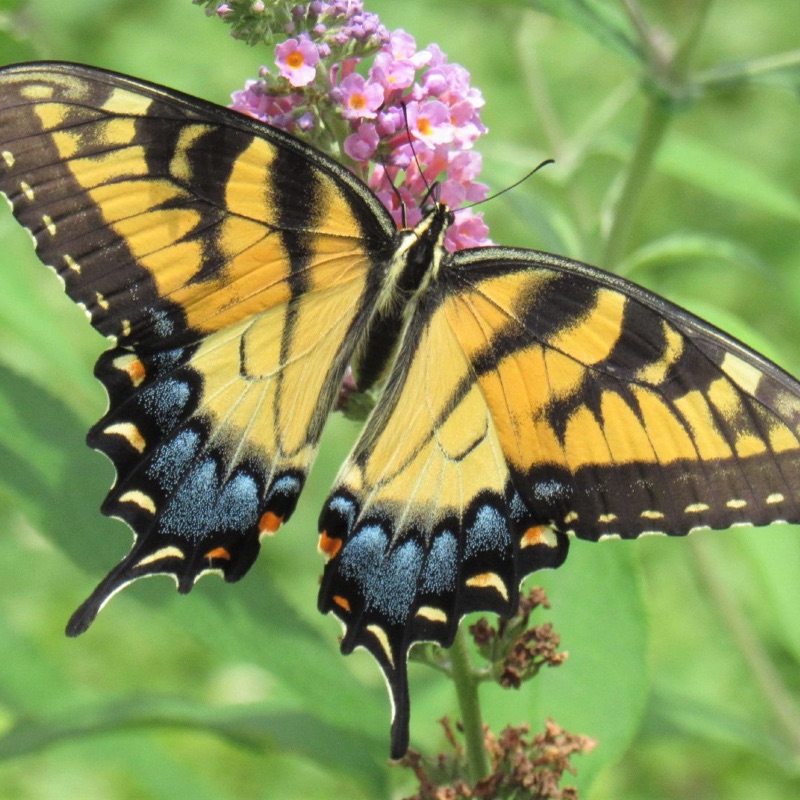 Eastern Tiger Swallowtail sipping nectar from a cluster of pale pinkish purple flowers with their wings opened. Photo Credits: Suzanne Herel
Common Name: Eastern Tiger Swallowtail
Scientific Name: Papilio glaucus
Other Common Names: Tiger Swallowtail or Tiger
Genus: Papilio
Most Commonly Seen:Late Spring through Late Summer
Colour: yellow, black, and blue
Wings: Large wings that are typically yellow in colour that have black tiger stripes as well as a black border.
Most Distinctive Features:Is their bright yellow wings with bold black stripes, which resemble a tiger’s pattern.
Wingspan: 7.9 to 14 cm (3.1 to 5.5 inches)
Native: Yes, the Eastern Tiger Swallowtail is a native butterfly species in the province of Ontario and other parts of Canada.
Native Range: Southern Canada, Southwestern Canada, and Eastern United States.
Sightings: Late Spring or Early Summer until Late Summer
Flight Period: With this butterfly species there are two different flight periods. The first flight period is from May to June, and the second flight period is from Late July to the end of August.
Flight Pattern: A combination of powerful wing flaps and glides.
Lifespan:A Eastern Tiger Swallowtail typically lives for 6 to 14 days, but some sources say that some individuals can live up to 40 days.
Host Plants: In the province of Ontario the Eastern Tiger Swallowtail relies on certain plants as host plants such as tulip tree (Liriodendron tulipifera) Native, wild black cherry (Prunus serotina) Native, white ash (Fraxinus americana) Native, sweet bay magnolia (Magnolia virginiana) Non Native, and pussy willow (Salix discolor) Native.
Adult Food Source: As adults Eastern Tiger Swallowtails primarily feed on nectar from various flowers such as milkweeds, buttonbush, joe pye weed, phlox, ironweed, coneflowers, beebalm, blazing star, and lilac. In addition to nectar, individuals can be found consuming sap from trees, the juices from fermented fruit, and the moisture as well as the minerals from damp soil or puddles.
The Eastern Tiger Swallowtail (Papilio glaucus) is a beautiful large swallowtail. This butterfly species is a member of The Swallowtail Butterfly Family.
With this butterfly it displays sexual dimorphism, where the males and females of this butterfly look different from one another, and they can be identified easily than others.
When the wings are opened the males boast a bright yellow colour with four black stripes. With the females when their wings are opened they may be yellow like the males or exhibit a darker, almost black hue with similar striping. Both males and females have blue spots on the hindwings.
When the wings are closed they are similar to when the wings are opened. Mostly bright yellow in colour with black wing veins, about three tiger stripes on each side of the wings, a black border on the wings, blackish blue markings that look like dots or spots, and orangish red markings that look dots or spots.
Both males and females of this swallowtail species have a tail on each of their bottom wings.
Northern Azure (Celastrina lucia)
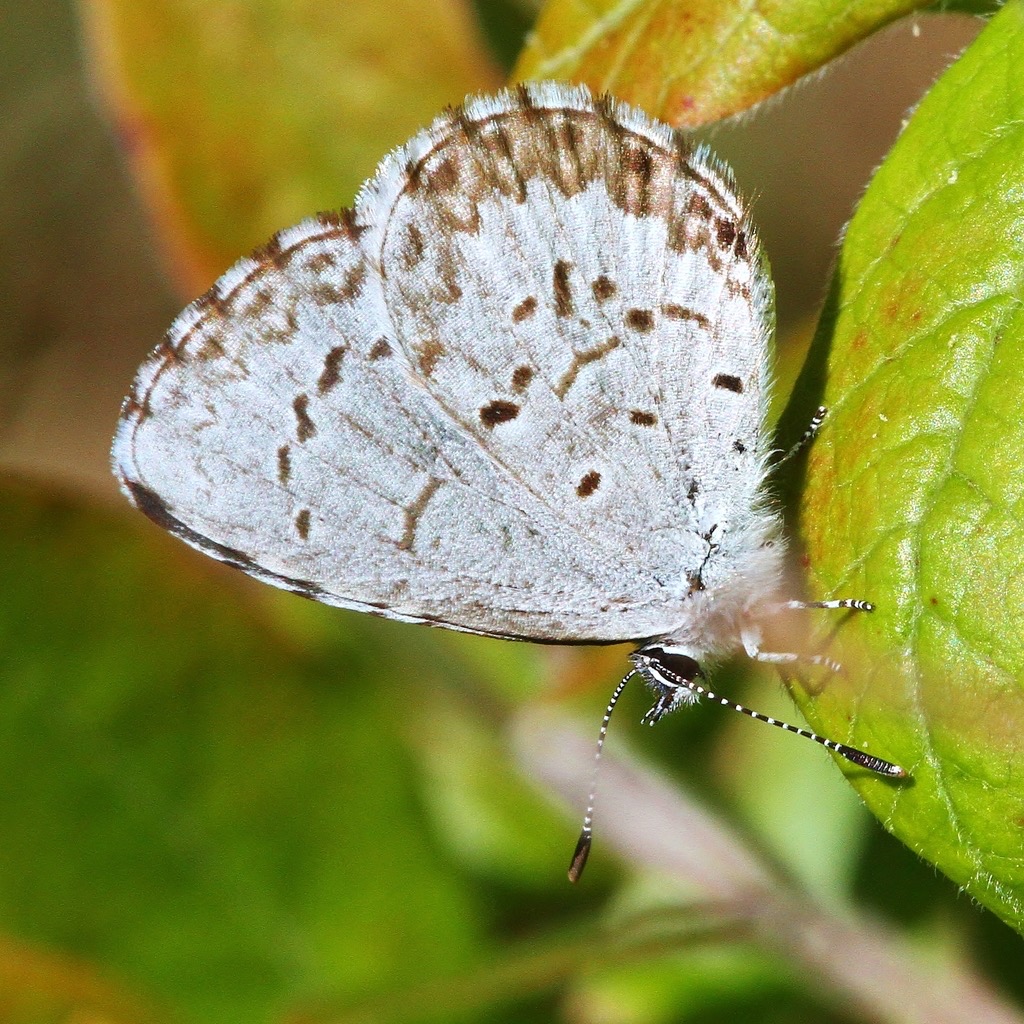
A Northern Azure resting in a sunny location on a leaf with their wings closed. Photo Credits: Denis Doucet from iNaturalist
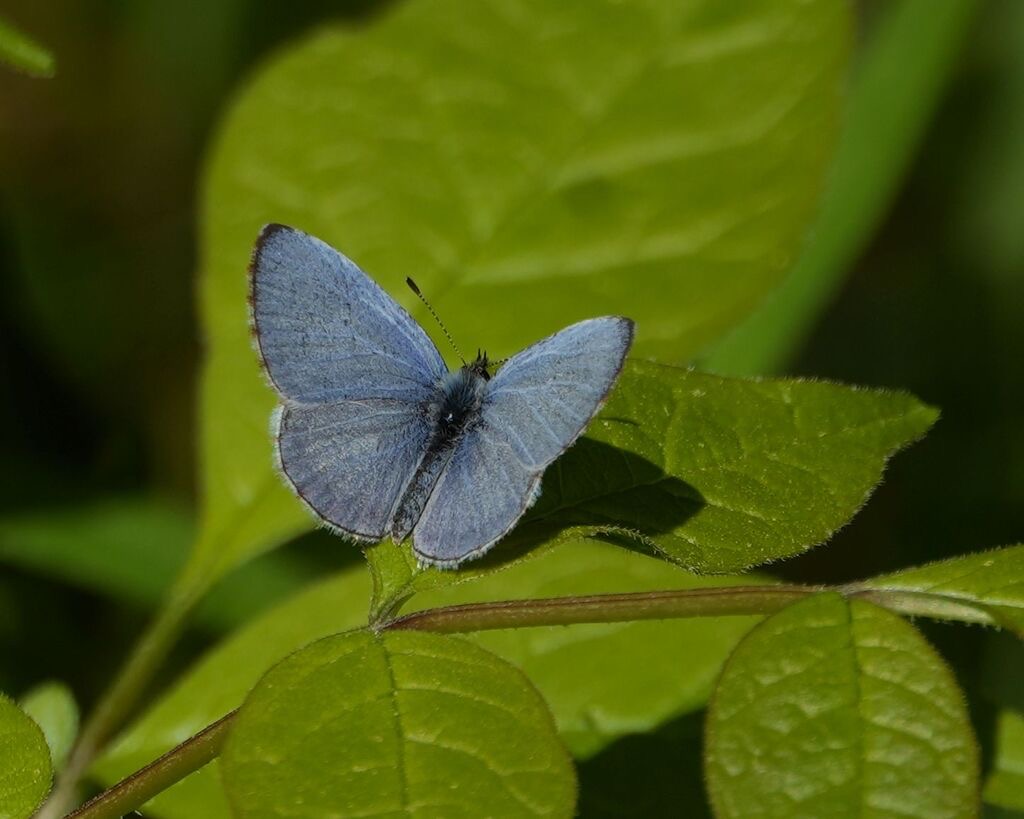
A male Northern Azure resting on the foliage of a plant with his wings opened. Photo Credits: awaysick from iNaturalist
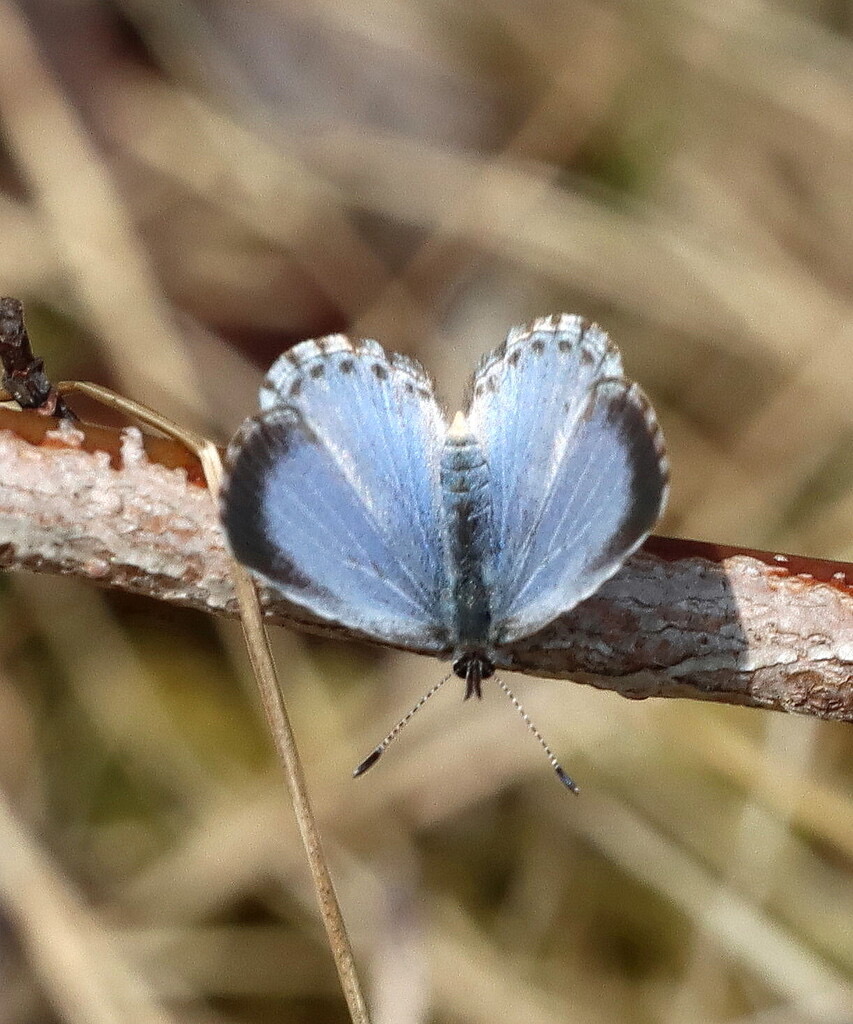
A female Northern Azure sun - basking in a sunny spot on an old branch or twig on a plant with her wings opened. Photo Credits: johngibbons from iNaturalist
Common Name: Northern Azure
Scientific Name:Celastrina lucia
Other Common Names: Lucia Azure, Northern Spring Azure, or Eastern Spring Azure.
Genus: Celastrina
Most Commonly Seen:Early Spring
Colour: iridescent blue, black, pale blue, brown, pale grey, and whitish.
Wings: The wings are quite small in size and the colouration varies depending on what wing surface is show, as well as the gender of the butterfly.
When the wings are opened the wings display a pale blue or bright blue colouration with a dark black wing border or a pale black wing border that is smaller, thinner, and light coloured.
While the wings are closed the wings have a silvery blue or bluish grey colour with black or grey markings.
Most Distinctive Features:Is the large silver - white spot on the underside of the hindwings.
Wingspan: 18 to 35 mm (0.7 to 1.4 inches)
Native: Yes, the Northern Azure is a native butterfly species in the province of Ontario and other parts of Canada.
Native Range: Alaska, Canada, Eastern United States, and Northern United States.
Sightings: The Northern Azure is typically spotted early spring to early summer, occasionally they can be spotted through late summer.
Flight Period: For the Northern Azure there are two flight periods in the province of Ontario. The first flight is from late April to early June, and the second flight occurs later in the summer mostly around the end of July or August till September.
Flight Pattern: erratic and bouncy, but can shift to a quick zigzag when dodging predators.
Lifespan:About four weeks
Host Plants: In the province of Ontario the Northern Azure relies on specific plants as host plants such as black cherry (Prunus serotina) Native, chokecherry (Prunus virginiana) Native, pin cherry (Prunus pensylvanica) Native, lowbush blueberries (Vaccinium angustifolium) Native, highbush blueberries (Vaccinium corymbosum) Native, and white meadowsweet (Spiraea alba) Native.
Adult Food Source: As adults Northern Azures primarily feed on tree sap especially from oak trees as well as rotting fruit. They will less frequent flowers for nectar.
The Northern Azure (Celastrina lucia) is a small sized butterfly that is pale blue in colour. This butterfly species is a member of The Gossamer - winged Butterflies Family.
This butterfly plays sexual dimorphism, where the males and females look different from one another to make it easier to tell them apart.
For males the upperside of their wings is pale blue in colour, and for the females the upperside of their wings has a darker border on their forewings.
On the underside of the wings the males and females look similar, since the wings look the same when they’re closed. The underside of the wings is grey in colour with black markings.
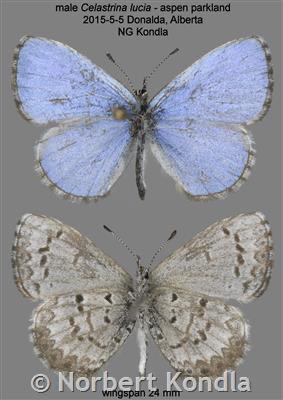
Specimens of male Northern Azures showing the upperside of wings and the underside of wings.
Photo Credits: Norbert Kondla
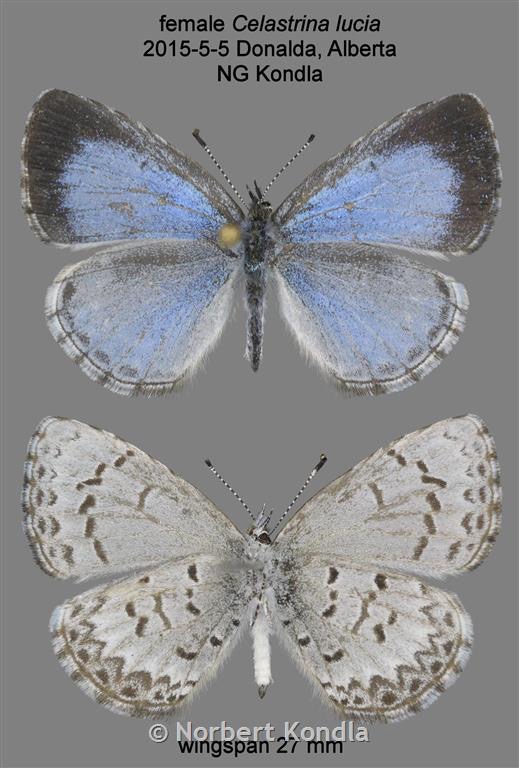
Specimens of female Northern Azures showing the upperside and underside of the wings. Photo Credits: Norbert Kondla
Summer Azure (Celastrina neglecta)
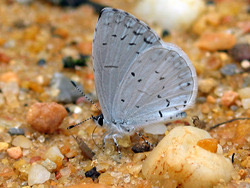
A Summer Azure sipping the minerals and nutrients from the wet sand and gravel with their wings closed. V. Charny
A male Summer Azure resting on the ground with his wings opened.
Photo Credits: Sarah Bright
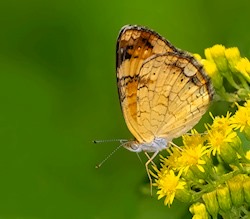
A female Summer Azure relaxing with her wings opened on a green leaf.
Photo Credits: Frances Kendrick
Common Name: Summer Azure
Scientific Name:Celastrina neglecta
Other Common Names: Summer Blue
Genus: Celastrina
Most Commonly Seen:Late Spring to Late Summer
Colour: bright blue, pale whitish blue, black, greyish blue, and silver blue.
Wings: They have small to tiny sized wings and the colouration varies depending on the wing surface that is being shown and the gender of the butterfly.
The upperside is usually light blue to purplish blue in colour with a shiny appearance or more white scaling than the blue colour and a wider black border.
On the underside of the wings is pale grey or white with small black spots, a dull black submarginal line or zigzag pattern.
Most Distinctive Features:Is their light blue wings, a wingspan of 1.0 to 1.3 inches, and their longer flight period than the Spring Azure.
Wingspan: 1.0 to 1.3 inches
Native: Yes, the Summer Azure is a native butterfly species in the province of Ontario and other parts of Canada
Native Range: Eastern United States and Southern Canada
Sightings: Typically Summer Azures are usually spotted late spring or early summer to late summer or early fall.
Flight Period: Mid June to Early September
Flight Pattern: quick, erratic motion, and flitting through
Lifespan:A few weeks
Host Plants: In the province of Ontario the Summer Azure relies on certain plants as host plants including red osier dogwood (Cornus sericea) Native, pagoda dogwood (Cornus alternifolia) Native, new jersey tea (Ceanothus americanus) Native, and white meadowsweet (Spiraea alba) Native.
Adult Food Source: As adults Summer Azures primarily feed on nectar from various flowers such as meadowsweet, dogwoods, new jersey tea, milkweeds, anemone, clematis, black eyed susan, blue vervain, hoary vervain, verbena, blackberries, raspberries, and strawberries.
In addition to flower nectar, individuals can be found feeding from rotting fruit, sap from trees, carrion, puddles, and animal poop.
The Summer Azure (Celastrina neglecta) is a small to tiny sized butterfly species, and it looks somewhat similar to the Northern Azure. This butterfly species is a member of The Gossamer - winged Butterflies Family.
This butterfly species displays sexual dimorphism just like the Northern Azure, where the females and males look different from one another.
For males the upperside of their wings is a powdery blue colour, that is often with a white patch on the hindwing.
For the females the upperside of their wings is a pale blue colour, with a wide black border on the forewing and some white scaling.
For the underside of the wings are the same, for both males and females of this butterfly species. They are pale grey or even white in colour with small dark grey spots, and a zigzag submarginal line on the hindwing.
Pearl Crescent (Phyciodes tharos)
A Pearl Crescent sipping nectar from a cluster of small yellow flowers with their wings closed.
Photo Credits: Jerry Green
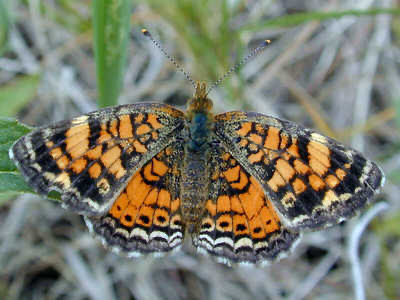
A male Pearl Crescent resting on an old twig or branch with his wings opened.
Photo Credits: Festge Park, Dane Co, Wl / wisconsinbutterflies.org
A female Pearl Crescent resting on foliage with her wings opened.
Photo Credits: Greenwood Refuge, Washara Co., Wl / wisconsinbutterflies.org
Common Name: Pearl Crescent
Scientific Name:Phyciodes tharos
Other Common Names: Calico Crescent or Simply Crescent
Genus: Phyciodes
Most Commonly Seen:Late Spring to Early Fall
Colour: orange, yellow orange, and black
Wings: The Pearl Crescent has small sized wings because of the size of this butterfly species. The colouration of the wings vary depending on what wing surface is showing, and the gender of the butterfly.
The upper surface of the wings is primarily orange with black markings.
On the underside there is a dark patch on the rear margin that contains a silvery or pale crescent.
Most Distinctive Features:Is a pale crescent - shaped marking on the underside of its hindwing, surrounded by a darker patch.
Wingspan: 1.25 to 1.75 inches (3.2 to 4.5 cm)
Native: Yes, the Pearl Crescent is a native butterfly species in the province of Ontario, and other parts of Canada.
Native Range: Eastern United States, Southern Canada, and Mexico.
Sightings: Late Spring or Early Summer through Late Summer or Early Fall.
Flight Period: For this butterfly there are two different flight periods because there are two generations of this butterfly a year. The first flight is from May to late September, and then the second flight is from Late July to early August.
Flight Pattern: low, erratic, flap guide motion, and rapid movements near the ground.
Lifespan:1 to 2 weeks
Host Plants: In the province of Ontario the Pearl Crescent relies on specific aster species as a host plant including new england aster (Symphyotrichum novae-angliae) Native, heath aster (Aster ericoides) Native, frost aster (Symphyotrichum pilosum) Native, smooth aster (Symphyotrichum laeve) Native, calico aster (Aster lateriflorus) Native, and panicled aster (Aster simplex) Native.
Adult Food Source: As adults Pearl Crescents primarily feed on nectar from various flowers including asters, swamp milkweed, butterfly weed, thistles, white clover, red clover, purple prairie clover, black - eyed susan, yarrow, coreopsis, lupines, and coneflowers.
In addition to nectar from various flowers, individuals can be found at or near wet areas such as puddles, moist soil or sand, and mud.
The Pearl Crescent (Phyciodes tharos) is a small sized butterfly species that is orange in colour. This butterfly species is a member of The Brush - footed Butterflies Family.
This butterfly species exhibits sexual dimorphism, where the males and females of this butterfly look different from another.
The males of the Pearl Crescent have a knob at their antenna’s tip, and their wings are a lighter orange colour.
The females of the Pearl Crescent don’t have a knob at their antenna’s tip, and their wings are a darker orange colour.
When this butterfly’s wings are opened they display a vivid orange colour with intricate black markings and margins.
When this butterfly’s wings are closed they display a grey brown or orange brown colour, devoid of black spots, and a white crescent along the border of the wings.
Milbert’s Tortoiseshell (Aglais milberti)
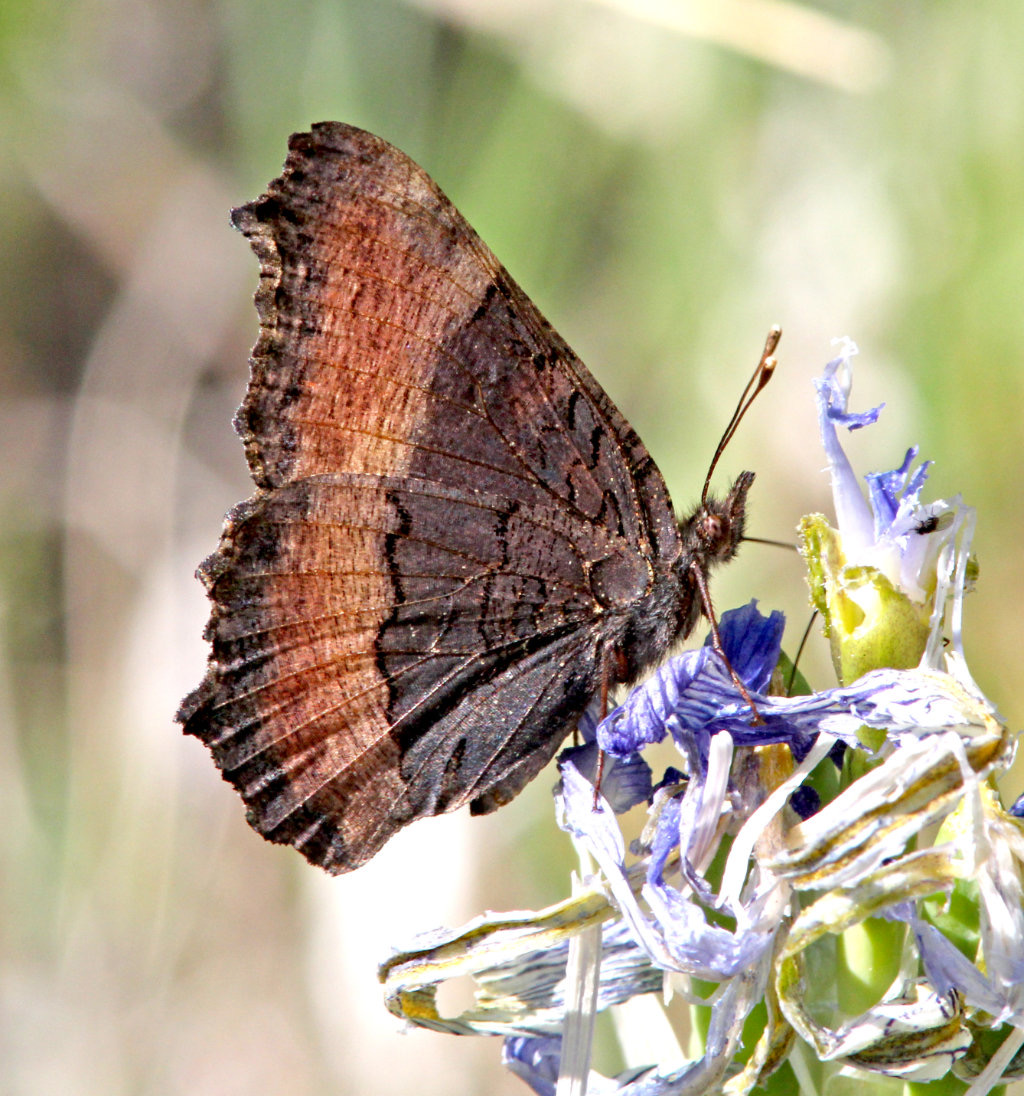
A Milbert’s Tortoiseshell sipping nectar from small purple flowers with their wings closed.
Photo Credits: ButterfliesAtHome.com
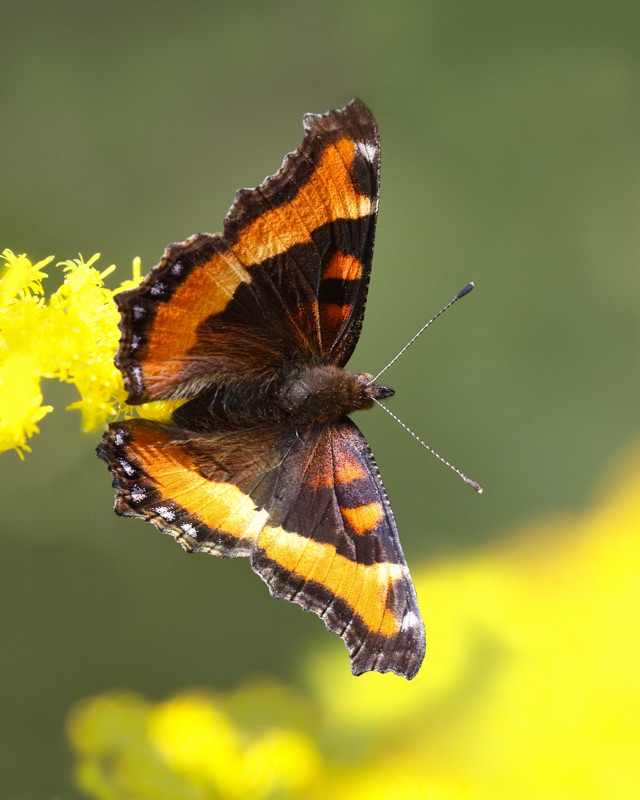
A Milbert’s Tortoiseshell resting on a cluster of small yellow flowers with their wings opened.
Photo Credits: Dale Swedberg / Local Naturalist & Retired Sinlahekin Wildlife Area Manager
Common Name: Milbert’s Tortoiseshell
Scientific Name: Agalis milberti
Other Common Names: Fire - rim Tortoiseshell
Genus: Aglais
Most Commonly Seen:Early Spring to Early Fall
Colour: dark brown or black, orange, yellow, black, and blue.
Wings: Has medium to large sized wings due to the size of this butterfly species. The wing colouration varies depending on what wing surface is showing.
The underside of the wings is mottled brown, which helps them to camouflage.
The upperside of the wings is dark brown with a broad orange band, which fades to yellow towards the body.
Most Distinctive Features:Is the bright orange and yellow band along the outer edge of its dark brown wings.
Wingspan: 1 5/8 to 2 1/2 inches (4.2 to 6.3 cm)
Native: Yes, the Milbert’s Tortoiseshell is a native butterfly species to the province of Ontario and other parts of Canada.
Native Range: Alaska, Canada, all of the western United States, and most of the eastern United States.
Sightings: The Milbert’s Tortoiseshell can be spotted from early spring through mid to late fall.
Flight Period: April to October
Flight Pattern: quick and flitting flight
Lifespan:About 10 days
Host Plants: In the province of Ontario the Milbert’s Tortoiseshell relies on three specific plants as a host plant such as stinging nettle (Urtica dioica) Non - Native, tall nettle (Urtica procera) Non - Native, and canada wood nettle (Laportea canadensis) Native.
Adult Food Source: As adults they feed on nectar from various flowers such as common milkweed, joe pye weed, black - eyed susan, red clover, swamp milkweed, thistles, ironweed, coneflowers, purple prairie clover, blazing star, butterfly weed, and false sunflower.
Individuals also tend to drink from sap from trees, rotting fruit, animal droppings, animal carcasses, moist or wet areas like puddles.
The Milbert’s Tortoiseshell (Aglais milberti) is a medium sized butterfly that has a unique pattern. This butterfly species is a member of The Brush - footed Butterflies Family.
The upperside of the wings reveals striking orange bands that fade into yellow towards the inner edges. Both the fore and hind wings are framed with the latter occasionally adorned with small blue spots.
In contrast, the underside of the wings presents a more subdued appearance, with black dominating and a subtle brown band visible.
Butterflies are more than just fleeting flashes of colour, they’re vital pollinators and indicators of a healthy environment. In Ontario, species like the Monarch, Eastern Tiger Swallowtail, and Cabbage White bring life to our gardens and enrich our natural spaces.
By planting native wildflowers, avoiding pesticides, and providing host plants like milkweed, Ontarians can transform their yards into safe havens for these delicate creatures.
Supporting butterfly populations not only helps preserve their fascinating life cycles but also invites moments of beauty and wonder right outside your window. Let’s make our gardens part of their world, not obstacles in their path.
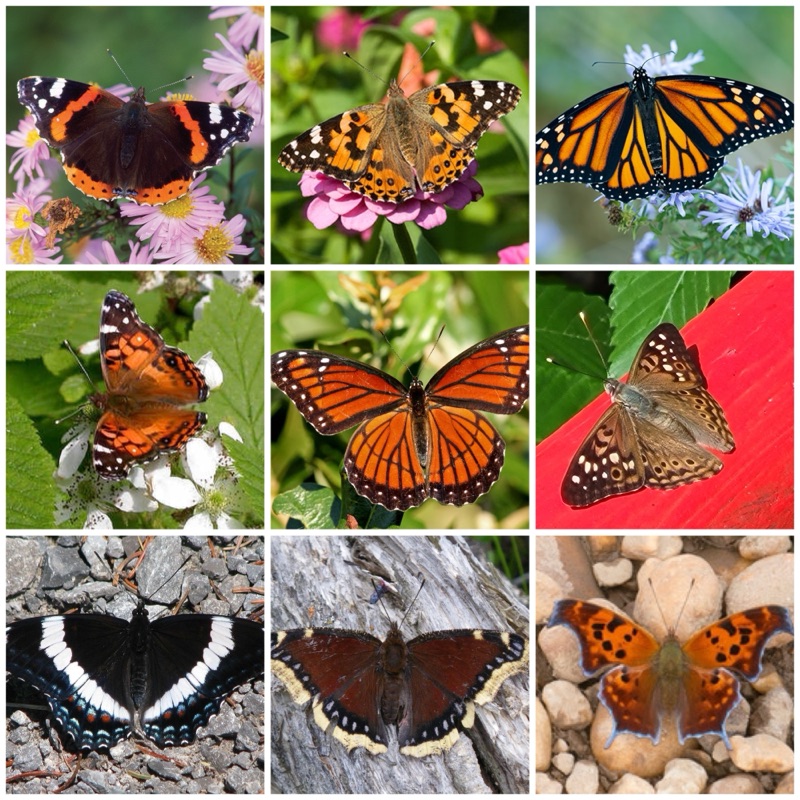
Photo Credits: Chris Gomersall, Mary Kay Rubey, Amy Prentice, Hamerstron Preserve and wisconsinbutterflies.org, Mary Keim, Leonard Weber, Bernell, John Acorn, and Sarah Bright.
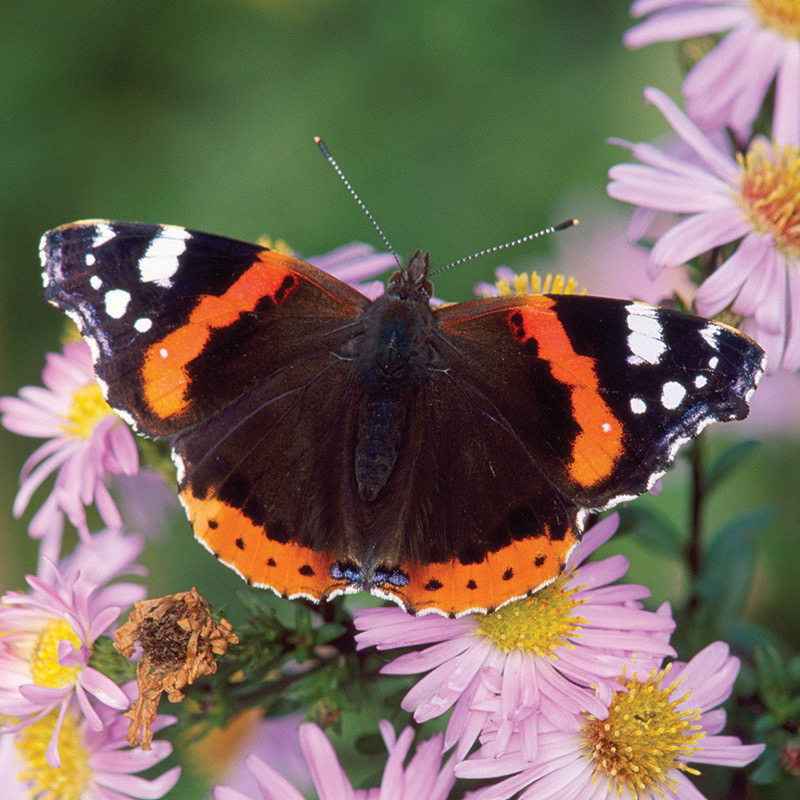
Photo Credits: Chris Gomersall
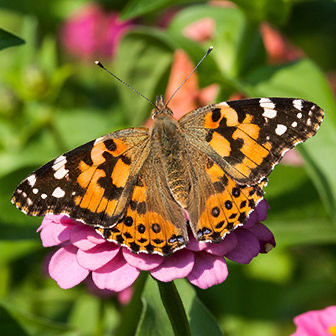
Photo Credits: Mary Kay Rubey
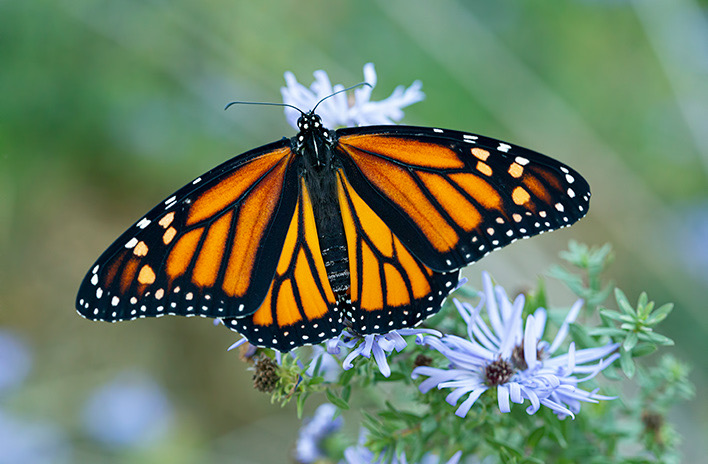
Photo Credits: Amy Prentice

Photo Credits: Hamerstrom Preserve and wisconsinbutterflies.org
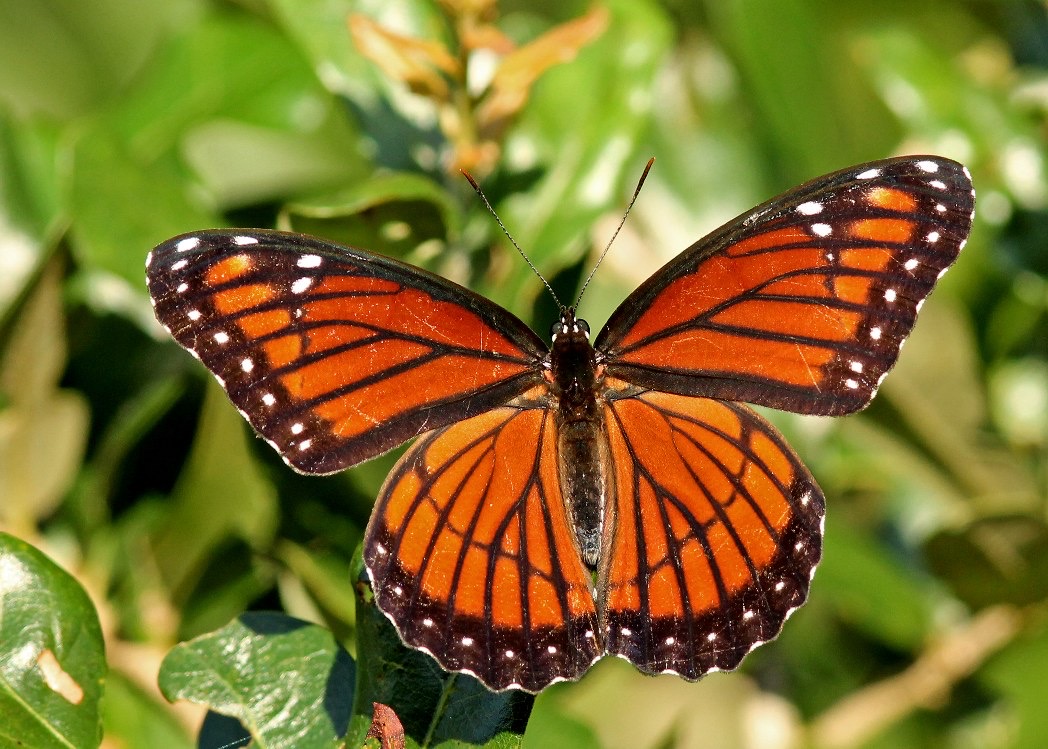
Photo Credits: Mary Keim
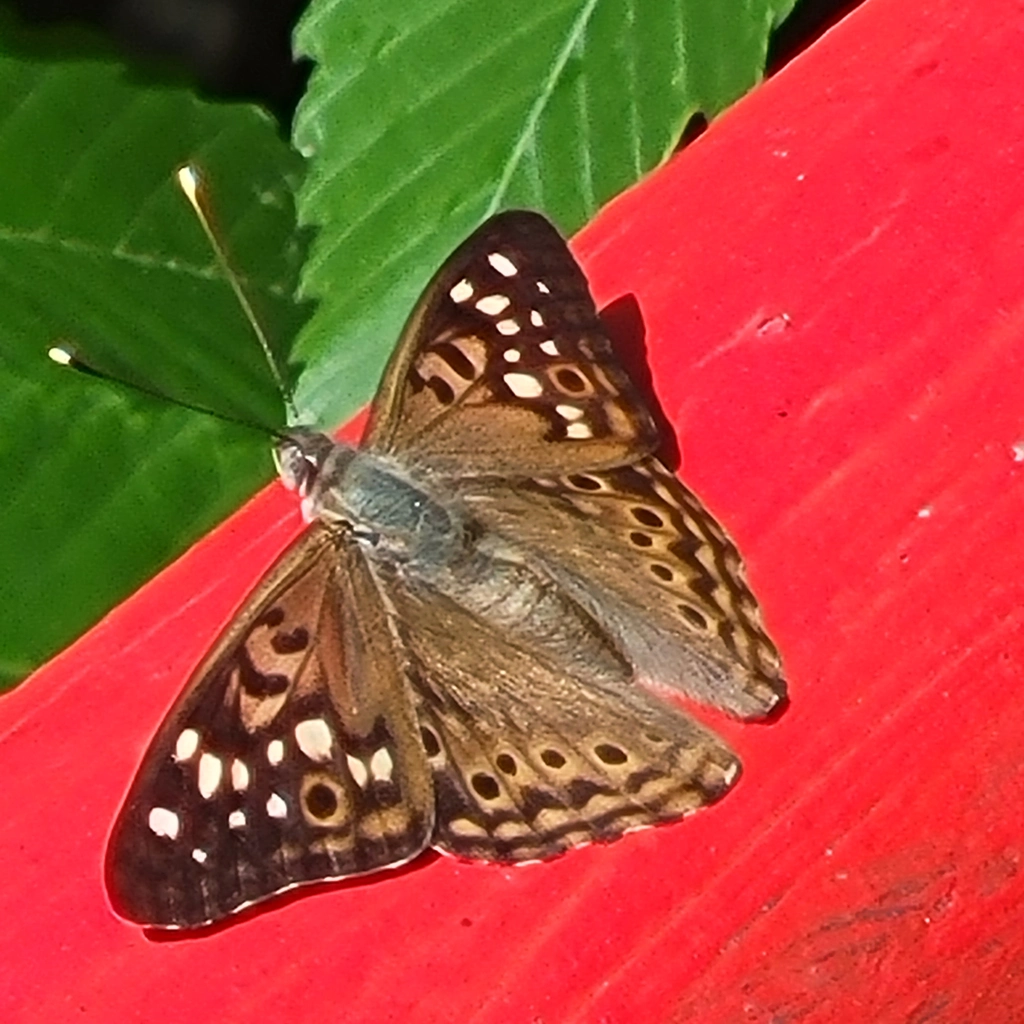
Photo Credits: Leonard Weber
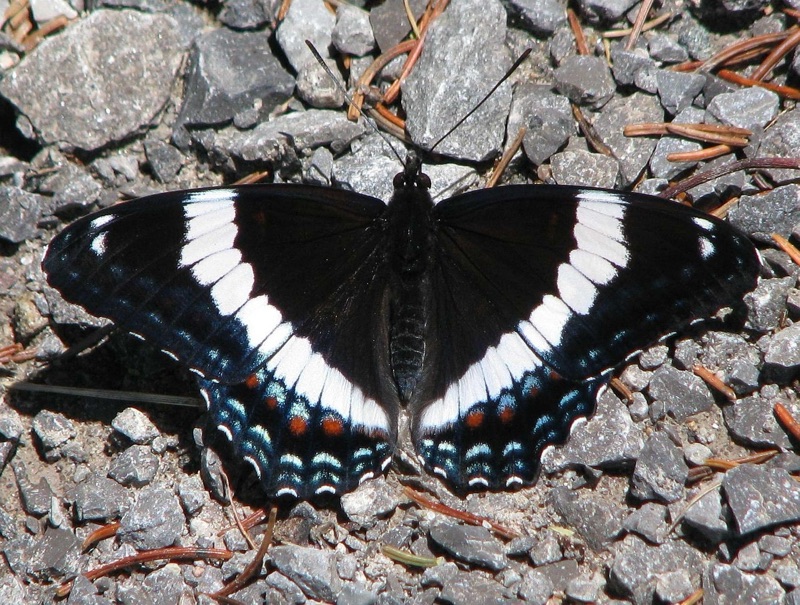
Photo Credits: Bernell
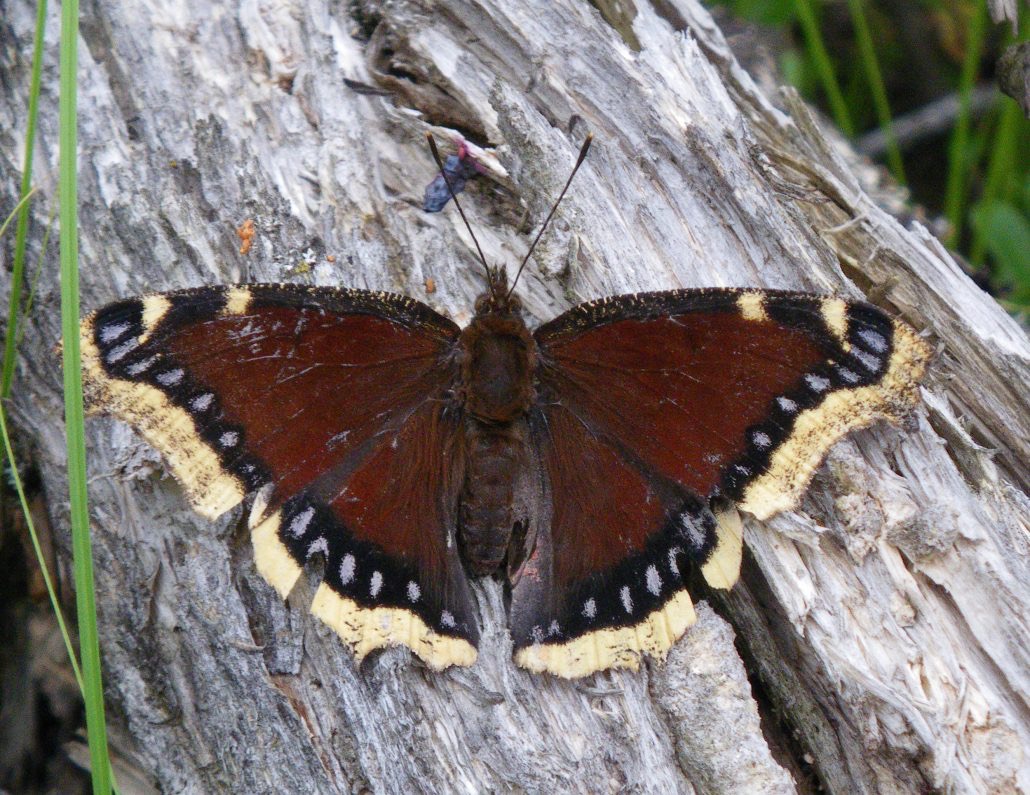
Photo Credits: John Acorn
Photo Credits: Sarah Bright


Comments
Post a Comment