All About The Spring Azure Butterfly (Celastrina ladon)
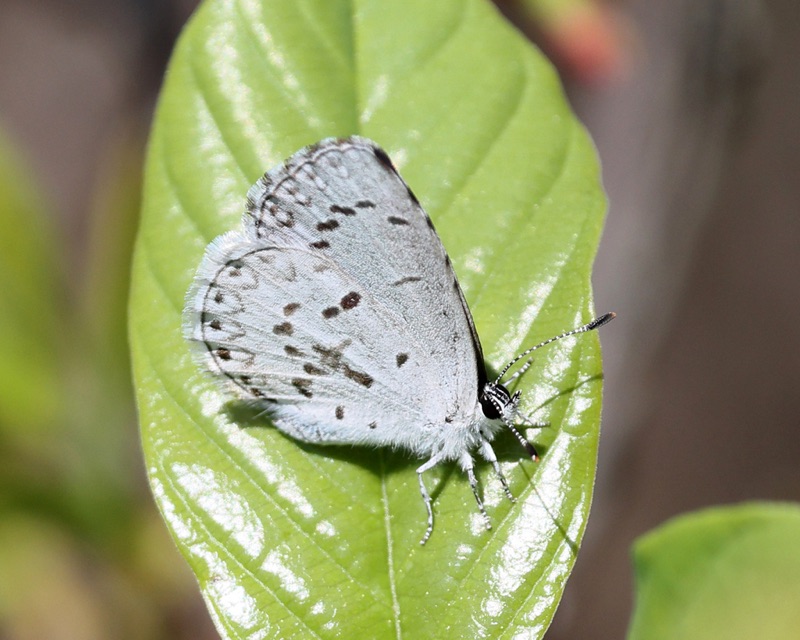
A Tiny Winged Jewel: Discover the Magic of the Spring Azure Butterfly!
With wings as delicate as a whisper and painted in shades of sky blue, the Spring Azure Butterfly is a tiny marvel of the natural world. Emerging with the warmth of spring, this butterfly flits through gardens and woodlands, its subtle beauty often overlooked. But behind its dainty wings lies a fascinating life cycle, filled with surprising transformations and hidden interactions with nature. How does such a small creature play a big role in the ecosystem? There’s so much more to uncover about this brilliant fluttering jewel!
Common Name: Spring Azure
Scientific Name: Celastrina ladon
Other Names: Common Blue or Echo Blue
Genus: Celastrina
Family: Gossamer - winged Butterflies Family
Subfamily: Aphnaeinae
Group Behaviour: As adult butterflies they exhibit both individual behaviour and group behaviour. Males patrol for mates individually, but they gather in groups around damp areas to take a drink. Females tend to be alone while they’re lay their eggs and sipping nectar from flowers, but they are not alone during mating season.
Most Distinctive Feature: Is their early emergence in the spring time, and their bright blue upper wings.
Litter Size: There is no concept of litter size for this butterfly species, as they lay individual eggs rather than a set number of offspring at once.
Diet: Their primary food source as adults is nectar from various different types of spring flowers.
Wings: The wings are tiny in size and they range from a silver greyish blue on the outside and pale blue or a light to dark blue on the inside.
Colour: iridescent blue, light blue or dark blue, black, pale grey, and white.
Skin Type: Exoskeleton
Weight: 0.27 to 0.75 grams
Wingspan: Their wingspan is approximately 3/4 to 1 1/4 inches wide.
Age Of Maturity: Shortly after emerging from their chrysalis.
Life History: Males patrol and perch all day but are most active from midafternoon until dusk. Eggs are laid on flower buds. Caterpillars feed on flowers and fruits and are tended by ants. Chrysalids hibernate.
Native Range: In Canada in occurs throughout the country including Southern Ontario and as far north as the treeline. For The United States it is found across the Northern USA, extending south through most of the Eastern USA.
Habitat: The Spring Azure is found in various habitats, primarily open deciduous woodlands, old fields, roadsides, and gardens. They are particularly attracted to areas where their larval food plants, and favourited nectar sources are.
Lifespan: The Spring Azure completes their life cycle in one year, but the adult butterfly only lives for a few days.
The Spring Azure (Celastrina ladon) is a small butterfly species that is one of the earliest butterflies to be spotted of the year. It is a butterfly that is a part of The Gossamer - winged Butterflies Family.
This butterfly has beautiful blue wings that vary depending on the gender, and striking patterns on their wings.
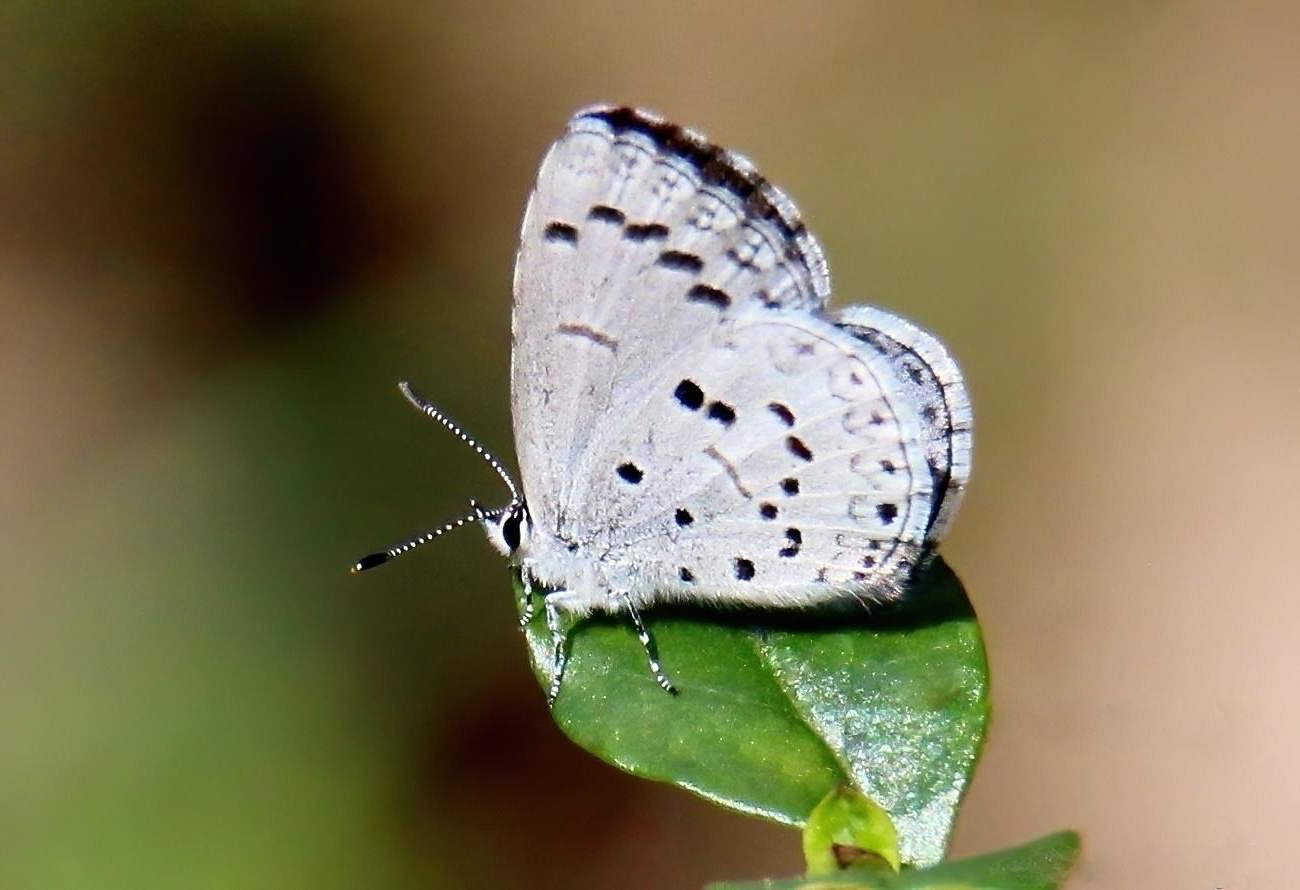 Photo Credits: Carolyn Cavender Alexander
The Life Cycle Of The Spring Azure Butterfly
Egg:
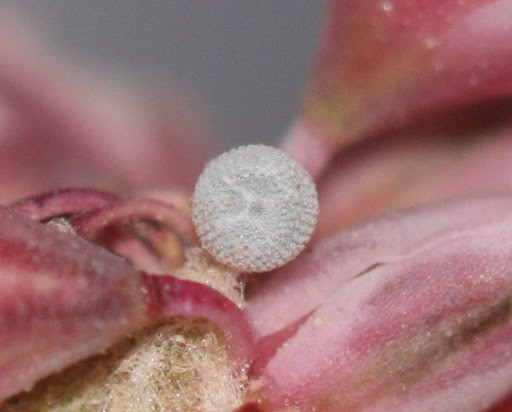 Photo Credits: raisingbutterflies.org
The eggs of the Spring Azure (Celastrina ladon) are small and are described as flattened discs or cushions in size. They are covered in raised points alternating with depressions. The colouration of them is a pale green colour, and the points on the eggs are white in colour. A female Spring Azure deposits her eggs individually on the flower buds and flowers of various host plants.The egg stage of the life cycle typically lasts around 4 to 8 days.
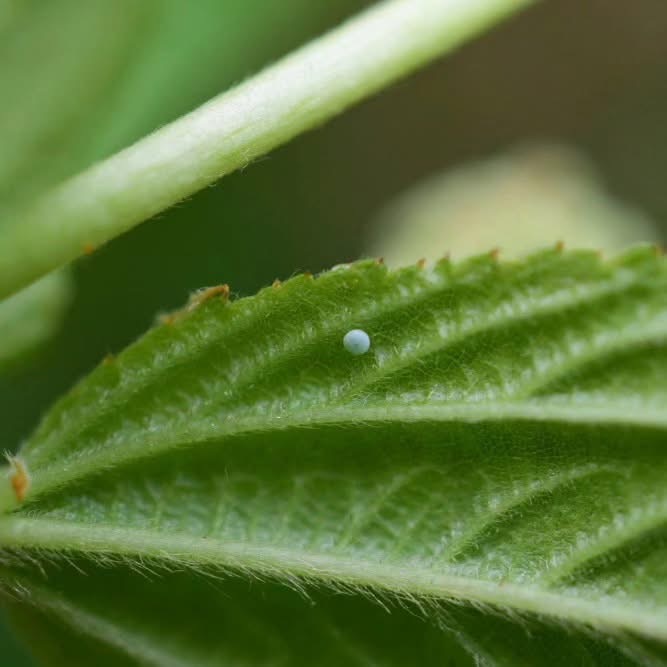 The actual size of a Spring Azure Butterfly egg. Photo Credits: Lucy Hooper
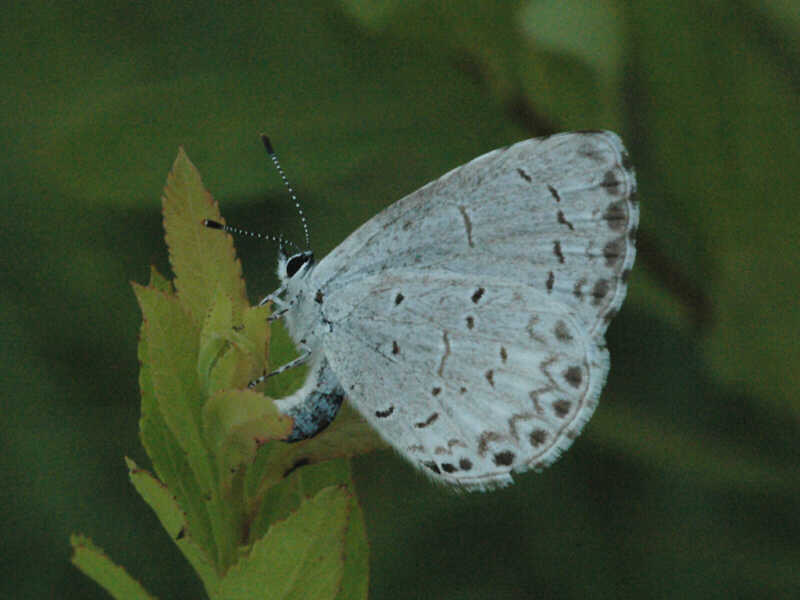 A female Spring Azure Butterfly laying eggs.
Photo Credits: wisconsinbutterflies.org
Caterpillar:
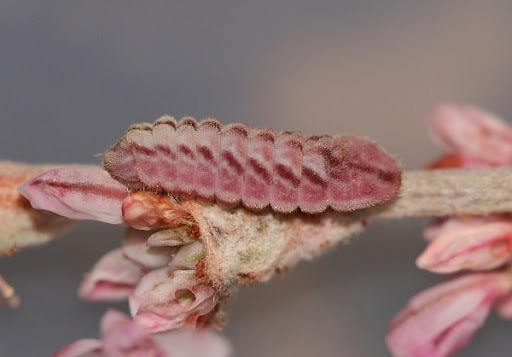
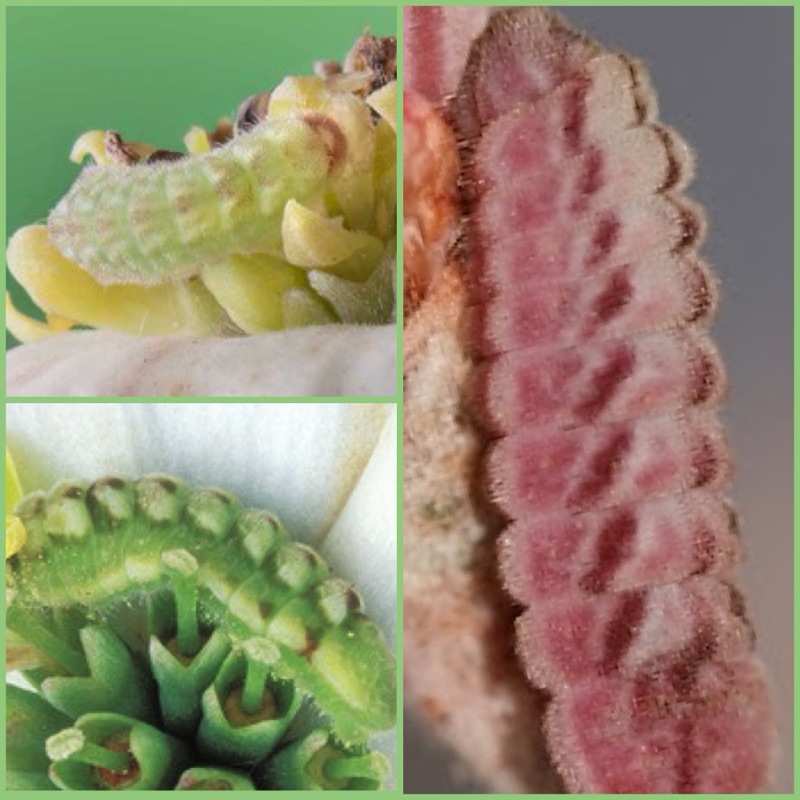 The different colour variations of the Spring Azure Butterfly caterpillar.
Photo Credits: Sarah Bright and raisingbutterflies.org
The caterpillars of the Spring Azure (Celastrina ladon) are slug shaped. The colouration of the caterpillars varies from white, green, and pink.
Younger caterpillars are a white colour with a pale green tinge to them. Caterpillars that are a bit older are more of a bright green to dark green colour. Then the mature caterpillars that are full grown are mostly a pinkish colour, which usually occurs close to the time of when they pupate and turn into the next stage of their life cycle.
The caterpillars of the Spring Azure (Celastrina ladon) feeds on the flower buds and flowers of the host plants that they were laid on as eggs by their mom (female butterfly).
The caterpillar stage of the life cycle lasts for about a month, which is a bit longer than the average butterfly caterpillar.
Chrysalis:
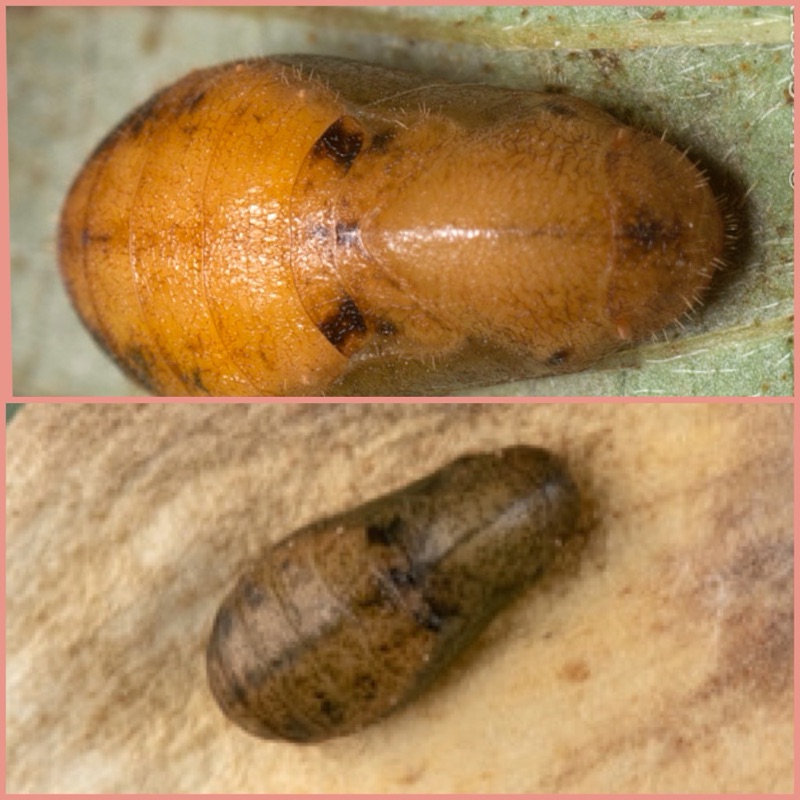 Two colour variations of a Spring Azure Butterfly Chrysalis. Photo Credits: Sarah Bright and Jay Cossey / Flickr
The chrysalis of the Spring Azure Butterfly (Calestrina ladon) is typically a smooth and oval shaped structure.
It often appearing light brown, brownish yellow, light beige, or grey colour with darker grey and dull white blotches.
The chrysalis forms on the upper side of leaves, and remains there until the adult butterfly emerges. In some cases a chrysalis is formed in a concealed spot like a crevice or under leaf litter.
The chrysalis stage of the life cycle typically lasts from early summer until next spring, which is usually between 10 months up to a year.
Adult Butterfly:
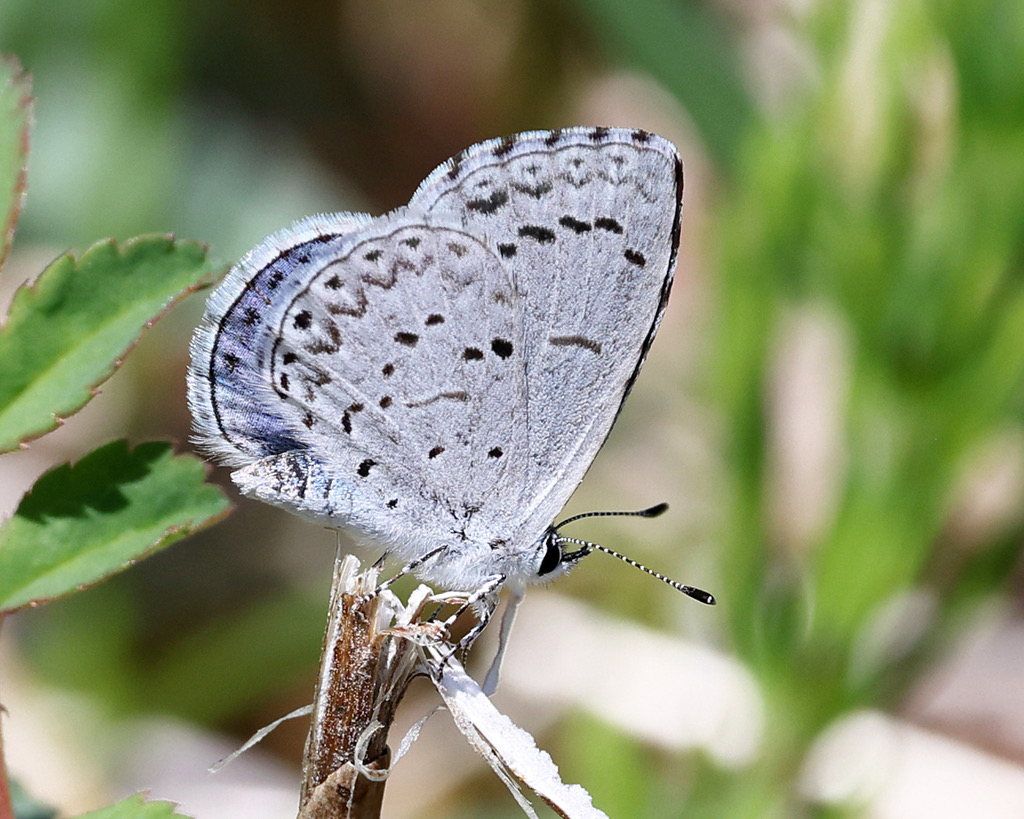 A Spring Azure Butterfly resting on an old piece of plant material with their wings closed. Photo Credits: tmurray74 from iNaturalist
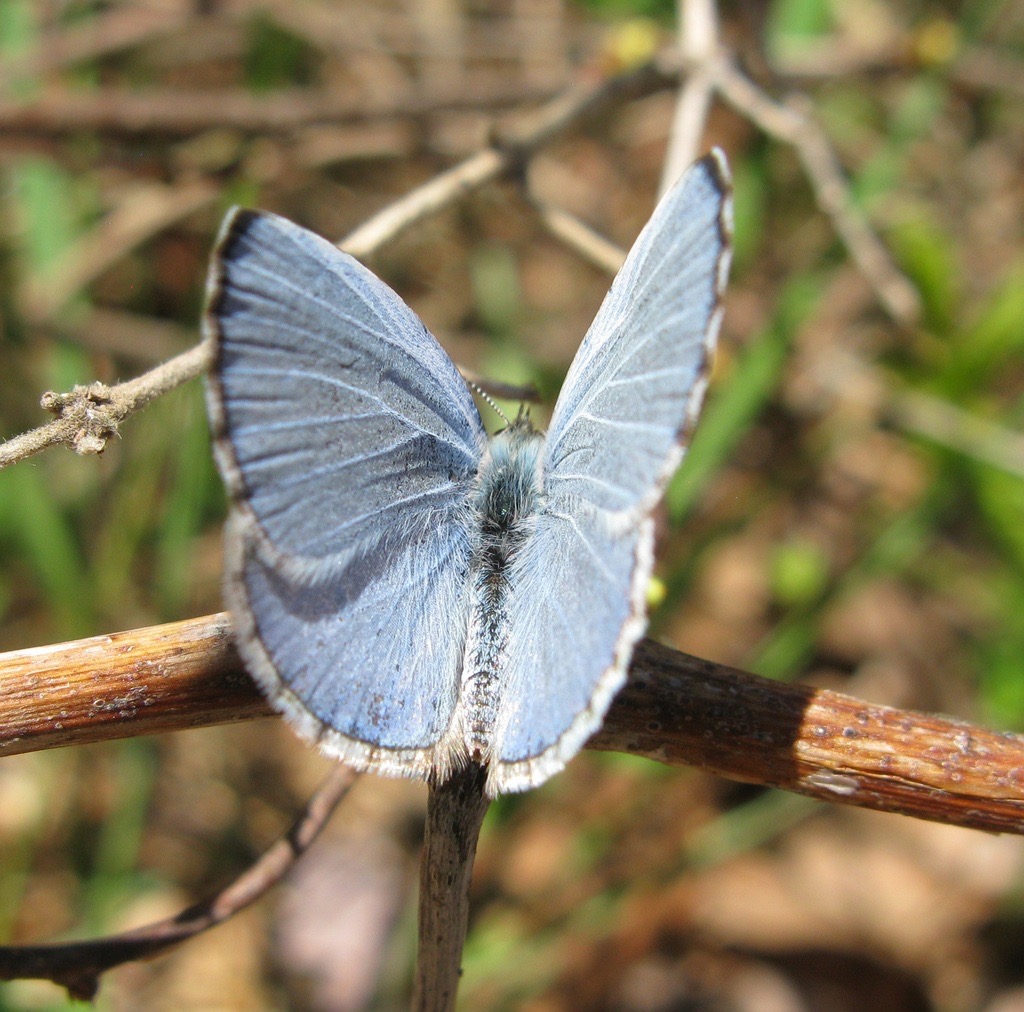 A male Spring Azure Butterfly resting on a branch with their wings opened. Photo Credits: mikealbion from iNaturalist
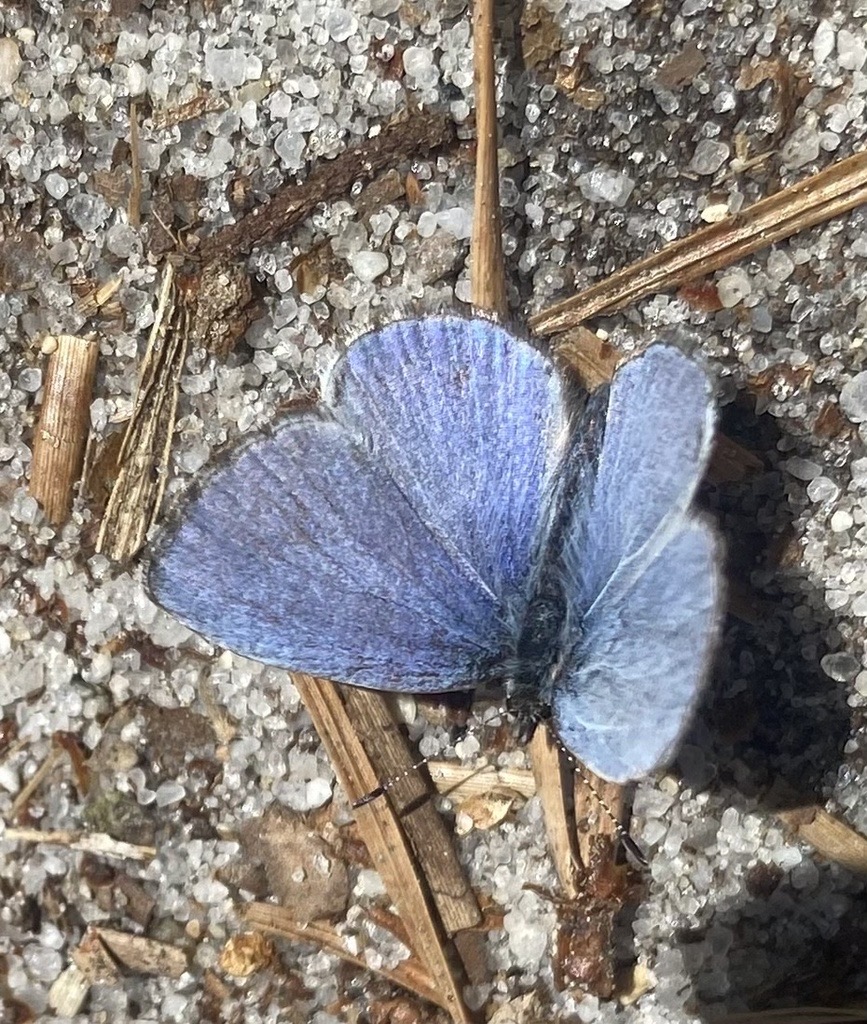 A female Spring Azure Butterfly resting on the ground with her wings opened. Photo Credits: wildlifewithsteve from iNaturalist
After spending 10 months up to a year inside their chrysalis the Spring Azure Butterfly (Calestrina ladon) emerges from their chrysalis during the early spring of the following year, in which it happens in mid April into early May.
The Spring Azure (Calestrina ladon) is a tiny butterfly that is smaller than most butterflies.
It has a blueish colour on the inside of their wings, and a greyish colour with spots as well as markings on the underside of their wings.
The colour variation of the Spring Azure (Calestrina ladon) varies depending on the gender of the butterfly.
The females of the Spring Azure (Calestrina ladon) are typically bright blue to dark blue in colour on the inside of their wings, often with a wide black border on the outer edge of their forewings and a row of black spots along the hindwing margin. The underside of their wings is generally a light grey colour with dark spots.
The males of the Spring Azure (Calestrina ladon) are typically a bright iridescent violet blue, with a thin black margin and a checkered black and white fringe on the inside of their wings. On the underside of their wings they’re a pale grey colour with dark spots.
Both male and female of the Spring Azure (Calestrina ladon) are seen flying low to the ground near their favourited nectar sources, and the low growing spring flowers.
The mature and adult Spring Azures (Calestrina ladon) typically feeds on nectar from various spring blooming flowers that are usually low growing. Occasionally these butterflies are seen feeding and drinking from mud puddles, rain puddles, and damp sand and soil areas. Sometimes they feed on fermented fruit when their nectar sources are scarce.
The butterfly stage of the life cycle is the final stage of this butterfly’s life, and it typically lasts a few days which is usually around 3 days up to five days. Some reports say that this butterfly can live a day up to two days.
Host Plants:
🌱 Flowering Dogwood (Cornus florida)
🌱 Red Osier Dogwood (Cornus sericea)
🌱 Pagoda Dogwood (Cornus alternifolia)
🌱 New Jersey Tea (Ceanothus americanus)
🌱 Common Blackberry (Rubus allegheniensis)
🌱 Smooth Blackberry (Rubus canadensis)
🌱 Trailing Blackberry (Rubus ursinus)
🌱 Himalayan Blackberry (Rubus armeniacus)
🌱 Low-bush Blueberry (Vaccinium angustifolium)
🌱 High - bush Blueberry (Vaccinium corymbosum)
🌱 White Meadowsweet (Spiraea alba)
🌱 Rosy Meadowsweet (Spiraea tomentosa)
🌱 Common Meadowsweet (Filipendula ulmaria)
🌱 Wild Cherry (Prunus avium)
🌱 Black Cherry (Prunus serotina)
🌱 Pin Cherry (Prunus pensylvanica)
🌱 Bitter Cherry (Prunus emarginata)
🌱 Chokecherry (Prunus virginiana)
*The Spring Azure Butterfly prefers to use the species of Dogwood and New Jersey Tea as preferred host plants. They will use species of Blackberry, Blueberry, and Cherry when their preferred host plants are scarce. *
Nectar Sources:
During the spring season adult Spring Azures feed on some spring blooming flowers such as Canada Violet (Viola canadensis), Northern Bog Violet (Viola nephrophylla), Downy Yellow Violet (Viola pubescens), Bog Violet (Viola lanceolata), Woolly Blue Violet (Viola sororia), Creeping Phlox (Phlox subulata), Blue Phlox (Phlox divaricata), Wild Geranium (Geranium maculatum), Wild Mustard (Rhamphospermum arvense), Wild Blue Lupine (Lupinus perennis), Blue False Indigo (Baptisia australis), and Golden Alexander (Zizia aurea).
In the summer time the adult Spring Azures feed on various flowers including Wild Bergamot (Monarda fistulosa), White Clover (Trifolium repens), Butterfly Weed (Asclepias tuberosa), Common Milkweed (Asclepias syriaca), Showy Milkweed (Asclepias speciosa), False Sunflower (Heliopsis helianthoides), Scarlet Bee Balm (Monarda didyma), Red Clover (Trifolium pratense), Showy Tick trefoil (Desmodium canadense), Purple Prairie Clover (Dalea purpurea), False Indigo (Amorpha fruticosa), Western Spiderwort (Tradescantia occidentalis), and Ohio Spiderwort (Tradescantia ohiensis).
Biggest Threats:
🖤 Habitat loss and degradation
🖤 Deer browsing on host plants
🖤 Climate Change
🖤 Invasive Species
🖤 Introducing new predators and parasites
🖤 Habitat fragmentation
🖤 Pesticide use
How To Support & Provide For The Spring Azure In The Backyard:
🩵 Make the yard a safe environment for the Spring Azure Butterflies.
🩵 Consider planting in areas of your backyard with partial shade, as Spring Azures are often found in the edges of woodlands.
🩵 Stop/Don’t use any type of pesticides, herbicides, and insecticides on your property.
🩵 Plant a few of their host plants on your property, especially the ones that they favourite to provide a place for the females to lay their eggs and food for the caterpillars. This will give the females a lot more options of host plants to choose from, and to provide extra food for the caterpillars if they run out of food from their other host plants.
🩵 Plant a couple nectar sources on your property that the adult butterflies love. By adding a couple different kinds will provide the butterflies different options to go to for nectar.
🩵 leave your garden(s) messy and untouched till the weather and temperatures is warm as well as above 10 degrees Celsius during the day and at night.
🩵 Leave a good layer of leaf litter in your garden(s) to provide a good covering for the plants as well as for the insects. Occasionally Spring Azure Caterpillars make their chrysalis in leaf litter.
🩵 Leave the host plant(s) that you have on your property for the Spring Azure alone, and don’t disturb them because there is a good chance a Spring Azure is overwintering as their chrysalis on their host plant.
🩵 Create a habitat on your property for the Spring Azure Butterfly that includes host plants, nectar plants, and shelter.
🩵 Plant a native shrub on your property such as Canadian Serviceberry (Amelanchier canadensis), American Hazelnut (Corylus americana), Nannyberry (Viburnum lentago), Common Ninebark (Physocarpus opulifolius), Fragrant Sumac (Rhus aromatica), or Common Snowberry (Symphoricarpos albus) on your property to provide shelter for the adult butterflies during inclement weather and for protective from predators.
🩵 Provide a puddling area in your backyard by placing a flat plate/plant saucer in a sunny location, and pour a little bit of sand or soil on the bottom, you don’t need much soil. Damp the sand or soil with a few drops or sprinkles of water. Then place a medium sized rock in the puddling area for the butterflies to rest on. ✨
✨ This is an alternative way to support and provide for the Spring Azure Butterfly, and it isn’t recommended to do all the time. The best way to provide and support the spring azure is by planting native flowers that they use for nectar, planting their host plants, and provide shelter for them. If you use this way to attract this butterfly, it is important to freshen up the puddling area a couple times a day since the area is located in the sun and will prevent any diseases from developing.
Interesting Facts About The Spring Azure Butterfly:
💙 The Spring Azure is the earliest native butterfly to emerge from their overwintering pupae.
🩵 Spring Azures often fly before the Wild Plum buds have opened.
💙 The Spring Azure is one of the smallest butterflies with a wingspan of an inch in length.
🩵 Spring Azures are the size of a nickel.
💙 The Spring Azure is among the shortest lived butterflies, with the adult’s lifespan typically spanning just a few days.
🩵 Males of the Spring Azure display a vivid blue on the upper side of their wings.
💙 Females of the Spring Azure display a darker colour with pronounced black borders, on the upper side of their wings.
🩵 The Spring Azure Butterfly flies at ground level when they fly from low growing flowers.
💙 As caterpillars, they rely on a symbiotic relationship with ants. The caterpillars secrete a sugary liquid (honeydew) that ants love, and in return the ants protect the caterpillars from predators like spiders, wasps, and other insects.
🩵 As adult butterflies they have a erratic flight pattern, which makes it difficult for birds and other predators to catch them.
💙 The underside of the Spring Azure’s wings have a greyish colour with darker spots when closed, which helps them blend in with dead leaves or bark making making them less visible to their predators.
🩵 The Spring Azure was described and founded by Pieter Cramer in 1780.
💙 In the last 20 years the Spring Azure has been studied extensively and many believe that it is actually a complex of several different species.
🩵 The Spring Azure Butterfly is more darker in colour than the Summer Azure Butterfly.
💙 They spend 10 months up to 1 year in their Chrysalis, and emerge from their Chrysalis in the following spring.
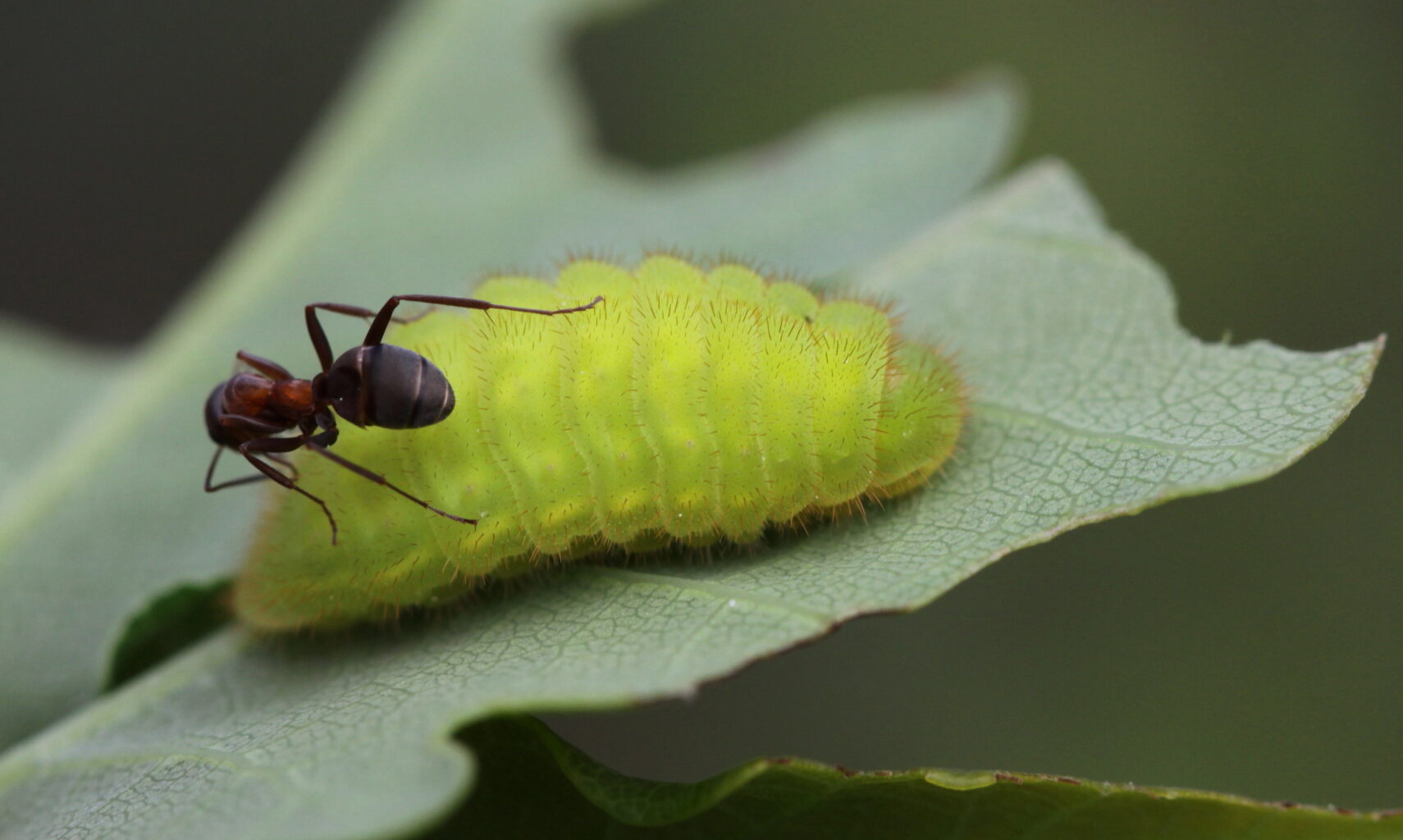 An ant tending to a young Spring Azure Butterfly Caterpillar. Photo Credits: Cara Fernandes
 A light coloured Spring Azure Butterfly Caterpillar. Photo Credits: Sarah Bright
 A green coloured Spring Azure Butterfly Caterpillar on a flower. Photo Credits: Sarah Bright
A pinkish red coloured Spring Azure Butterfly Caterpillar on flower buds. Photo Credits: raisingbutterflies.org
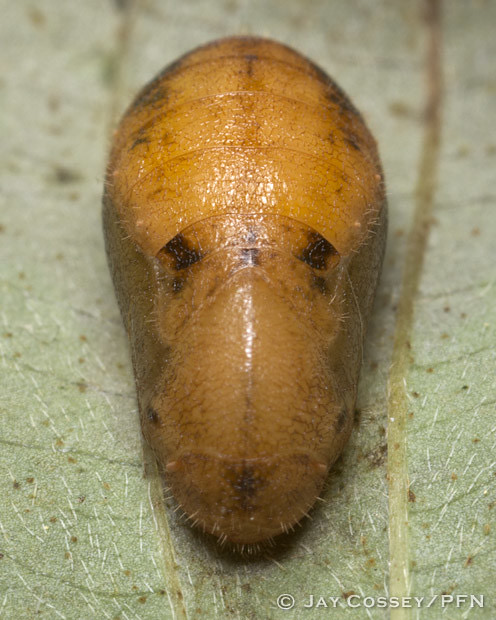 A light coloured Spring Azure Butterfly Chrysalis. Photo Credits: Jay Cossey / Flickr
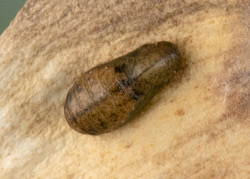 A darker coloured Spring Azure Butterfly Chrysalis. Photo Credits: Sarah Bright
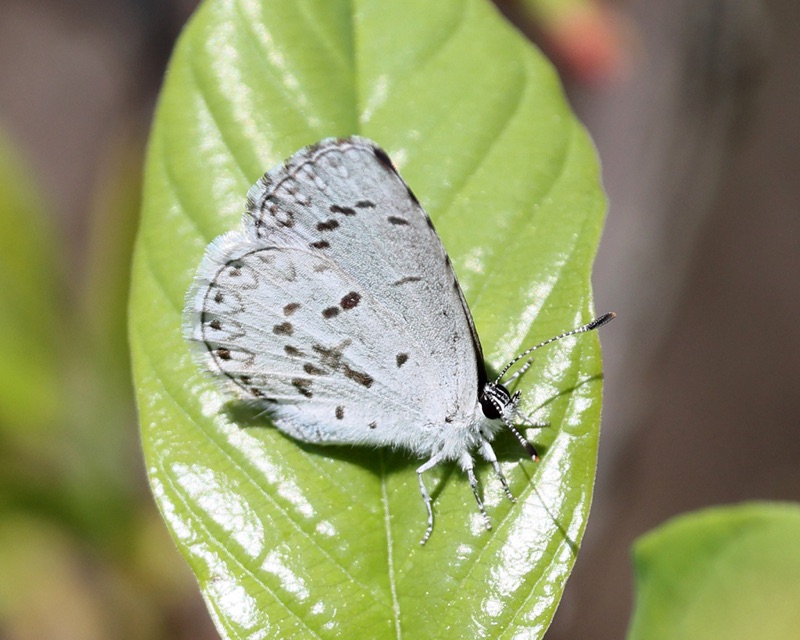 A Spring Azure Butterfly resting on a big green leaf with their wings closed. Photo Credits: tmurray74 from iNaturalist


Comments
Post a Comment