All About The Cecropia Moth (Hyalophora cecropia)
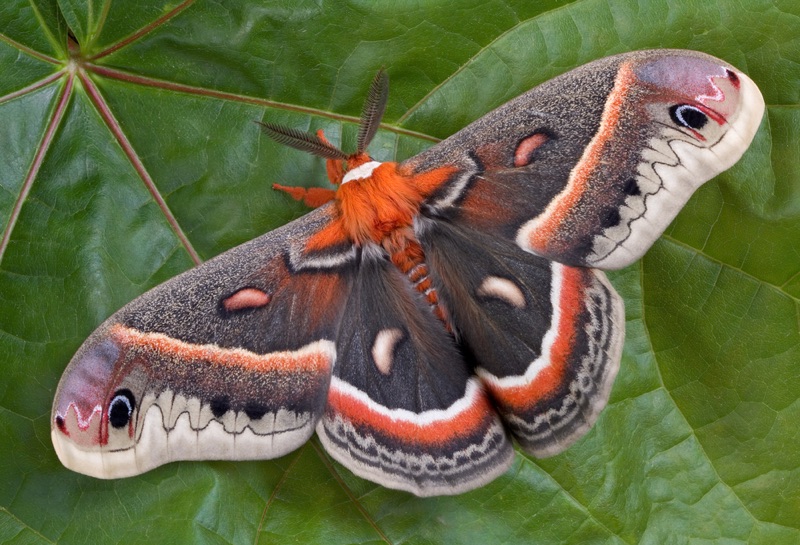
A Flutter of Mystery: Discover the Largest Moth in North America!
Imagine a creature that emerges under the cover of darkness, adorned with velvety wings spanning nearly six inches, bigger than some birds! The Cecropia Moth, North America's largest native moth, is a marvel of nature, fluttering silently through the night with striking red, white, and brown patterns that look almost hand painted. But its beauty is fleeting this mysterious insect lives only a couple of weeks as an adult, focused solely on one mission: to find a mate. No mouth, no meals, just a breathtaking dance of survival. Intrigued? There's so much more to discover about this nocturnal wonder!
Common Name: Cecropia Moth
Scientific Name: Hyalophora cecropia
Other Names: Robin Moth or Cecropia Silkmoth
Genus: Hyalophora
Family: Saturniidae (Giant Silk Moths)
Subfamily: N/A
Group Behaviour: The Cecropia Moth is generally a solitary creature, especially as adults with limited interactions with other moths of their kind. They are seen in pairs during the mating season.
Most Distinctive Feature: The most distinctive features of the Cecropia Moth are their large size (wingspan) and unique wing patterns.
Litter Size: Typically between 80 and 400, with an average of 300.
Diet: As an adult they don’t feed due to not being with mouth parts, but when they were a caterpillar their main food source is the foliage from their host plant that they were laid on as an egg.
Wings: Large brownish wings with reddish colouration near the base of the forewing. They are marked with crescent shaped white spots, often with a reddish border on all four wings.
Colour: red, black, brown, white, and tan.
Skin Type: Exoskeleton
Weight: 10.2 grams (0.36 ounces)
Wingspan: Has a wingspan ranging from 5 to 7 inches (13 to 18 centimetres).
Age Of Maturity: Shortly after emerging from their cocoon.
Life History: Females lay rows of 2-6 eggs on both sides of the leaves of small host trees or shrubs. Eggs hatch in 10-14 days. Young caterpillars feed in groups on leaves; older caterpillars are solitary. The cocoon is attached along its full length to a twig; to escape predation by rodents and birds, the cocoon is usually constructed in a dark, protected area.
Native Range: Spans across most of Eastern North America including The United States and Canada. Specifically, they are found as far west as the Rocky Mountains, and north into the majority of Canadian provinces. Their range extends south to central Florida and Texas.
Habitat: Hardwood Forests and other areas with trees. they can also be found in both urban and suburban environments.
Lifespan: They complete their full life cycle in one year, but the adult moth lives for 3 to 5 days. Occasionally they can live up to 10 to 14 days, but that doesn’t happen on a daily basis.
The Cecropia Moth (Hyalophora cecropia) is a large moth belonging to The Giant Silk Moth Family that has a big wingspan, which is larger than most moths.
It is a really colourful moth, and this moth is one of our beautiful giant silk moths.
The Cecropia Moth (Hyalophora cecropia) is red with white stripes, and reddish brown wings with crescent shaped marks as well as eyespots on their wings.
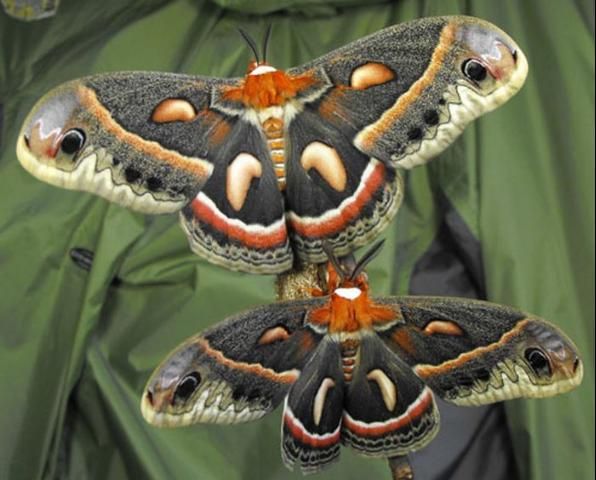 Photo Credits: David Britton
The Life Cycle Of The Cecropia Moth
Egg:
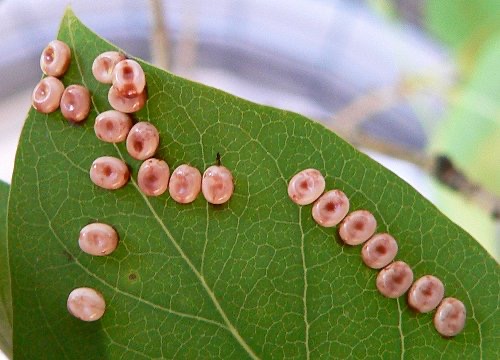 Two rows of Cecropia Moth eggs on a large green leaf.
Photo Credits: Marcie O’Connor
The eggs of the Cecropia Moth (Hyalophora cecropia) are small and oval in shape. The shape of the eggs look similar to the shape of a donut. The colouration of the eggs is a mottled reddish brown colour with a bit of an off white tinge. The female Cecropia Moth lays a row of 2 to 6 eggs on both sides of the leaves on a host plant. The egg stage of the life cycle typically lasts for 10 to 14 days, sometimes this stage can last between 18 days and 20 days which depends on the weather and the temperature.
Caterpillar:
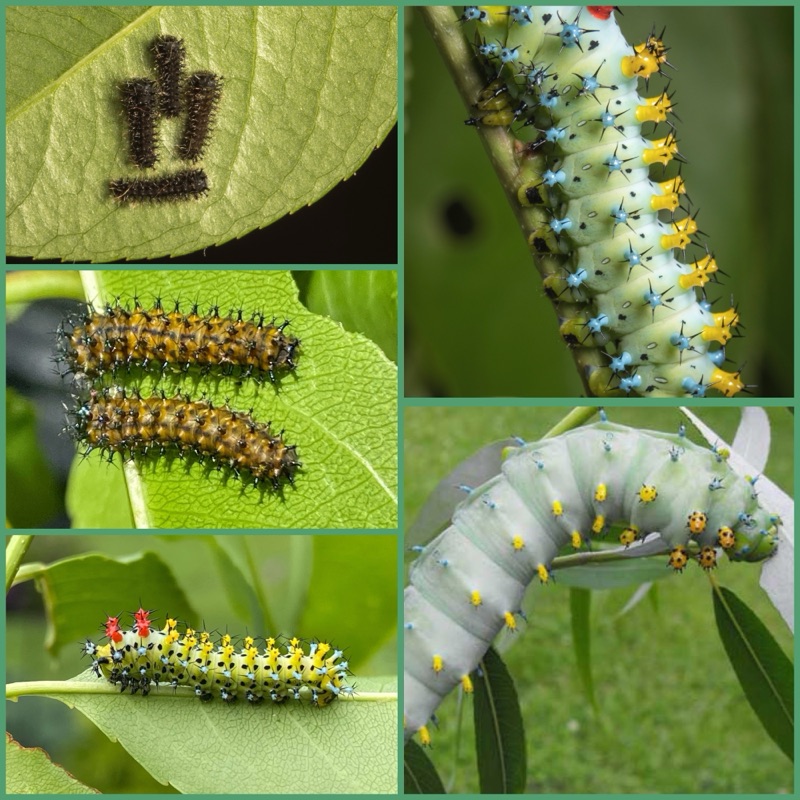 The different stages of the a Cecropia Moth caterpillar.
Photo Credits: roadsendnaturalist.com and David Britton
The caterpillars of the Cecropia Moth (Hyalophora cecropia) are known for their vibrant colours and distinctive spiky appearance.
They start out as small and black when they are first born, and then change to various shades of yellow, green, and even blue as they grow.
The caterpillars of the Cecropia Moth (Hyalophora cecropia) are characterized by large, colourful tubercles (small bumps) on their backs, which can be red, orange, or yellow and are covered with black spikes. They also have two rows of yellow and blue spikes along their body.
As the caterpillars of this moth species matures, they can grow to be 4 or 5 inches long and are very chunky in appearance.
The main food source for the caterpillars is the foliage of the host plants that they were laid on as eggs.
The caterpillar stage of the life cycle typically lasts about three months. Sometimes this stage in the life cycle can last between 5 to 6 weeks.
Cocoon:
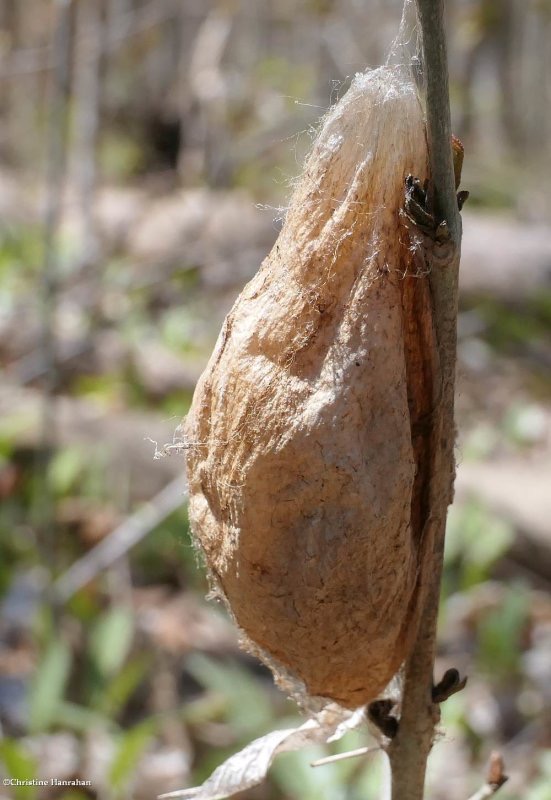
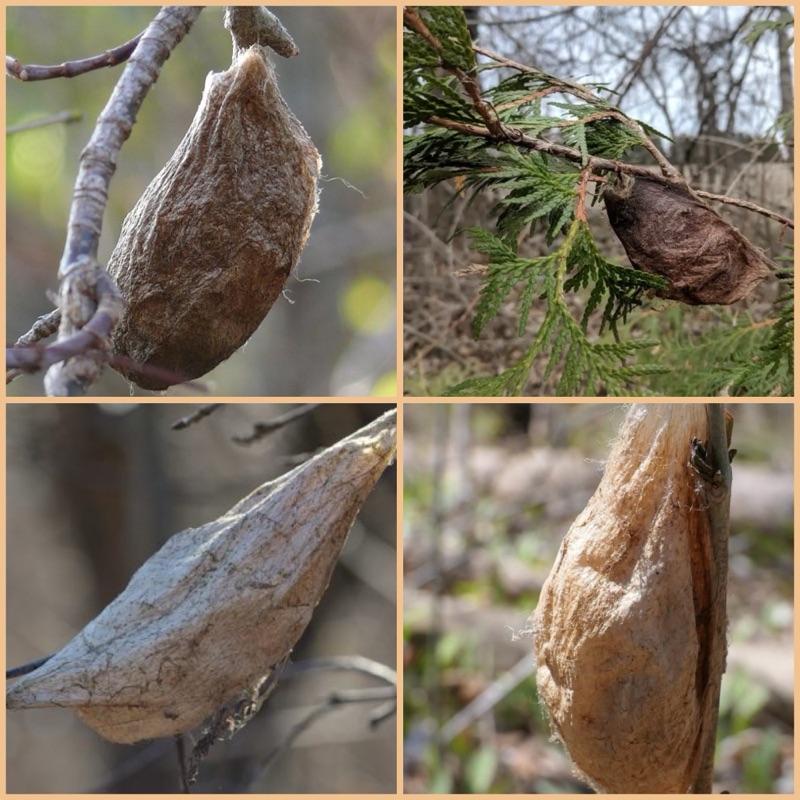 Different colour variations of Cecropia Moth Cocoons. Photo Credits: Marcie O’Connor from buglifecycle.com, Frame to Frame - Bob and Jean, Ryan Hodnett, and Christine Hanrahan.
The cocoon of the Cecropia Moth (Hyalophora cecropia) is spindle shaped, which means it’s elongated and tapers at both ends.
They are usually around 4 to 5 inches long and about 1 or 2 inches wide. The cocoon can be either tightly wrapped or have a baggie appearance.
The colouration of the cocoon varies depending on the caterpillar that created it, the type of host plant it was made on, and the age of it.
They can be light brown, dark brown, tan, beige, light grey, dark grey, off white, or white in colour. The cocoons are most often attached to branches, particularly the thin branches of a host tree or shrub with old foliage (leaves) wrapped around them.
The cocoon stage of the life cycle is approximately 10 months up to 1 year, which is usually around late spring to early summer of the following year.
Adult Moth:
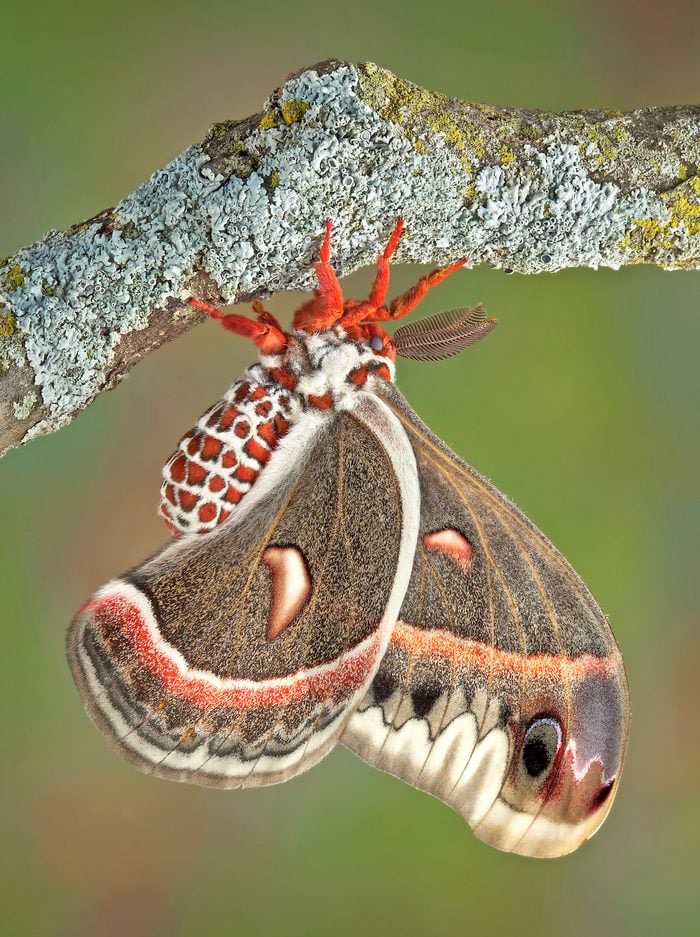 A Cecropia Moth resting underneath a large branch with their wings closed. Photo Credits: CATHY KEIFER/GETTY IMAGES
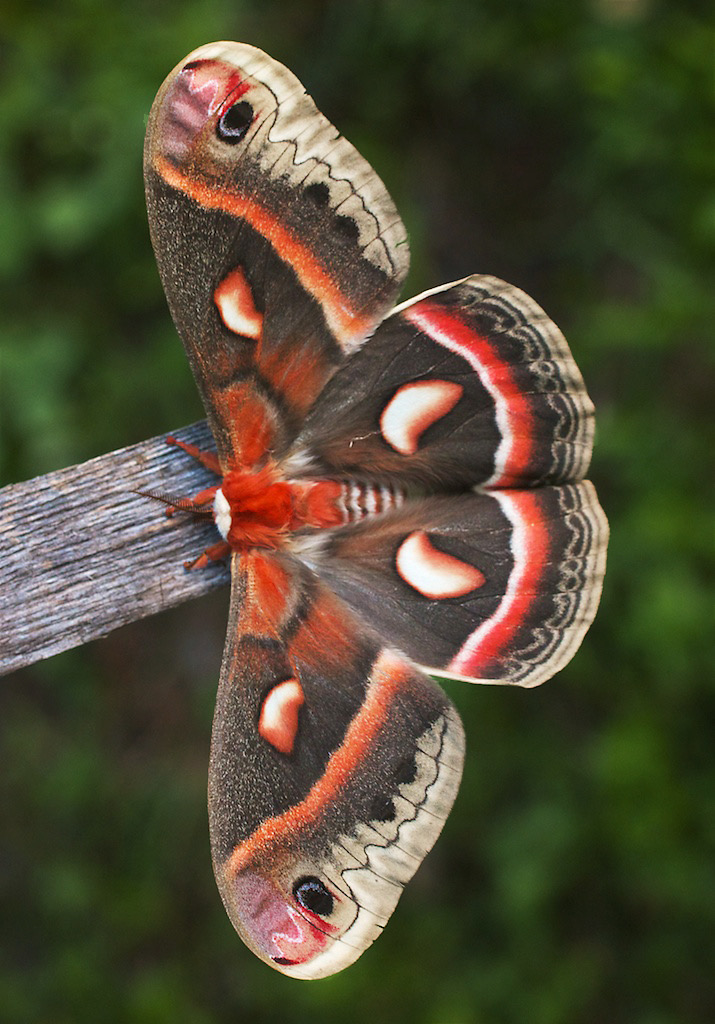 A Cecropia Moth resting on the edge of a piece of wood with their wings opened. Photo Credits: Sparky Stensaas/sparkyphotos.com
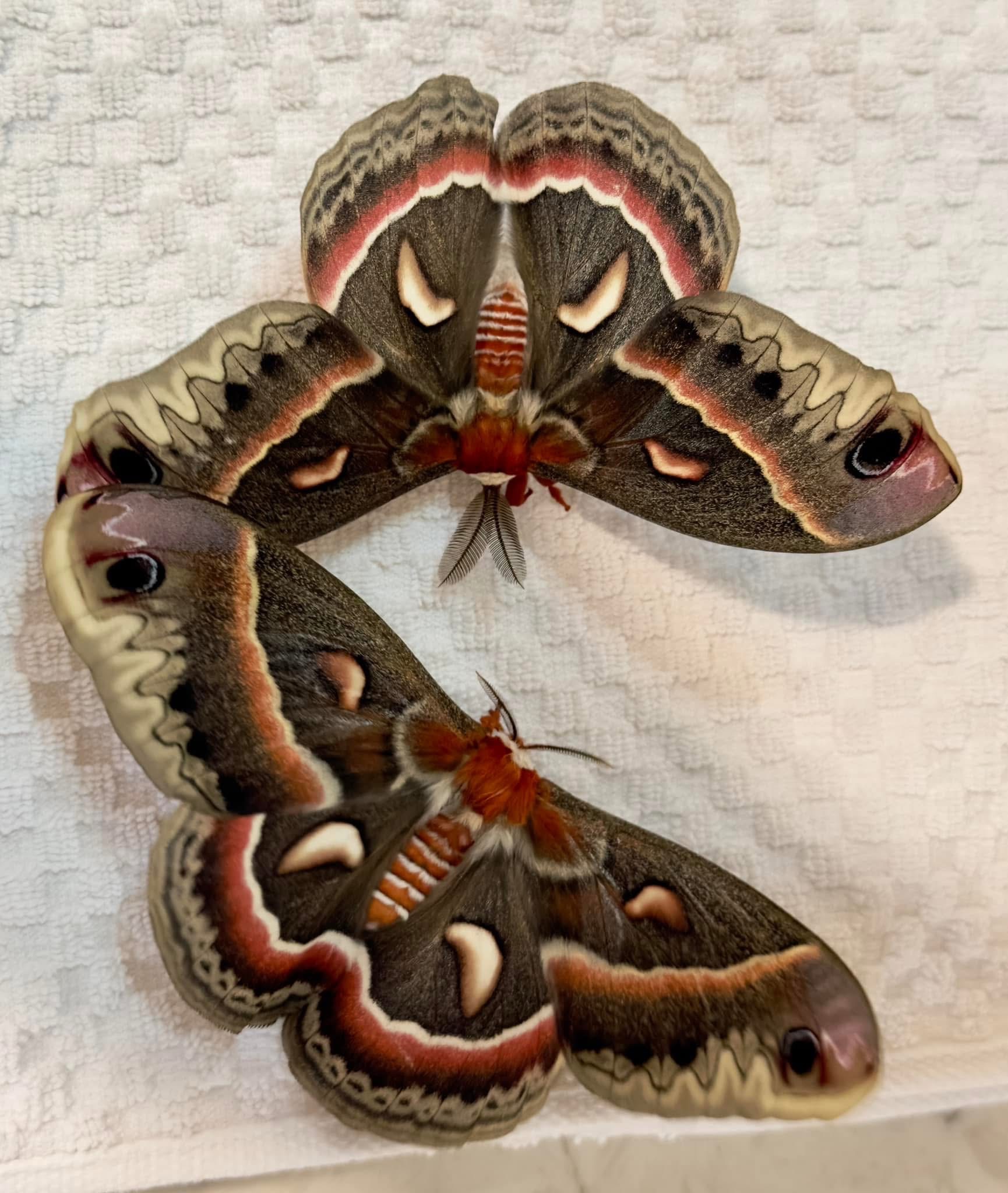 A male and female Cecropia Moth resting together. The male Cecropia Moth is up at the top, and the female Cecropia Moth is down at the bottom.
Photo Credits: Barbara Fanson
After spending 10 months up to a year inside their cocoon the Cecropia Moth (Hyalophora cecropia) emerges from their cocoon late spring to early summer of the following year.
The Cecropia Moth (Hyalophora cecropia) is a large sized moth, which is way bigger compared to most moths that are commonly seen out in nature.
Their body is large and hairy with reddish colouring on the anterior which fades to a reddish or whitish colour. The abdomen has alternating bands of red and white.
The wings on a Cecropia Moth (Hyalophora cecropia) are quite large in size, and are reddish brown to brown in colour with a white line running down the middle.
There are red crescent moon markings on their top wings, and white crescent moon markings on their bottom wings. There is a white post median band on the wings, and there is a red band on the edge of the post median band on the wings.
On the top of the wings of their wings there is a big eye spot which is black with a greyish brown ring around it, which makes them look like the head of a snake. These eyespot markings are visible on the outside and the inside of the wings of a Cecropia Moth (Hyalophora cecropia).
Both male and female of the Cecropia Moth (Hyalophora cecropia) have the same markings on their wings, but their appearance is a bit different from one another.
The females of the Cecropia Moth (Hyalophora cecropia) have a more noticeable heavier abdomen that is more rounder in shape.
The abdomen is also more thicker and bigger in appearance, which indicates the presence of mature eggs. Their antennae is shorter and less feathery and they appear more slender.
They are typically larger in size compared to the males, which makes the females bigger than the males.
The males of the Cecropia Moth (Hyalophora cecropia) are smaller in size compared to the females of the Cecropia Moth (Hyalophora cecropia).
They also have a smaller and thinner abdomen that is not thick compared to the one on the females.
The males of the Cecropia Moth (Hyalophora cecropia) have large antennae that are feathery like.
Adult Cecropia Moths (Hyalophora cecropia) don’t pollinate, and they don’t feed because they don’t have any mouth parts. Their main focus of their short life is to find a mate to mate with, and to have their life cycle repeated over again.
The moth stage of the life cycle is the final stage in a Cecropia Moth’s life, and this stage typically lasts between 3 to 5 days at the most. Some sources say that occasionally an adult Cecropia Moth (Hyalophora cecropia) can live up to 7 to 10 days, but this doesn’t happen all the time because this is not the regular lifespan of the Cecropia Moth (Hyalophora cecropia).
Host Plants:
🌳 Red Maple (Acer rubrum)
🌳 Sugar Maple (Acer saccharum)
🌳 Silver Maple (Acer saccharium)
🌳 Big-leaf Maple (Acer macrophyllum)
🌳 Mountain Maple (Acer spicatum)
🌳 Striped Maple (Acer pensylvanicum)
🌳 Douglas Maple (Acer glabrum)
🌳 Paper Birch (Betula papyrifera)
🌳 Yellow Birch (Betula alleghaniensis)
🌳 Grey Birch (Betula populifolia)
🌳 Sweet Birch (Betula lenta)
🌳 Mountain Paper Birch (Betula cordifolia)
🌳 Sweet Crabapple (Malus coronaria)
🌳 McIntosh Apple (Malus domestica “Mclntosh”)
🌳 Spartan Apple (Malus pumila)
🌳 Ambrosia Apple (Malus domestica “Ambrosia”)
🌳 Common Lilac (Syringa vulgaris)
🌳 Common Elderberry (Sambucus canadensis)
🌳 Northern Red Oak (Quercus rubra)
🌳 White Oak (Quercus alba)
🌳 Swamp White Oak (Quercus bicolor)
🌳 Oregon White Oak (Quercus garryana)
🌳 Black Oak (Quercus velutina)
🌳 White Ash (Fraxinus americana)
🌳 Black Ash (Fraxinus nigra)
🌳 Green Ash (Fraxinus pennsylvanica)
🌳 Blue Ash (Fraxinus quadrangulata)
🌳 Wild Cherry (Prunus avium)
🌳 Black Cherry (Prunus serotina)
🌳 Pin Cherry (Prunus pensylvanica)
🌳 Bitter Cherry (Prunus emarginata)
🌳 Chokecherry (Prunus virginiana)
🌳 American Elm (Ulmus americana)
🌳 Rock Elm (Ulmus thomasii)
🌳 Slippery Elm (Ulmus rubra)
🌳 Buttonbush (Cephalanthus occidentalis)
🌳 Common Sassafras (Sassafras albidum)
🌳 Pussy Willow (Salix discolor)
🌳 Black Willow (Salix nigra)
🌳 Weeping Willow (Salix babylonica)
*The Cecropia Moth prefers species of Cherry as a host plant, and their young does better on Cherry than other host plants.*
Nectar Sources:
As an adult the Cecropia Moth (Hyalophora cecropia) does not feed on nectar from flowers, this is due to not having any working mouth parts.
Biggest Threats:
🖤 Light pollution
🖤 Habitat loss
🖤 Urban development
🖤 Pesticide use
🖤 Parasitic Wasps
🖤 Parasitic Flies
🖤 Deforestation
How To Support & Provide For The Cecropia Moth In The Backyard:
💕 Making the backyard as a safe place for both male and female Cecropia Moths.
💕 Stop using/don’t use pesticides, insecticides, and herbicides in the backyard.
💕 Add a couple of their host plants to the yard. Planting their preferred host plants would be great as well.
💕 Provide a suitable habitat for the caterpillars and the adult moths.
💕 Provide shelter for the adult moths by planting a native shrub such as Red Osier Dogwood (Cornus sericea), Red Elderberry (Sambucus racemosa), or Pagoda Dogwood (Cornus alternifolia). Any of these shrubs will provide shelter and protection for these adult moths from inclement weather and predators. Any of these shrubs will also provide a food source for various butterfly species.
💕 Reduce or eliminate the use of artificial lighting at all times, especially during their flight season.
💕 Avoid getting your property sprayed for mosquitoes and other unwanted pests.
💕 Avoid getting lawn companies to come in and take care of your lawn and property.
💕 Leave the cocoons of the Cecropia Moth where they’re and don’t touch them. This will encourage the moths to go into diapause and their systems are able to adjust properly.
Interesting Facts About The Cecropia Moth:
❤️ With their wingspan of 5 to 7 inches wide, it makes the Cecropia Moth the largest Moth in North America.
🤎 As adults they rely on the food that they consumed as caterpillars, because they lack mouthparts where they are not able to feed.
❤️ These moths can be variable in colour, with some of the adults displaying patterns that blend with the tree bark, while others have a uniformly dark melanic form.
🤎 They have a short lived life span as adults, where the main focus is on mating and reproduction.
❤️ Female Cecropia Moths can lay between 100 and 350 eggs in their life time. The bigger they are the more eggs they will lay.
🤎 They can be easily recognized by their size, body, and legs that are covered in hairs (fuzz).
❤️ The caterpillars of the Cecropia Moth are one of the biggest caterpillars in Canada and The United States, because they can get up to 4 or 5 inches in size.
🤎 The Cecropia Moth was described and founded by Carl Linnaeus in 1758.
❤️ Their wings are covered in fur like scales, which help protect the adult moths from bats.
🤎 Adult Cecropia Moths are born without a proboscis and a digestive tract.
❤️ The Cecropia Moth is so big in size, that it can cover the palm of a man’s or woman’s hand.
🤎 The adult Cecropia Moths are univoltine, which means they only have one generation per year.
🤎 The Cecropia Moth is not only the largest moth in size, but they are the heaviest in weight. It can weigh as much 0.1 pound or 1.6 ouches.
🤎 The Cecropia Moth’s caterpillar is one of the heaviest in weight, because it can weigh up to 1 pound.
❤️ They are attracted to street and porch lights, which is where most people encounter them.
🤎 In order to find a mate, male Cecropia Moths they use their strong senses to search for one.
❤️ Adult Cecropia Moths only live for a couple of days, because they spent a lot of time as caterpillars and inside their cocoons.
🤎 Female Cecropia Moths produce natural chemicals called pheromones which are located in their scent gland at the bottom of their abdomen. These pheromones that the girls produce naturally, will attract male Cecropia Moths to them.
❤️ Male Cecropia Moths use their large feathery like antennae to detect and follow the pheromones released by the female Cecropia Moths.
🤎 A male Cecropia Moth can detect the pheromones that a female Cecropia Moth released from over a mile away.
❤️ The Cecropia Moth’s defence mechanism involves a combination of camouflage, mimicry, and a defensive display on their wings.
🤎 On the inside of their wings they have a pattern and markings that resemble a crescent moon 🌙.
❤️ The wings of the Cecropia Moth particularly the eyespots, are designed to resemble the head of a snake. This can deceive predators, giving the adult moth a chance to escape.
🤎 The moth’s colouration and patterns on their wings help them blend in with their surroundings, which makes it even harder to spot them.
❤️ Adult Cecropia Moths may use a rapid startling movement of behaviour, to startle their potential predators.
🤎 While not the primary defence, adult Cecropia Moths can release two defensive fluids when they feel threatened. One of the defensive fluids is from the cervical gland at the base of the head, and the second defensive fluid is from the anus.
❤️ During the darkness of dusk to dawn, a female Cecropia Moth will release her pheromones into the night sky, that are produced from a retractable protrusion at the end of her abdomen.
🤎 The adult Cecropia Moths are nocturnal creatures, which means that they’re the most active during the night hours from dusk to dawn.
❤️ The Cecropia Moths are mostly seen when the moon comes up into the early morning hours of the next day.
🤎 Cecropia Moth’s caterpillars grow and eat for a full two months up to three months, building up protein and nutrients that they need for when they become adult moths.
❤️ Cecropia Moths spend 10 months up to a year as their Cocoons.
A video of a mature Cecropia Moth Caterpillar munching away on a leaf. To see the video click on the link 🔗 that is provide up above. Turn up your volume 🔊 in order to hear the caterpillar feeding on the leaf. Video Credits: Deserae Emmett
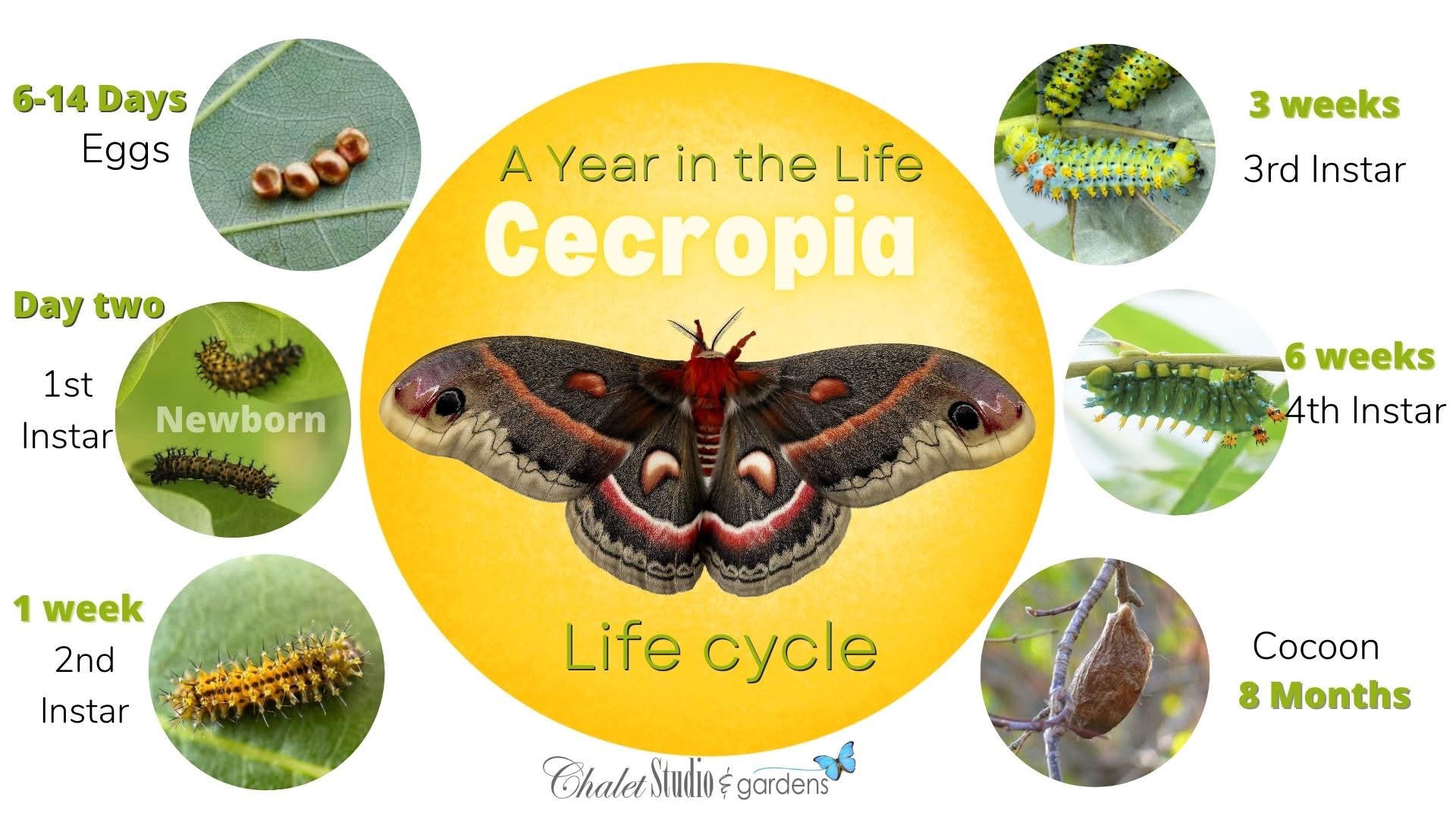 The Life Cycle Of A Cecropia Moth and the different stages of their life.
Photo Credits: Chalet Studio & Gardens
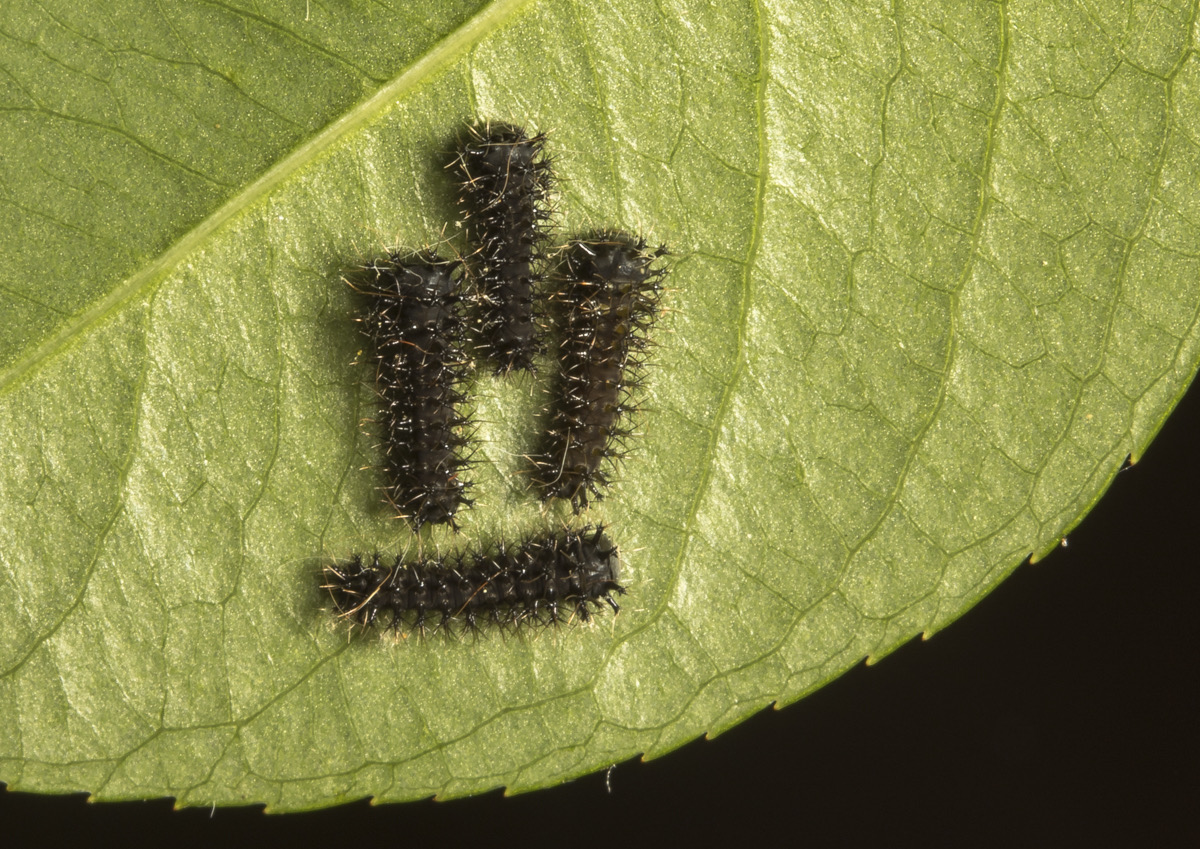 A couple of newborn Cecropia Moth Caterpillars resting together on a leaf. Photo Credits: roadsendnaturalist.com
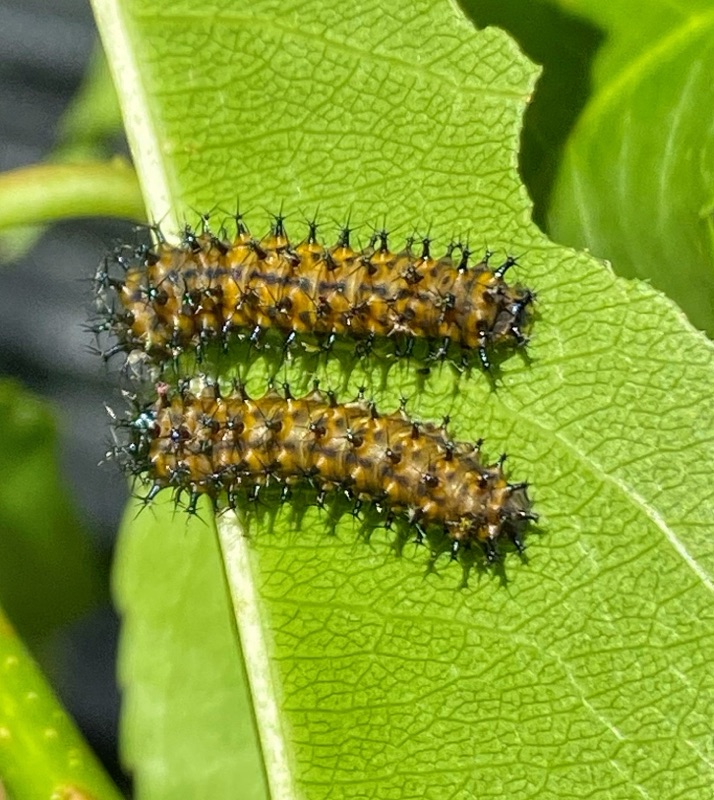 A pair of second instar Cecropia Moth Caterpillars munching on a leaf together. Photo Credits: roadsendnaturalist.com
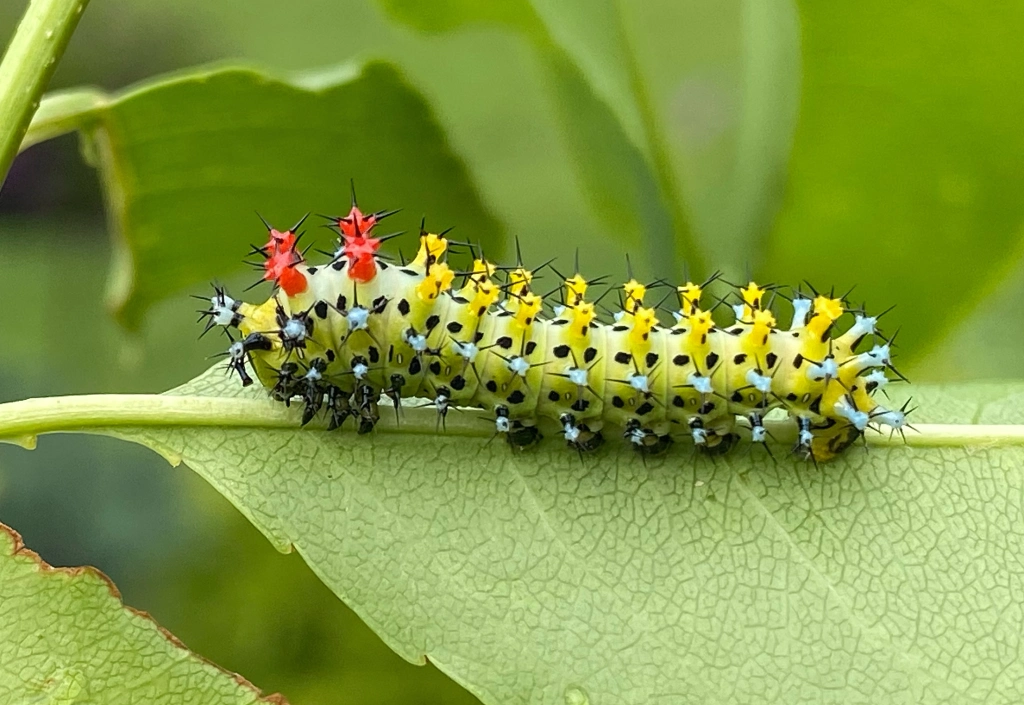 A third instar Cecropia Moth Caterpillar resting on the stem of a leaf.
Photo Credits: roadsendnaturalist.com
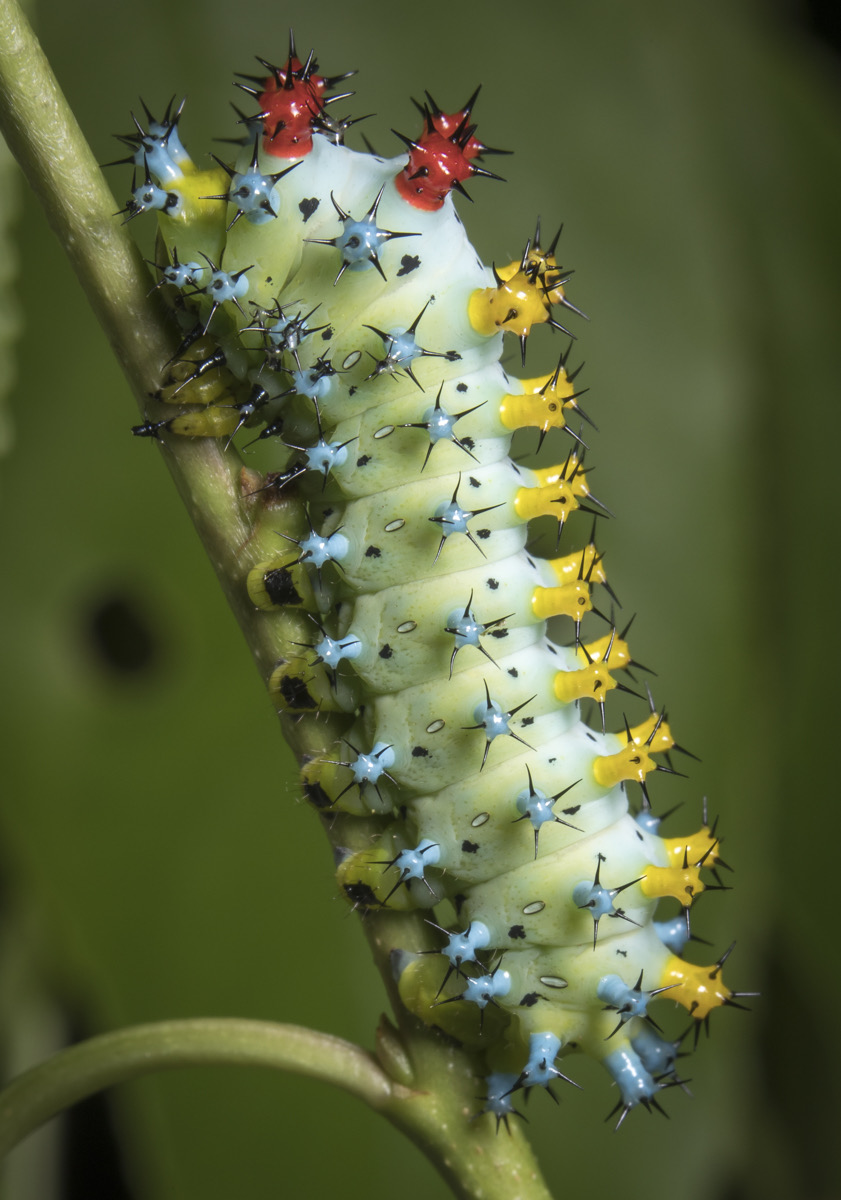 A fourth instar Cecropia Moth Caterpillar resting on a stem.
Photo Credits: roadsendnaturalist.com
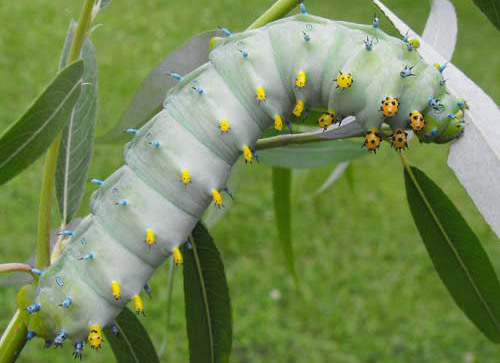 A full size and mature Cecropia Moth Caterpillar munching on a leaf.
Photo Credits: David Britton
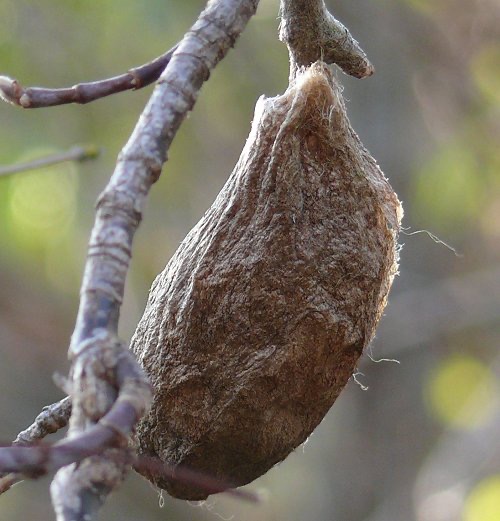 A light brown Cecropia Moth Cocoon on the side of a branch on a plant.
Photo Credits: Marcie O’Connor from buglifecycle.com
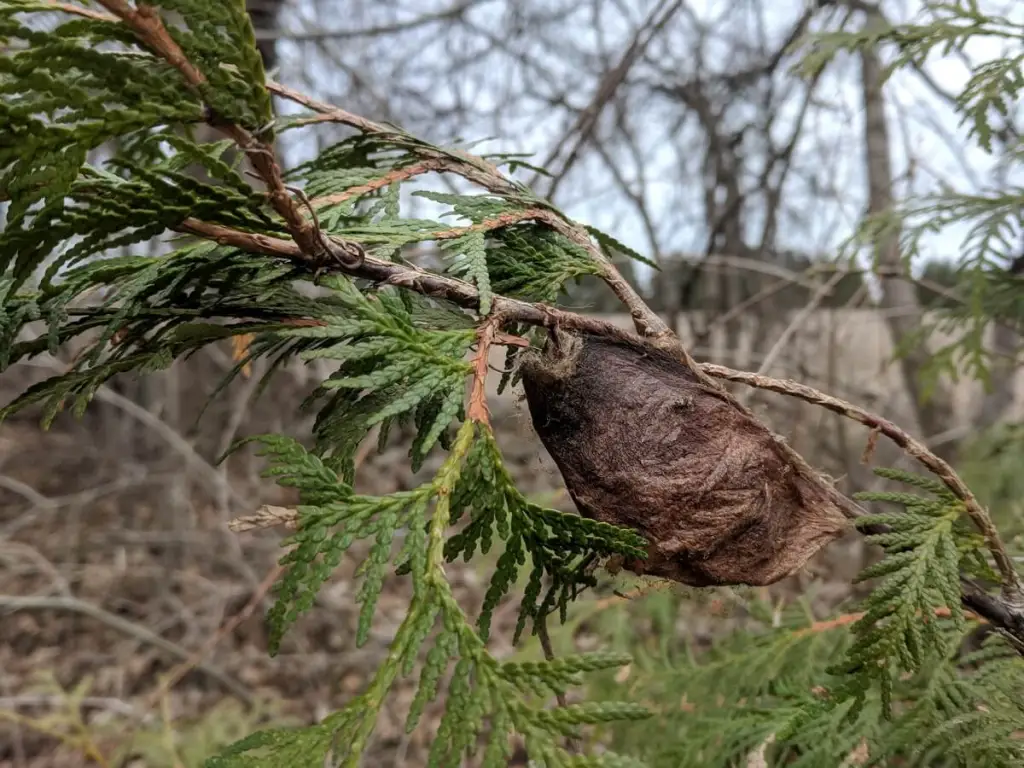 A dark coloured Cecropia Moth Cocoon hiding in between the branch and the foliage on a Cedar Tree.
Photo Credits: Frame to Frame - Bob and Jean
 A whitish grey coloured Cecropia Moth Cocoon at the edge of a branch on their host plant. Photo Credits: Ryan Hodnett
A light tan coloured Cecropia Moth Cocoon up against the twig of a plant.
Photo Credits: Christine Hanrahan
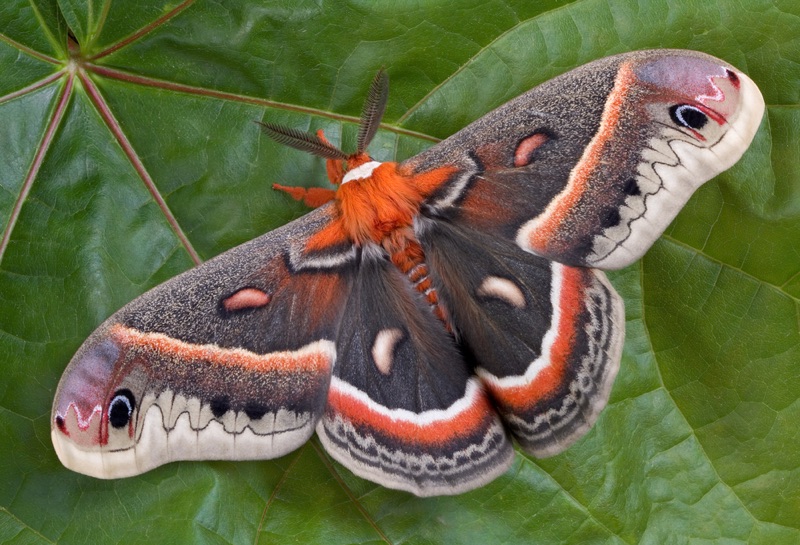 A Cecropia Moth resting on a big green leaf with their wings opened.
Photo Credits: CATHY KEIFER / GETTY IMAGES


Comments
Post a Comment