Early Spring Butterflies In Canada
All About The Fascinating World Of Spring Butterflies In Canada, And How To Provide And Support These Butterflies In The Garden.
This article is about the thirteen butterfly species that are early spring butterflies where you get to learn a little bit about each butterfly, how to identify each one, what their host plants are, what their favourite food sources are, and so much more. You will also find out ways in how you can provide and support them in your own backyard and garden.
Welcome! To the amazing world of the butterfly species who come out earlier in the season than other butterfly species. Did you know some butterflies hibernate as adult butterflies? Did you know some butterflies overwinter as their chrysalids? And Did you know some butterflies are just early fliers in the spring time?
As you know there are some local butterfly species that hibernate as adults during the winter months here in Canada and other parts of North America. There are four local butterfly species who hibernate as adult butterflies which are the Mourning Cloak, Eastern Comma, Compton Tortoiseshell, and Question Mark. You will learn more about these unique more butterfly species later on in the article.
You have learned already that there are a few species of butterflies who overwinter as their chrysalis during the winter months here in Canada and other parts of North America. There are six butterfly species who overwinter as their chrysalids which includes Eastern Pine Elfin, Frosted Elfin, Spring Azure, Cabbage White, Cloudless Sulphur, and Eastern Black Swallowtail. You will find out more about these fascinating butterfly species later on in the article.
You already know that there are some butterfly species who are early spring fliers here in Canada and other parts of North America. There are 3 butterfly species who are early spring fliers which include the Red Admiral, American Lady, and Painted Lady. You will learn about these beautiful butterfly species later on in this article.
What Is Hibernation? : Is an inactive state resembling deep sleep in which certain animals living in cold climates pass the winter. In hibernation, the body temperature is lowered and breathing and heart rates slow down. Hibernation protects the animal from cold and reduces the need for food during the season when food is scarce.
What Is Overwintering? : Is a sort of hibernation undertaken by insects to survive the cold temperatures. Insects can overwinter in any stage of their development unless they migrate to a warmer climate.
What Are Early Spring Flying Butterflies? : Early spring flying butterflies are butterfly species who come out very early in the spring and butterfly season than other local butterfly species.
Hibernating Butterflies
Hibernating butterflies are specific butterfly species that hibernate as mature adult butterflies during the winter months in certain locations and spots outdoors.
Come explore and learn about the four special butterfly species that hibernate in adult form during the winter months!
Mourning Cloak Butterfly (Nymphalis antiopa):
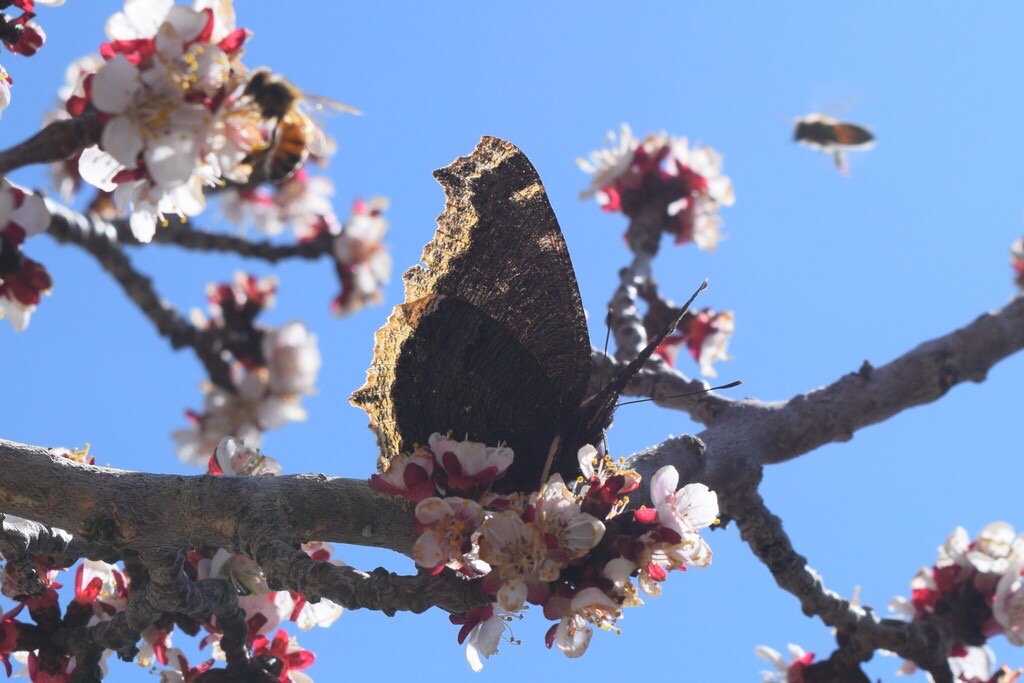 A Mourning Cloak Butterfly on a branch with flowers resting with their wings closed. Photo Credits: williamharmonlds from iNaturalist
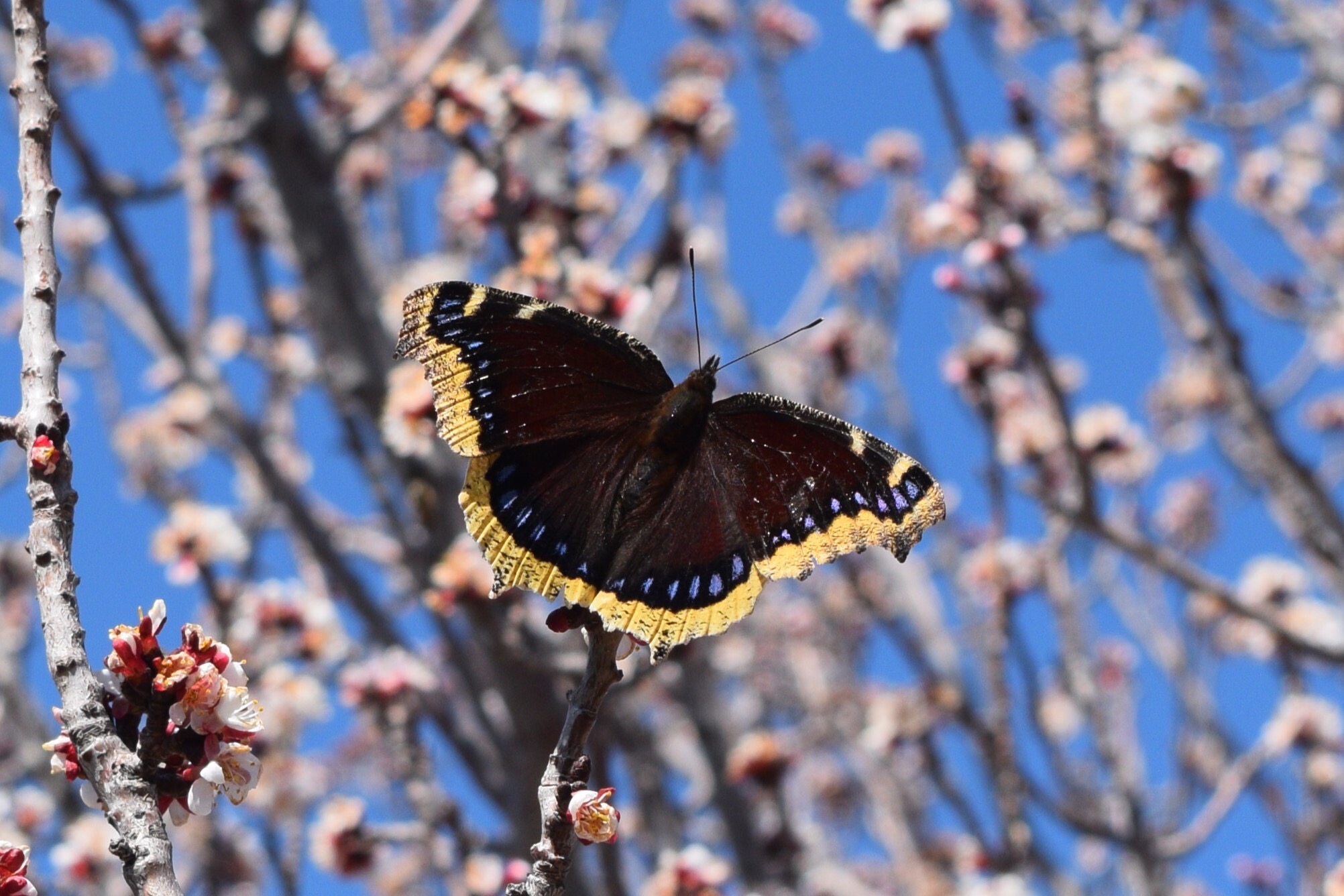 A Mourning Cloak Butterfly resting with their wings opened on a branch with small spring flowers. Photo Credits: williamharmonlds from iNaturalist
A Mourning Cloak (Nymphalis antiopa) is a large sized butterfly that is a member of The Brush - footed Butterflies Family.
This butterfly is 2 1/4 to 4 inches in length. It is a little bit smaller than the Monarch butterfly, but bigger than the Cabbage White butterfly.
This butterfly has a very unique pattern than other butterfly species. The upper surface of the wings is a rich maroon or purple brown colour. There is a bright yellow band along the irregular wing edges, bordered by a row of bright iridescent blue spots on the inside. The underside of the wings is a dark brown with wavy thin black lines with a dirty greyish beige border along the edges.
The native range of this butterfly is North America (Canada, USA, and Central Mexico.), Eurasia, and South America.
Their lifespan is 10 months up to a year, which is much longer than other local butterflies.
This butterfly hibernates in holes of tall trees, old rotting logs, holes in large rocks, underneath leaf litter, holes in tree stumps, holes in fences, and other locations that are outside.
The host plants of the Mourning Cloak are American Elm (Ulmus americana), Weeping Willow (Salix babylonica), Black Willow (Salix nigra), Paper Birch (Betula papyrifera), Common Hackberry (Celtis occidentalis), Bebb’s Willow (Salix bebbiana), Heart - leaved Willow (Salix cordata), Meadow Willow (Salix lucida), Trembling Aspen (Populus tremuloides), Large tooth Aspen (Populus grandidentata), Balsam Poplar (Populus balsamifera), Eastern Cottonwood (Populus deltoides), and Pussy Willow (Salix discolor).
The Mourning Cloak does not sip nectar from flowering plants like other butterflies. Instead the Mourning Cloak’s primary food sources as adults include tree sap, and decaying fruit.
During early winter and late winter a Mourning Cloak can be seen relaxing and sun basking in the sunshine when it is warm outside.
A Mourning Cloak usually emerges and comes out from their long winter nap in the middle of March into early April. Occasionally they come out in February during the thaws, but it doesn’t happen all the time in February because usually it is very cold during that month.
Eastern Comma Butterfly (Polygonia comma) :
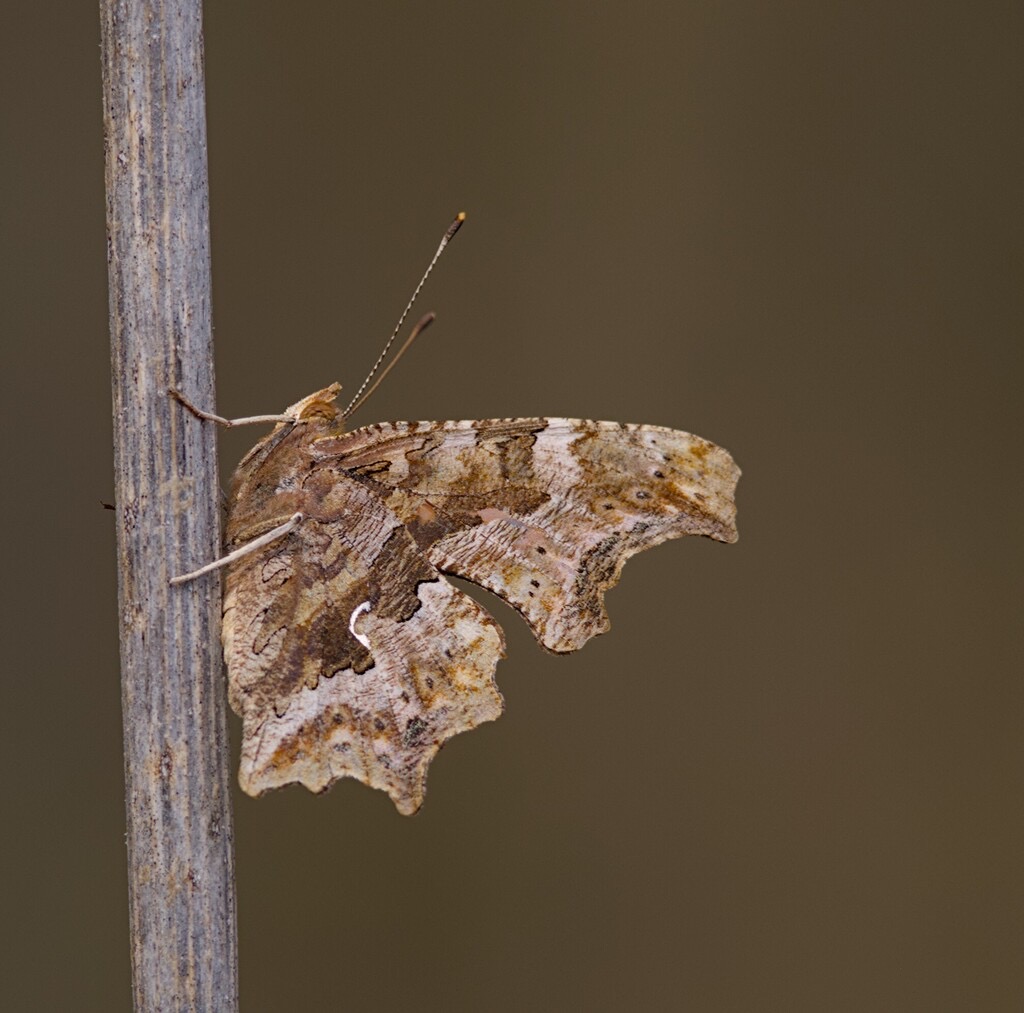 A Eastern Comma Butterfly relaxing on a plant stalk with their wings closed. Photo Credits: jimdanzi from iNaturalist
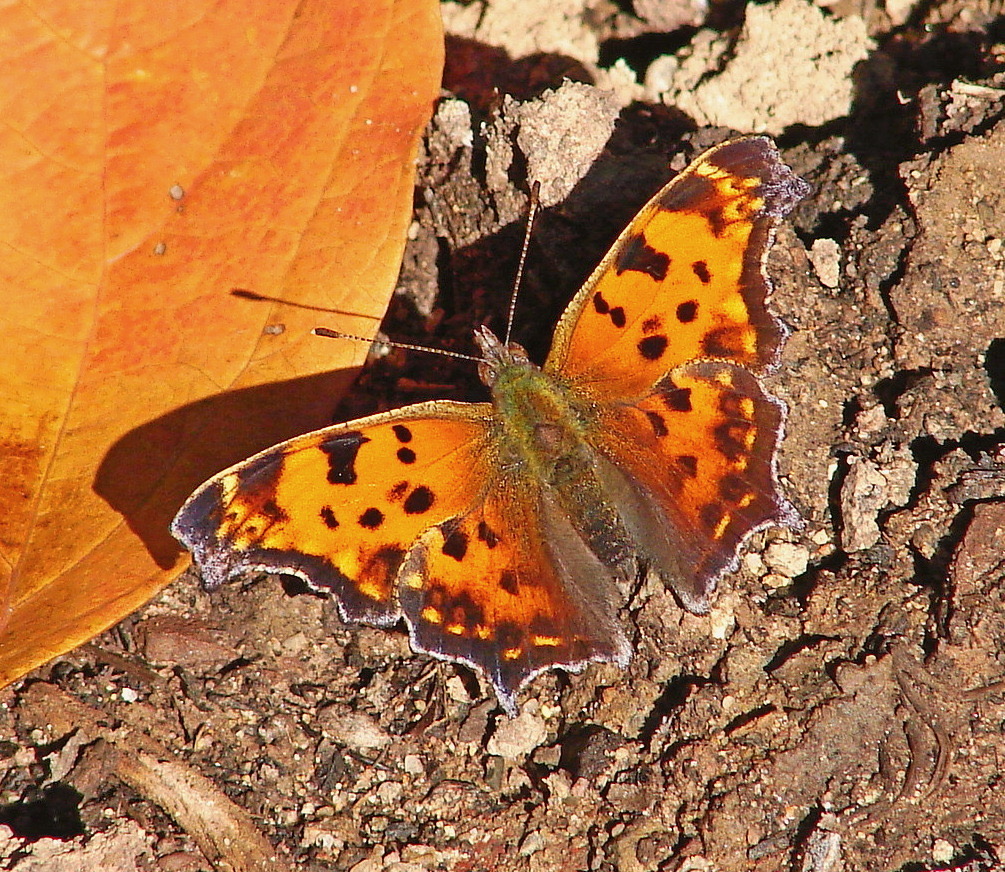 A Eastern Comma Butterfly relaxing in the sunshine on the ground with their wings opened. Photo Credits: didymops77 from iNaturalist
An Eastern Comma (Polygonia comma) is a large sized butterfly species that is a member of The Brush - footed Butterflies Family.
Is a common angle wing butterfly species that has two forms which are winter form and summer form. The winter form of this butterfly is a pale colouration, and the summer form of this butterfly is a dark colouration.
The wingspan of the Eastern Comma ranges from 1 3/4 to 2 1/2 inches (4.5 to 6.4 cm) in length. It is a smaller butterfly species than other local butterfly species.
This butterfly has a really neat colouration and pattern than other butterflies. This species of Comma butterfly is very similar to the other commas with a lot of orange, dark wing margins, and various black spots.
The Eastern Comma has short hindwing projections. The forewing on this butterfly is brownish orange with dark spots, one dark spot at center of bottom edge. The hindwing on this butterfly has two patterns. The summer form of this butterfly is mostly black, and the winter form is orange with black spots. Both of the forewing and hindwing have a dark border containing pale spots. The underside of the wings is brown with a central silver or white comma which is swollen at both ends.
The native range of this butterfly is Eastern North America (Eastern United States, Eastern Canada, and Central Canada.), Canada (Ontario, Southeastern Saskatchewan, and The Atlantic Coast of Quebec.), and United States (South to The Gulf Coast of Texas, and Northern Florida.
There are two generations each year of this butterfly, where there is a first generation and a second generation. The first generation of this butterfly is the summer brood. The second generation of this butterfly is the fall/winter brood.
the lifespan of this butterfly vary depending on what generation it is in. For the summer brood of this butterfly the lifespan is 6 to 20 days, and for the fall/winter brood of this butterfly the lifespan is 11 months up to 1 year.
The fall/winter brood of this Comma butterfly species hibernates in tree cavities, under bark, rock crevices, under leaf litter, and other protected areas that are out of the elements.
The host plants of the Eastern Comma are Stinging Nettle (Urtica dioica), Wood Nettle (Laportea canadensis), American Elm (Ulmus americana), Slippery Elm (Ulmus rubra), Rock Elm (Ulmus thomasii), and Hops.
The Eastern Comma doesn’t sip nectar from flowers, and flowering plants like other local butterfly species do. This butterfly’s primary food source includes tree sap, and fermented fruit.
On winter days that are full of sunshine and a bit of warmth this butterfly can be seen soaking up the sun resting on tree trunks, logs, fences, branches on plants and trees, and rocks.
This species of Comma butterfly hibernates in tree cavities, in logs, and in other snug places that are out of the elements.
The Eastern Comma comes out in the spring usually in late March and early April. The butterflies that are in the summer brood fly from June through July, and the butterflies that are in the fall/winter brood fly from August into October.
Compton Tortoiseshell Butterfly (Nymphalis vaualbum) :
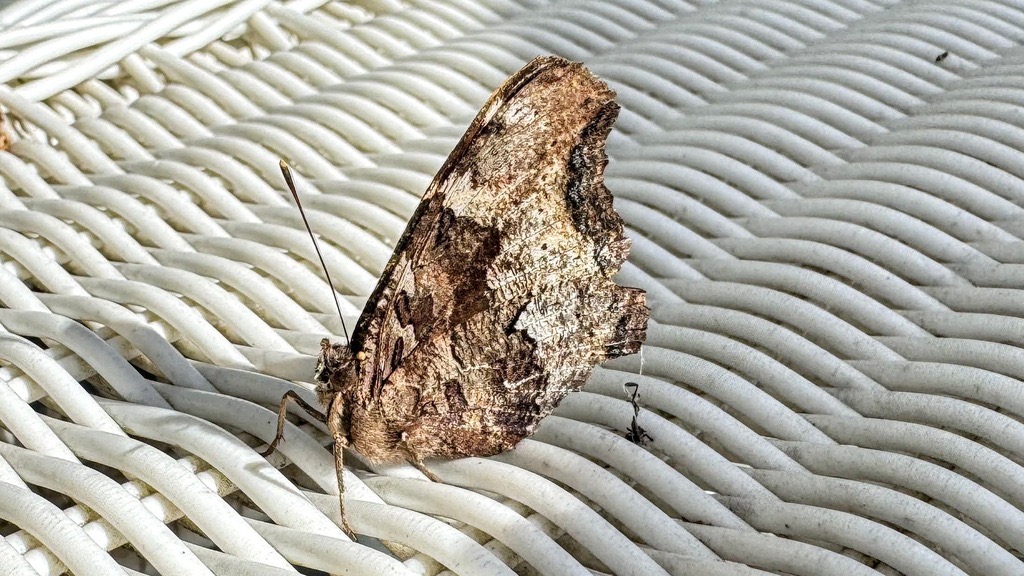 A Compton Tortoisehell Butterfly relaxing with their wings closed. Photo Credits: jwalewski from iNaturalist
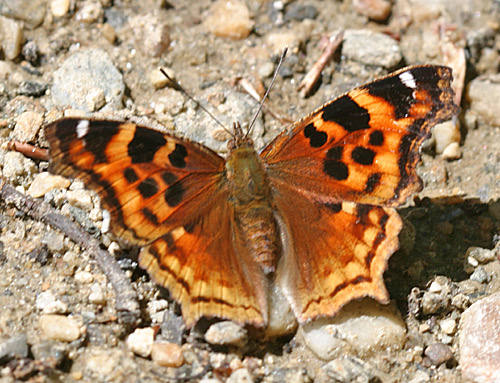 A Compton Tortoiseshell Butterfly sun basking on the ground with their wings opened. Photo Credits: tmurray74 from iNaturalist
The Compton Tortoiseshell Nymphalis vaualbum) is a medium sized butterfly, and it is a member of The Brush - footed Butterflies Family.
The wingspan of the Compton Tortoiseshell is 2 1/2 to 3 1/16 (6.4 to 7.8 cm) in length. This butterfly is a little bit smaller than the Mourning Cloak and a bit bigger than the Eastern Comma.
The upperside of the wings on this butterfly is orange - brown with darker wing bases and black spots, and a single white spot on leading edge of each wing. The underside of the wings on this butterfly is mottled grey and brown, and with dark bases and borders. The hindwing has a small white V at outer end of cell.
The native range of this butterfly is Western North America (Southeast Alaska, Canada, south into the mountains of Montana and Wyoming.), Eastern North America (Southern Canada, Northern United States, New England, and south to North Carolina and Missouri.), and Eurasia (Temperate Eurasia, Eastern Europe, Romania, Ukraine, the south of Russia to the areas west of the Urals, the southern part of Siberia to the Himalayas and Japan.) .
It has a lifespan of 10 months up to 1 year, since this butterfly is a species of butterfly that hibernates as an adult.
The host plants of the Compton Tortoiseshell include Trembling Aspen (Populus tremuloides), Large tooth Aspen (Populus grandidentata), Grey Birch (Betula populifolia), Paper Birch (Betula papyrifera), Weeping Willow (Salix babylonica), Black Willow (Salix nigra), Bebb’s Willow (Salix bebbiana), Heart leaved Willow (Salix cordata), and Meadow Willow (Salix lucida).
The Compton Tortoiseshell’s main food source as an adult butterfly is not the nectar from flowers and flowering plants. Their main food source is tree sap and fermented fruit.
On the winter days that are full of sunshine and more warmer than usual during the winter months, the Compton Tortoiseshell can be seen sun basking in sunny locations of trees, logs, rocks, fence posts, sand, dirt, patio stones, and other outdoor locations.
The Compton Tortoisehell hibernates during the winter as mature adults in loose tree bark, rock crevices, leaf litter, tree crevices, and sometimes in buildings in small groups.
The Compton Tortoiseshells come out and can be seen flying between March and June. Occasionally this butterfly can be seen flying around on warm days during the month of April.
Question Mark Butterfly (Polygonia interrogationis) :
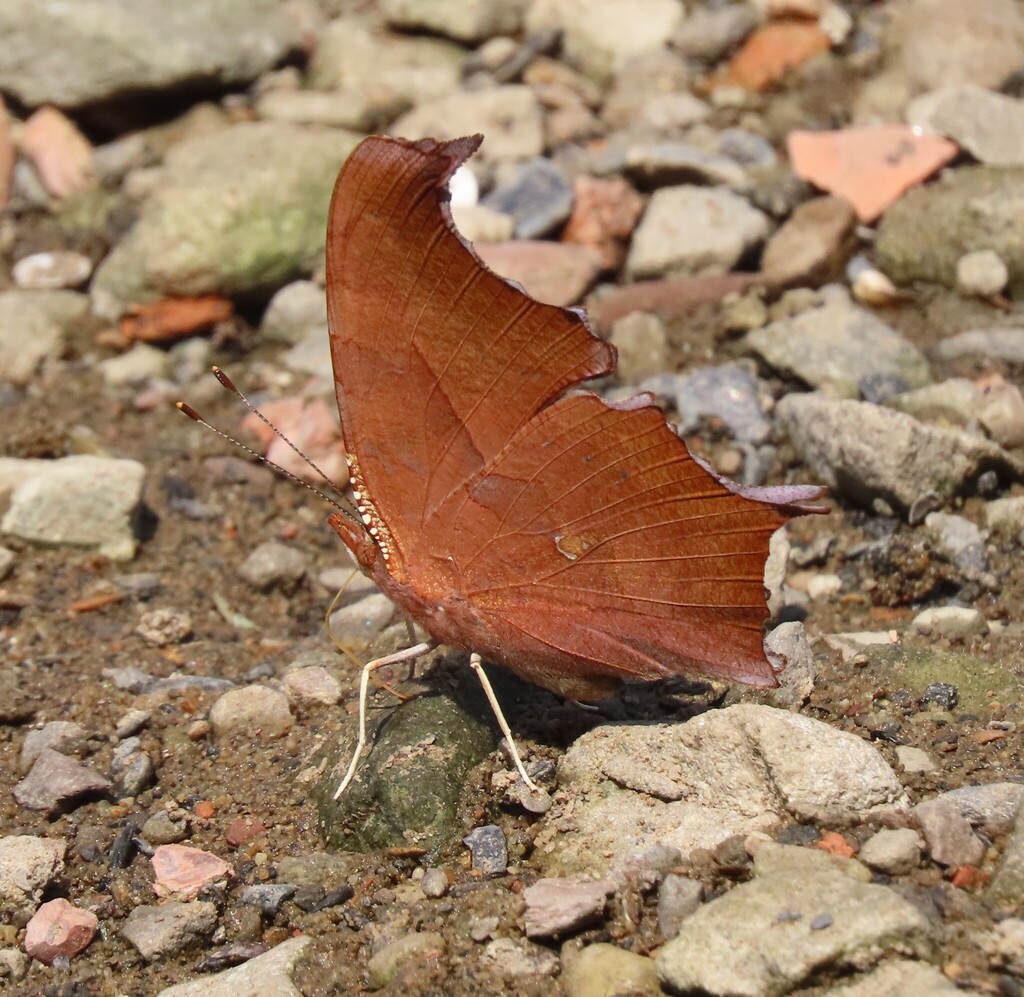 A Question Mark Butterfly relaxing on the ground with its wings closed. Photo Credits: loriarent from iNaturalist
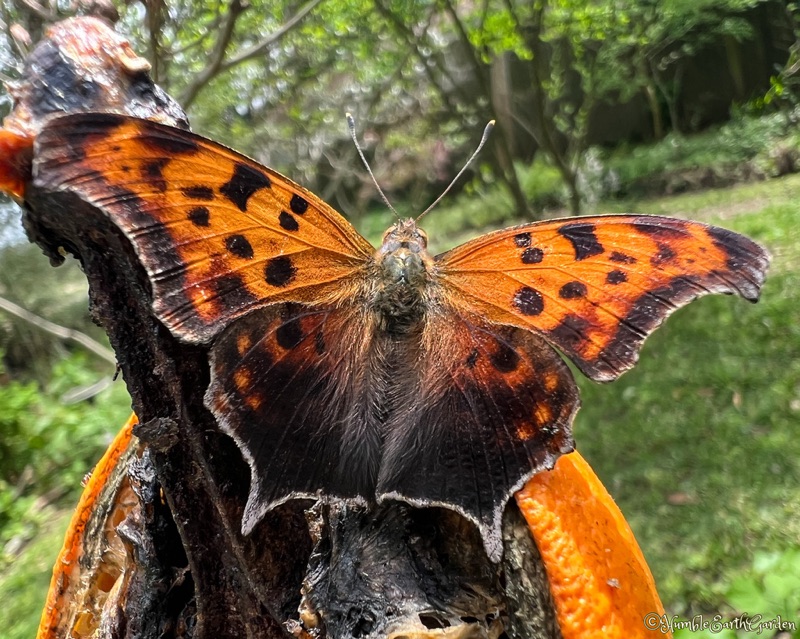 A Question Mark Butterfly resting with their wings opened. Photo Credits: humbleearthgarden from iNaturalist
The Question Mark (Polygonia interrogationis) is a medium sized butterfly, who is a member of The Brush - footed Butterflies Family.
It has a wingspan of 2 1/4 to 3 inches (5.7 to 7.6 cm) in length. This butterfly is a little bit bigger than the Eastern Comma and the Compton Tortoiseshell.
The upper wings of the Question Mark are orange with black spots and irregular wing margins. The lower wings on the Question Mark are a light brown with a silvery white mark in the shape of a question mark in the center of the hindwing.
The underside of the wings on a Question Mark butterfly mimics dead leaves when they fold their wings over their body.
This butterfly has two forms which are the summer form and the winter form. For the summer form of this butterfly the hindwing is darker in colour almost black. The winter form of this butterfly has a longer tail and a largely red - orange dorsal hind wing.
The native range for the Question Mark Butterfly is Canada (Southern Canada, Southeastern Saskatchewan, Nova Scotia, and New Brunswick.), United States (Eastern USA, Central USA, peninsular Florida, west to the eastern edge of the Rocky Mountains.), and Mexico.
For the Summer Brood of this butterfly these butterflies only live 6 to 20 days, and for the Fall/Winter Brood of this butterfly these butterflies live 10 months up to 1 year since they hibernate as mature adults.
The host plants of the Question Mark butterfly are American Elm (Ulmus americana), Slippery Elm (Ulmus rubra), Northern Hackberry (Celtis occidentalis), Stinging Nettle (Urtica dioica), Wood Nettle (Laportea canadensis), Japanese Hops (Humulus japonicus), False Nettle (Boehmeria cylindrica), and Sugar Hackberry (Celtis laevigata).
The Question Mark’s main food source is not nectar from flowers and flowering plants. Their primary food source is tree sap, fermented fruit, and dead animals. This butterfly sips nectar from flowers and flowering plants, when their main food sources are scarce.
On winter days that are full of sunshine and the temperatures are above normal, this Question Mark can be seen sun basking in the sun on tree trunks, branches of trees and shrubs, large rocks, patio stones, sand, dirt, gardens, fence posts, and other locations that are outside.
The Question Mark hibernates as an adult butterfly during the winter in tree cracks, under peeling bark on trees, crevices in big rocks, or in outdoor wooden structures.
Mature adult Question Marks emerge from their winter hibernation in early spring like March or April depending on the weather and temperature.
Overwintering Butterflies :
Overwintering butterflies are specific butterfly species who overwinter as their chrysalids during the winter months, where they’re fast asleep in their chrysalids.
Come follow along and discover these butterfly species who overwinter as chrysalids during the winter season!
Eastern Pine Elfin Butterfly (Callophrys niphon) :
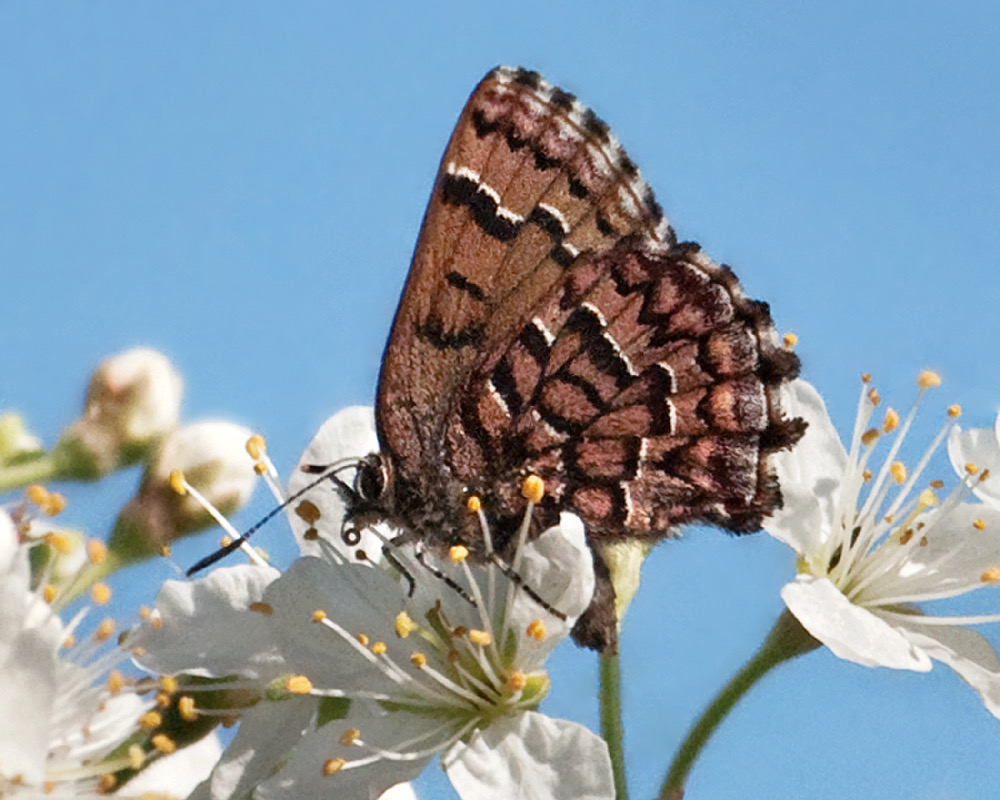 A Eastern Pine Elfin sipping nectar from white flowers with their wings closed. Photo Credits: Alabama Butterfly Atlas
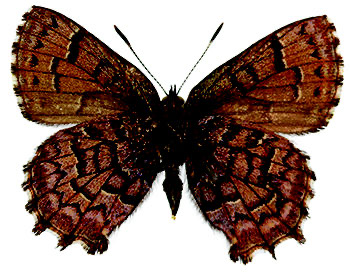 A Eastern Pine Elfin with their wings opened. Photo Credits: Illinois Department Of Natural Resources
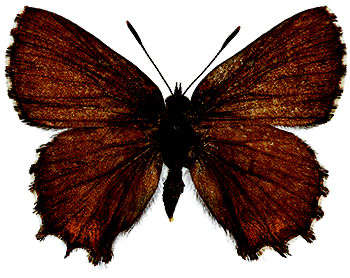 A Eastern Pine Elfin with their wings opened. Photo Credits: Illinois Department Of Natural Resources
The Eastern Pine Elfin (Callophrys niphon) is a small sized butterfly that is a member of The Gossamer - winged Butterflies Family.
The wingspan of this butterfly is 3/4 to 1 1/4 inches (1.9 to 3.2 cm) in length, which is very small in size compared to other local butterfly species.
The upper surface of the wings on an Eastern Pine Elfin varies depending on the gender. In males the upper surface is dark brown with a forewing stigma patch. In females the upper surface of the wings is a lighter brown in colour.
The under surface of the wings are brown, strongly marked with grey, reddish brown, black chevrons, and bands. There are no tails on the under surface of the wings.
The upper surface of the wings on an Eastern Pine Elfin is rarely seen, because this butterfly usually has their wings closed when they are resting. The underside of the wings on this butterfly are more commonly seen, because they are seen when they rest on structures and outdoors objects.
The native range of the Eastern Pine Elfin is Canada (Northern Ontario and occasionally Southern Ontario, Central Alberta, Central Manitoba, Southeast to the Great Lakes, and east to Nova Scotia), and United States (Eastern United States, east of the Great Plains, Eastern Texas, and Northern Florida.).
For the Eastern Pine Elfin they are able to complete their full life cycle in 1 year. Once the newly emerged Eastern Pine Elfin comes out of their chrysalis, it lives for 10 to 20 days which is just under two weeks or two full weeks depending on the butterfly.
The host plants of the Eastern Pine Elfin are Pitch Pine (Pinus rigida), Red Pine (Pinus resinosa), Eastern White Pine (Pinus strobus), and Jack Pine (Pinus banksiana).
The primary food source for mature adult Eastern Pine Elfin is nectar from flowering plants. Some of their favourite flowering plants for nectar include Wild Lupine (Lupinus perennis), Lowbush Blueberry (Vaccinium angustifolium), and Bearberry (Arctostaphylos uva - ursi). This butterfly also sips on the moisture from wet ground.
The Eastern Pine Elfin overwinters as a loosely formed chrysalis beneath leaf litter or soil that is just below a host plant which is a Pine Tree.
This butterfly emerges from their chrysalis sometime in mid to late May, depending on the temperature and the weather outside.
Frosted Elfin Butterfly (Callophrys Iris) :
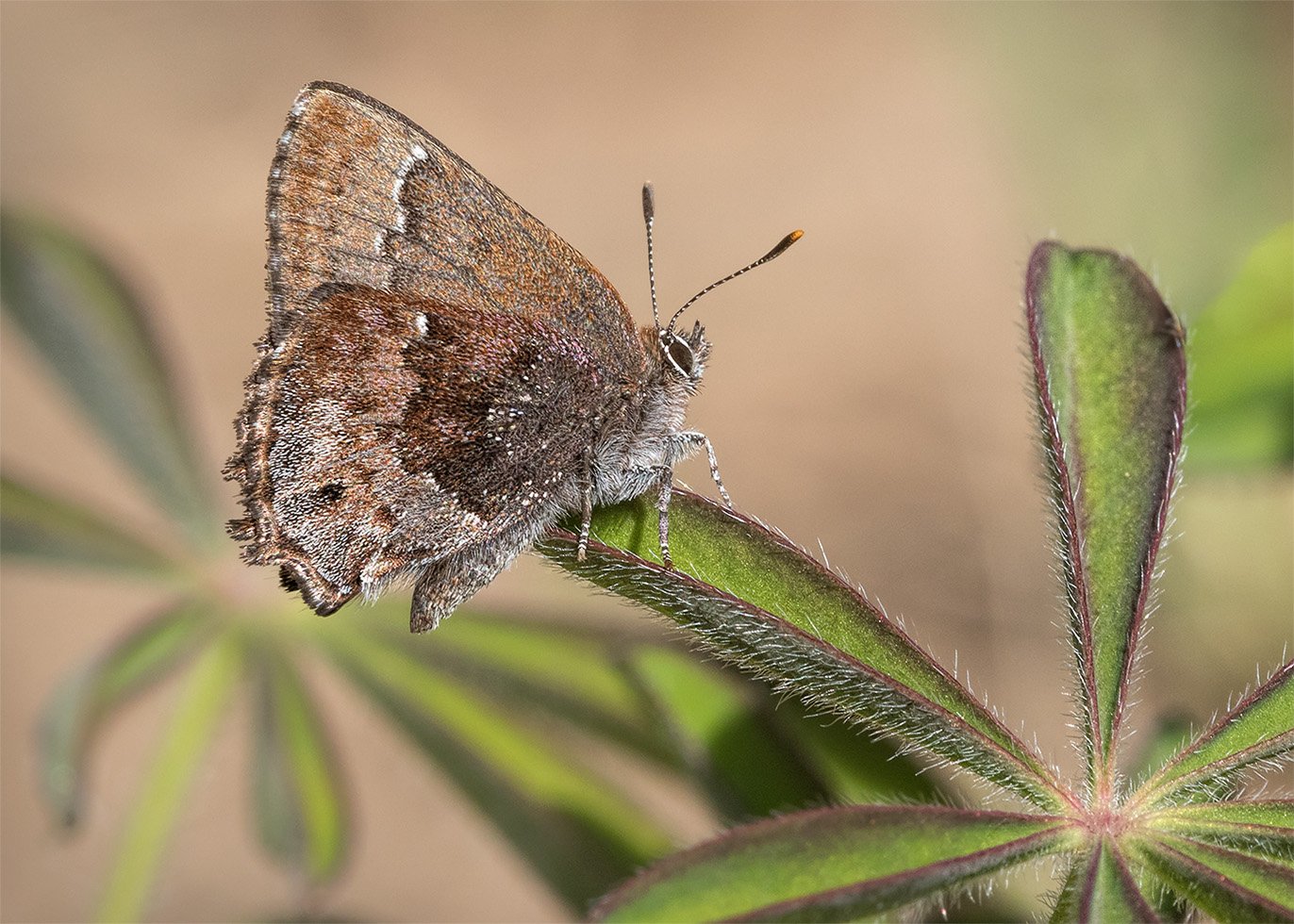 A Frosted Elfin resting with their wings closed on a leaf of a Wild Lupine. Photo Credits: Wilton Wildlife Preserve & Park
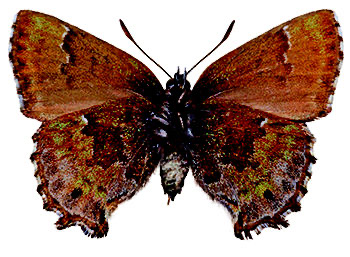 A Frosted Elfin with their wings opened Photo Credits: Illinois Department Of Natural Resources
The Frosted Elfin (Callophrys irus) is a small sized butterfly, who is a member of The Gossamer - winged Butterflies Family.
The wingspan of the Frosted Elfin is 1 to 1.25 inches (2.5 to 3.2 cm) in length. This butterfly is way smaller than the Eastern Pine Elfin even though they’re both small sized butterflies.
The upper side of the wings on a Frosted Elfin is largely uniform brown. The under side of the wings is variegated with a dusting of pale scales on the outer third, a short "tail" on the hindwing, and a dark "thecla" spot near the base of the tail.
In males the upperside of the wings are grey brown. The forewing possesses a dark stigma patch (a long oval dark spot) on the leading edge. On the hindwing it has a black spot above a single short tail.
In females the upperside of the wings are reddish brown in colour. On the hindwing there is a black spot above a single short tail.
The Frosted Elfin was once found from Florida and Texas north to Ontario, Canada, and west to Minnesota.
Sadly, the Frosted Elfin is now extirpated in Ontario, Canada, and the District of Columbia, Georgia, Illinois, and Vermont.
The Frosted Elfin completes their life cycle in one year. Once the Frosted Elfin emerges from their chrysalis, and fully dries their wings they live 1 week up to 2 weeks.
The host plants of the Frosted Elfin are Blue False Indigo (Baptisia australis), and Wild Blue Lupine (Lupinus perennis).
The adult food source of the Frosted Elfin is nectar from various flowering plants. Some of the Frosted Elfin’s favourite flowering plants for nectar are Lowbush Blueberry (Vaccinium angustifolium), Bearberry (Arctostaphylos uva - ursi), Blue False Indigo (Baptisia australis), Wild Blue Lupine (Lupinus perennis), Sweet Crabapple (Malus coronaria), Pacific Crabapple (Malus fusca), Pussy Willow (Salix discolor), and Golden Alexander (Zizia aurea).
A Frosted Elfin overwinters as a loosely made chrysalis that is typically found in leaf litter, beneath the soil surface, near or on a host plant.
The Frosted Elfin early spring like in March or April. Usually they emerge during the month of May like in the middle or at the end of the month. This all depends on the weather and the climate.
Spring Azure Butterfly (Celastrina ladon) :
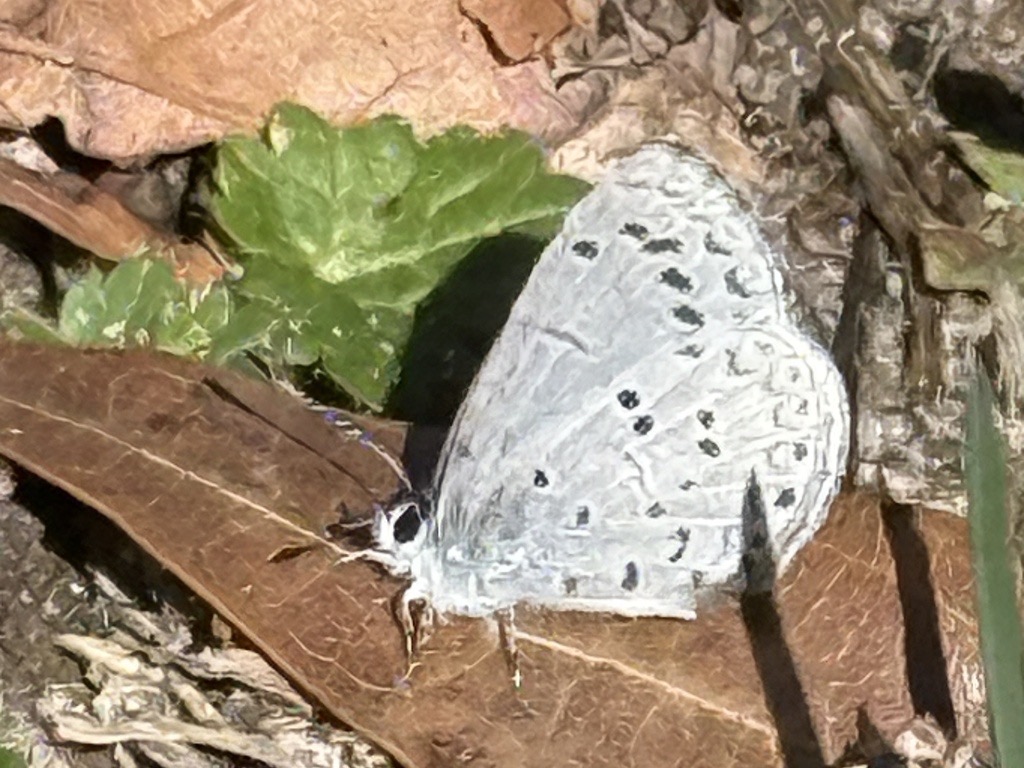 A Spring Azure Butterfly relaxing on the ground with their wings closed. Photo Credits: aviatrix-79 from iNaturalist
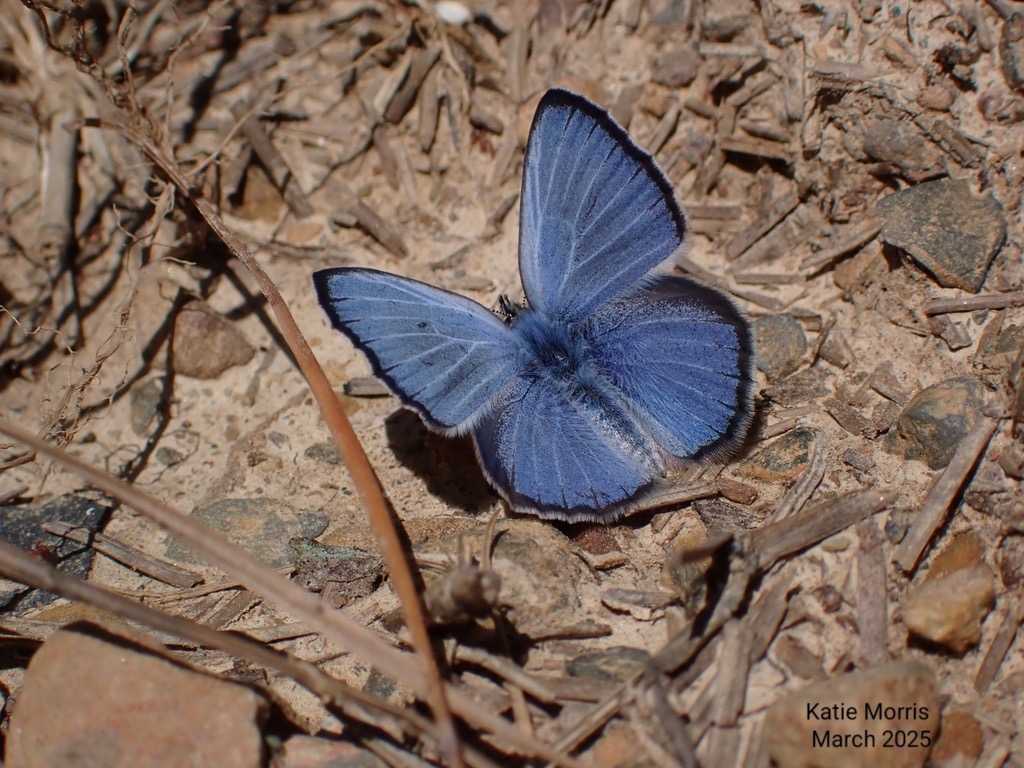 A Spring Azure Butterfly relaxing on the ground with their wings opened. Photo Credits: ar_etheostoma from iNaturalist
The Spring Azure (Celastrina ladon) is a small sized butterfly, that is a member of The Gossamer - winged Butterflies Family.
The wingspan of this butterfly is 3/4 to 1 1/4 inches (2.2 to 3.5 cm) in length. The Spring Azure is smaller than the Frosted Elfin, but it is around the same size as the Eastern Pine Elfin.
The underside of the wings on a Spring Azure are pale grey to whitish with small dark spots.
The upper side of the wings on a Spring Azure varies depending on the gender of the butterfly. On the males the upper side of the wings are iridescent blue in colour. In females the upper side of the wings are blue with a darker border around the wings. There are no hindwing tails and orange spots.
The native range of the Spring Azure is much of Central North America, Eastern North America, Southern Canada, and Southern United States.
The Spring Azure completes their lifecycle within 1 year. A Spring Azure survives inside their chrysalis for a year, by going through a process called diapause. A Spring Azure emerges from their chrysalis sometime during mid to late spring, and this butterfly lives only a couple of days which is between 1 to 3 days.
The host plants of the Spring Azure are Red Osier Dogwood (Cornus sericea), Flowering Dogwood (Cornus Florida), New Jersey Tea (Ceanothus americanus), and White Meadowsweet (Spiraea alba).
The primary food source for mature adult Spring Azures is the nectar from various flowers and flowering plants. Some of the Spring Azure’s favourite flowering plants for nectar include Canada Plum (Prunus nigra), American Plum (Prunus americana), New Jersey Tea (Ceanothus americanus), Smooth Blackberry (Rubus canadensis), Trailing Blackberry (Rubus ursinus), Black Raspberry (Rubus occidentalis), Common Milkweed (Asclepias syriaca), and Swamp Milkweed (Asclepias incarnata).
The Spring Azure butterfly overwinters as a chrysalis in a crevice of a tree or a rock, on the ground, beneath the soil surface, or in leaf litter that is near or below a host plant.
Spring Azure butterflies emerge from their chrysalids in early spring of the following year, like during the months of March or April which depends on the weather and the temperature outside.
Cabbage White Butterfly (Pieris rapae) :
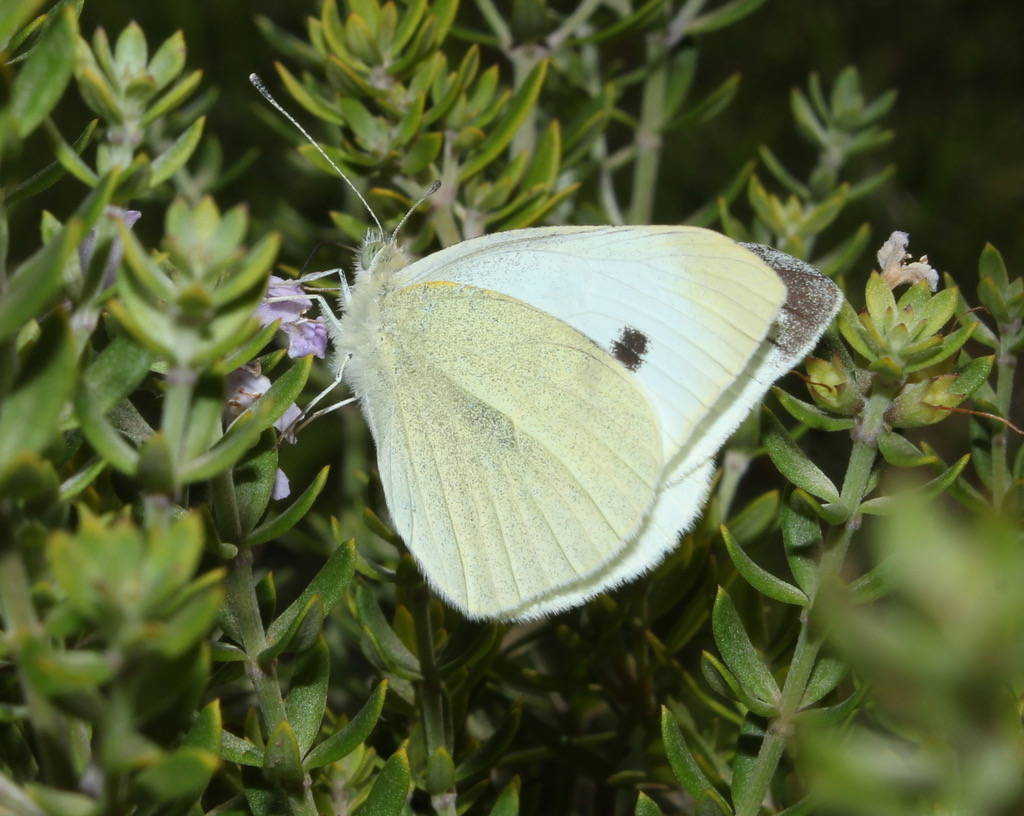 A Cabbage White relaxing on a plant with their wings closed. Photo Credits: joshua992 from iNaturalist
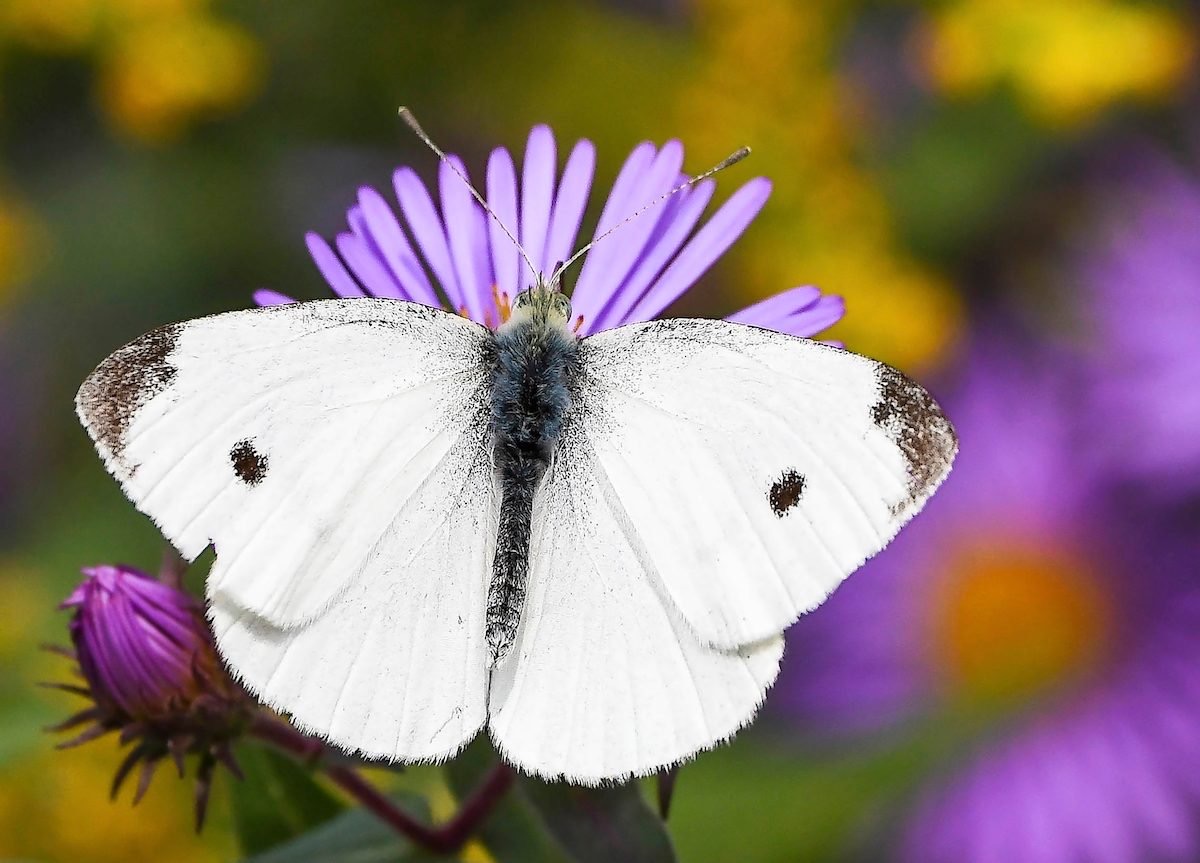 A male Cabbage White relaxing on a New England Aster with his wings opened. Photo Credits: Birds & Blooms
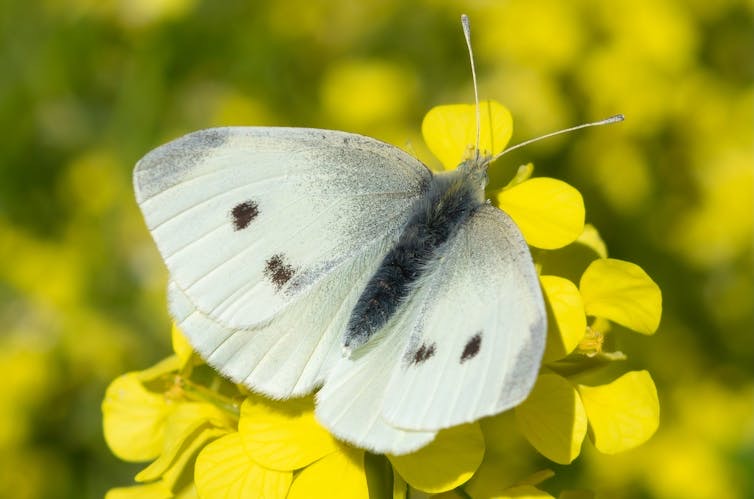 A female Cabbage White is relaxing with her wings opened on a Wild Mustard flower. Photo Credits: Anna N Chapman from Wikimedia Commons
The Cabbage White (Pieris rapae) is a small sized butterfly, who is a member of The Whites & Sulphurs Butterfly Family.
The wingspan of the Cabbage White is 32 to 47 mm (3.2 to 4.7 cm) in length. This butterfly is bigger than a Spring Azure butterfly, and is close to the size of the Frosted Elfin and the Eastern Pine Elfin.
The Cabbage White exhibits sexual dimorphism, which is so fascinating because each gender looks similar to the naked eye but they have different physical appearance from one another.
In males they have flaunt creamy white wings adorned with a singular black spot. In females they display a paler yellow hue with two central black spots. The underside of their wings reveals a yellowish tinge sprinkled with black speckles. Male Cabbage White butterflies have a dark greyish marking that is similar to a line on the top of their wings.
The females of the Cabbage White have a very pale light greyish marking that is similar to a line on the top of their wings.
The dot on the top of the wings on a male, and the dots that are on the top of the wings on a female can be seen from the outside of their wings.
The Cabbage White is an introduced butterfly species in the province of Ontario, and the rest of Canada. Its native range is Europe, Asia, and North Africa.
This butterfly is not invasive like other people think it is, it is actually non native and is an introduced species. The Cabbage White does eat a lot when it is in the caterpillar stage, and that is why some individuals think they’re invasive even though this species isn’t.
The life cycle of a Cabbage White is completed within 30 days up to 1 year, depending on the generation that the butterfly is in. The lifespan of the summer generation is 5 to 15 days, but the lifespan of the fall/winter generation is 10 to 20 days depending on the temperature and the weather outside.
The host plants of the Cabbage White include Kale, Brussels Sprouts, Cabbage, Collard Greens, Broccoli, and Cauliflower.
If you don’t want the Cabbage Whites to lay their eggs on your crop plants in your backyard, plant Nasturtiums near or around your crop plants. The Cabbage Whites will use Nasturtiums in your garden instead of your crop plants.
The main food source for the adult Cabbage Whites is nectar from various flowering plants and flowers.
Some of the Cabbage White’s favourite flowering plants for a nectar source are Azure Blue Sage (Salvia azurea), Blue Vervain (Verbena hastata), Hoary Vervain (Verbena stricta), Pale Purple Coneflower (Echinacea pallida), New England Aster (Symphyotrichum novae-angliae), White Wood Aster (Eurybia divaricata), Smooth Blue Aster (Symphyotrichum laeve), Swamp Milkweed (Asclepias incarnata), Butterfly Weed (Asclepias tuberosa), Tall Ironweed (Vernonia gigantea), Sweet Joe Pye Weed (Eutrochium purpureum), Blue False Indigo (Baptisia australis), and Wild Blue Lupine (Lupinus perennis).
The Cabbage White overwinters as a chrysalis on the underside of leaves of their host plant, tree branches, twigs on shrubs, fence posts, or even up against houses.
The summer generation of the Cabbage Whites are around from March or April until July. The winter generation of the Cabbage Whites emerge from their chrysalides in early to mid spring, like April or May depending on the weather and the temperature outside.
Cloudless Sulphur Butterfly (Phoebis sennae) :
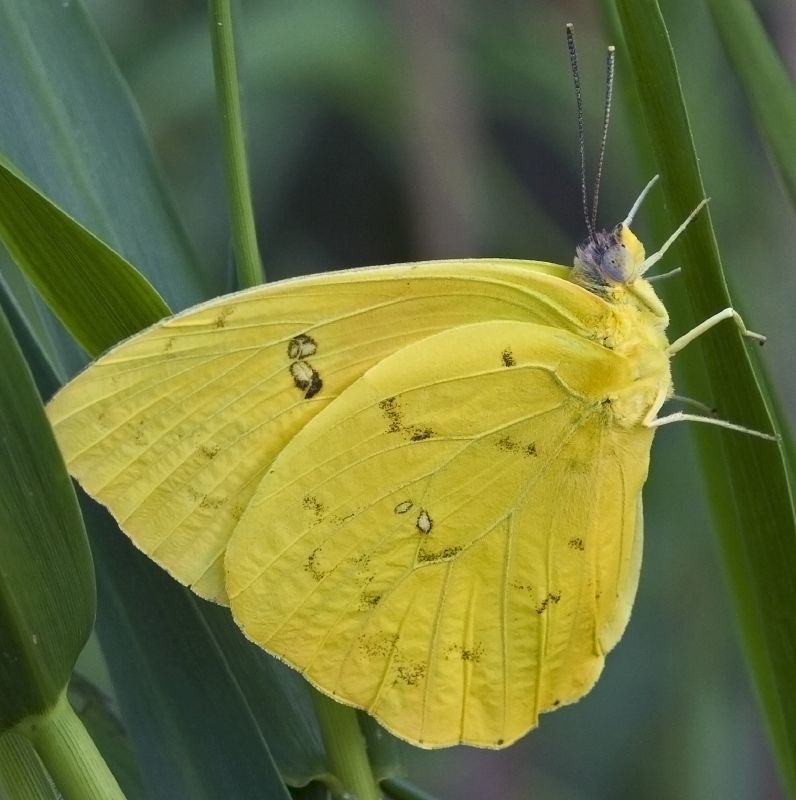 A Cloudless Sulphur relaxing on a leaf of a plant with its wings closed. Photo Credits: Richard Crook
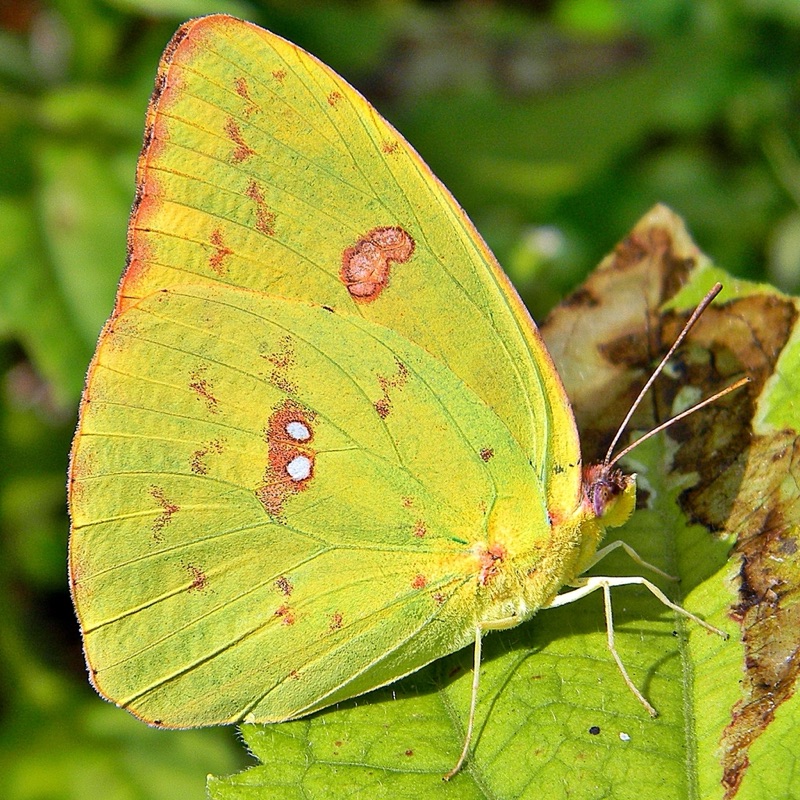 A Cloudless Sulphur relaxing with their wings closed while on a plant sun - basking in the sun. Photo Credits: Bob Peterson
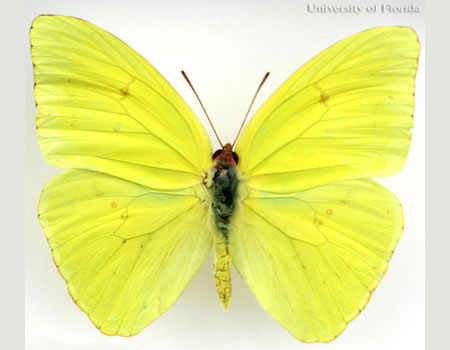 A male Cloudless Sulphur with his wings opened. Photo Credits: Donald Hall from University Of Florida
A female Cloudless Sulphur with her wings opened. Photo Credits: Donald Hall from University Of Florida
The Cloudless Sulphur (Phoebis sennas) is a small sized butterfly, who is a member of The Whites & Sulphurs Butterfly Family.
The wingspan of the Cloudless Sulphur is 2 to 2.75 inches (50 - 68 mm). This butterfly is smaller than the Cabbage White, but a bit bigger than the Spring Azure.
The physical appearance of the Cloudless Sulphur depends on the gender of the butterfly, because each gender of the butterfly look a bit different from one another.
In males they have bright clear yellow wings with no markings. In females they are yellow or pale yellow, sometimes with a very narrow dark or reddish line highlighting the outside edges of the wings. They may have a thin black border on the wings and a dark spot on the forewing.
The native range of the Cloudless Sulphur is Southwestern Ontario, Southern Ontario, Northern Ontario, Northeastern Ontario, South Carolina, Gulf States, and Central and South America.
The Cloudless Sulphur is able to complete their life cycle in 30 days up to 1 year, which depends on what generation the butterfly is a part of.
The summer generation of the Cloudless Sulphur lives for 7 days up to 14 days. The fall/winter generation of the Cloudless Sulphur lives for 21 days up to one month, which depends on the butterfly and the weather outdoors.
The host plants of the Cloudless Sulphur includes Canada Milk Vetch (Astragalus canadensis), Purple Prairie Clover (Dalea purpurea), Round - headed Bush Cloverr (Lespedeza capitata), Wild Senna (Senna hebecarpa), Showy Tick Trefoil (Desmodium canadense), Speckled Alder (Alnus rugosa), and Partridge Pea (Chamaecrista fasciculata).
The primary food source for adult Cloudless Sulphurs is nectar from various flowering plants.
Some of the Cloudless Sulphur’s favourite flowering plants for nectar sources include Red Cardinal Flower (Lobelia cardinalis), Swamp Rose Mallow (Hibiscus moscheutos), Common Milkweed (Asclepias syriaca), Swamp Milkweed (Asclepias incarnata), Butterfly Weed (Asclepias tuberosa), Azure Blue Sage (Salvia azurea), Partridge Pea (Chamaecrista fasciculata), Purple Prairie Clover (Dalea purpurea), Pale Purple Coneflower (Echinacea pallida), Tall Ironweed (Vernonia gigantea), Sweet Joe Pye Weed (Eutrochium purpureum), Blue False Indigo (Baptisia australis), Wild Blue Lupine (Lupinus perennis), Prairie Coneflower (Ratibida columnifera), False Sunflower (Heliopsis helianthoides), Blue Vervain (Verbena hastata), Hoary Vervain (Verbena stricta), New England Aster (Symphyotrichum novae-angliae), White Wood Aster (Eurybia divaricata), and Smooth Blue Aster (Symphyotrichum laeve).
The fall/winter generation of the Cloudless Sulphur overwinters as their chrysalides. The chrysalides of the overwintering Cloudless Sulphurs can be found on the stem of their host plant, a leaf vein of a leaf on a host plant, underneath leaf litter, and even on fence posts.
The summer generation of the Cloudless Sulphur is seen flying around from May through July, sometimes when the weather is nice they come out as early as the month of April.
The fall/winter generation of the Cloudless Sulphur is seen flying around from June through October.
Eastern Black Swallowtail Butterfly (Papilio polyxenes) :
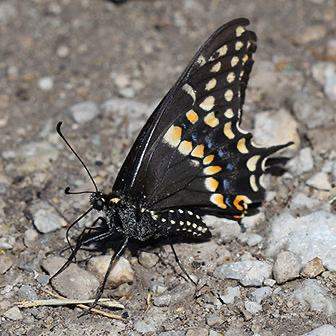 A Eastern Black Swallowtail relaxing on the ground with their wings closed. Photo Credits: Illinois Department Of Natural Resources
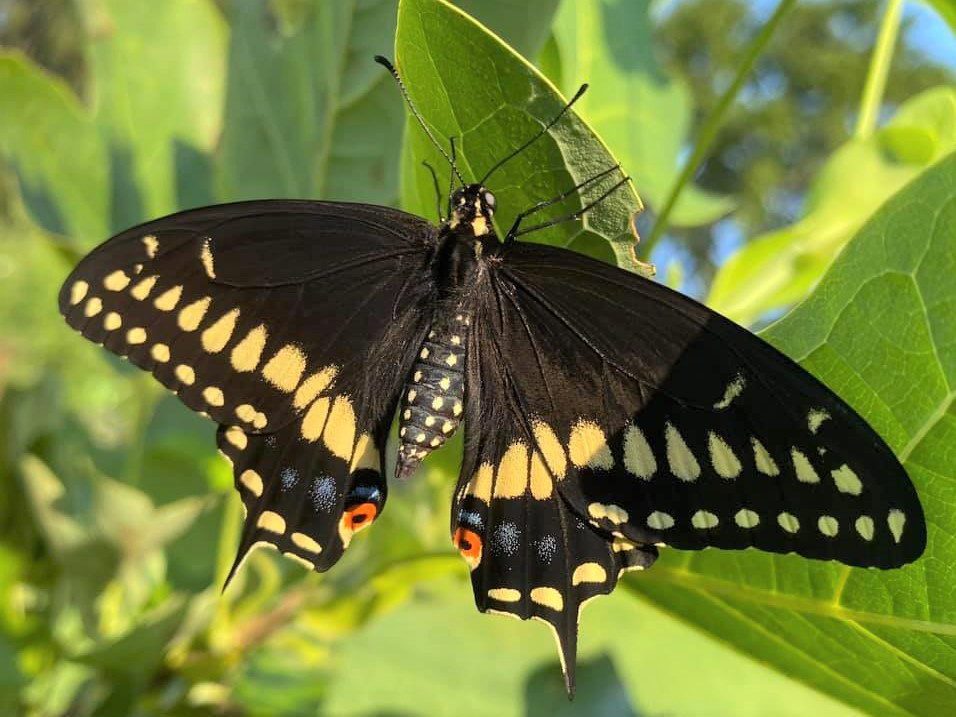 A male Eastern Black Swallowtail relaxing on a leaf of a plant with his wings opened. Photo Credits: Suzanne Herel
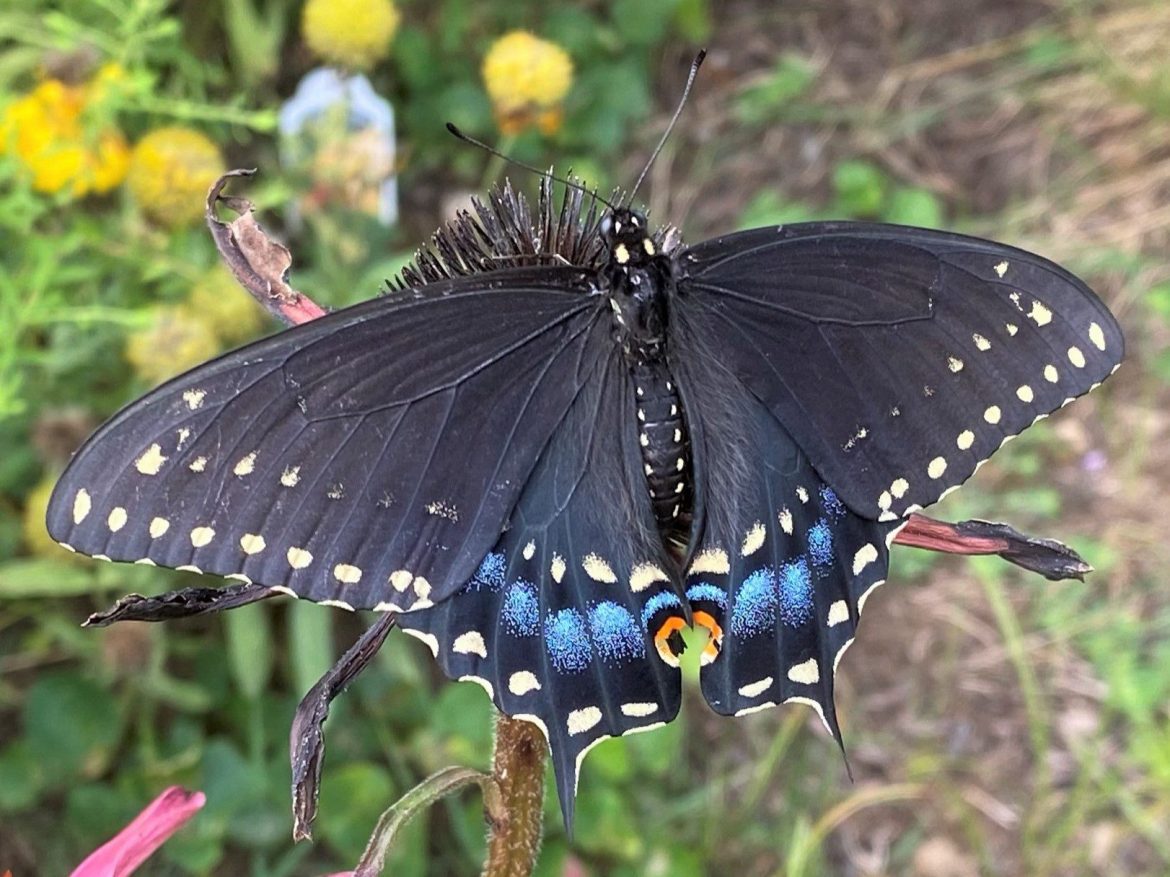 A female Eastern Black Swallowtail relaxing on a dried flower head with her wings opened. Photo Credits: Suzanne Herel
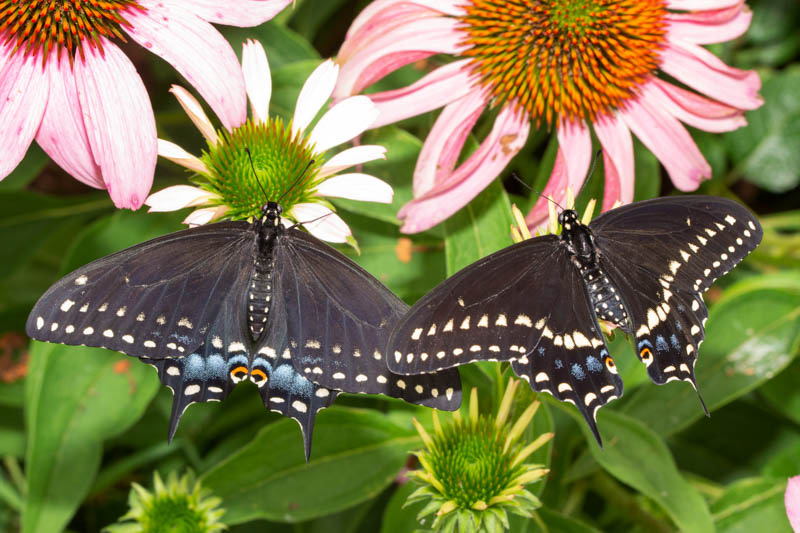 A female and a male Eastern Black Swallowtail resting on Coneflowers. The female Eastern Black Swallowtail is on the left, and the male Eastern Black Swallowtail is on the right. Photo Credits: GARDENIA Creating Gardens
The Eastern Black Swallowtail (Papilio polyxenes) is a medium to large sized butterfly, who is a member of The Swallowtail Butterfly Family.
The wingspan of the Eastern Black Swallowtail is 6.9 to 8.4 centimetres (2.7 to 3.3 inches). This butterfly is bigger than the Eastern Pine Elfin, Frosted Elfin, Spring Azure, Cabbage White, and Cloudless Sulphur. It is a bit smaller than the Mourning Cloak.
The native range of the Eastern Black Swallowtail is Canada (It extends into southern Canada, including southern Ontario and Quebec, as well as parts of Manitoba and the Maritimes.), United States (Its range covers most of the eastern and mid-western United States, extending west to the Rocky Mountains and southwest into Arizona and northern Mexico.), and South America (The butterfly's range extends southward into northern South America. ).
There are two generations of the Eastern Black Swallowtail each year. The first generation of this butterfly species is the summer generation. The second generation of this butterfly species is the fall/winter generation.
For the summer generation of the Eastern Black Swallowtail completes their life cycle within 30 days, but for the fall/winter generation of this butterfly completes their life cycle in 1 year.
The butterflies that are in the summer generation live for 7 to 14 days, which is one week up to two weeks. For the butterflies that are in the fall/winter generation they live for 14 days up to 21 days, which is two weeks up to three weeks.
The physical appearance of this swallowtail species varies depending on the gender of the butterfly.
The underside of the wings on both male and female have yellow, orange, and blue markings that are similar to dots and spots. Both males and females have a tail on each of their hindwings.
When the males rest with their wings opened they have yellow spots on the upper surface of the wings that are larger in size, and are all over the inside of the wings. The yellow colouration of the spots are very bright. They have less blue hindwing hue on their wings compared to the females of this swallowtail species.
When the females rest with their wings opened they have a prominent blue area between the rows of yellow spots on their hindwings. The yellow spots on the inside of their wings are much smaller, thinner, and lighter than the ones on the males.
The host plants of the Eastern Black Swallowtail are Italian Parsley, Moss Curled Parsley, Dill, Fennel, Common Rue, Carrot, Queen Anne’s Lace, Golden Alexander (Zizia aurea), Heart - leaf Alexander (Zizia aptera), and Yellow Pimpernel (Taenidia integerrima).
In their adult form their primary food source is nectar from various flowering plants. Some of their favourite flowering plants for nectar sources include Common Milkweed (Asclepias syriaca), Swamp Milkweed (Asclepias incarnata), Butterfly Weed (Asclepias tuberosa), Pale Purple Coneflower (Echinacea pallida), Tall Ironweed (Vernonia gigantea), Sweet Joe Pye Weed (Eutrochium purpureum), Buttonbush (Cephalanthus occidentalis), Wild Blue Phlox (Phlox divaricata), Woodland Stonecrop (Sedum ternatum), Worm-leaf Stonecrop (Sedum stenopetalum), Scarlet Beebalm (Monarda didyma), Wild Bergamot (Monarda fistulosa), Black eyed Susan (Rudbeckia hirta), Cardinal Flower (Lobelia cardinalis), Zinnias (Annual), Lantana (Annual), and Autumn Beauty Sunflower (Annual).
The adult Eastern Black Swallowtails can commonly be seen puddling in mud puddles, and rain puddles.
The fall/winter generation of this swallowtail species overwinters as their chrysalises. The chrysalids of the Eastern Black Swallowtail can be found on a stiff branch, a stem on their host plant, a patio stone, a large rock, a fence post, or even up against a house.
The summer generation of this butterfly species is seen flying around from June through August. For the fall/winter generation of this butterfly species is seen flying around the following year, as soon as they emerge out of their chrysalids which is from mid to late May through June.
Early Flying Butterflies
These butterflies do not overwinter as their chrysalids, and they do not hibernate as adult butterflies. They migrate to warmer climates when the weather and temperatures changes.
The butterfly species come even earlier than the butterflies who overwinter as their chrysalids, but they come out around the same time as the butterflies who hibernate as adults during the winter.
Come on to explore these cool butterfly species who are early fliers in the season!
Red Admiral Butterfly (Vanessa atalanta) :
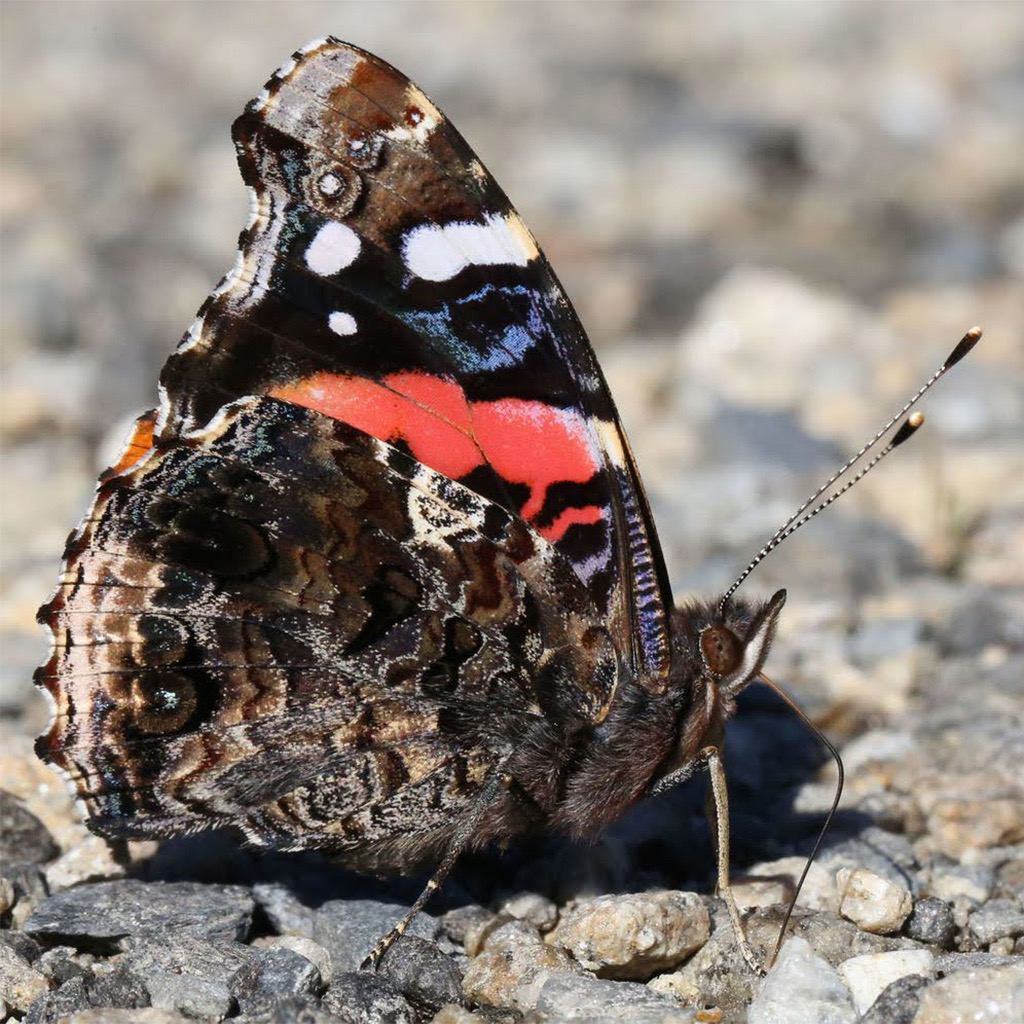 A Red Admiral relaxing on the ground with their wings closed. Photo Credits: Robert Gessing from Cambridge Day Paper
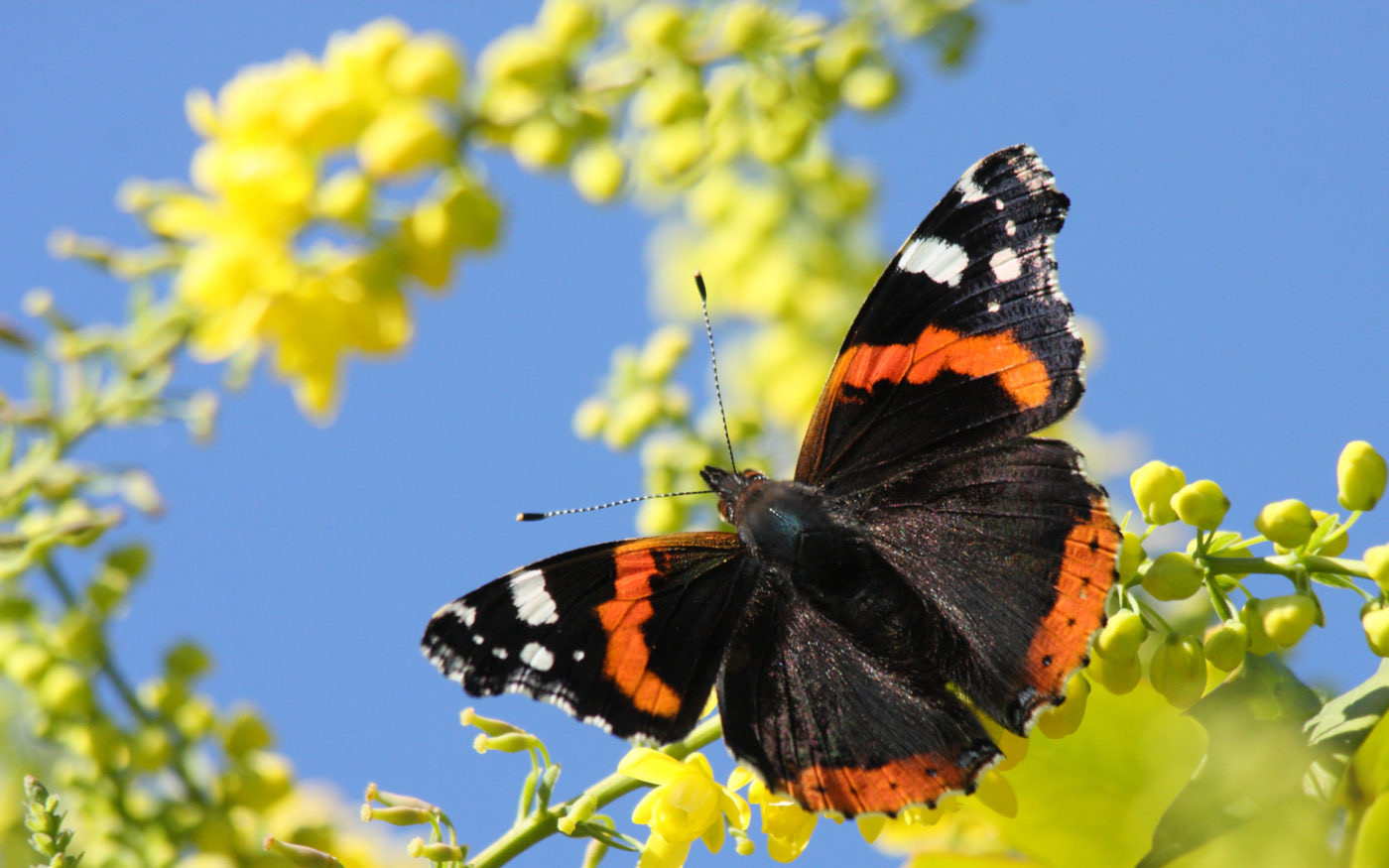 A Red Admiral relaxing on clusters of yellow flowers with their wings opened. Photo Credits: Jenny Bailey
The Red Admiral (Vanessa atalanta) is a medium sized butterfly, who is a member of The Brush - footed Butterflies Family.
The wingspan of a Red Admiral is 1 3/4 to 3 inches (4.5 to 7.6 cm) in length. It is bigger than the Eastern Pine Elfin, Frosted Elfin, Spring Azure, Cabbage White, and Cloudless Sulphur. The Red Admiral is smaller compared to the Mourning Cloak and the Eastern Black Swallowtail.
The native range of the Red Admiral is North America (Found from southern Canada and the US to the northern part of Mexico.), Europe (Common throughout Britain and Ireland, and also found in Scandinavia and northern Russia.), Asia (Extends to Central Asia, Pakistan, and China.), and North Africa (Found in temperate regions ).
The colouring of the Red Admiral is predominantly black with bright orange-red bands, or stripes across the forewing and hindwing.
The forewings on a Red Admiral have a diagonal red band, and white spots near the tips.
The hindwing on a Red Admiral have a red-orange border, and small blue eyespots near the body.
Their primary host plant is Stinging Nettle (Urtica dioica). When Stinging Nettle is scare or it is not available to them they will use False Nettle (Boehmeria cylindrica), and Wood Nettle (Laportea canadensis).
As adults their primary food source is nectar from various flowering plants.
Some of their favourite flowering plants as a nectar source includes Sweet Crabapple (Malus coronaria), Chokecherry (Prunus virginiana), Pussy Willow (Salix discolor), Common Milkweed (Asclepias syriaca), Swamp Milkweed (Asclepias incarnata), Butterfly Weed (Asclepias tuberosa), Pale Purple Coneflower (Echinacea pallida), Tall Ironweed (Vernonia gigantea), Sweet Joe Pye Weed (Eutrochium purpureum), Spotted Joe Pye Weed (Eutrochium maculatum), Wild Blue Phlox (Phlox divaricata), Wild Bergamot (Monarda fistulosa), Black eyed Susan (Rudbeckia hirta), Smooth Oxeye (Heliopsis helianthoides), Blue Vervain (Verbena hastata), and Hoary Vervain (Verbena stricta).
Mature adult Red Admirals can be seen drinking from tree sap, fermented fruit, animal poop, and puddles.
The Red Admirals who are migrants are seen in May over most of Southern Canada, and they’re seen in mid April on Point Peele Island. The other generation of the Red Admirals are seen from June through September.
Painted Lady Butterfly (Vanessa cardui) :
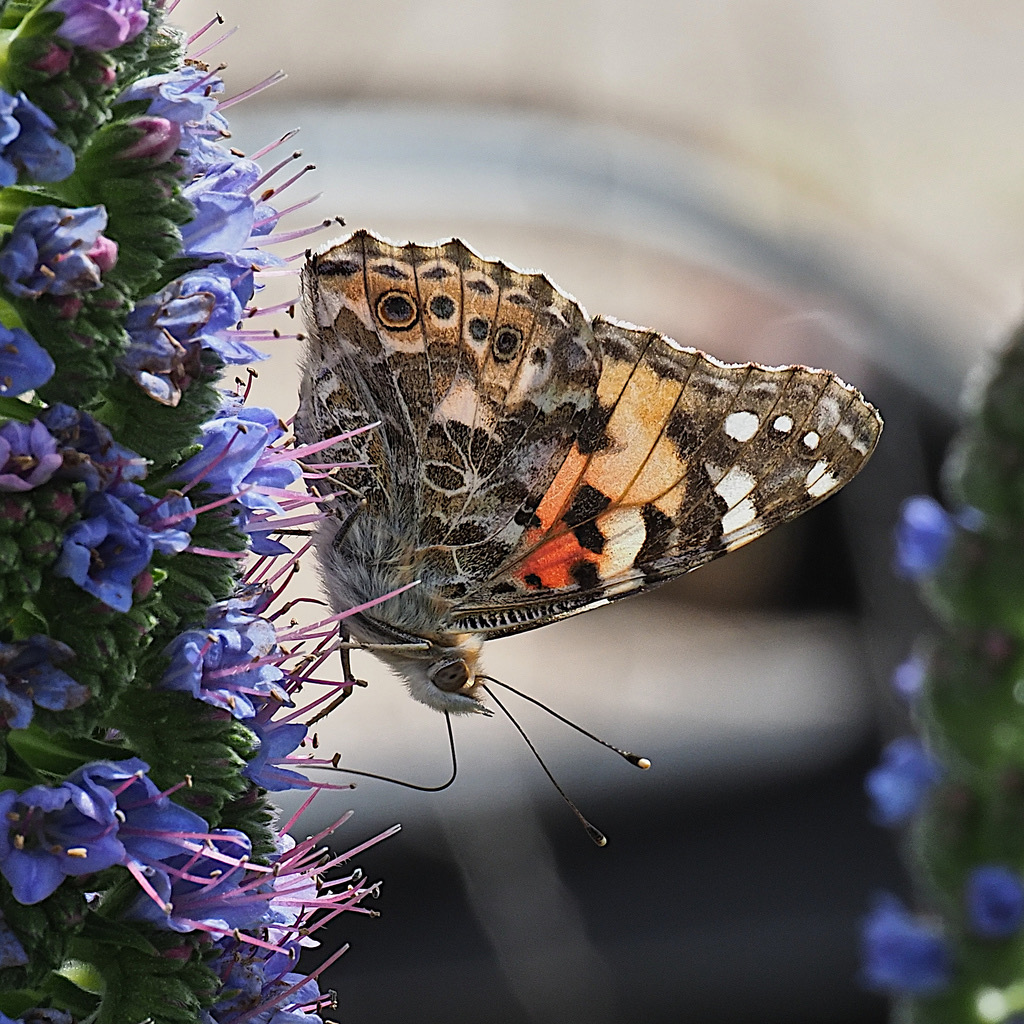 A Painted Lady sipping nectar from small clusters of purple flowers with their wings closed. Photo Credits: aurearamon from iNaturalist
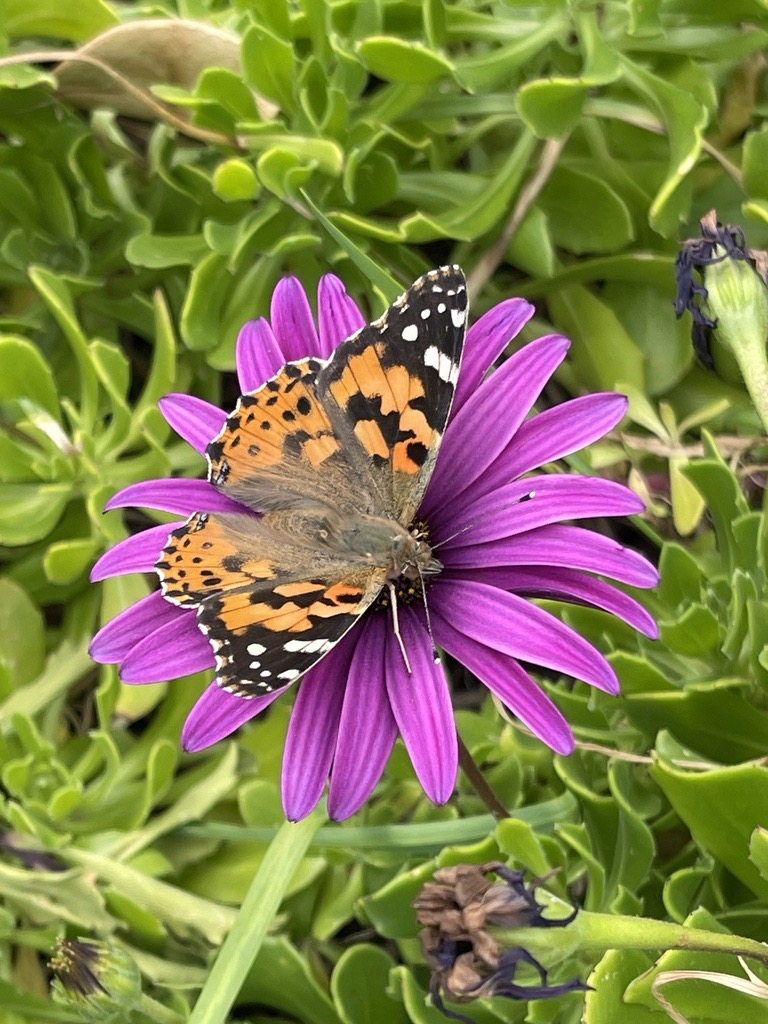 A Painted Lady relaxing on a purplish pink daisy like flower with their wings opened. Photo Credits: ivonnekellner from iNaturalist
The Painted Lady (Vanessa cardui) is a medium sized butterfly, who is a member of The Brush - footed Butterflies Family.
The wingspan of a Painted Lady is 2 to 2 7/8 inches (5 to 7.3 cm) in length. The Painted Lady is around the same size as the American Lady. This butterfly is smaller than the Mourning Cloak and Eastern Black Swallowtail.
The Painted Lady is a cosmopolitan species, meaning it's found on every continent except Antarctica and Australia.
The native region of the Painted Lady is North America (they are widespread across the United States and Canada.), and Other Regions (They are also found in Europe, Asia, Africa, and the Middle East.).
Painted Ladies are known for their extensive migratory patterns, with populations in North America overwintering in warm southern areas or in Mexico, and then migrating and temporarily colonizing the US and Canada south of the Arctic.
The upperside of the wings on a Painted Lady are orange-brown with darker wing bases; forewing has black patch and white bar on leading edge, and the hindwing row of 5 small black spots sometimes has blue scales.
The underside of the wings on a Painted Lady are black, brown, and grey pattern with 4 small eyespots.
When a Painted Lady is resting or sun-basking in the sunshine the underside of their wings are often shown. Occasionally, the Painted Lady is seen resting or sun - basking in the sunshine the upperside of their wings are showing.
The primary host plants of the Painted Lady are Field Pussytoes Antennaria neglecta), and Pearly Everlasting (Anaphalis margaritacea).
The Painted Lady occasionally will use Field Thistle (Cirsium discolor), Swamp Thistle (Cirsium muticum), Swamp Rose Mallow (Hibiscus moscheutos), Marsh Mallow (Althaea officinalis), and False Sunflower (Heliopsis helianthoides) as secondary host plants when their primary host plants are scarce.
In their adult form their primary food source is nectar from various flowering plants.
Some of the Painted Lady’s favourite flowering plants as nectar sources include Buttonbush (Cephalanthus occidentalis), Tall Ironweed (Vernonia gigantea), Field Thistle (Cirsium discolor), Swamp Thistle (Cirsium muticum), Pale Purple Coneflower (Echinacea pallida), Sweet Joe Pye Weed (Eutrochium purpureum), Spotted Joe Pye Weed (Eutrochium maculatum), Black eyed Susan (Rudbeckia hirta), Blue Vervain (Verbena hastata), Hoary Vervain (Verbena stricta), False Sunflower (Heliopsis helianthoides), Cosmos (Annuals), and Zinnias (Annuals).
Occasionally Painted Ladies can be seen feeding and sipping on decaying fruit, and puddles.
The Painted Ladies are typically seen during the spring and summer months, from late spring (May) to early fall (October).
American Lady Butterfly (Vanessa virginiensis) :
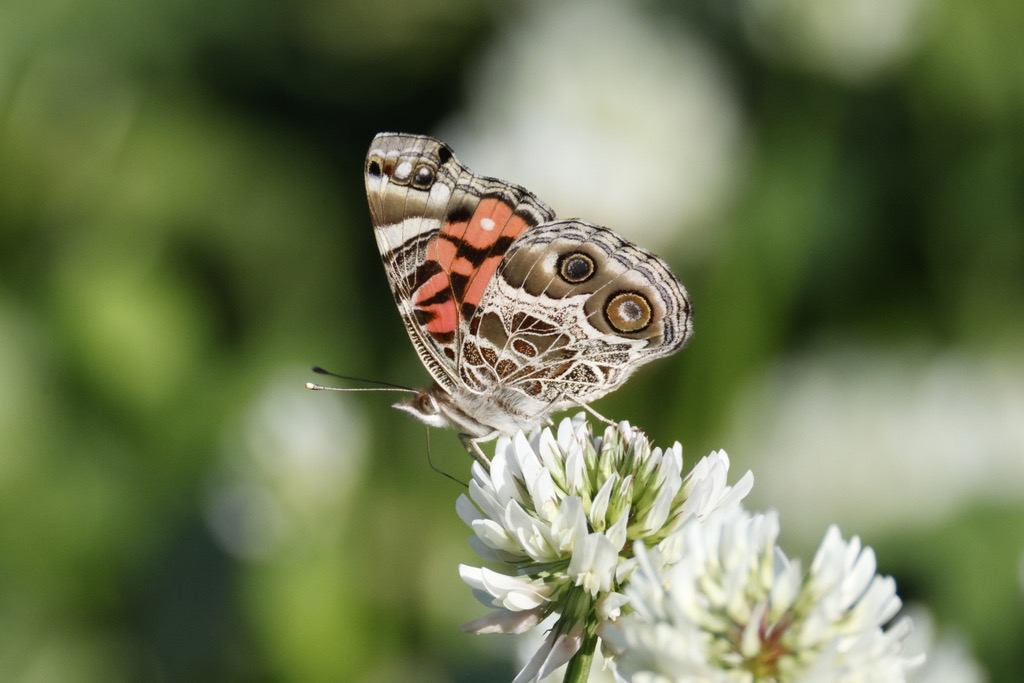 American Lady sipping nectar from a white flower with their wings closed. Photo Credits: ctatman7 from iNaturalist
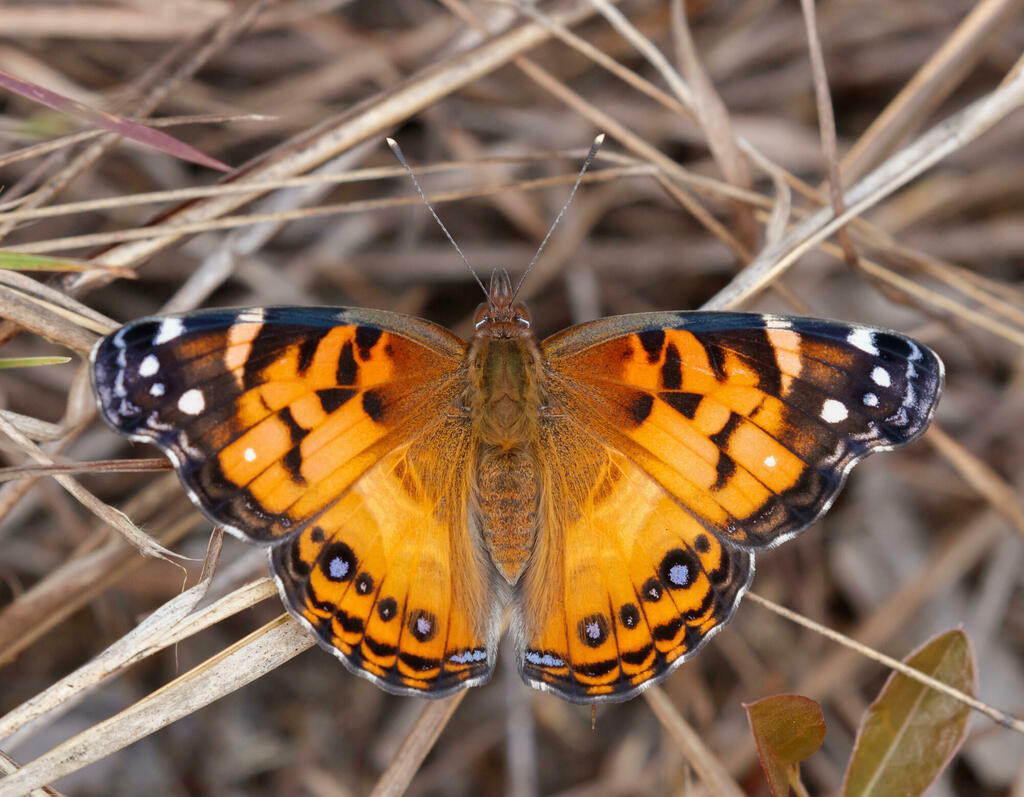 An American Lady resting on older foliage with their wings opened. Photo Credits: chris_rorabaugh from iNaturalist
The American Lady (Vanessa virginiensis) is a medium sized butterfly, who is a member of The Brush - footed Butterflies Family.
The wingspan of the American Lady is 3/4 to 2 5/8 inches. The American Lady is about the same size as the Red Admiral, but it is much smaller compared to the Eastern Black Swallowtail.
The native range of the American Lady is North America (It's found throughout much of the continent, including the eastern and central United States and parts of Canada.), and South America (Its range extends southward to northern South America.)
While the American Lady is not native to Europe, Hawaii, or the Caribbean, American Ladies been observed occasionally in these areas, possibly as strays.
The upperside of the wings on an American Lady are orange - brown with black margins, a black patch on the forewings, and a small white spot in the orange field near the edge of the forewing.
The underside of the wings on an American Lady are complex pattern of olive, black, and white, with two large, dark eyespots near the outer margin of the hindwings. The outer edge of the forewing is somewhat concave or notched.
The undersides of the hindwings on an American Lady features two large, dark eyespots, which helps differentiate it from the Painted lady (Vanessa cardui) that has four small eyespots.
Their favourited host plants are Pearly Everlasting (Anaphalis margaritacea), and Field Pussytoes (Antennaria neglecta). They will occasionally use Swamp Rose Mallow (Hibiscus moscheutos), Rabbit Tobacco (Pseudognaphalium obtusifolium), and False Sunflower (Heliopsis helianthoides)as host plants if their favourited host plants are not available to them.
As adults their primary food source is nectar from various flowers and flowering plants.
Some of their favourite flowers and flowering plants for nectar sources include Blue Vervain (Verbena hastata), Hoary Vervain (Verbena stricta), Common Milkweed (Asclepias syriaca), Swamp Milkweed (Asclepias incarnata), Butterfly Weed (Asclepias tuberosa), Pale Purple Coneflower (Echinacea pallida), Tall Ironweed (Vernonia gigantea), Sweet Joe Pye Weed (Eutrochium purpureum), Spotted Joe Pye Weed (Eutrochium maculatum), Black eyed Susans (Rudbeckia hirta), Zinnias (Annual), Cosmos (Annuals), and Autumn Beauty Sunflower (Annual).
Adult American Ladies can be seen feeding on other things as well which includes tree sap, decaying fruit, and puddles. They don’t feed on these all the time, but they do choose these items occasionally.
American Ladies can be seen from mid to late May through September, but this depends on the weather and the temperature outside.
How To Provide For These Butterflies :
Since you have learned so much about these butterfly species, and know what they like or don’t like you’re probably wanting to know how to provide for them.
The best way to provide and to support these butterflies is by having your property and gardens chemical free, plant a few of their host plants on your property or garden to offer a place for the females to lay their eggs and to provide food for the caterpillars once they hatch, and plant more than one of their favourite flowers or flowering plants for nectar sources.
Offer shelter to the butterflies by planting a native tree or shrub on your property such as Red Osier Dogwood;Pussy Willow; Buttonbush; or Chokecherry.
Provide the butterflies with resting spots that are located in sunny locations of your property or garden by placing flat smooth rocks for the butterflies to rest on.
On your property especially in your backyard you can offer puddling stations as well as feeding stations for the butterflies.
For puddling stations you can create a small square area of your yard or garden. Make sure there is a bit of soil (a lot of soil but too much), and spray the soil with a little bit of water by using a garden hose. Then place a few medium sized smooth rocks that are flate in shape on the soil. The smooth rocks will provide a sitting and resting spot for the butterflies while they drink from the puddling station, and will prevent any butterflies who visit from drowning.
For feeding stations get a flat plate or a medium sized plant pot saucer. Place couple slices of fermented fruit on the plate or saucer such as bananas, oranges, mangos, peaches, strawberries, watermelon, grapefruit, and pineapple. Then place the feeding station up high for the butterflies to spot, and to keep it out of reach from ants.
For the puddling stations and the feeding stations that you put out for the butterflies, you will need to refresh them a couple times a day due to them being exposed to sunlight, garden pests, and to prevent diseases.
These two things are not the regular way to attract butterflies to your yard, but instead these are alternatives. The regular way to attract these butterflies is by planting their host plants, and planting their favourite flowers for nectar.
If you already have their host plants and nectar sources on your property, but you would wish to add the puddling stations and feeding stations for the butterflies go for it because nobody is stopping you from doing that for the butterflies.
In conclusion when you plant the host plants, their favourited plants as nectar sources, made your yard and garden chemical free, and offer other things to the butterflies it won’t take long for the butterflies to notice that you’re supporting them, and providing for them.
Remember that by planting native host plants, planting native flowering plants for nectar sources, adding native trees or shrubs for shelter, and making your yard and garden chemical free for the butterflies and other insects it will keep the butterflies and the other pollinators healthy, and they would be able to complete their life cycle properly.
For the butterflies who do not sip nectar from flowering plants like the Mourning Cloak, Eastern Comma, Question Mark, and Compton Tortoiseshell it is really important to provide them with a plate of fermented fruit, sap from native trees such as Red Maple and Sugar Maple, and red fruit juice in a small round bottle cap with cotton swabs to provide food for them in a different way.
Don’t forget when you do the plate of fruit slices and the cap of fruit juice and cotton swabs, that you will need to refresh the plate of fruit and fruit juice three times to prevent other insects from getting to them, and they will be in a sunny location where the sun beats down on them making the fruit and juice feel hot.
No matter the size of your yard or garden that created for these butterflies, the butterflies will still come around to visit your garden because they will be happy with what you have provided for them. Once you plant for them, it won’t take them too long to notice what you have done for them and in return they will help you pollinate the flowering plants that you have planted in your yard.
Please admire these butterflies when they come to visit your yard and garden because they have come along way to get there, and thank them for visiting as well as pollinating the flowers you have planted in your garden.
Don’t forget to be a friend to these fluttering beauties, and don’t be a bully towards these beautiful creatures. By being their friend the butterflies will thank you by visiting the garden you have created, and pollinate the flowers for you.
The Butterflies Need Our Help More Than Ever!!
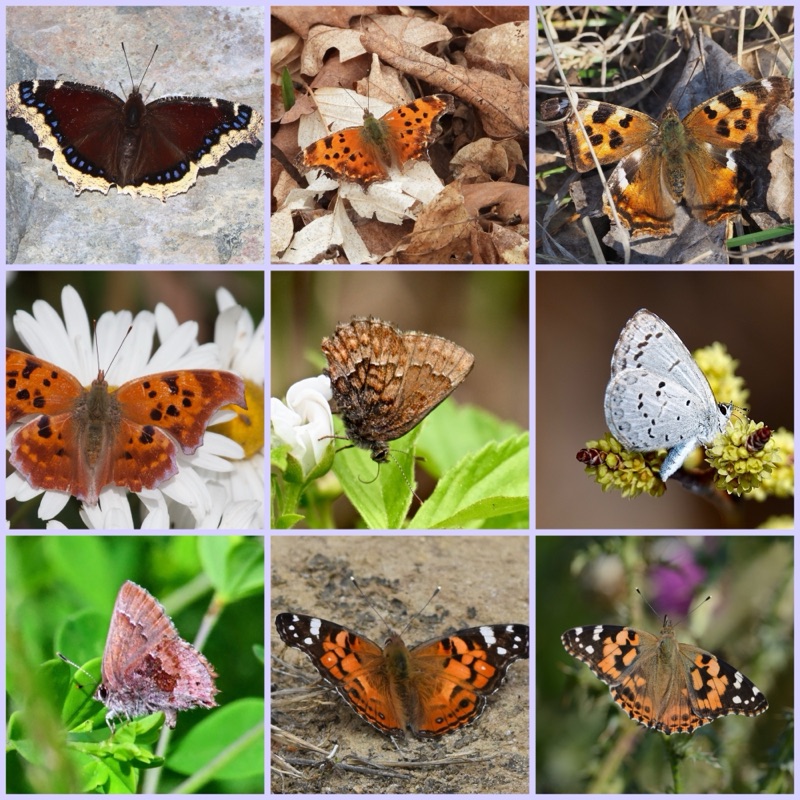
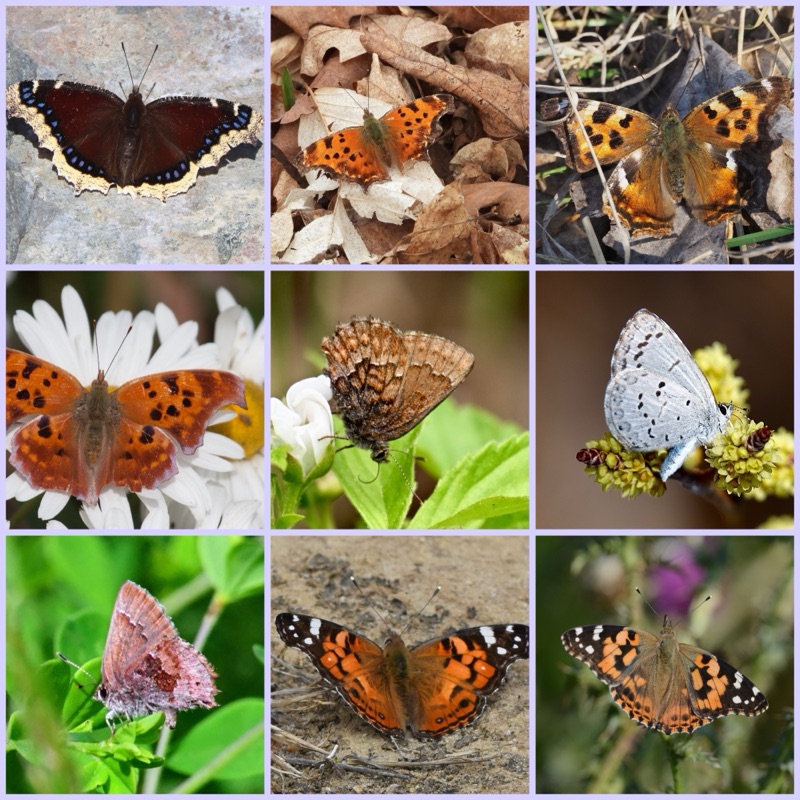 Butterfly Collage which is the article’s cover photo. Photo Credits: selwell from iNaturalist, cooperjohn from iNaturalist, igor_scherbakov from iNaturalist, michaelnewlon from iNaturalist, michelecarnerie from iNaturalist, njcarpenter from iNaturalist, mark86864 from iNaturalist, stewart_blackwell from iNaturalist, and andreymoskvichev from iNaturalist.
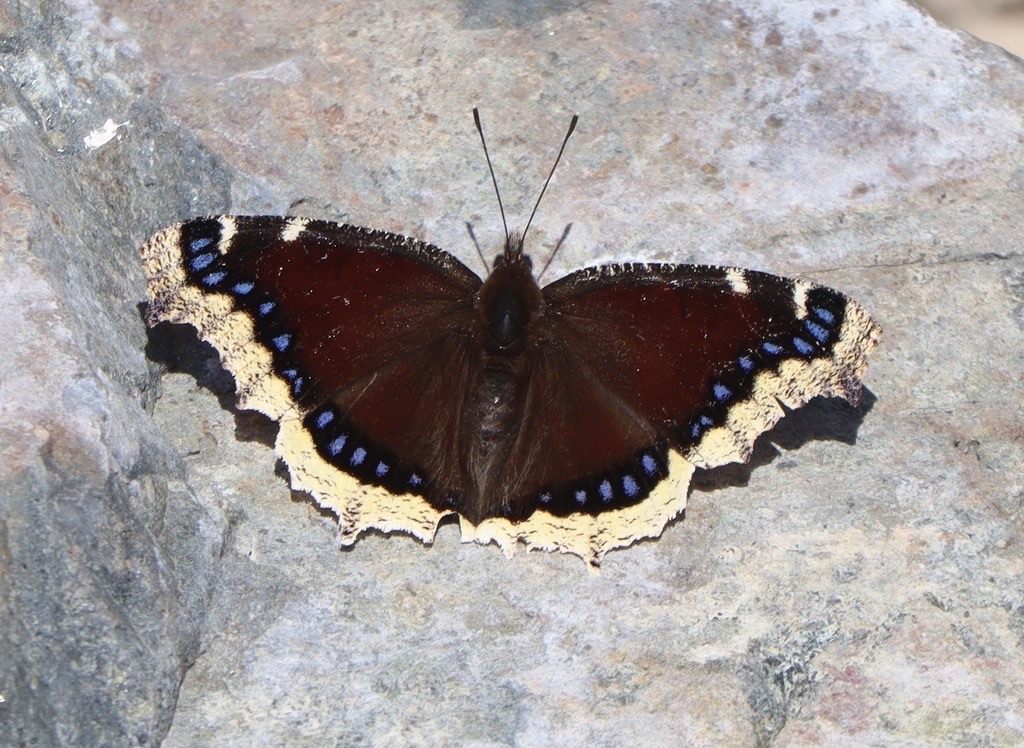 A Mourning Cloak resting with their wings opened on a large rock. Photo Credits: selwell from iNaturalist
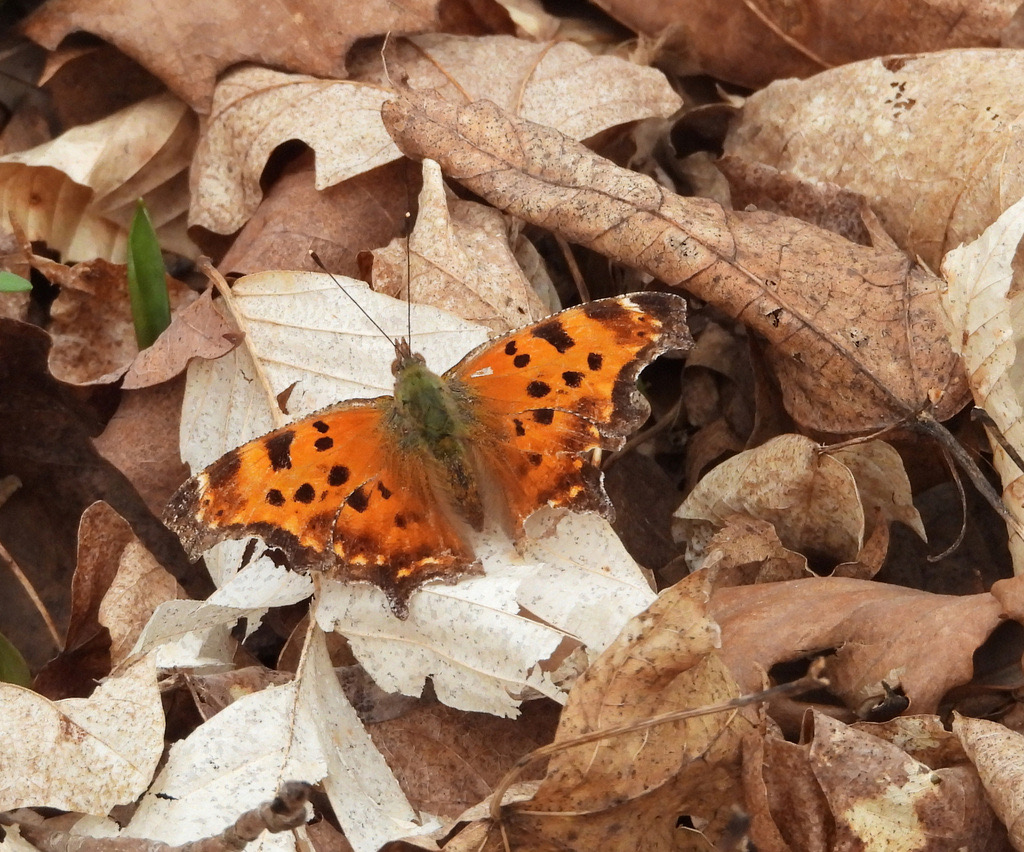 A Eastern Comma Butterfly resting on leaf litter with their wings opened. Photo Credits: cooperjohn from iNaturalist
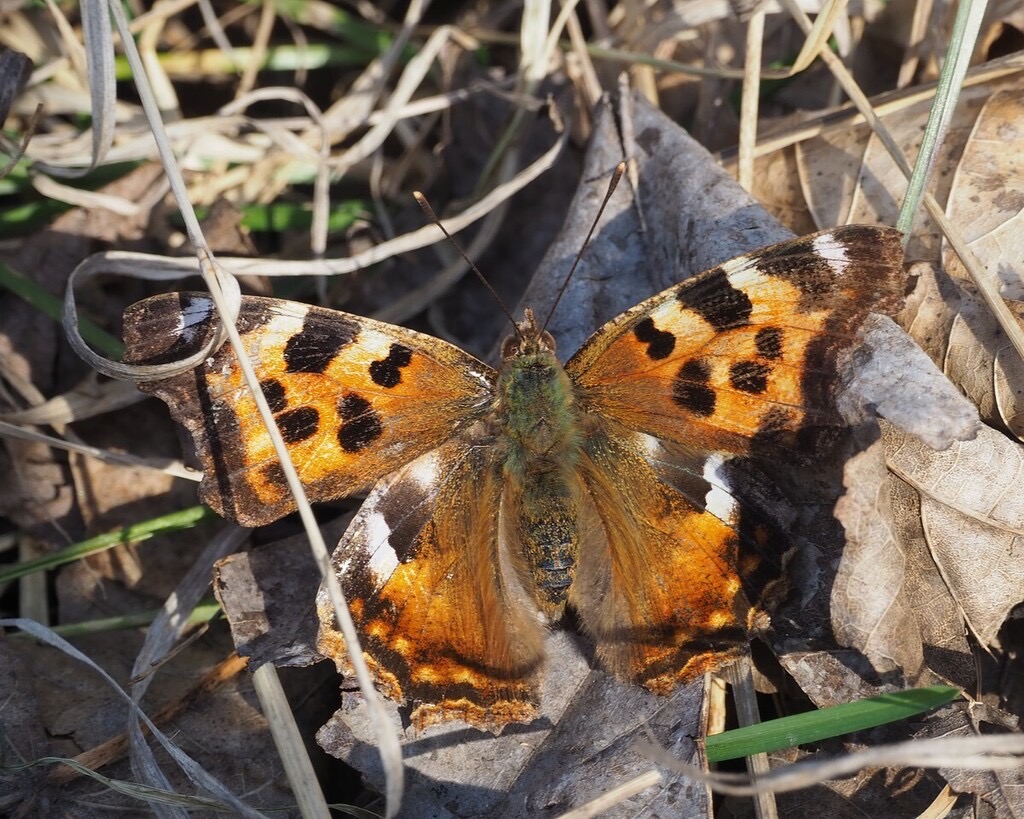 A Compton Tortoiseshell relaxing on leaf litter with their wings opened. Photo Credits: igor_scherbakov from iNaturalist
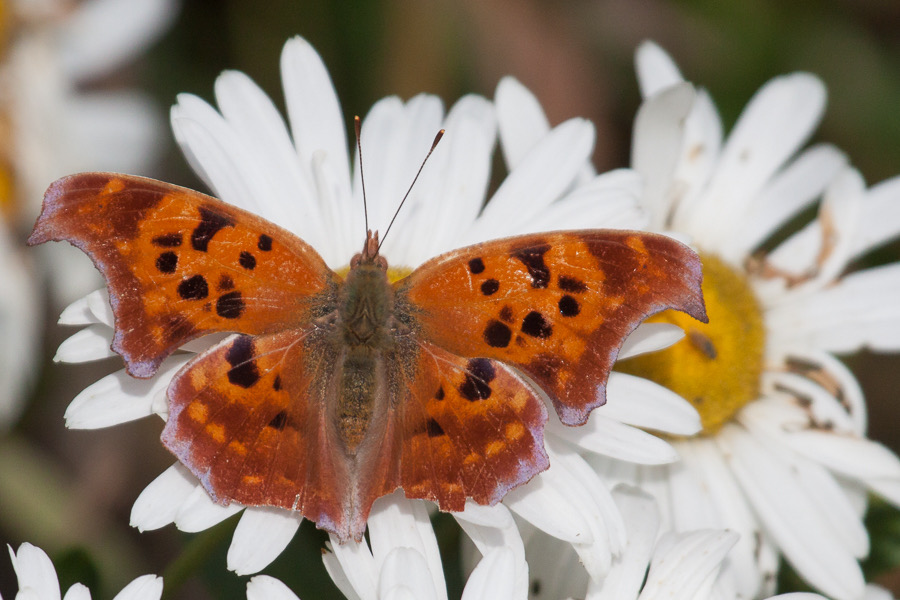 A Question Mark relaxing on a white Daisy with their wings opened. Photo Credits: michaelnewlon from iNaturalist
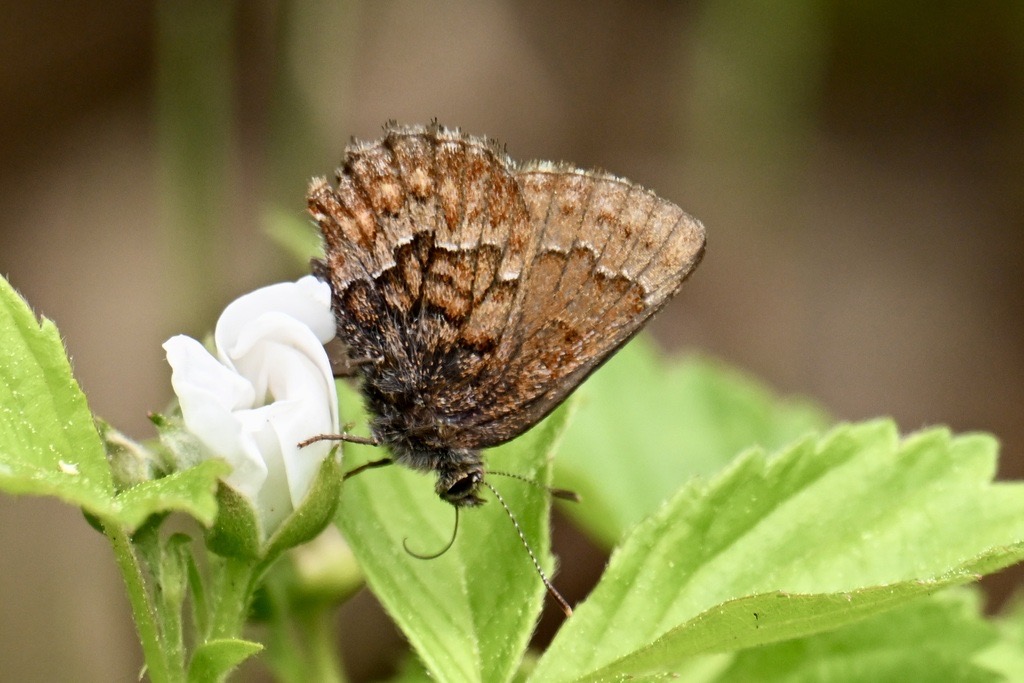 A Eastern Pine Elfin resting on a white flower with their wings closed. Photo Credits: michelecarnerie from iNaturalist
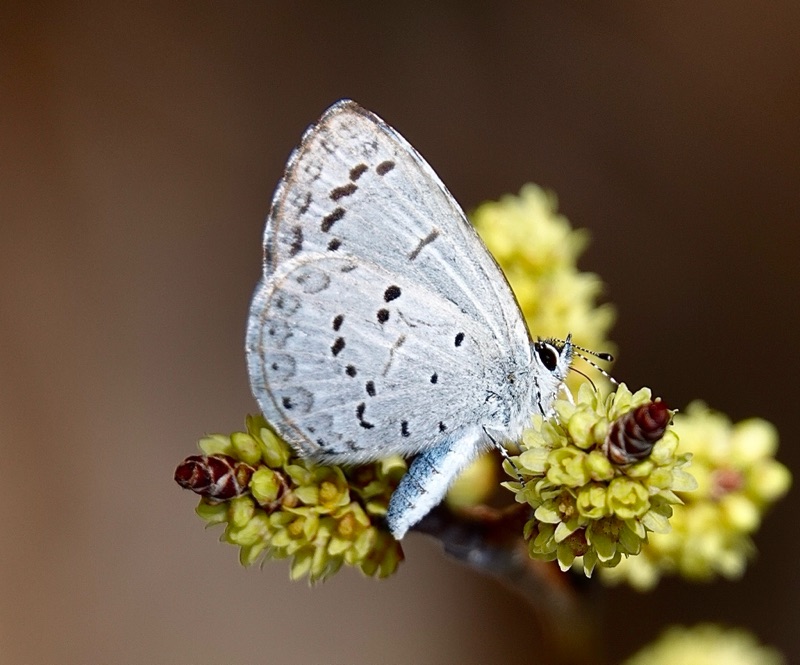 A Spring Azure sipping nectar from a cluster of yellow flowers. Photo Credits: njcarpenter from iNaturalist
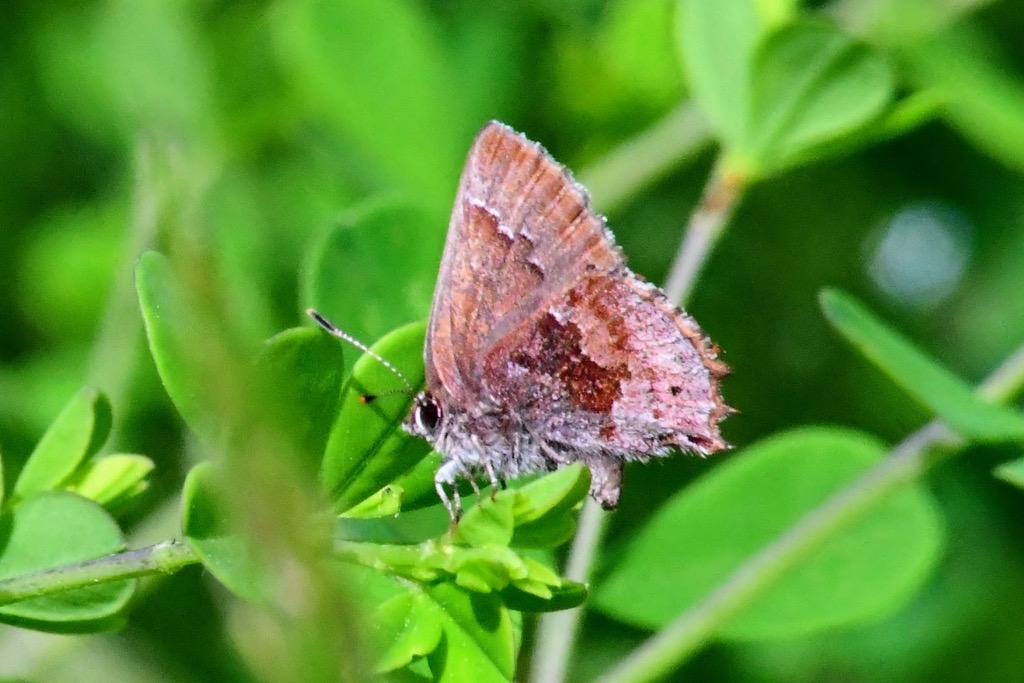 A Frosted Elfin relaxing on a Blue False Indigo Plant with their wings closed. Photo Credits: mark86864 from iNaturalist
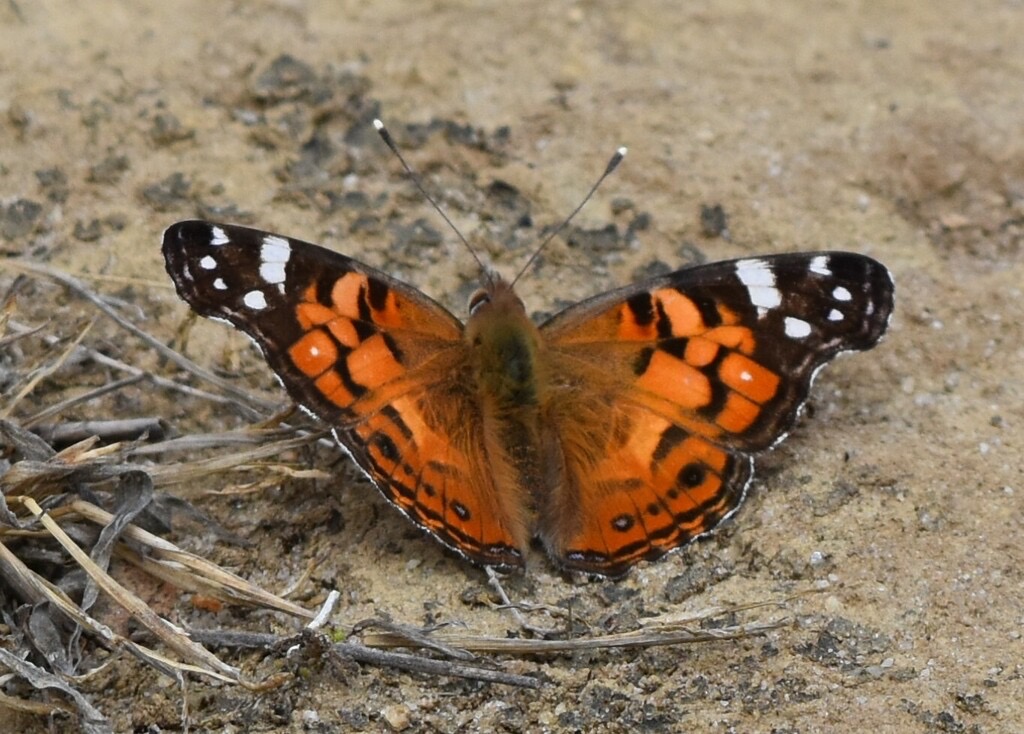 A American Lady resting on the ground with their wings opened. Photo Credits: stewart_blackwell from iNaturalist
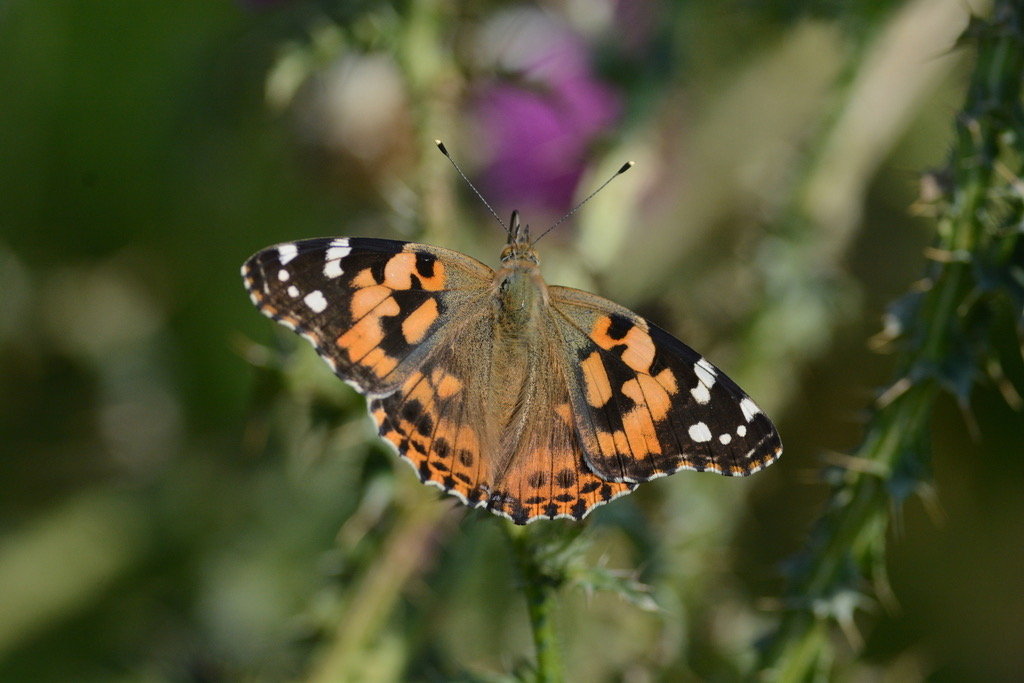 A Painted Lady relaxing with their wings opened on a plant. Photo Credits: andreymoskvichev from iNaturalist


Comments
Post a Comment